Posted in musings

new life through a crown of thorns

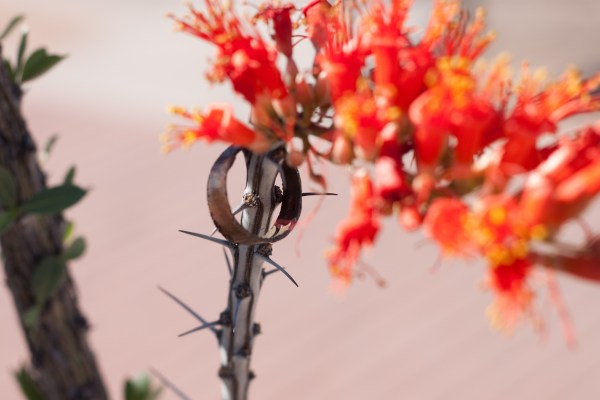
Through the crown of thorns comes beauty and new life.

IMG_4319
IMG_4320

(I found this at the park this morning – it was like a reminder from God, on this day of waiting and held breath between the crucifixion and resurrection, of both the pain and the beauty bound together in Christ’s sacrifice.)

Posted in family life, phfr

{pretty, happy, funny, real} – spring in bloom

This is really one of the loveliest times of year here in Arizona. It seems like everything that can bloom is blooming, and flowers of all different shapes and hues and scents are everywhere.

{pretty}

IMG_4200
so many yellow daisies!
IMG_4197
daisies against a field of purple lantana
IMG_4192
bold and brilliant pomegranate reaching out to the orange tree

{happy}

IMG_4203
smiling at grandma being silly

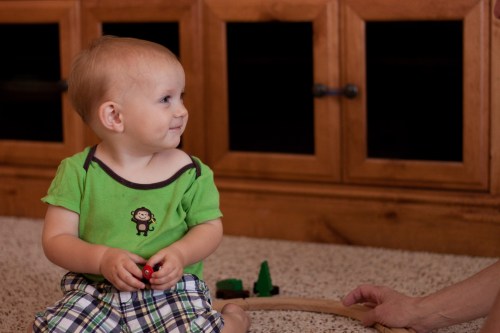
This little guy is one of the happiest people I know. If he isn’t exhausted or hungry, he’s typically smiling, laughing, and generally being silly. His good spirits bring such joy to our house, especially since Rondel and I are less even-keeled… And it’s hard not to smile back at Limerick when he gets that twinkle in his eyes and that little dimple on his cheek, even when it’s been a rough day!

{funny} and {real}

Rondel was sick over the weekend (hence the rather disheveled look – this was one of his brief interludes away from his sick nest on the couch), which I suppose is {real} and not {funny}, but I found this new activity he’s devised really quite amusing. We have three wooden puzzles that spell out our names – one for me that I’ve had since childhood, and one for each of the boys. So Rondel took the letters out of the puzzle and lined them up on the lid of the piano, and was very pleased with himself for the accomplishment! By the end of the day he’d managed to balance them all up along the piano and was then fiercely guarding it against his fascinated little brother…

There’s no linkup today, which I maybe should have foreseen since it’s Holy Thursday, but since I wrote the post preemptively, I’m still sharing it here 🙂 Like Mother Like Daughter has a different (but very fascinating) type of post up today, about the Triduum and the curious fact that tomorrow is the celebration of both the Annunciation and Good Friday, including thoughts on this rare event from the 17th century poet John Donne – so go read it, especially if you need a seed idea to help you pray and meditate on Christ over these next few days.

Posted in musings

Holy Week in the midst of everyday life

Holy Week.

When the profound realities of the liturgical year – the past that comes again, ever new, with each turn of the calendar – should be coming alive in our hearts and minds.

When the passion and suffering of our Lord should be the meditation of our hearts and the prayer on our lips.

When we remember the gift of His body and blood, in the once-for-all-time sacrifice of Friday’s cross and in the ceremonial establishment of the Eucharist at Thursday’s Passover meal.

When the truths that fade away from us so easily – the forgiveness God offers, the love He extends, the high cost of His grace, the mercy that seasons His justice, and the pathway to unity that He creates – should be standing out to us in sharp relief.

And yet, in Holy Week, the world still keeps spinning and life still keeps going on as it always does.

In Arizona, we held presidential primaries on the Tuesday of Holy Week this year, distracting ourselves from the King of the Universe in our quest to choose a new president to lead us to greatness. I couldn’t help but be reminded of the crowds acclaiming Jesus on Palm Sunday, sure that He would be the Messiah to rescue them from Roman oppression, only to turn on Him a few days later when they realized that His was a heavenly kingdom. A heavenly kingdom doesn’t fix our problems here and now, like Trump and Sanders and Cruz and Clinton all promise to do in their various personal styles – so the heavenly kingdom can wait, right, while we focus on cleaning up the issues we’ve got going on right now? (Well, no, actually, that heavenly kingdom should always come first, and should inform our approach to the temporal problems we’re facing.)

In Brussels, another terrorist attack left the city (and Europe) reeling and devastated, unsure of the best way to respond to danger without losing freedom and integrity. With friends and family killed or injured, people are dealing with a sea of sorrow and, most likely, anger and a desire for justice. Does God offer that justice and revenge this week? We see Jesus’s grace and forgiveness extended even to those who murdered Him, and we cringe because such an act is too great for us, in the raw pain of our grief and outrage. He says, watch, I have suffered for you, and I suffer with you – and we say, go somewhere else with Your presence and Your comfort, and let me find another who will promise me the security and vengeance my heart craves.

People still go to work, performing the same tasks and interacting with the same coworkers as on every other day of the year. Families still deal with bedtime battles, dirty diapers, potty learning, sicknesses, homework, friendship drama, housecleaning, and marital stress. The daily commute, the daily chores, the daily routines are all the same.

And into the middle of everyday, normal life, Christ comes.

With the power of His sorrowful passion, He comes. The details of Jesus’s suffering on the cross make us uncomfortable and uneasy, but in Holy Week we are almost forced to think about them.

Let these daily routines be baptized in Me, He says. Let your great worries and great sufferings find solace in Me; come drink of peace and rest. My suffering has purchased for you redemption – that all the banalities and all the piercing sorrows of life, alike, might be worked into new life, and beauty, and purpose.


Posted in musings, quotes

Arizona primaries, and loving my state well

Well, the results for my state’s primary election are in, and I’m really not surprised by them. Disappointed, yes, but not surprised.

We’re known as a state that undervalues education, that struggles with racism, and that wrestles with substantial income inequality and poverty. Our national “face,” for a lot of people looking at us from afar, is Sheriff Joe Arpaio, a man who has faced accusations and lawsuits concerning abuses of power, racial profiling, election misconduct, and failure to investigate sexual crimes. So it’s not really a surprise that people who dismiss illegal immigrants as lawbreakers rather than understanding the dynamics of family ties and desperate need, who are okay with law officials playing racial favorites and coming down more harshly on Hispanics and Muslims, who harbor some nostalgia for the Wild West when might made right and the strong man was the honorable man, would overwhelmingly vote for Donald Trump.

For me, who have always looked at my state in the best possible light, it’s a disappointment that’s hard to get over. Maybe my fellow citizens here aren’t as good as I thought they were, from the subset that I happen to know well. Maybe this isn’t such a good place to live and raise my family as I’ve always thought, if people are so incredibly welcoming of the dishonest and self-serving “leaders” who offer them satisfaction and validation.

But do I love my state because of its (actual or perceived) good characteristics, or do I love it because it is my home and I want it to become the best that it possibly can be? Chesterton wrote on this exact topic over a century ago, and here I’m going to replace his example city with Arizona:

Let us suppose we are confronted with a desperate thing – say Arizona. If we think what is really best for Arizona we shall find the thread of thought leads to the throne or the mystic and the arbitrary. It is not enough for a man to disapprove of Arizona: in that case he will merely cut his throat or move to [California]. Nor, certainly, is it enough for a man to approve of Arizona, for then it will remain Arizona, which would be awful. The only way out of it seems to be for somebody to love Arizona: to love it with a transcendental tie and without any earthly reason. […] If men loved Arizona as mothers love children, arbitrarily, because it is theirs, Arizona in a year or two might be fairer than Florence. […] Men did not love Rome because she was great. She was great because they had loved her.

– G.K. Chesterton, Orthodoxy

I don’t know many people who love Arizona in this way (although I do know a few, and I’m incredibly thankful for them). So many people I speak to are using the state for what they can get out of it, and counting down the time until they can move away. College students come for the universities and then head out again, glad to be gone. Snowbirds come down for the golf courses and mild winters, but keep themselves apart from the permanent population and head back to the places they truly consider their homes each spring. People gripe about the job prospects, the pollution, the bad drivers, the housing market, the immigrants, the homeless, the transit system, the public schools, and (above all) the weather.

And I get that we have problems, a lot of problems, and some very serious problems. But this is my home. This is the place I love, the soil into which my roots have sunk deep, even if it is pretty lousy soil (clay or sand, take your pick!). I get angry sometimes, at work or on social media, about the constant cloud of Arizona complaints, even when they’re completely justified, in a similar way to how I get upset when someone casts aspersions on my children (I was angry at my brother-in-law for over a year because he made a negative comment about Rondel once… I’m not quite that bad about my state).

Am I going to let this love just be an emotion, or am I going to put it into action, working to transform my home into a thing of beauty and grace? I tend towards contemplation instead of action, but true love will, I think, result in both. I think of a pastor at my church who, after years of traveling and living across the world, has settled down here and devotes himself to building community, establishing relationships across lines of race and religion, and creating a literal oasis in the desert. He sees Arizona with objective eyes, but because he also sees it as his home, he has made it part of his vocation to labor for its betterment, instead of leaving or complaining. If there were more like him, maybe someday Arizona really could become “fairer than Florence” – and maybe then, we would elect politicians who displayed things like beauty, love, justice, and truth.

Posted in musings

suffering and the music of the church

I wonder if much “early” Christian music (well, it lasted long past the early years of the Church!) was some variation of chant because the Church was so aware of the brokenness of the world, and the chant allowed worshippers to lift up their voices in lament, in solidarity, in supplication, and, ultimately, in a hope devoid of false optimism. The tones of traditional chant are so haunting, so melancholy, and yet so natural to sing to – almost as natural as speaking – and I think those qualities reflect the way in which early Christians saw the world. They were close to its pain, suffering with it and for it and because of it, oppressed and persecuted, a misunderstood minority, laboring for the vulnerable and cast out, weeping with Christ for a world that they saw destroying itself. One cannot simultaneously be saving babies from abandonment to the elements and skipping around like nothing is wrong with the world; one cannot see friends and loved ones tortured and killed for their faith and still think that this life is a fountain of roses and rainbows.

So their music was born of the pain they saw (pain stemming from unredeemed sin in the world), the pain they felt (pain born of their own jarring disconnect with the culture around them), and the pain they remembered (pain that Jesus had endured on their behalf). It should be no surprise that it was a sorrowful and melancholy music, a music of prayer and supplication, of lament and mourning; we should expect that even their joy and hope would be colored by the sorrow they felt for a broken world and the pain they knew at their own persecution and suffering in that world. I wonder how we could re-introduce this spirit of worship (not necessarily the style) back into our Christian worship today, which (at least in the Evangelical circles I’m familiar with) tends to be buoyant, cheerful, excited, and positive. I don’t think those are bad things by any means – I think the church has much to be thankful for and much reason to give praise to God – but I do think that it tends to be the focus at bit too much of the time. Our constant obsession with the positive leaves us isolated when suffering comes, because we have never seen our community mourn together over the simple, everyday, sorrows and struggles of life in a fallen world. Instead, we see that the “Christian” thing to do is to give praise no matter what, to focus on the blessings no matter what, and to deny the pain and the brokenness.

There’s obviously a balance that’s needed, on a theological as well as a musical level. It is good to be reminded of the larger purpose and beauty of God’s plan when life is hard and things hurt; it’s not so good to feel like the worship service is a pep rally and our pain is out of place and unheard even by God. It is good to enter into the sufferings and laments of those who broken and hurting; it’s not so good to be left feeling that there is no cause for hope or joy or celebration in this life. But maybe if we learn from the Church throughout the ages, in all her many traditions, we might find a way to better balance the tendencies and weaknesses of our own age.

And now just for something incredibly beautiful and uplifting, even if you don’t think chant is your type of thing 🙂

(I’ve been learning a lot more about chant tones, notations, and how to chant prayers from David Clayton through his website The Way of Beauty and especially through his talk to the Institute of Catholic Culture, which, incidentally, I would highly recommend as a source of information about the history and theology of the Church from Biblical to modern times.)

Posted in family life

gentle sleep and bedtime battles

A few weeks ago I wrote about the beginnings of our night-weaning journey with Limerick and I can now say confidently that it is going really, really, well. Our new routine has endured through a 5 day, 104 degree fever as well as through the cutting of two molars, and last night Limerick didn’t even ask to nurse before falling asleep. He knew he was tired, and had asked to go to bed when we were playing as a family downstairs, but I was still surprised when I gave him the option of nursing or turning the light off and getting his water bottle that he replied, “light off, bottle!”

So that’s what I did – I gave him his bottle, turned the light off, turned the music on, and lay down next to him on the bed, and he fell asleep. Wow. I’m still amazed at his ability to go to sleep so easily! And he slept until 1:15, for a stretch of 5.5 hours straight! This is probably not a big deal to anyone who night weaned or sleep trained at an earlier age, but for my nighttime snugglers and nursers, this is huge. Honestly, I think he would have slept longer if he hadn’t needed a new diaper, because he went right back to sleep after I changed him.

Now my bedtime issues have swiveled back to Rondel, who has decided that nighttime is not a good time, and that being in bed is akin to being locked up in prison. I’m rather at a loss for how to structure his days and evenings so that bedtime isn’t a battle, since he’ll keep protesting even when he’s so exhausted he can hardly keep his eyes open. Any ideas from the more experienced moms out there?

Posted in family life

{pretty, happy, funny, real} – feeding the ducks!

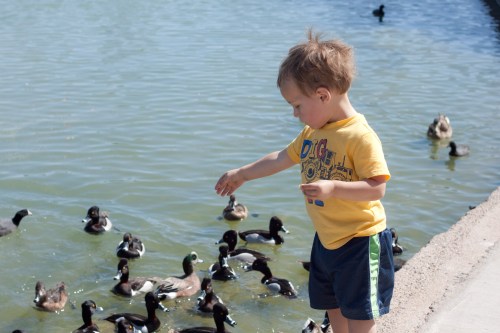
The boys and I went to a new park this week, just a few miles south of our house. To our delight, behind the playground was a lake, complete with ducks!

{pretty}

IMG_4121

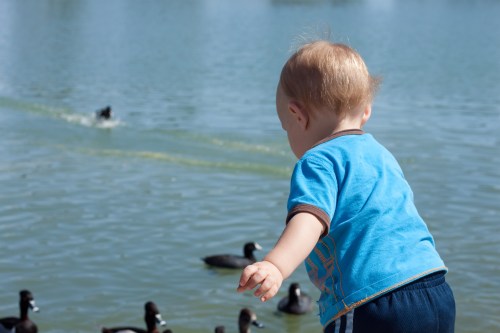
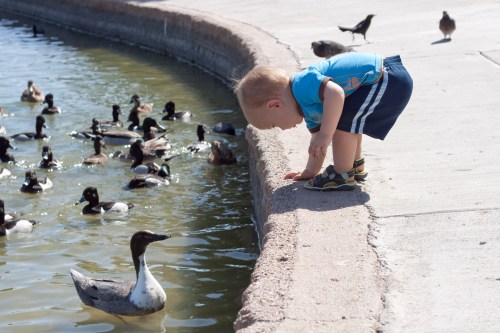
Limerick absolutely loves birds and was completely captivated by the ducks. It took him a few tries to throw his pieces of bread into the water instead of just dropping them at his feet, but once he got it he didn’t want to stop.

{happy}

IMG_4119

IMG_4127

We fed the ducks at the end of our time at the park, after a couple hours of running and digging in the sun, and I was a bit worried that the boys would be too worn out to really enjoy it – but they were so excited about seeing all the birds that they got a second wind 🙂 I was amazed at how fast our small supply of bread heels disappeared into those ducks’ tummies.

{funny}

Tuesday was free ice cream cone day at Dairy Queen, and there happens to be a Dairy Queen within a block of our house, so I took the boys for their first ever ice cream cone experience. This little man was a bit overwhelmed by the cone in its pristine form, but he got all silly and happy once we reduced it down to more manageable proportions. Limerick was exactly the opposite: he plunged right into the tower of ice cream on the cone, uncaring of the creamy sticky mess all over his face, and ate quite a bit before deciding he was done, about halfway through the ice cream. The upshot of the adventure was that we had 3 good-sized cones and I ended up eating about 2 of them, between my own and helping the boys with theirs!

{real}

IMG_4159

This little guy, while decidedly cute and happy, has also decided that it is ridiculously fun to run away from me and generally play keep-away when I call him. It is hard not to let it turn into a game every time, the way he laughs so mischievously as he scampers away! I’m having to enforce the rules a bit more strictly than I wish I had to – it’s like, if you would stay away from the road you could play anywhere in this whole huge area, but because you keep running towards the road with trouble on your face, thinking it’s a game, you’re going to have to sit with me or in the stroller. I feel like his need to test the boundaries keeps him from having as much fun as he otherwise could, which makes me sad for him.

My primary solution is to let him play, as much as possible, in areas where the boundaries are few and far between, so he doesn’t feel as much need to test: a playground where the road isn’t in sight, or where the road is on the other side of a fence; a child-safe backyard; the inside of our house or my parents’ house. In those settings, he can explore and play independently without the constant need for supervision or the shadow of a potential “no” interrupting his agenda.

Any other tips for what to do in places where I can’t control all those variables, and where the boundaries are simultaneously much tighter and much less clearly defined (for a 1.5yr old, anyway)?

Head on over to Like Mother, Like Daughter for the link-up today!

Posted in family life

silly kids being kids

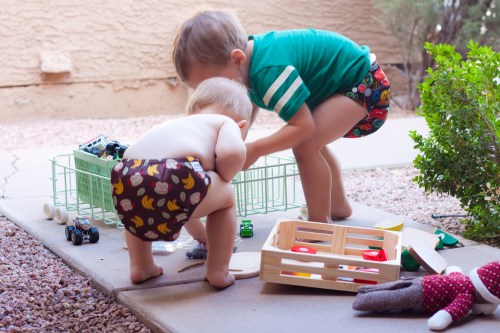
The dishwasher rack made it outside for a day, as the accessory and prop to many different pretend plays:

IMG_4060

Shortly thereafter I replaced it into the dishwasher and the boys haven’t pulled it out again yet, so I suppose the novelty has worn off a bit. It was a bit of a large and obtrusive play thing so I don’t mind it being back in it’s rightful home and out of my hallway!

(With regards to these pictures – I found the old kit lens that came with my camera and while it is really sensitive to poor lighting, it is really nice for close-up shots as it can get down to 18mm, as opposed to my main shooting lens which is a fixed-width at 50mm. Unfortunately, unless I’m in bright sunlight it distorts and washes out the colors to a certain extent. I’ve been simultaneously enjoying the flexibility of the wide-angle option in the often small and enclosed places we occupy, and remembering why I had put the lens away in a drawer in the first place…)

Sometimes I can follow what the boys are doing, like when they count stone and grass squares as they hop on them,

IMG_4077

or dance around and around in circles until they (pretend to) fall down (with little brother watching and doing his best to follow the leader),

IMG_4080

but sometimes I just really have no idea what is going on inside their heads:

IMG_4071

At least I know that every day will hold something new or unexpected 🙂 I know that whether the boys have fun playing together or whether they have to work through conflicts, whether they are happy little explorers or clingy sad babies, whether we deal with each other with patience and grace or tightly restrained frustration, each day is an adventure we will have together, a time to learn and love and grow together. And I love them, and they love me – my life is so full of blessings.

Posted in musings, quotes

the prayer of daniel

Daniel was one of the righteous men of his generation, the young exiles to Babylon. He kept the law of God, in spirit and in letter, despite the extraordinarily serious threats made upon him because of it. And yet, when he prays for his people, his nation, he makes no distinction between himself and them. He confesses for them, including himself in their number; he begs for God’s mercy, making no mention of his own righteousness or years of faithfulness.

Do we do this when we pray for our country, our churches, our communities? Or do we, in our prayers, distance ourselves from the ones we’re praying for? Do we see ourselves a step above them, separate from their problems and sins? Daniel could easily have done so, and yet he did not. Foreshadowing the intercessory mediation of Christ, he metaphorically took the sins of his nation upon himself and sought mercy at the throne of grace. As members of Christ’s earthly body, faced with the brokenness and sin of our nation, surely we can do no less, in our prayers and in our lives.


“O Lord, great and awesome God, who keeps His covenant and mercy with those who love Him, and with those who keep His commandments, we have sinned and committed iniquity, we have done wickedly and rebelled, even by departing from Your precepts and Your judgments. Neither have we heeded Your servants the prophets, who spoke in Your name to our kings and our princes, to our fathers and all the people of the land.

O Lord, righteousness belongs to You, but to us shame of face, […] because we have sinned against You. To the Lord our God belong mercy and forgiveness, though we have rebelled against Him. […]

O Lord, according to all Your righteousness, I pray, let Your anger and Your fury be turned away from [us]. Hear the prayer of Your servant, and his supplications, and for the Lord’s sake cause Your face to shine on Your sanctuary, which is desolate.

O my God, incline Your ear and hear; open Your eyes and see our desolations […]; for we do not present our supplications before You because of our righteous deeds, but because of Your great mercies.

O Lord, hear!

O Lord, forgive!

O Lord, listen and act!” (from Daniel 9:4-19)


Posted in musings, quotes

is it really that bad to want to be a homemaker?

Indeed, while a vibrant Cuban women’s movement flourished in Havana during the first part of the twentieth century (Stoner 1991), the writings of early Cuban feminist Mariblanca Sabas Alomá ([1930] 2003) make clear that the desired outcomes of social and political reform for many poor urban women in Havana were economic and conjugal stability – meaning the possibility of remaining within the unpaid domestic sphere with the support of a male breadwinner – rather than the right to work and autonomy from men. – Elise Andaya, Conceiving Cuba: Reproduction, Women, and the State in the Post-Soviet Era, pg 41

The perspective of this author seems to be that the highest goal for women, the most progressive and ideal, is to join the paid workforce and be free of dependency on men. While I agree with her that the ability for financial independence is necessary, I take issue with the demeaning tone she uses throughout her book to describe women who live out more stereotypical female roles in the context of marriage and child-raising. It is consistently presented as the lesser option, the choice of the unenlightened and ignorant, or (alternately) the luxury or prison of the wealthy.

I think even in the United States today, where women have the right to work outside the home, can be financially autonomous and self-sufficient, and are culturally encouraged to obtain an education and pursue a career, a lot of women still desire the stability offered by marriage as well the ability to devote substantial amounts of time to their young children that the financial support of a partner enables. We have found that we can achieve autonomy, but that it is a hard and lonely road, and that the interdependency of committed marriage and family life can often bring joy and fulfillment. The simple truth is that while many women choose careers that bring them incredible satisfaction and purpose, many other women work simply out of financial necessity (often occasioned by family breakdown) and would love to spend more time making their homes and neighborhoods places of beauty and community and raising their own children instead of outsourcing their care. The benefits they can bring to their families and communities in the context of the “unpaid domestic sphere” are not the less for being monetarily unrecognized, and it is a harsh devaluation of the family, the child, and the task of raising the child to act as though the financial remuneration for a job is its only source of worth.