Posted in musings

accepting autism when I want to be normal

I remember the first time I revealed my depression to another person, and the first time I admitted that I had wanted to commit suicide. It’s not an easy thing to be open about; it’s shameful, and dark, and has the potential to hurt the person you’re talking to quite a bit (especially if they knew you when you were going through it and didn’t open up to them until years later). I’ve found a way to accept it as a part of my story and talk about it now, though, and I hope when I talk about it that I can encourage others who experience it. I have a mental illness, I can say, without being ashamed or guilty. I have been in these dark valleys, and heard these poisoned voices, and felt the dank stagnant breath of despair on my face. If you are there, I can say, where hope seems entirely absent and all light is lost, where you are lost in a pathless wilderness and the very thought of finding a way out seems pointless, I have been there too, and I am a witness that it is possible to return to the land of the living.

Autism has been a more difficult name to claim for myself. While I don’t have a medical diagnosis, it’s not doubt about the validity of the label that stops me; I can see every symptom in my autistic son mirrored in myself, I score well above the cutoff for every ASD questionnaire I’ve ever taken, and it’s evident to others to the point that my husband laughed at me when I told him I wasn’t sure if I could be autistic myself.

Instead, I think what makes it difficult for me is the admission, in accepting this diagnosis, that I may struggle with certain things for the rest of my life without a “fix.” That some of the aspects of myself I’ve always hated, some of the traits I’ve never accepted, are part of my neurology that will never go away. I can take a pill to shut out the blackness of my depression; there is no pill that will help me fit in with a group, or know how to move my face the right way when I listening to someone talk, or recognize when a friend is being sarcastic and when they’re being serious. I can go to a therapist to talk through unhelpful thought patterns and try to replace them with healthy and positive ones so that a depressive trigger won’t need to set off a ruminative episode of self-hatred; I can’t go to a therapist to talk away the irritability caused by spending all day with three kids whose normal play and conversation feels like an assault of noise, or the emotional breakdown induced by a last-minute schedule change, or the heights of anxiety scaled every time a new event or social appointment is upcoming. I mean, a therapist could potentially help me find ways to cope with those physical and emotional reactions – but they are still always going to be there.

As we’ve gone through the process of Rondel’s diagnosis and my accompanying self-discovery, I’ve read and read blogs and articles from the #actuallyautistic community – I’ve sought to have my understanding shaped by the words of autistic adults and self-advocates. So I know that autism is just a different wiring, a different way of perceiving the world and being in the world. I know that very often it is social norms and expectations that make autism difficult, not autism itself – that is, the difficulties do not exist because autism is bad, but because it is different in a world not designed to accommodate differences. I love that autism has given me a mind like a database and an unfailing eye for patterns. I think I can give autism some credit for saving me from the girl drama of middle school and high school, for giving me dedicated and focused attention on things of interest and importance to me, for helping me to be an honest and trustworthy person, for developing my (often repetitive) love of books and reading.

But sometimes it is just hard. I don’t want to be a different person, but sometimes I’d love to be part of a conversation without constantly having to evaluate and compare my responses with the responses of the other people involved, without having to laugh at a joke even if I don’t get it at all, without having to guess whether a statement was meant to be funny or sarcastic or not. Sometimes I’d like to be invited when church friends or coworkers have a BBQ or a game night – and sometimes I’d like to receive an invitation with casual nonchalance instead of panicked uncertainty. Sometimes? – I wish I could actually be normal instead of just pretending to try to fit in.
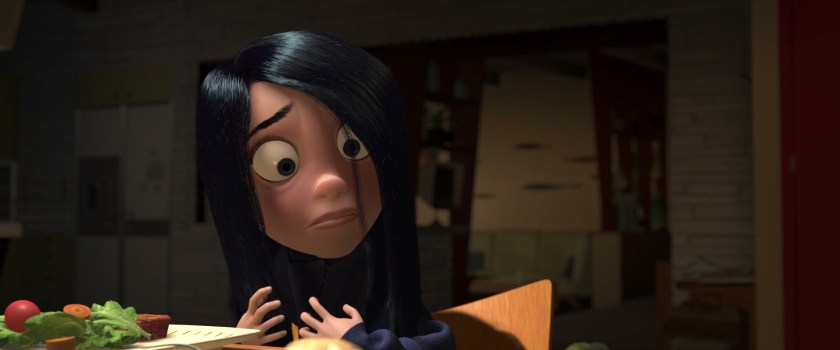
violet_incredibles
“Normal? What does anyone in this family know about normal? […] We act normal, Mom, I want to be normal!” – Violet Parr, Incredibles
But maybe it is harder to try to be someone I’m not, and waste my life wishing I were that other, neurotypical, person, than learning to accept and embrace who I am, struggles and all. Maybe it is harder, in the long run, to wear a disguise every day of my life and pretend that I never need help or support. I just know that right now I’m still too scared to take off that mask.

Posted in sqt

{sqt} – reclaiming joy

I noticed this week that my children never want to go to bed, because they are just having so much fun and don’t want the day to end, and they wake up each morning full of excitement about the day ahead.

My husband and I, on the other hand, have entered that exhausted parent state where we spend all day waiting for night to come so we can have some quiet space and rest. It makes sense that we end up there, but constantly looking forward to the evening has a tendency to rob the day of its joy.

How can I reclaim some of that joy I had as a child about the new day ahead of me, full of potential for discovery and adventure, for beauty and love?

I’m not entirely sure, but today’s seven quick takes are going to be some ideas I want to implement in my own life this upcoming week. Head over to This Ain’t the Lyceum for the rest of the {sqt} link-up!

  1. Reframe the moment: when something is irritating or inconveniencing me, is there a way to look at the situation through different eyes? For example, when one of my children is whining and flopping around about something, I tend to be instantly triggered into frustration. I want to yell at them to pick themselves up and show some independence! At the very least I want to ignore them until they stop whining. But though that is my automatic response, a change in perspective can help me build a more compassionate and helpful response. If I can hear the whining and think, “here is an opportunity for me to love and serve this child like God loves and serves me,” then I can help them with their needs and wants with more gentleness and joy (although I will still ask them to try using a different tone of voice!)
  2. Pause: this goes along with the first point, since a pause can be a good time to try to reframe a situation. But it is good and useful all on its own, also. Instead of coasting through my day on autopilot, pausing for all sorts of reasons can help me see the beauty and feel the joy of everyday life. I can pause to watch with pride as my children take turns with their favorite water bottle; I can pause and count to ten when I hear angry voices coming from the play room to prepare my heart before they come running out to me; I can pause; I can pause when the baby has made yet another awful mess and make the cleanup something we can do together rather than something to make her feel ashamed about. I can pause to breathe out a prayer and breathe in grace when life is overwhelming.
  3. Put the phone away: except for when I’m reading a good book or listening to a good podcast (things I can mostly only do when I’m alone anyways), phone time tends to be an escape from reality and as such hinders any attempt to find joy in my current reality. It distracts me from the good and happy moments of the day especially, since those are the times when the kids are least demanding of my attention – and so it blinds me to the everyday beauty of their growing relationships and maturing character.
  4. Have a plan: if I know at the start of the day something fun that we’re going to do later, the anticipation and enjoyment of that event can easily spread throughout the rest of the day. And if we don’t follow through with the plan because we’re having too much fun doing other things, that is also a source of joy 🙂 It also eliminates some of the tension of looking forward through 12 empty hours not knowing what to expect and thus how to mentally prepare, and it breaks up the cabin fever the kids sometimes get when we’ve been in the house hiding from the heat all day. This could be some sort of outing (like the park or the library or even the grocery store), but it could also just be an activity or craft that we don’t do as often because it requires more set-up (like water balloons or finger-painting).
  5. Go to bed on time: because if I’m tired, it’s going to be a lot harder to feel happy. It’s going to be a lot harder to make the mental effort to reframe each moment. It’s going to be a lot harder to pause instead of reacting emotionally. And it’s going to be a lot harder to be present and engaged instead of sinking away into the virtual reality of my phone.
  6. Play with the kids: play is where they are finding their happiness, joy, and intellectual fulfillment right now, at this age. And they still want me to play with them a lot of the time! Essentially, they are inviting me into their happiness. All too often, being a boring (and tired) adult, I turn them down and find other “more important” tasks I need to do. But if I could let myself go – relax my body, forget the to-do list, ignore the “should’s”, suspend my disbelief – and play with them, even for a little while, I could in those moments have the presence and the joy that they have, and connect with them through it.
  7. Sing!: and dance! Move my body, stretch out of my comfortable shell, and make music! Music is so good for all emotional states – it expresses sorrow and anger, passion and despair, joy and silliness, peace and contentment, and in the expression elicits and draws out those same feelings in us, helping us experience them more deeply and process them more fully. So going back to point 4, I’m planning on having a dance party to silly kids’ songs at least one day this week, and I’m not going to care if my kids think I’m crazy!

What about you? How do you find joy when life is monotonous or stressful?

Posted in wwlw

what we’re learning wednesday: episode 3

Today we went to the grocery store and learned about the way peaches smell when they’re ripe and good to eat (and also plums). I learned that Limerick will pull the leaves off of strawberries before he eats them, while Aubade will eat them leaves and all.

We learned about the strength of the wind in a storm when we saw huge branches torn off of trees by the monsoon that came through last night.

We learned about the hiddenness of the wind, how it can only be inferred by the consequences of its presence, last night as we watched that storm crash down the street and read Christina Rosetti’s poem about the wind:

Who has seen the wind?
Neither I nor you:
But when the leaves hang trembling,
The wind is passing through.

Who has seen the wind?
Neither you nor I:
But when the trees bow down their heads,
The wind is passing by.

Rondel wondered at how we can feel the wind when it presses against us even though we can’t see it coming with our eyes.

Today, we talked about how scary things can be when they are new and unfamiliar and unknown, when really they are good and beautiful things, because we discovered some books on that theme at the library: Tiny’s Big Adventure by Martin Waddell, What Do You Do With a Chance? by Kobi Yamada, and Little Frog and the Scary Autumn Thing by Jane Yolen.

Earlier this week we made a 10×10 number chart and discovered that if we covered up all the odd numbers with flakes (all the numbers that can’t be split into two groups, as the boys say), the even numbers that were left all lined up in neat columns and had 2, 4, 6, 8, or 0 in their ones place. We also spent a lot of time figuring out which numbers would be visible if we covered up the ones that couldn’t be split into three groups, but we didn’t discover a reliable pattern yet for those numbers. (Limerick loved figuring it out for each number though, so I’m sure he’ll find the pattern pretty soon).

Rondel watched a documentary about the Galapagos islands and learned about an iguana that laid its eggs in nests of volcanic ash and so couldn’t leave the volcano summit of one of the islands, and also learned about the blue-footed booby for the first time and was impressed by how blue its feet really are!

And I learned that the best way to turn around a bad day is to apologize directly for my irritability and impatience, instead of just hoping it will go away and be forgotten.

Those are our recent highlights! What have you all been learning and discovering in your lives lately? What riches of knowledge and adventure have your curiosity and hunger to learn unearthed for you?