Posted in musings

parenting towards inclusion

Inclusion begins with honesty.

If I gloss over the differences between people, my child will be confused by the discrepancy between what he sees and what he hears from me, and will intuit that difference is something shameful, something not to be spoken of.

Inclusion begins with knowledge.

Last week we watched a friend’s three children for a few hours at our home, one of whom is severely autistic. One of his favorite things to do is to take things apart (things like Duplo creations)… which was understandably frustrating for Rondel, who is very particular about his creations and gets worked up if anyone even gets too close to them. They were building together when the inevitable happened, and when I separated them Rondel told me that he didn’t like his friend “at all.”

But when I explained to him why his friend was behaving that way – that his brain was developing differently and he was in a lot of ways similar to Aubade as far as impulse control and the kinds of activities he enjoyed – it made sense to him, and he was able to adjust the way he played to accommodate those differences. Having that knowledge helped him to more fully include his friend.

Inclusion begins with presence.

One of the reasons I offered to watch my friend’s children (besides the fact that she needed someone urgently at the last minute) was that I want my children to spend time with people who aren’t like them: people of different ethnicities, people with physical disabilities, people with neurodivergences, people of different ages. It isn’t actually inclusive to sit around and talk about equality and opportunity and diversity if you aren’t living it out by filling your community with all types of people. I want my children to know from lived experience that even people who face incredible physical and mental challenges are just people, with their own needs and preferences and personalities, with their own unique strengths and weaknesses and quirks.

Inclusion begins with me.

Because my attitude and my choices determine the environment in which my children grow up, I have to shape it into one of acceptance and love. This is not necessarily easy for my introverted self, but I believe it is critically important for the future of our society and communities for inclusion to become part of the fabric of our everyday life and personal relationships. It begins here, in my home and in your home.

Posted in family life, musings

love

Love is such a difficult thing to describe; it is impossible to quantify. Rondel and Limerick have been attempting to articulate how much they appreciate or enjoy something by telling me they love it “even more” than they love something very special to them, including people (so one would say he loved Grandma more than Mommy, and the other one would state the opposite, or they would say they loved a new type of popsicle even more than swimming). They have also asked me a few times who I loved the most – talk about a question with no right answer!

What I’ve been explaining to them, and how I answered their question, was that I love all of them in different ways, because they are different people and our relationships are likewise different. I love them all just the same amount, but it looks different; in a sense, my love for each of them is a different color, but each color blazes with the same intensity, beauty, and brightness.

If they asked me which color represented my love for each of them, this is how I would respond…

Continue reading “love”

Posted in family life, musings, quotes

wonder

Watching my children play, I am reminded of the wonder and beauty of small and simple things. There is enough joy in a glass of milk to send a three year old dancing around the kitchen; there is enough beauty in a well-done coloring page to keep a distractible, active four year old still and entranced watching it happen; there is enough passion in a stuffed animal to occupy the full attention and imagination of the one year old who walk around snuggling and protecting it. Continue reading “wonder”

Posted in family life

pea gravel!

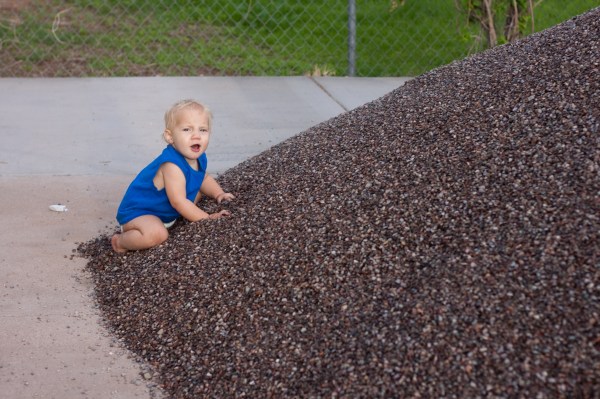
When we moved into our new house last summer, the home had been mostly fixed up (aside from a few plumbing issues that surfaced in our first month living here… old pipes) but the yards were completely flat dirt. Horrible dusty barren dirt, too, filled with trash; even the Bermuda grass could only survive in a few patches.

We’ve been slowly trying to make the space both aesthetically pleasing and functional, so towards that end we got twenty tons of pea gravel delivered one weekend, to fill in a play area in the back yard.

IMG_9028.jpg Continue reading “pea gravel!”

Posted in family life

his hands were dancing

Hands are useful communicators.

Sometimes we use them deliberately, pointing at an object of interest or gesturing to show how large or small an item is.

Other times they are less intentional – for example, someone may scratch their head or rub their chin while thinking, subtly communicating to others that now is not a good time to interrupt them, or that the pause in the conversation doesn’t mean they aren’t paying attention!

Sometimes we are able to communicate emotions or needs with our hands faster than we are able to share them verbally.

My husband and my mom will both notice when my hands drift to my arms and start picking (a sign of escalating tension or anxiety, typically), and try to address whatever is going on; it would be very difficult for me to break into the flow of the conversation to bring up my anxiety until I was much closer to a meltdown.

Another good example of this is from Rondel the other afternoon, when he saw a bee near Aubade in the kiddie pool and started flapping his hands frantically until I came over and asked what was wrong; he told me later that his hands were telling me that he needed me. The worry of the moment made it difficult for him to access the relevant words, but his hands were able to alert me that something was going on.

Probably my favorite expression of hand communication, however, comes from a moment when Rondel’s hands were demonstrating a thrill of joy.

We were stopped at a red light waiting to turn left out of our neighborhood, and the boys asked me why we weren’t moving. “We’re waiting for the light to turn green,’ I explained, and showed them where to watch for the green light. When it finally turned green, Rondel’s hands went crazy waving around – and a minute later, when he had calmed down, he told me (referring to himself as “you”) that “Your hands were dancing because you were so excited that the light turned green!”

His hands were dancing.

I can’t really think of a more beautiful way to express the unadulterated, uninhibited demonstration of joy and excitement that is Rondel’s happy hand flapping. His hands were communicating to me the rush of pleasure that he was feeling, allowing me to share in it more deeply than a verbal declaration would have accomplished.

Posted in musings

the unknowability of parenting outcomes

When I was very small (no more than six years old), my mom had a serious talk with me about my temper. Anger, she told me, was like a dark spot inside me, and if I held on to that anger I would be allowing that dark spot to grow and spread (at least, that is what I remember of the conversation now, over twenty years later…).

I didn’t bring this story up with my therapist when she was asking me why I thought anger was such a negative thing… I didn’t want to be a parent-blamer when I have such amazing parents! But it did make me wonder – how many of the well-intentioned discussions I have with my kids now, trying to help them understand the world and themselves and other people, will be internalized in an unhelpful way?

For example, tonight Rondel was being incredibly loud for no reason at all while I was lying down with the boys for bedtime – he was just trying to keep himself in a high-energy state by making random noises non-stop. I had asked him to be quiet multiple times, to no avail. Finally I turned to him and said that I couldn’t make him be quiet, that it was his choice – and that he could choose between being selfish and inconsiderate or kind and helpful. “And the choice you make,” I told him, “will affect the type of person you are becoming. So think about what type of person you want to be.”

“You want to be helpful” he replied. And he was silent after that (aside from asking for more water), snuggling up to me and letting his brother fall asleep in peace.

In the moment, my explanation worked and the boys fell asleep. I think the overall principle is a good one as well, and one I try to use for myself; it is paraphrased from C. S. Lewis. But I don’t know how that will settle down into the mind and heart of a four year old – if it will be a healthy motivator or a source of anxiety and shame in years to come.

Oh well.

I suppose all one can do as a parent is to try the best one can in the moment and pray that it will turn out alright!

Posted in family life

little problems, big feelings

We had some frustrations, today, as we went about our normal adventures.

Someone was upset to the point of tears because the cars in the lane next to us were moving and we weren’t and this child didn’t understand why (they had a left turn arrow…).

Someone broke down because their brother finished the bag of goldfish, even though they’d been able to eat an equal amount.

Someone sobbed and wailed in the grocery store because they were thirsty but didn’t want to drink from the water fountain.

Someone screamed and threatened because their brother put in the puzzle piece they wanted to do (make that two someones…)

Someone ran across the playground hiding their face in their hands because I wouldn’t let them push another kid off of the equipment they wanted to use.

Honestly, most of these moments involved fairly trivial triggers, at least from my perspective. It’s been a long time since forgetting a cup for my water and having to use a fountain instead brought me to tears… But for my children, these “little” things have a big impact. Something in their world isn’t functioning the way they expect or want it to, and it throws everything off kilter emotionally.

And when it does, I have the incredible privilege of being able to support and comfort them without being pulled underwater by my own equally strong emotions, since the things that bother them no longer affect me in that way. I can be the pillar of strength and the promise of unconditional love in those moments when they are falling apart, using those struggles as an opportunity to connect with them and deepen our relationship, instead of mocking or shaming them for “overreacting” to something so small. All I have to do is remember how vastly different their perspective is from mine, how much less experience they have to understand the world around them, and how little control and independence they have in their lives, and respond to them accordingly.

Posted in family life, musings

the value of a diagnosis

As we proceed with Rondel’s diagnosis (since the school district is unable to provide an actual medical diagnosis in their evaluations), we’re using an innovative diagnostic app developed by a local children’s hospital, which involves capturing multiple videos of Rondel’s actions and interactions in specific situations. I like the concept a lot, as it lets the doctors see into Rondel’s everyday life and observe him unnoticed for far longer than would be possible in an office setting! However, as I’m going through the videos to trim and upload them, I keep wondering if the specialists will see the differences that we believe are present – or if they will tell us that his struggles are due to something like poor parenting. Maybe if I were stricter, or reinforced acceptable behaviors more consistently, or provided him with a more stable routine, or cleaned up our diet, or or or or…

IMG_8588

…then maybe he would be fine, maybe he would be normal, maybe he would fit in with all the other kids instead of sticking out uncomfortably.

He just isn’t so significantly different that it’s obviously a medical problem to a layperson. His differences are hidden, partially masked, behind his gregariousness and intelligence and creativity, until he’s used up all his energy on coping and he falls apart. So when people see him melting down or acting out, it’s easy for them to assume he is doing so willfully, or to think that he is simply being “spoiled” and “self-centered.” Even I, who see him every day, wonder sometimes if the difference is truly there, all the way down, no matter what, or if I could find some parenting technique that would work better for him and “catch him up” to his peers.

But I wonder that about myself also. Do I fail to maintain relationships or engage in neighborhood community-building because I am selfish, lazy, and don’t care about other people? If I were a better Christian, could I overcome my introversion? Many people do, after all, and are able to make time to recharge themselves. So am I guilty of using my social anxiety as an excuse to cover up for my vices or inadequacies?

Similarly, before I was diagnosed with depression (and honestly sometimes still), I would tell myself that if I just tried harder – if I prayed more, exercised more, ate better, spent more time in self-care, spent more time with close friends, practiced the right mental exercises, etc – I could get through the negative feelings and be fine. Getting the diagnosis was one of the best days of my life, because of what it meant to me: that I wasn’t an awful person taking advantage of the people around me, just a sick person who was trying as hard as possible to find joy and light but needed some extra help.

IMG_8585

And my hope is that a diagnosis will be a similar gift to Rondel: a confirmation that his differences are real, and valid, and significant; a reminder that some things will be harder and it will be ok to seek and use help and support; and a shield against the barbs of guilt and shame that always accompany deviations from social and cultural norms. The alternative – refusing to acknowledge and name the neurological differences that give rise to his behavioral differences – is only a recipe for disaster as he grows older and begins to notice his differences without a framework for comprehending and addressing them. How much better to provide him with a framework of informed understanding, acceptance, support, and unconditional love!

Posted in family life

going to the zoo!

The boys – especially Rondel – have been deeply interested in dinosaurs for quite a long time now, and are beginning to branch out into animals of all types. It really began with the Planet Earth documentaries that I would put on for them during Aubade’s nap times, and has continued with a short series called Africa’s Deadliest that is just as overly dramatic as the name suggests but which contains some great footage of wild animals as well as a lot of scientific facts. When we found and caught a lizard (well, rescued it from a bowl it had fallen into, to be more accurate) not too long ago, he was entranced: he understood intuitively how to hold it gently and carefully, and let it climb all over him with no fear, and ended up playing with it for 45 minutes before releasing it so it could return to its natural habitat.

So I was not surprised when he asked to go to the zoo this week, nor when he actually showed in interest in seeing the animals instead of just the dinosaur exhibit and the splash pad! And it was a good day to go!

We did of course have to visit the dinosaurs:

Obviously we couldn’t observe any live, wild, natural animal life here – but we had some discussions about the different types of nests made by different dinosaurs (we compared the twig nest of the Citipati – a feathered broody dinosaur – to that of the Diabloceratops, which was too large to brood its eggs and most likely made a mud nest like a crocodile), as well as about how the different types of dinosaurs might react if they saw us!

From the dinosaur trail the bighorn sheep exhibit is also visible, and Aubade got very excited when I pointed them out and told the kids what they were. She leaned forward in the stroller as far as she could, waving and yelling, “Hi!” – and then she turned to me, smiled, and matter-of-factly said, “Baa!” It was neat seeing her make the connection between the distant animal on the mountainside and the fuzzy white blob in her Moo, Baa, La La La board book by Sandra Boynton.

When we left the dinosaur trail, it seemed like a lot of the animals were active and awake – we got to see baboon, mandrills, oryx, cheetah (unfortunately they were difficult to see, but we did manage to spot them), otters, flamingos, zebras, and more! The flamingos were standing right by the fence, so we stood on one leg like they did, and noticed how they could turn their heads all the way around backwards to use their back like a pillow, and wondered why their large beaks only ever opened a very small amount.

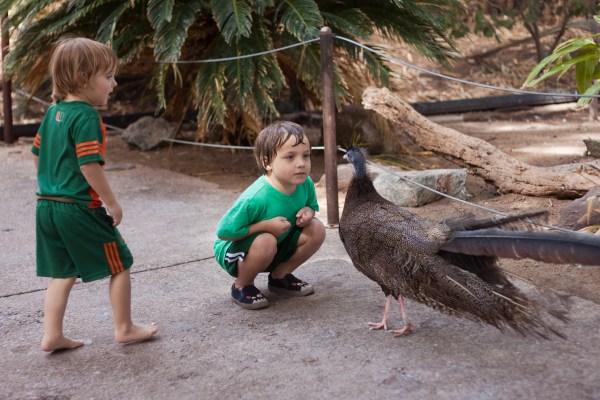
Per Rondel’s request, after a cool-down break at the splash pad we visited the Tropical Birds trail, which includes a small aviary. Apparently, it is mating season at the zoo – so all the birds were awake and showing off their finery! The male peacock had his full tail fan extended, and kept shaking it at the peahen, making a surprisingly loud rattling noise when he did so. In the aviary, the male argus pheasant was strutting around on the path, making a call that the zoo keeper told us he only made during this season, instead of hiding in the back corners as he tends to do the rest of the year.

IMG_8684

Rondel was absolutely captivated. He approached the bird slowly and quietly, and held his hands tightly back so he wouldn’t accidentally touch it (he would jump out of the way if the bird turned around so that he wouldn’t end up touching his long tail feather!), and just squatted down gazing at him for a long time, as other groups of people came and went.

IMG_8689

Limerick was a little less certain, but he eventually went over as well. I was super proud of both of them – they are often very impulsive and active kids, and they had no trouble at all adjusting their behavior to what was needed by the animals. We talked a bit here about how a lot of viruses can jump between birds and people, so if we touched the birds we could get them sick or they could get us sick… my molecular biology background always ends up showing itself somehow 🙂

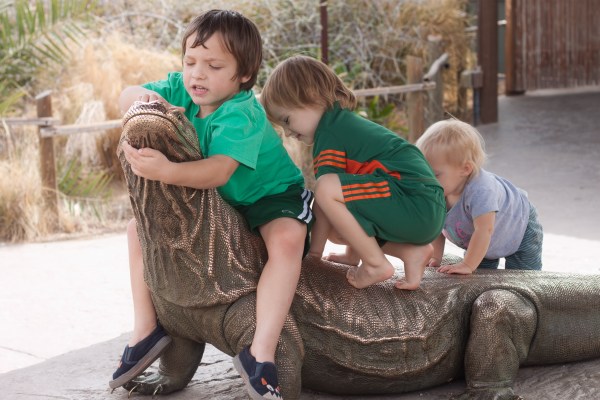
We finished up with the tiger and the Komodo dragon. I had never actually seen the Komodo dragon exhibit at our zoo, but Rondel instantly remembered them from the new Planet Earth series and was incredibly excited about them. They weren’t moving much – just soaking in the sun – but they are impressive creatures. We noticed how it was basking in the sun to soak up the energy it needs as a cold-blooded animal, and counted its claws (five on each foot, just like us, in case you wondered).

And of course we played on the Komodo dragon statue for a while!

IMG_8693
This is what I get when I tell the kids to smile at me… I guess Rondel is somewhat close?
IMG_8697
Playing together – I think they are subduing the Komodo dragon so it can’t fight them.

The most wonderful thing about homeschooling is the ability we have to follow our interests – obviously in going to the zoo for a whole morning instead of adhering to a lesson plan or a class schedule, but also in deciding when to linger at an exhibit and when to move on, when to talk about the details of how an animal lives and when to stick to the basic overview, when to focus on the live animal exhibits and when to simply just have fun. The experience we had today was so real and so rich that I wouldn’t trade it for any classroom I’ve ever known.

Posted in family life

meltdowns

People are hard for me.

Last weekend was filled with people – a water system sales guy came over right after work on Friday, we had our church small group on Saturday morning, I took the kids to a park Saturday afternoon, we went to church Sunday morning, and we visited my parents Sunday afternoon. So – a complete stranger in my house for several hours, and a crowded, noisy, open-plan park, on top of a weekend already social-heavy, with the looming threat of preparing for the babysitter to come Monday morning, was not a good situation.

Unexpected changes of routine are also hard for me.

Last weekend had a lot of those also. I had hoped to celebrate Candlemas with the boys on Friday after work by melting some beeswax and making earth candles in the planter out front (I had even managed to find my old candle-making supplies from high school!). But then my husband made the appointment with the water system guy (for the promise of a Home Depot gift card, which is always useful), which started 30 minutes earlier than I had thought and went considerably longer than I had expected. So because of a misunderstanding about the start time I didn’t get home until shortly after he arrived, meaning my normal coming-home rituals and reconnection with the kids were hampered; the length of time he stayed meant we didn’t get to make candles and didn’t even get to have time together as a family until dinner (which I had to throw together last minute as soon as the sales guy left).

In addition to that, I forgot how crowded the parks around here are on Saturdays this time of year, and this was a new park for us. That in itself was stressful, because we didn’t have a routine for where we would go first, what we would do next, etc., and what favorite corners we would end up in, and it is hard to develop those routines when there are so many other people around. But it became exponentially more stressful when Rondel didn’t stay put while I maneuvered the stroller around an awkward spot, and wandered off into the crowd. Those 5-10 minutes before I found him (ensconced in the arms of a mother with an older daughter, who had come across him panicking and offered to help him) were some of the worst I’ve ever lived through, as I’m sure any parent would agree!

Then, Limerick had a low fever and runny nose Saturday night/Sunday morning, so my husband stayed home with him while I took the other two to church by myself – which was not really that stressful, but it did change things up and force me to make a lot of logistical/efficiency decisions that I don’t normally need to. Not a big deal in itself, but not ideal after the two days prior.

So… I crashed, Sunday night. As in, I laid myself down on the bed after dinner and cried, leaving everyone else to fend for themselves. I had spent all my energy on small talk, relationships, social navigation, people in all their myriad forms, and I had none left to craft the semblance of “engaged parent” for even the remaining hour or two till bedtime.

We hear/talk a lot about children having meltdowns – how to help them, how to distinguish meltdowns from tantrums, how to prevent meltdowns from happening in the first place – but we seem to think that once someone is an adult, they’ve somehow managed to outgrow them. Well, adults can still be introverted, socially anxious, and sensitive to sensory and emotional stimuli. We can still push ourselves too far. We can still collapse, now, just like we did when we were children – and the best way to help us is with space, rest, patience, and gentleness.

(Protip: it is not helpful, in the moment where a meltdown is happening, to try to identify a specific trigger and explain all the ways that trigger is really insignificant or fixable and therefore unworthy of causing said meltdown. Did you notice how many things I mentioned in this post that contributed to my meltdown? And yet the apparent in-the-moment trigger was a whiny baby during dinner. When someone is emotionally collapsing and feeling completely overwhelmed, they aren’t going to be able to give you the blow-by-blow account of the multiple days’ events that led up to the meltdown.)

(Another protip: It is also not helpful, if you see a person supporting someone else through a meltdown, to start talking to the support person about how you don’t understand what’s going on and really don’t know what to do, with a shocked, confused, and/or repulsed look on your face. The support person is busy taking care of someone in clear emotional/sensory need; they most likely do not have the time or bandwidth to simultaneously coach you through the ins and outs of what a meltdown is, why this particular individual is experiencing one, and how he/she prefers to be assisted through it. If you want to learn, bring it up another time. But in the moment, shut up and give the individual some space and privacy unless they indicate otherwise.)

Things to remember:

  1. I (or my child) am not necessarily melting down because I dislike you, the people in my immediate vicinity. In my experience, meltdowns occur more around trusted friends and family.
  2. I (or my child) am most likely not melting down because of something you did personally, but because of some environmental factor pushing us over the edge. This could include:
    1. Physical discomfort (itchy clothes, hot/cold feelings, allergies, hunger, fatigue, etc.)
    2. Sensory overload (large groups of people, loud noises, irritating noises, bright lights, strong/unpleasant/unusual smells, etc.)
    3. Anxiety (crowds, unfamiliar locations, unexpected changes to routine, uncertainty with how to navigate the social terrain, etc.)
  3. I (or my child) would very much rather not be melting down, especially in front of you, and are trying our hardest to contain, control, and calm ourselves.
    1. For example, Rondel, today, when I asked him to try communicating without screaming, told me that screaming was the only way he could tell me how he felt. This statement is not always true of him – but in that moment, with the emotional capacity available to him in his meltdown, it was true, and I needed that reminder.
  4. I (or my child) would appreciate it if you could minimize reference to meltdowns and welcome us back with open arms when we are ready to rejoin you.
    1. If you help us avoid triggers, pace ourselves, and prevent collapse – without making us feel like incompetent and defective human beings by snide/cutting remarks or tones – that would be amazing. That would feel like full and complete acceptance and love. But I understand how hard that is in an ableist culture. It is still hard for me not to address myself with negative and shaming thoughts following a meltdown, given how much our society values self-control, self-sufficiency, and outward appearances. So I don’t expect otherwise from you – but if you can consistently provide otherwise, you will become one of the few people I implicitly trust, and around whom I can step out from behind my layers and facades.

Meltdowns happen. Rondel had one just today, victim to another over-scheduled weekend (which was partly my fault, and I feel awful about it). We can try to suppress them with feelings of shame, isolating the individual for their socially inappropriate behavior, or we can support the individual through them, and learn from them so that we can be better prepared for the future. I know which choice I’d rather make – for myself, and for my children.