Posted in musings

not a hugger

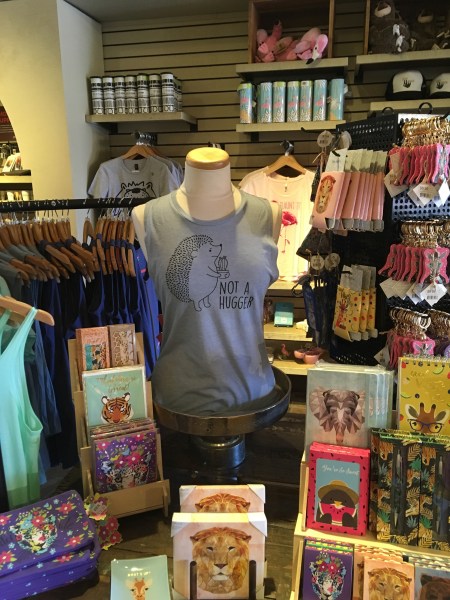
Every time we go to the zoo, we have to walk through the gift shop (it is strategically placed at the exit so that you literally have to go through it to leave, and the blast of air conditioning does feel nice this time of year anyways), and lately they have had a shirt on display that really speaks to me:

IMG_3378.jpg
(Image description: gray tank top on a manikin on a gift store display table, with a picture of a hedgehog holding a cactus with the words “Not a Hugger”)

It’s not that I don’t like hugs, exactly… it’s just that if I never had to hug someone else for reasons of perpetuating my friendship with said person, I would be quite happy. And while I do like hugging my kids and understand the importance of it for connecting with them, there have been many times when I’ve had to do deep breathing exercises because they were simply too close for too long.

Also that hedgehog is adorable. Maybe I could get away with being more prickly if I were also more adorable, in a hedgehog-esque fashion… 😉


The Differently Wired giveaway is still open! Just leave a comment on the giveaway post and I’ll enter you in the drawing. I guarantee this is a book you won’t want to miss.

Posted in family life, information, musings

responding to an autism diagnosis

We received Rondel’s clinical report today, with his official diagnosis of autism spectrum disorder. It was definitely not unexpected, and in many ways it is a huge relief to finally have it on paper with a physician’s signature and notes.

But it is also very hard to read through the report and take in the medical assessment of my child, who I see in all his brilliance and originality and intelligence, and who is being evaluated in light of his struggles and deficits. It is the very embodiment of the pathology paradigm, particularly given the list of recommendations at the end of the report that includes ABA, a therapy that is consistently attacked by autistic adults who experienced it as children. It reminded me of why we used the NODA app for diagnosis in the first place: so that Rondel wouldn’t need to be exposed to the pathology mindset, but would still be able to obtain a diagnosis for support, self-advocacy, and understanding. I just forgot that I as the parent would still have to deal with all of that negativity on his behalf, and buffer him against it.

In an ideal world, doctors could still assign the autism label without calling it a disorder. There are definite differences between the way the autistic mind functions – in the way it perceives the world, in the way it processes information, and in the way it prefers to interact with other people and objects – and the way the majority of minds (neurotypical minds) function. What people often miss, including doctors and therapists, is that the autistic wiring comes with its own unique strengths as well as its own unique weaknesses. A diagnostic process that sought to exist within the neurodiversity paradigm rather than the pathology paradigm could look for examples of both these strengths and these weaknesses, to generate a complete picture of the individual, and to help develop specific plans of support for the individual. In other words, for example: you have autism, and so you struggle with sarcasm and implied humor, you have difficulty reading facial expressions, social interactions and small talk take a lot of energy because of how hard you have to work to keep up and fit in, and certain noises and smells make you want to curl up into a ball or run away – but you also have a mind like a steel trap, the ability to make connections between information and ideas, unique ways of solving problems, and intense loyalty towards the people you are attached to. How can we craft your daily routine to take advantage of your strengths without putting too much pressure on you in your areas of weakness? That would be useful and practical support, without pathologizing the condition.

The pathology paradigm shows up in other places than the medical profession, though. Even a shift in the diagnostic process would take a while to seep through the culture – and until the culture changes, a diagnosis of autism is still going to be met by attempts to sympathize over the tragedy of it, doubt (because your child doesn’t look like he has autism), pseudoscientific “cures”, and even blatant disbelief.

What I wish I could tell everyone I know is that I am not sad or upset at all by Rondel’s diagnosis. His mind is different, and it is different in a beautiful and wonderful way. Will he struggle in a neurotypical society because of those differences? Probably so. But with love and practical support, he can also flourish and give to the world using his unique gifts and talents. He has the focus and the interest to immerse himself deeply in a topic and absorb everything there is to know about it. He has the imagination to see past the status quo and envision new ways of being and doing. And he has support around him to help develop his emotional awareness and executive functioning (two things that were a struggle for me well into adulthood).

What I wish everyone knew is that autism doesn’t just look like one thing. It might look like a mostly non-verbal ten year old communicating in one or two word phrases, dumping out every toy box and taking apart every Duplo tower, standing with the outdoor curtains blowing against his cheek to calm his body down, dancing to his favorite music videos, wanting to be part of the social action around him even as it overwhelms him. It might look like a very verbal twelve year old swinging endlessly because the sensation is so enjoyable, singing the same made-up song over and over again because the repetitive loop is comfortable and fun and transitioning to something else is hard, identifying what day of the week any date falls on, and communicating the love of God in profound and beautiful words. It might look like a four year old melting down because the color he used on his picture doesn’t look the way he expected, talking nonstop to manage auditory input, mimicking the meter and pattern of books and songs in his own games with new characters and situations, wanting a parent to snuggle with him every night at bedtime, or demanding animal documentaries at every possible moment. It might look like an adult struggling to focus on assigned tasks at work because their mind is stuck on other less-prioritized projects, getting into arguments with their spouse because of missed non-verbal cues, falling apart at movies because the emotions and sensations are just too strong and overwhelming, crying because they are running fifteen minutes later than they wanted, or developing a new system of project tracking for their lab from scratch and becoming a source of expertise without formal training because of their analytical skills and desire to learn.

Labeling all of those individuals as autistic helps them to obtain the support they need for the shared weaknesses that accompany the condition (weaknesses partially but not entirely due to living in a neurotypical society), but it doesn’t predict what they will do with their strengths and how their lives will play out. We are just as unique as neurotypical individuals in that regard! I believe – and this is why I think the neurodiversity paradigm is so critical – that if we can stop thinking of neurodivergence as disordered we can create better conditions for autistic and other neurodivergent individuals, a culture where all people can receive support in their areas of weakness and be given the opportunity to explore, develop, and contribute in their areas of strength.

What I wish everyone could see is that the autistic way of seeing and perceiving the world is also beautiful. That a person’s thoughts and feelings are equally valid whether they prefer to speak them, write them down, sign them, or use an assisted communication device. That the same processing circuits that cause us to flap our hands or scratch our arms or chew on our clothes to stay regulated are the same ones that allow us to retain incredibly detailed information and connect seemingly unrelated data in relevant and insightful ways. That the honesty and authenticity that keeps us from betraying or lying to the people we love makes up for our tendency to laugh at the wrong moments in a conversation or our inability to pick up on all your sarcasm or implied humor. That while we may experience and exist in a different way than you do, our differences do not make us less than you.

As an autistic adult (without an official diagnosis yet) raising an autistic child (now with an official diagnosis, hooray!), my plan for “treatment” consists mostly of helping Rondel to understand himself and to understand the world around him, cope with the things that are difficult and embrace the things that give him passion and fulfillment; and of prizing the wonderful individual that he is, and giving him the support he needs (right now, practically, speech therapy and mindfulness practice) to keep his areas of weakness from overshadowing and hindering his talents and strengths. It does not and will never include considering him to be disordered because his mind doesn’t function within that narrow range deemed “normal” or “typical” by the DSM.

Posted in musings, quotes

letting go

My therapist used to tell me, “it isn’t your business what other people think of you.” I’m still not sure I completely agree with her, since what other people think can occasionally have fairly large consequences on a practical level (promotions at work, for example) – but in general it’s correct. I’m entitled to my beliefs and opinions, and other people are entitled to theirs. Someone else might think I’m antisocial or making poor parenting choices because I want to homeschool; I might think someone is arrogant and disconnected from local community because they are a snowbird. But if I choose to live my life based on the thoughts of others about me and my decisions, I’ll be miserable (just like all those snowbirds would be, sweltering here all summer without the communities they grew up in, or being shut in all winter there because they can’t shovel themselves out anymore).

I have to let it go. Continue reading “letting go”

Posted in musings

pastor barbara and the out-of-sync girl

Once upon a time there was a church which had a female pastor. Now, this pastor wasn’t the lead pastor, or even the primary teaching pastor; she led the family and children’s ministries, actually, and spent most of her ministry time with women and youth. But she had the title of pastor – Pastor Barbara.

She was beautiful. She had long, curly brown hair and a nose with that perfect spark of defiance bringing its straight lines singing up from her face. She had a gentle way of moving – never too fast or too sudden – and a gentle way of speaking – never too loud or too harsh. And when she saw the children she loved and taught and prayed for, her whole body would glow with that love and light, like an emanation of the Holy Spirit through her presence.

There was a small girl at this church who adored Pastor Barbara wholeheartedly and unstintingly, although mostly from a distance as she was a quiet child. She enjoyed above all the new songs that Pastor Barbara would sing with them! For her, songs were a release from the uncertainty of social interactions, because the songs (at least the children’s songs that she knew) would specify how you were supposed to act. Take for example “Father Abraham:” no one would ever move that way in everyday life, but the song says to do it so everyone does it and no one has to worry about being out of sync.

Continue reading “pastor barbara and the out-of-sync girl”

Posted in sqt

{SQT} – first week home

It’s been a long time since I remembered about the Seven Quick Takes link up far enough in advance to write a post for it! This is a good week for it, too, since it was my first week as a (mostly) SAHM…

Also, after writing these I realized that every point on the list can serve as an example of some autism characteristic. I suppose it supports the argument that autism is an integral part of who an autistic person is – informing their strengths, joys, temptations, and weaknesses. Bonus points if you can name the trait that is on display in each quick take 😛 Continue reading “{SQT} – first week home”

Posted in family life, musings

fear of change

After eight years of working in a genomics research center, I’ll be transitioning to being a stay-at-home parent a week from now. Technically I’ll be working eight hours a week, in a sort of consultant role, which will keep me connected to the science – but it will still be a big change. It’s what I’ve been wanting ever since Rondel was born almost four years ago – but as it approaches, I find myself becoming more and more anxious.

I like my job, and I am good at my job. My supervisor respects me and my opinions; the researchers who rely on the services our facility provides respect me and my scientific knowledge and experience. I know what types of problems are most likely to arise, and I have tools and strategies for troubleshooting them. And I know that if I put in time, effort, and energy, I will have a successful outcome.

To be totally honest, I really like having the respect of other professionals whose opinion I value and who do innovative and important research. It gives me self-confidence: I may be a complete wreck if I have to call my doctor to schedule an appointment, but when I sit down with a researcher to discuss their experiment and figure out the best plan for them to take moving forward, I am completely at ease. It also gives me a sense of identity and self-definition: when acquaintances ask what I do, I can tell them about the science and feel that I’m doing something of worth, something that uses my talents and gifts, something beyond just staying at home and cleaning and cooking like any other person could do.

At the heart of my nervousness about the transition, then, I think, is a fear of losing that respect and identity – of becoming part of the crowd, no one in particular, no one with any valuable skills or gifts to offer my community. When I spend time with other moms, I feel so inadequate in the areas they are gifted in: my home is rarely clean, laundry and meals happen on an as-needed basis rather than with planning, small talk eludes me, playdates terrify me, schedules and extra activities overwhelm me, my children are dirty and wild. My mind is usually lost in a book, or an idea, or a project, instead of focusing on the people around me. I say nothing and feel isolated, or I say too much and still never manage to connect with anyone else. I simply don’t have the skills that these other women have, and without them, I’m not sure where I can fit in or belong in the mom world (especially the homeschool mom world… those women are so organized that I give up just at the thought of trying to be like them).

In the workforce, in academia, where everyone is a bit weird and everyone is valued simply for the expertise they offer, I knew where I fit in and I knew how I could flourish.

In this new world, I’m afraid I won’t ever be able to flourish – and that in my lack of flourishing, I will stunt my children’s future as well.

I’m not going to let my fears make a decision for me, when I believe on principle that a self-directed education is ideal for children, and when I observe pragmatically the stress that a classroom environment would add to our family life. I’m going to choose to let my love for my family be the motivating factor here instead!

But I’m still afraid.

Posted in musings

the unknowability of parenting outcomes

When I was very small (no more than six years old), my mom had a serious talk with me about my temper. Anger, she told me, was like a dark spot inside me, and if I held on to that anger I would be allowing that dark spot to grow and spread (at least, that is what I remember of the conversation now, over twenty years later…).

I didn’t bring this story up with my therapist when she was asking me why I thought anger was such a negative thing… I didn’t want to be a parent-blamer when I have such amazing parents! But it did make me wonder – how many of the well-intentioned discussions I have with my kids now, trying to help them understand the world and themselves and other people, will be internalized in an unhelpful way?

For example, tonight Rondel was being incredibly loud for no reason at all while I was lying down with the boys for bedtime – he was just trying to keep himself in a high-energy state by making random noises non-stop. I had asked him to be quiet multiple times, to no avail. Finally I turned to him and said that I couldn’t make him be quiet, that it was his choice – and that he could choose between being selfish and inconsiderate or kind and helpful. “And the choice you make,” I told him, “will affect the type of person you are becoming. So think about what type of person you want to be.”

“You want to be helpful” he replied. And he was silent after that (aside from asking for more water), snuggling up to me and letting his brother fall asleep in peace.

In the moment, my explanation worked and the boys fell asleep. I think the overall principle is a good one as well, and one I try to use for myself; it is paraphrased from C. S. Lewis. But I don’t know how that will settle down into the mind and heart of a four year old – if it will be a healthy motivator or a source of anxiety and shame in years to come.

Oh well.

I suppose all one can do as a parent is to try the best one can in the moment and pray that it will turn out alright!

Posted in family life, musings

waking in the night: a meditation on love

I lie on the low bed in the darkness, and my baby curls against me, resting her head on my soft chest and stomach (the stomach I resent when I try to dress for adult life but which functions so perfectly as a cozy baby pillow). Our breaths are the only sound, her faster, shallower breaths a counterpoint to my deep and steady rhythm. I slow the pace of my breathing to guide her into sounder sleep, hoping her body will follow mine. She is warm and solid next to me, tangible physicality grounding me in embodied reality and relationship. There are books I wanted to read, projects I wanted to work on, chores I ought to take care of, but I stretch out this moment much longer than necessary. There is such immense privilege in being the one whose presence can calm her fears and dry her tears; there is such wonder in being able to soothe and comfort another when I cannot do so for myself. I recall her newborn months, when I sat in the hospital rocking her, deep into the darkest depression I have yet experienced, and yet somehow able to calm and comfort her anyways.

Maybe none of us can completely accomplish that for ourselves; maybe consolation and peace are gifts we can give to others better than we can create them for ourselves, and which we must in turn receive from others if we are to experience them fully. My baby cries out for me to come to her and restore her to peace, to console her in the loneliness of the night; we grow, and become independent, and pride ourselves on our self-sufficiency and strength, and we stifle our own cries in the darkness. Maybe we have cried too many times into an unresponsive void, and have decided we don’t want to risk adding the pain of rejection and worthlessness to the burden we already bear. We forsake the openness and vulnerability of our infancy, protecting our hearts – and closing the door to the fullness of comfort and peace that only comes through the love and presence of another.

I come to my babies in the night, though I may be exhausted or frustrated, because I know the pain of crying when no one hears, and I don’t want that pain to be theirs. I lift them in my arms, my little ones wakeful and sad for reasons beyond their ability to explain. And in the teary eyes wiped on my shoulder, the little head laid against my chest, the arms wrapped around my neck, I receive gifts just as powerful as any I give: love, meaning, and worth. They remind me of my own need for love and connection even as they show my my own power as a giver of that love and connection. However weary I may be, all the sleepless nights, all the hours pacing and rocking and snuggling, all the worry and time and energy spent, are nothing compared to what I have received simply be being their mother.

Posted in family life

meltdowns

People are hard for me.

Last weekend was filled with people – a water system sales guy came over right after work on Friday, we had our church small group on Saturday morning, I took the kids to a park Saturday afternoon, we went to church Sunday morning, and we visited my parents Sunday afternoon. So – a complete stranger in my house for several hours, and a crowded, noisy, open-plan park, on top of a weekend already social-heavy, with the looming threat of preparing for the babysitter to come Monday morning, was not a good situation.

Unexpected changes of routine are also hard for me.

Last weekend had a lot of those also. I had hoped to celebrate Candlemas with the boys on Friday after work by melting some beeswax and making earth candles in the planter out front (I had even managed to find my old candle-making supplies from high school!). But then my husband made the appointment with the water system guy (for the promise of a Home Depot gift card, which is always useful), which started 30 minutes earlier than I had thought and went considerably longer than I had expected. So because of a misunderstanding about the start time I didn’t get home until shortly after he arrived, meaning my normal coming-home rituals and reconnection with the kids were hampered; the length of time he stayed meant we didn’t get to make candles and didn’t even get to have time together as a family until dinner (which I had to throw together last minute as soon as the sales guy left).

In addition to that, I forgot how crowded the parks around here are on Saturdays this time of year, and this was a new park for us. That in itself was stressful, because we didn’t have a routine for where we would go first, what we would do next, etc., and what favorite corners we would end up in, and it is hard to develop those routines when there are so many other people around. But it became exponentially more stressful when Rondel didn’t stay put while I maneuvered the stroller around an awkward spot, and wandered off into the crowd. Those 5-10 minutes before I found him (ensconced in the arms of a mother with an older daughter, who had come across him panicking and offered to help him) were some of the worst I’ve ever lived through, as I’m sure any parent would agree!

Then, Limerick had a low fever and runny nose Saturday night/Sunday morning, so my husband stayed home with him while I took the other two to church by myself – which was not really that stressful, but it did change things up and force me to make a lot of logistical/efficiency decisions that I don’t normally need to. Not a big deal in itself, but not ideal after the two days prior.

So… I crashed, Sunday night. As in, I laid myself down on the bed after dinner and cried, leaving everyone else to fend for themselves. I had spent all my energy on small talk, relationships, social navigation, people in all their myriad forms, and I had none left to craft the semblance of “engaged parent” for even the remaining hour or two till bedtime.

We hear/talk a lot about children having meltdowns – how to help them, how to distinguish meltdowns from tantrums, how to prevent meltdowns from happening in the first place – but we seem to think that once someone is an adult, they’ve somehow managed to outgrow them. Well, adults can still be introverted, socially anxious, and sensitive to sensory and emotional stimuli. We can still push ourselves too far. We can still collapse, now, just like we did when we were children – and the best way to help us is with space, rest, patience, and gentleness.

(Protip: it is not helpful, in the moment where a meltdown is happening, to try to identify a specific trigger and explain all the ways that trigger is really insignificant or fixable and therefore unworthy of causing said meltdown. Did you notice how many things I mentioned in this post that contributed to my meltdown? And yet the apparent in-the-moment trigger was a whiny baby during dinner. When someone is emotionally collapsing and feeling completely overwhelmed, they aren’t going to be able to give you the blow-by-blow account of the multiple days’ events that led up to the meltdown.)

(Another protip: It is also not helpful, if you see a person supporting someone else through a meltdown, to start talking to the support person about how you don’t understand what’s going on and really don’t know what to do, with a shocked, confused, and/or repulsed look on your face. The support person is busy taking care of someone in clear emotional/sensory need; they most likely do not have the time or bandwidth to simultaneously coach you through the ins and outs of what a meltdown is, why this particular individual is experiencing one, and how he/she prefers to be assisted through it. If you want to learn, bring it up another time. But in the moment, shut up and give the individual some space and privacy unless they indicate otherwise.)

Things to remember:

  1. I (or my child) am not necessarily melting down because I dislike you, the people in my immediate vicinity. In my experience, meltdowns occur more around trusted friends and family.
  2. I (or my child) am most likely not melting down because of something you did personally, but because of some environmental factor pushing us over the edge. This could include:
    1. Physical discomfort (itchy clothes, hot/cold feelings, allergies, hunger, fatigue, etc.)
    2. Sensory overload (large groups of people, loud noises, irritating noises, bright lights, strong/unpleasant/unusual smells, etc.)
    3. Anxiety (crowds, unfamiliar locations, unexpected changes to routine, uncertainty with how to navigate the social terrain, etc.)
  3. I (or my child) would very much rather not be melting down, especially in front of you, and are trying our hardest to contain, control, and calm ourselves.
    1. For example, Rondel, today, when I asked him to try communicating without screaming, told me that screaming was the only way he could tell me how he felt. This statement is not always true of him – but in that moment, with the emotional capacity available to him in his meltdown, it was true, and I needed that reminder.
  4. I (or my child) would appreciate it if you could minimize reference to meltdowns and welcome us back with open arms when we are ready to rejoin you.
    1. If you help us avoid triggers, pace ourselves, and prevent collapse – without making us feel like incompetent and defective human beings by snide/cutting remarks or tones – that would be amazing. That would feel like full and complete acceptance and love. But I understand how hard that is in an ableist culture. It is still hard for me not to address myself with negative and shaming thoughts following a meltdown, given how much our society values self-control, self-sufficiency, and outward appearances. So I don’t expect otherwise from you – but if you can consistently provide otherwise, you will become one of the few people I implicitly trust, and around whom I can step out from behind my layers and facades.

Meltdowns happen. Rondel had one just today, victim to another over-scheduled weekend (which was partly my fault, and I feel awful about it). We can try to suppress them with feelings of shame, isolating the individual for their socially inappropriate behavior, or we can support the individual through them, and learn from them so that we can be better prepared for the future. I know which choice I’d rather make – for myself, and for my children.

Posted in book lists, musings

zombies, democracy, and the definition of humankind

Having made my first foray into the world of zombie fiction, I am struck by the idea that zombies are the end product of dysfunctional democracy.

In a democracy there is rule by the many, leading to decisions that may be good for individuals in the majority but not so good for individuals who are part of minority groups. As social structure and community connectedness decreases, more and more people feel that democracy is failing them by its inability to address their needs (since, as people splinter away from each other, almost everyone is bound to end up in the minority with regards to at least one significant issue in their lives). They observe society crumbling and blame the vast hordes of their fellow citizens – not without reason, as those vast hordes are the decision-makers of a democracy!

Similarly, in the zombie apocalypse, society breaks down (in very dramatic ways) at the hands of the vast masses of humankind. We, the reader, identifying with the main characters of the book or film, see ourselves as the rational few who still cling to sanity and good judgment, while the rest of the world is wildly destroying itself around us. And since our democracy is so huge (at least here in the US) that there isn’t much we can do to tangibly alter its course, zombie fiction allows us an escape into the lives of people who are even more horribly stuck – but who aren’t limited to polite social mores in their methods of dealing with their frustrations and problems!

Of course, I have no idea if this idea has any basis in reality, but it was interesting to me 🙂

If you’re wondering how I decided to make entry into the world of zombies, I did it by reading The Girl With All The Gifts, by M.R. Carey, on the recommendation of my boss. The introduction is brutal, mysterious, and haunting; the end is absolutely perfect. The middle feels rather stereotyped or trope-ish: you have the tough and experienced military man, the disposable underling, the obsessive and unethical scientist, and the bleeding-heart who is sympathetic to the zombies’ plight. However, I still definitely enjoyed it! As a science nerd, I particularly enjoyed the description of the source of the zombie plague (for reference, Cordyceps is a fungus that attacks ants, infiltrates their nervous systems, and controls their behavior for the purpose of spreading its spores; most species of Cordyceps are specific to a single species of ant):

“At some point a Cordyceps came along that was a lot less finicky. It jumped the species barrier, then the genus, family, order, and class. It clawed its way to the top of the evolutionary tree, assuming for a moment that evolution is a tree and has a top. Of course, the fungus might have had a helping hand. It might have been grown in a lab, for any number of reasons; coaxed along with gene-splicing and injected RNA. Those were very big jumps.”

It made me happy that they acknowledged the implausibility of the fungus mutating that much on its own – but also the possibility of some scientist designing it to do so. It reminded me of the professor of my senior capstone class, who told us that we now knew everything we needed to create a bioweapon that would devastate humanity, and were responsible to conduct our science ethically. If humanity is wiped out by some pathogen, I won’t be surprised to learn that humanity had created that pathogen to begin with.

I also appreciated that this book was not overly graphic (this is the reason I’ve avoided zombie films in particular). It allowed me to enjoy the concept and implications without having to deal with excessive violence and gore! So I recommend it for anyone wanting an action novel that will, if you permit it, also raise the question of what it means to be human.