Posted in family life, sqt

{sqt} – finding community and playing board games

I’m linking up with This Ain’t the Lyceum again today for seven quick takes! I’ve had a bit of writer’s block this week and having a format laid out for me helps get the words flowing again 🙂

  1. I’ve been feeling a lot more isolated lately. Rondel (and even Limerick) are older than the kids who show up to the weekly church playgroup, all of their friends from church are in school or therapy most of the time, and I’m having trouble finding a homeschool group that is relaxed enough to accommodate our family’s needs. I mean, field trips and classes aren’t going to help the boys make friends, and park days where the kids are expected to play away from the adults is going to be hard with the little kids (and Rondel’s tendency to zone out and lose track of where he is and how to find his way back to me). And honestly, I don’t need a whole group, just one or two families who can walk through life with us right now.
  2. Sometimes I think our family falls into so many different/radical/tiny niche categories that I will never find anyone who really gets it on all levels. There’s the large “autism family” blanket – but oh wait, they don’t know how to handle an autistic parent, and they tend to support ABA therapies that are described as abusive by a lot of autistic adults who have experienced them (perks of an adult diagnosis here…). There’s the homeschool blanket – but we are using ESA funds from the state to help pay for speech therapy and curriculum, which puts us in a special legal category, and is apparently reason enough for several of the larger state groups to exclude us. And we’re Christian of course, but I’m uncomfortable in a lot of the Christian homeschooling circles (they can swing fundamentalist and Calvinist), and I want my kids to be exposed to the diversity of ideas and backgrounds that a secular group might offer – but I still want them to know (and hopefully believe) what I believe to be true about God. I could try to get all the pieces in different places but that is so much socializing and I don’t think I can handle that many people/groups/acquaintances!
  3. Mostly I just want Rondel to find a best friend. He told me he would like to play more with other kids but he ends up just watching them and doing his own thing a lot of the time because he isn’t sure how to join in. And I don’t know how to help him 😦 I just sort of clung to my best friend through most of childhood and depended on her to navigate social events. So I keep hoping he will meet someone to be that kind of friend… if you are ever wanting to pray for our family, that would be at the top of my list right now.
  4. In other news, we have been making more and more board games until they seem to be everywhere. We have number boards up to 100, 195, 223, and 550 (Limerick keeps requesting more and more numbers with smaller and smaller squares, but I think 550 is the limit even using our smallest game pieces). We have a traditional path-format board game with colored squares, a spiral snake with colored squares, a loop board game with the letters of the alphabet, and most recently a sting ray-shaped board with a colored path twisting along his body. My favorite game is called “LEGO Monsters” and we play it on path or spiral snake boards: each square gets one or two LEGO pieces of the same color as the square, and if a player’s piece lands on a square they get to collect the pieces and use them to build a monster. We all start with a head and eyes to make sure we aren’t missing those crucial elements, and we end up with some crazy creations! This game also has the advantage of removing the winning/losing element 🙂
  5. While I may get tired of playing the board games all day long, I have to admit they were the cause of the least stressful visit we have ever had to the pediatrician. Usually the boys have a lot of trouble keeping their hands off of things, leaving the light on, staying quiet when the doctor is talking, and so on – but this time they each brought a board game and were able to play contentedly even though we had to wait quite a while (not due to any fault of the doctor; Aubade has a UTI and we had to wait for her to pee so they could test it). Even the doctor complimented them on how well they behaved, which is definitely a first at this office!
  6. Another side effect of the board games is that Limerick is beginning to internalize a lot of the numbers and their relationships. He can do quite a bit of addition now without having to count to make sure, especially with numbers 1-6 (thank you dice) but also with larger numbers because of his number boards. It’s neat to see his understanding of the numbers deepen – when I watch him think about the sum of his three dice, for instance, or about what number he’ll be moving to after adding his roll to his current position, I can almost see him manipulating the numbers in his head, breaking them up and recombining them, becoming friends with them.
  7. And finally, we have been counting. Counting and counting and counting. We drove to church and Rondel counted the whole time drive and all the way to Sunday School (he made it to 1025). We drove to speech therapy and Rondel almost cried when we asked him to take a break from counting for his appointment and pick up again afterwards (poor guy – it is hard to stop when you’re in the middle of something and going strong!). I’m not sure what he likes about it, since he isn’t nearly as in love with numbers as Limerick, but hey, he’s never going to forget those numbers now!

How has your week been? Do you have tips for making connections and building community? How about any favorite board games (non-competitive games in particular)?

Posted in book lists, family life, information, wwlw

what we’re learning wednesday: episode 6

Due to his love of rain and his constant desire to know exactly when things are going to happen, Rondel has begun to ask me questions about the weather constantly. And because I never properly learned about the weather to begin with, there wasn’t much I could tell him.

So we did what we always do when faced with a topic of ignorance and armed with a thirst for knowledge: we went to the library and came home with books!

There are surprisingly few books about clouds, and no books that I could find at our library specifically about Arizona or desert weather, at least not at my kids’ comprehension level. But these three are not bad, and we’ve learned a lot from them.

Look at the Weather, by Britta Teckentrup, is a beautiful, artistic book, filled with gorgeous atmospheric drawings, leading questions and statements about the personal impact of weather, and interesting scientific facts about weather. Each page tends to have only a few sentences, so although the book is very thick it doesn’t take nearly as long to read as one might expect. It will walk you through the build-up to a storm, for instance, painting the gradual accumulation of clouds slowly, until you almost feel the tension of it around it. But it will also give you tidbits of very fascinating information – I never knew how hail was formed until Teckentrup explained it here, for example!

The Man Who Named The Clouds, by Julie Hannah and Joan Holub, is really more of a biography of Luke Howard, the man who invented the precursor to our current scientific classification system for clouds, than a book actually about clouds – but there is a serious amount of scientific information included. I particularly appreciated the diagram towards the end of the book illustrating the current cloud classification system, and we’ve been attempting to classify the clouds we see when we are out and about each day (we saw mostly cirrus clouds today; Rondel is holding out hope for some cumulonimbus clouds since they are the type of rain clouds we typically get with the monsoons!). Overall this book was a bit above the boys’ heads, and not completely aligned with their area of interest, but by skimming and omitting while I was reading it aloud we managed to get a lot out of it anyways. On a second read through I will probably include more, depending on how it seems to be holding their attention.

Clouds, by Anne Rockwellis probably the book best-suited for answering Rondel’s questions about clouds at his level. But I haven’t read it with him yet! We’ve been distracted with the other books, and he’s caught the virus the rest of us have been passing around so we’ve been a bit preoccupied with that. This book also has instructions at the end for creating a small cloud in a jar, and I’m looking forward to doing that with the boys. From reading the book on my own, this should reinforce the information we gleaned from The Man Who Named The Clouds, and be a short, easy way to soak up more weather-related knowledge. The Let’s-Read-And-Find-Out series, of which this is a part, has been in my experience a good source of basic knowledge on any science topic we happen to have questions about.

While we continue enjoy these books, I’m going to continue searching for books about our local weather; we live in a fairly unique ecosystem, and I’d love to learn more about the weather patterns and seasonal changes specific to the Sonoran Desert. Please let me know if you have a good resource on this!

(And if you were curious about how hail is formed, here is what Britta Teckentrup has to say:

“Hail is caused when the wind sweeps raindrops up into higher, cooler parts of a cloud before they get a chance to fall. They freeze in the cold air. When the ice droplets begin to fall, sometimes the wind catches them and sweeps them to the top of the cloud again. They can cycle up and down inside the cloud several times, adding layers of water and ice as they go.

“Eventually, the ice balls become too heavy for the wind to carry upward, and they fall as hail.”

So the stronger the wind, the bigger the hail can get! Now I understand why we typically only see hail in our craziest, most intense storms – only they have strong enough winds to lead to the formation of hail.)

Posted in family life, sqt

{sqt} – school, summer, splash pads, and schedules

I’m joining This Ain’t the Lyceum today for the Seven Quick Takes link up! Head over and read some other interesting, humorous, and uplifting thoughts from the past week 🙂 The topic this week is supposed to be book-related but I didn’t know until too late – still, I’m looking forward to reading about other people’s recent reads!

  1. Almost every school in our area is back in session (some have been for several weeks already), but the highs are still over 100 most days, we’re still in the middle of monsoon season, and it just generally feels like summer. Kids are walking past our house every morning towards the elementary school in their put-together outfits with their backpacks full and my three are hanging out in their underwear eating popsicles and asking to watch a movie…
  2. The quite enjoyable side effect of school having started again is that all the fun places to cool off in the heat are mostly empty! The splash pads, for example, are no longer crowded! And we have some epic splash pads near us. This week we’ve been exploring the Cloud at Kiwanis since we’re in the area for swim lessons anyway:

    How cool is it to have a splash pad that thunders and pours like a rain storm at the end of each cycle? Rondel would get so excited every time the thunder started, just running around waving his hands, and Limerick would tell me, “the rain is starting, the rain is starting!”

  3. The other nice thing about this splash pad is the large non-sandy playground adjacent to it, ideal for my skinny kid who gets cold after five minutes in the water. Being a climber by nature as well, Limerick tends to spend most of his time on the playground, returning to the splash pad periodically to cool down again. He doesn’t always like me to take pictures of him (which is why I often have more of the other two), but he was quite proud of himself for climbing up to the top and hanging in all kinds of crazy positions!

    4. I’ve noticed that all my kids will try to copy each other if they notice one of them doing something new or different. They do so, however, in wildly different ways. When Rondel saw Limerick swinging off the metal pole, he wanted to do exactly that same thing, and tried to climb up the swirly metal ladder – but his anxiety and fear of heights kept him from going quite as high, and I had to coach him back down (which is actually something I’m super proud of him for – not too long ago he would have panicked so much I would have had to lift him down). Aubade, on the other hand, picked a nearby ladder so she wouldn’t have to wait for the boys to clear off theirs and headed up, making it to the top repeatedly and trying again even after falling from the top rung.

  4. Rondel and Aubade’s primary differences (sweet vs. fierce, cautious vs. fearless) show up in their pretend play at the park too (Rondel here is a baby inside an egg about to hatch. I am not sure what is going on inside Aubade’s mind!)
  5. Swim lessons (the reason we’ve been at Kiwanis) are also a lot less crowded once school starts. The boys are in a class together with only three other kids, and they love it! Aubade hangs out with me on the sidelines and we get some silly mommy-daughter time, and the boys learn new skills, play fun games, and get to be in the water. I think they would swim every day if they could, and they’re getting better all the time. I’ve been impressed also with how well the instructor is able to help five bouncy 3-5 year olds focus and practice during the lesson!

  6. As Rondel’s scheduled activities increased, and as the summer tended to be less predictable overall, I noticed that he was asking me very frequently when certain things would take place, and how many days away they were, and so on. So we made a visual schedule for him so he can see when things are going to happen each day of the week! We have regular events like church, speech therapy, and swim lessons, as well as more flexible events like grocery shopping, going to the library, and playing at the park. I still need to print out the names of the days of the week (I still can’t believe I forgot to do so in the first place), and then I’ll share the whole thing here. It has been so helpful for him, and he loves checking it to establish his place in the week and figure out when different things are going to happen.
  7. Speech therapy, which I so casually mentioned in point 6, could be a whole post of its own! For now I’ll just say that we’ve done three weeks of it, so there isn’t much noticeable improvement, but Rondel loves it and has acquired a passionate interest in board games as a result of it 😛 In lieu of any actual kid-friendly board games in the house he’s been racing animals across the couches by rolling dice – we should probably make a decent board of our own out of cardboard or buy a commercial game somewhere…

I hope you all had a great week! I’d love to hear anything that stood out or made you smile 🙂

Posted in wwlw

what we’re learning wednesday: episode 4

Rondel and Limerick are very different academic beings. Rondel’s first love is stories – he tells them, he listens to them, he invents them, he demands them, he constantly (since before he could talk) brings us books so he can hear their stories too. He soaks up facts about animals, and then populates his worlds with monsters generated from conglomerations of the different animals he loves. Limerick, on the other hand, has always been intrigued by symbols and patterns. He knew all (and could write most) of the letters and numbers by 18 months, spent a good 6 months nearly inseparable from a Duplo pattern board he created, and currently puts a lot of energy each day into creating symmetrical designs and exploring the world of numbers.

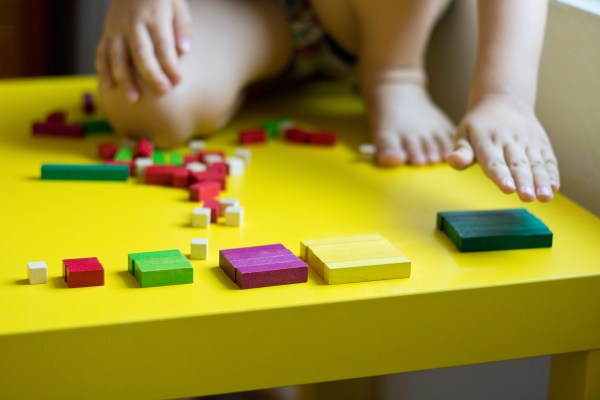
When we introduced Cuisenaire rods (a really great math manipulative, by the way – I grew up using these with the Miquon math curriculum and have always felt that they gave me a strong conceptual foundation in mathematics) for the first time this week in preparation for more kindergarten-type activities, this difference in their inclinations was immediately evident.

Limerick went through each color rod, noticing how long each one was as compared to the small white unit blocks. When he reached the longest rod, he began to line up the smaller rods next to it, to see how he could split it up. Ten is ten groups of one, he realized, and five groups of two, but when you try to split it into groups of three you end up with one empty space.

We made squares (one group of one, two groups of two, three groups of three, etc.) and talked about the difference between the perimeter of a shape (how long all the edges are, put together) and its area (how many white unit squares could fit inside it).

IMG_0239.jpg

Meanwhile, Rondel was using different sizes and color of blocks to retell the story of the Three Little Pigs with house-building fleas and a predatory lion (I think he chose fleas because they are too small to see, and he didn’t have any prey animal toys on hand to use with the lion figurine). He went through all the steps of the story with sound effects and drama, creating and destroying as necessary, completely immersed in his imagined world.

When the boys play together, I see these inherent differences leading to growth in each of them. Rondel’s love of imagination draws Limerick along with him into wildly creative and unrealistic pretend games, while Limerick’s fascination with numbers and patterns motivates Rondel to learn the vocabulary and concepts of math also. It makes me glad all over again that they have each other to grow up with.

So what are we learning, this Wednesday? We are learning about how numbers work together, how they split apart and recombine in consistent ways. We are learning about the trial and error it takes to finally build a house that can keep out a powerful lion. And we are learning about each other, and how we can help each other learn in grow in different ways.

Posted in musings

because prejudice ends up hurting everyone

Recently, when I mentioned I wasn’t yet part of any homeschooling support groups, a (non-homeschooling) friend mentioned a local co-op called Branches, so I looked it up. It is far more structured and school-like than I am interested in, and also has several concerning (to me) points in its code of conduct and statement of faith. When choosing a homeschool group, as when selecting a private school, it is important to read through to that level of detail because no matter where the co-op or school falls academically, it will be detrimental to your child if its culture differs dramatically from your home culture or endorses cultish or prejudiced beliefs.

Some of those concerning aspects were (unfortunately) fairly familiar to me – the parent must sign a strict statement of faith, and must cede to the group’s board the final word on the interpretation of that faith. Considering they are not my pastors, nor theologians, nor even members of my church, I don’t think they can legitimately claim to have that level of authority. I did appreciate their honesty, however, in stating that while they believe the Bible is the final authority it is their interpretation of that authority that will have the ultimate say… it reveals a weak point in Protestant understandings of religious authority in general.

However, one point that I had not run across before was as follows. In a list of forbidden behaviors, along with things like cheating and bullying, the group prohibits “personal appearance and behavior contrary to one’s biological sex.”

Interesting.

That is so broad and vague. While it was most likely intended in a transphobic manner, it is so loosely worded that it essentially prohibits all display of non-gender-stereotypical behavior. So… apparently in this group, math is only for boys, and the girls can’t be competitive in STEM topics or hope for a career as a scientist. Apparently, it’s inappropriate here for little boys to wear pink and purple shirts, or play house, or take care of baby dolls (because heaven forbid they grow up to be engaged and involved fathers when they have babies of their own). Apparently, girls need to wear makeup, do their hair neatly, wear skirts, and make sure they stay clean when they play; boys on the other hand should probably get muddy every so often to avoid an appearance of girliness. According to the words in this code of conduct, it is ok for girls to giggle and cry with each other, but boys should stick to anger and aggression if they have strong emotions. If a girl does just happen to be athletic, she should definitely stick with acceptable sports like gymnastics and volleyball, and avoid playing pick-up basketball or touch football with the boys. And just to be on the safe side, boys should play with boys, and girls should play with girls, to ensure that all the play is happily gender-conforming.

How can a child feel free to explore the fullness of the world around them if they have to be worried about stepping over a (socially-constructed, averages-based, generally-applicable, ambiguous) line all the time? Even a feminine, female-identifying, biologically female individual is going to have some aspects of their personality and behavior that fall outside female gender-stereotypical lines (for example, I am a cis-gendered female who likes my hair cut very short, does not wear makeup or heels, and has a career in the hard sciences). In this group, would that behavior be censored in a (transphobic) attempt to force all people into one or other of two black-and-white categories? I’m guessing it wouldn’t be – but the exceptions would be tolerated in an unpredictable, social-norms-based way (kind of negating the whole emphasis on biological differences) instead of by any sort of reliable and consistent rubric, which creates confusion and has the potential to lead to shame or stigma.

And finally, because this is what this kind of discriminatory rule is really intended to address, what happens to the child who actually struggles with gender dysphoria? Here, they would not be met with support and help, but with shame and rejection. Here, they would be told that because their brains and their bodies aren’t in sync, they are unfit to be part of an educational activity with other children (a mixed-gender educational activity, no less). Here, they would be told that the shape of their body is more important than their identity, their natural inclinations, their talents and giftings, and their mental health and emotional well-being.

That isn’t ok with me.

Trying to discriminate against one group of people usually ends up this way, with the implementation of vague social rules that constrain and restrict all sorts of unintended behaviors while adding to the stigma and isolation faced by the target group. I would rather be with people who may not always act as I would, but who accept and love each other anyway, around whom I can be my authentic self and know their authentic selves. While this co-op may have good things to offer, they don’t outweigh the negatives of prejudice and social control. After all, we are homeschooling in part so that our children can be free to explore, learn, and grow in their own time and in their own way; we don’t need a group of self-appointed parental “experts” trying to shape us into their acceptable mold anymore than we need the public school system doing so. And I am sure that in the right time, we will find the right group and homeschool community for our family.

Posted in wwlw

what we’re learning wednesday (episode 2)

Limerick is currently in love with numbers.

He counts everything he can, comparing amounts and sizes: he counted all the straps on the plastic pool chairs at the public pool Saturday afternoon, at least ten times in a row; he makes long chains of flakes and counts them over and over again as he builds to find out how long they are and which color is the longest; he counts the number of bites or slices on his plate and recounts each time he eats one. Essentially, he is spending time with the numbers and quantities, becoming friends with them, getting to know how they interact with each other and discovering their unique qualities.

IMG_0210
Limerick figuring out how many sticks could fit on the length of our big wooden cutting board – I think it was somewhere around 40.

He will break numbers down into their component groups: if he builds a tower with fourteen wooden blocks, he will tell me proudly that it is two groups of seven. When he expanded his tower to eighteen blocks, I asked if it could split into two equal groups and he lined them up into two equal lines and counted each one to make sure that they both contained nine blocks. When I then asked if it could split into three groups, he made many little groups of three blocks and found out there were six of them – so, six groups of three and three groups of six. Since he’s been doing this on his own anyway, I introduced the vocabulary of “even” and “odd” to him.

“See this group of seven? I can’t break it into two groups of the same size – one of them is always bigger than the other. Numbers like that are called odd.”

Limerick pondered, then declared, “But eight is two groups of four!”

“Exactly! Numbers that can be split into two groups of the same size are called even!”

“Nine would be five and four,” Limerick told me with a slight frown, “but ten would be five and five!”

“So nine is odd, and ten is even!”

We’ll see if he remembers – he tends to hold a new word to himself for a week or so after he learns it, before he brings it out for everyday use.

Emboldened by all the math talk going on, I pulled out one of my favorite math tools from my own childhood (one that I believe my mom created, and that she now uses in her job as a remedial math professor at the community college):

IMG_0214

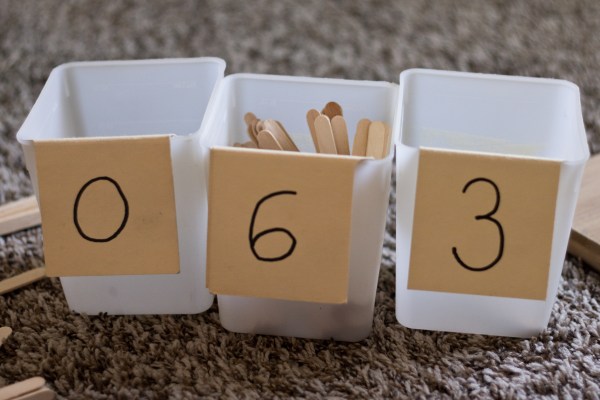
It’s a physical representation of place value – the numbers on the cards in front show what the number would look like written down, while the buckets hold the appropriate number of craft sticks. In this picture, there are three single craft sticks in the box on the right, six bundles of ten craft sticks each in the middle box (the tens place), and nothing in the box on the left (the hundreds place).

We pulled out some huge foam dice and decided to take turns rolling and adding the number we rolled to the number already in the buckets:

Sometimes the boys knew right away what the answer would be; other times they would line up all the sticks to count them to make sure, and to bundle up the new ten-pack if needed.

IMG_0207
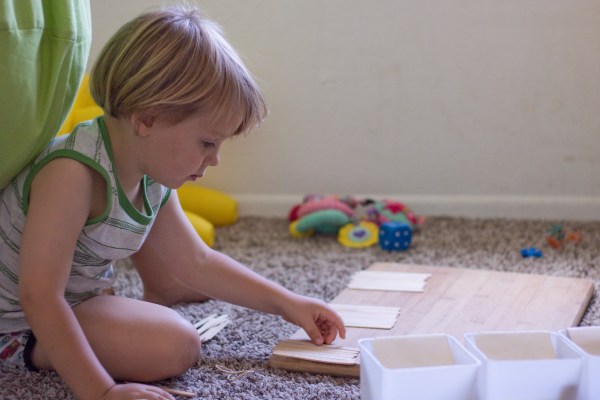
Limerick verifying that the three bundles of ten sticks in the tens place bucket really did equal 30 total sticks! I liked how he lined them up in groups of ten instead of just all in one big pile.

Before this we hadn’t done much with written numbers – the boys know all the digits, but they didn’t understand double digit numbers. So it was a bit confusing at first for them, but by the time we stopped I think they were beginning to understand what the numbers meant and looked like, which is really cool!

Math tools and games like this aren’t necessary for learning math – Limerick has certainly been picking up on concepts ranging from quantitative comparison to division (with even a touch of fractions) just from everyday conversations about the numbers around us – but they are definitely helpful for illustrating a specific concept, challenging the mind to use a concept in a new way, or just having fun together with numbers! And since all you need for this particular tool are buckets, sticks, and paper, it doesn’t get much easier 🙂


Posted in sqt

{sqt} – seven quick thoughts from a quick week

I’m linking up with This Ain’t the Lyceum today – head over and read some more!

  1. I’ve been tapering off my antidepressants over the past month and a half (my doctor recommended trying it after a year, and I waited until warm sunny weather would give me some help), and I think it’s going well! I have noticed some old thought patterns re-emerging, but they aren’t strong and all-consuming, and I’m equipped to process them effectively thanks to therapy. I should be completely off by the end of August, and probably due to my long and slow journey away from them I’ve avoided the unpleasant symptoms one can experience when abruptly messing with one’s serotonin pathways 😉
  2. Aubade had yet another dermatology appointment this week and we finally had good news: it appears that her mysterious rash is gone for now (or at least controlled without continued daily use of heavy steroids), and her skin is healthy. We’ll keep an eye on it in case it was triggered by some allergen or environmental factor that might be an issue again next spring, but at least for now she should be comfortable and unmedicated except for moisturizing cream.
  3. In case anyone else needs allergen-free lotion, we’ve been using Vanicream and I like it a lot. It doesn’t have lanolin in it, which can apparently irritate or trigger some people, and it’s probably all completely artificial, but it has a good feel and has definitely helped Aubade’s rash of mysterious origin.
  4. In non-medical news, I got a new camera!! My old DSLR was 8.5 years old and still working great, but there have been some advances since then 🙂 and it is nice to have the added pixels in the sensor especially in low-light settings. The boys have even posed for a me a few times (or at least, smiled at the camera and then asked to see themselves).IMG_0174
  5. It has been hot here, and humid since we’re in between waves of the monsoon, but we have to get out of the house so we’ve been playing a lot out back with the hose. We’ve rigged things so the hose will spray on the slides and the large wading pool will tuck underneath the slides, so the boys can go up and down the slides endlessly to much splashing underneath the mist.
  6. I’m attempting to babysit two little girls from church a few days a week, Limerick and Aubade’s ages; we had our first afternoon together this week and it went so well (despite my bone-crushing anxiety the night before)! All five kids played together well, in kind of a parallel play sort of way, and there was only one instance of quarreling the entire time. I’m sure it won’t always be that smooth and easy, but it was a good start, and left the boys anticipating the next playdate rather than dreading it. From the other mom’s perspective, it’s a chance for her to work and pay off debt; from my perspective, it’s a chance for my boys to make friends and practice social skills in a low-stress environment, and an opportunity for me to contribute monetarily a bit more to the household. Maybe I wouldn’t care about that so much if I were an excellent homemaker… but I’m really not 😛 In fact it’s tempting to use some of the extra income to pay someone to clean the house every other week or so…
  7. We qualified for ESA funds for Rondel for the year! In Arizona, if a “special needs” student (one who would have an IEP) isn’t enrolled in a public school, they are eligible for a certain amount of money to use for curriculum and therapeutic services. Since we’re homeschooling, we can use some of it for some good books and manipulatives, and since health insurance can be finicky about approving therapy, we can also use it for his speech therapy. It’s not a huge sum of money, but it’s enough to be very helpful with things. The eligibility criteria are very specific, but if you meet them the application process is very simple and straightforward, so I would encourage any homeschooler in Arizona with a developmentally delayed child to look into it.

How has your week been? What do you do to cope with the summer heat? What resources have you found in your state/country to support the needs of differently wired students, especially outside the public education system?

Posted in wwlw

what we’re learning wednesday: episode 1

As a way to document our unschooling journey in case we need records or information for doubtful friends and family, as well as for our own memories, I’m going to showcase once a week some of the things we’ve been learning. It may be through conversations, books, TV, exploration, or more (and I’ll try to mix it up week to week!), since our goal is to be whole-life learners. Hopefully it may also provide some ideas for others, especially when I’m sharing resources we love!


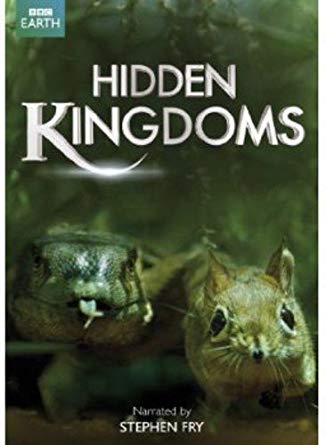
In a search for a new animal documentary that Rondel “hadn’t even seen one of yet!”, we discovered BBC’s show Hidden Kingdoms.

hiddenkingdoms

I know this show generated a bit of controversy because it is more scripted and less observational than a typical nature documentary – but almost because of that it is an excellent introduction to these animals for people (especially young children) who may not have enough background information about them to appreciate something purely observational. These episodes showcase the unique abilities and challenges faced by its “stars” in a very compelling way, while still remaining biologically accurate. And the extra feature at the end of each episode, explaining how they filmed parts of the show, is fascinating in its own right!

Some of our favorite facts:

African sengis create trails in the grass for themselves to make it easier to run away from predators or catch prey – it is essentially a maze that they know by heart. (All of Rondel’s current imaginary animals are now building trails for themselves in the grass too.)

Arizona grasshopper mice are immune to scorpion venom and will fight, kill, and eat scorpions! They also howl to claim their territory, somewhat like wolves. (All three kids will now run through the house howling in a very high and squeaky way, telling me they are grasshopper mice.)

When chipmunks fight, they move so fast that the human eye can barely make out what is going on, but in slow motion you can see incredible twists and turns they are performing in midair. It’s absolutely amazing.

Marmosets (monkeys small enough to sit in your hand) who live in cities are often pursued by street cats, but are typically agile enough to escape. (Rondel uses stuffed animals to imitate this, constantly telling me how so-and-so escaped through his “amazing agility”.)

All small animals move at a much faster pace than large animals. They run faster compared to their body size, their metabolism is faster, and so on.

Without dung beetles, the African savanna would be pretty disgusting! It’s so neat that a creature exists whose purpose is simply to clean up (and eat) other animals’ poop, making the world better for everyone. They may appear small and lowly, but they are determined, strong, resourceful, and crucial for the ecosystem. Hmm… that may be a good object lesson someday 😉

What have you been learning this week? I’d love to hear about any fascinating, weird, exciting, or unexpected fact you’ve learned – or about any great resource that has facilitated your learning!

Posted in family life, musings

fear of change

After eight years of working in a genomics research center, I’ll be transitioning to being a stay-at-home parent a week from now. Technically I’ll be working eight hours a week, in a sort of consultant role, which will keep me connected to the science – but it will still be a big change. It’s what I’ve been wanting ever since Rondel was born almost four years ago – but as it approaches, I find myself becoming more and more anxious.

I like my job, and I am good at my job. My supervisor respects me and my opinions; the researchers who rely on the services our facility provides respect me and my scientific knowledge and experience. I know what types of problems are most likely to arise, and I have tools and strategies for troubleshooting them. And I know that if I put in time, effort, and energy, I will have a successful outcome.

To be totally honest, I really like having the respect of other professionals whose opinion I value and who do innovative and important research. It gives me self-confidence: I may be a complete wreck if I have to call my doctor to schedule an appointment, but when I sit down with a researcher to discuss their experiment and figure out the best plan for them to take moving forward, I am completely at ease. It also gives me a sense of identity and self-definition: when acquaintances ask what I do, I can tell them about the science and feel that I’m doing something of worth, something that uses my talents and gifts, something beyond just staying at home and cleaning and cooking like any other person could do.

At the heart of my nervousness about the transition, then, I think, is a fear of losing that respect and identity – of becoming part of the crowd, no one in particular, no one with any valuable skills or gifts to offer my community. When I spend time with other moms, I feel so inadequate in the areas they are gifted in: my home is rarely clean, laundry and meals happen on an as-needed basis rather than with planning, small talk eludes me, playdates terrify me, schedules and extra activities overwhelm me, my children are dirty and wild. My mind is usually lost in a book, or an idea, or a project, instead of focusing on the people around me. I say nothing and feel isolated, or I say too much and still never manage to connect with anyone else. I simply don’t have the skills that these other women have, and without them, I’m not sure where I can fit in or belong in the mom world (especially the homeschool mom world… those women are so organized that I give up just at the thought of trying to be like them).

In the workforce, in academia, where everyone is a bit weird and everyone is valued simply for the expertise they offer, I knew where I fit in and I knew how I could flourish.

In this new world, I’m afraid I won’t ever be able to flourish – and that in my lack of flourishing, I will stunt my children’s future as well.

I’m not going to let my fears make a decision for me, when I believe on principle that a self-directed education is ideal for children, and when I observe pragmatically the stress that a classroom environment would add to our family life. I’m going to choose to let my love for my family be the motivating factor here instead!

But I’m still afraid.

Posted in family life

going to the zoo!

The boys – especially Rondel – have been deeply interested in dinosaurs for quite a long time now, and are beginning to branch out into animals of all types. It really began with the Planet Earth documentaries that I would put on for them during Aubade’s nap times, and has continued with a short series called Africa’s Deadliest that is just as overly dramatic as the name suggests but which contains some great footage of wild animals as well as a lot of scientific facts. When we found and caught a lizard (well, rescued it from a bowl it had fallen into, to be more accurate) not too long ago, he was entranced: he understood intuitively how to hold it gently and carefully, and let it climb all over him with no fear, and ended up playing with it for 45 minutes before releasing it so it could return to its natural habitat.

So I was not surprised when he asked to go to the zoo this week, nor when he actually showed in interest in seeing the animals instead of just the dinosaur exhibit and the splash pad! And it was a good day to go!

We did of course have to visit the dinosaurs:

Obviously we couldn’t observe any live, wild, natural animal life here – but we had some discussions about the different types of nests made by different dinosaurs (we compared the twig nest of the Citipati – a feathered broody dinosaur – to that of the Diabloceratops, which was too large to brood its eggs and most likely made a mud nest like a crocodile), as well as about how the different types of dinosaurs might react if they saw us!

From the dinosaur trail the bighorn sheep exhibit is also visible, and Aubade got very excited when I pointed them out and told the kids what they were. She leaned forward in the stroller as far as she could, waving and yelling, “Hi!” – and then she turned to me, smiled, and matter-of-factly said, “Baa!” It was neat seeing her make the connection between the distant animal on the mountainside and the fuzzy white blob in her Moo, Baa, La La La board book by Sandra Boynton.

When we left the dinosaur trail, it seemed like a lot of the animals were active and awake – we got to see baboon, mandrills, oryx, cheetah (unfortunately they were difficult to see, but we did manage to spot them), otters, flamingos, zebras, and more! The flamingos were standing right by the fence, so we stood on one leg like they did, and noticed how they could turn their heads all the way around backwards to use their back like a pillow, and wondered why their large beaks only ever opened a very small amount.

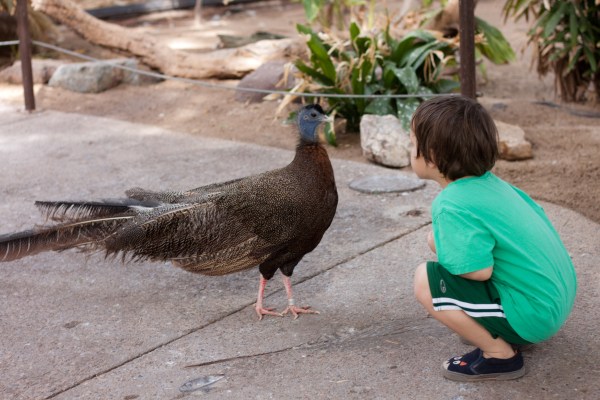
Per Rondel’s request, after a cool-down break at the splash pad we visited the Tropical Birds trail, which includes a small aviary. Apparently, it is mating season at the zoo – so all the birds were awake and showing off their finery! The male peacock had his full tail fan extended, and kept shaking it at the peahen, making a surprisingly loud rattling noise when he did so. In the aviary, the male argus pheasant was strutting around on the path, making a call that the zoo keeper told us he only made during this season, instead of hiding in the back corners as he tends to do the rest of the year.

IMG_8684

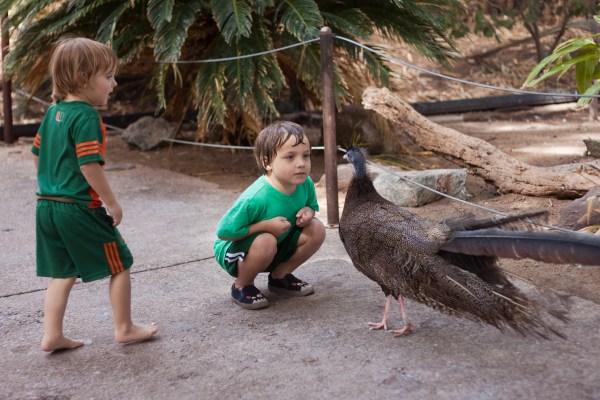
Rondel was absolutely captivated. He approached the bird slowly and quietly, and held his hands tightly back so he wouldn’t accidentally touch it (he would jump out of the way if the bird turned around so that he wouldn’t end up touching his long tail feather!), and just squatted down gazing at him for a long time, as other groups of people came and went.

IMG_8689

Limerick was a little less certain, but he eventually went over as well. I was super proud of both of them – they are often very impulsive and active kids, and they had no trouble at all adjusting their behavior to what was needed by the animals. We talked a bit here about how a lot of viruses can jump between birds and people, so if we touched the birds we could get them sick or they could get us sick… my molecular biology background always ends up showing itself somehow 🙂

We finished up with the tiger and the Komodo dragon. I had never actually seen the Komodo dragon exhibit at our zoo, but Rondel instantly remembered them from the new Planet Earth series and was incredibly excited about them. They weren’t moving much – just soaking in the sun – but they are impressive creatures. We noticed how it was basking in the sun to soak up the energy it needs as a cold-blooded animal, and counted its claws (five on each foot, just like us, in case you wondered).

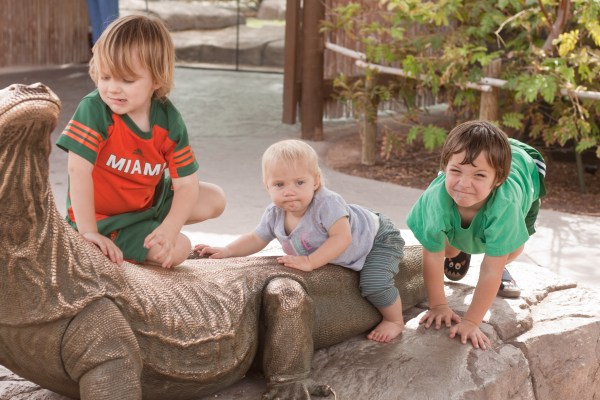
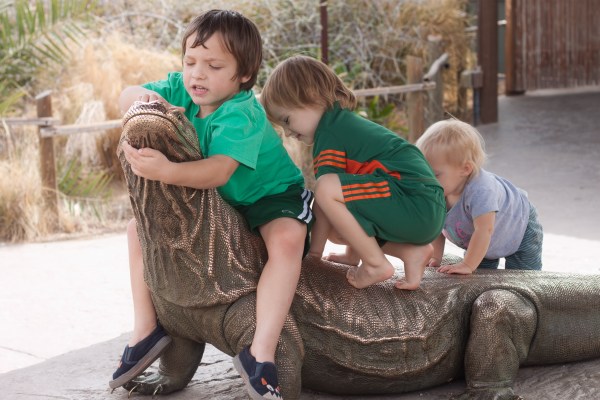
And of course we played on the Komodo dragon statue for a while!

IMG_8693
This is what I get when I tell the kids to smile at me… I guess Rondel is somewhat close?
IMG_8697
Playing together – I think they are subduing the Komodo dragon so it can’t fight them.

The most wonderful thing about homeschooling is the ability we have to follow our interests – obviously in going to the zoo for a whole morning instead of adhering to a lesson plan or a class schedule, but also in deciding when to linger at an exhibit and when to move on, when to talk about the details of how an animal lives and when to stick to the basic overview, when to focus on the live animal exhibits and when to simply just have fun. The experience we had today was so real and so rich that I wouldn’t trade it for any classroom I’ve ever known.