Posted in family life, sqt, wwlw

{sqt} – because limerick loves numbers

If you ask him, Limerick will tell you that his favorite thing in the whole world is numbers. More than milk, more than cookies, more than hugs – numbers are the best. So I thought I would capture seven ways he shows that love for this week’s {SQT}! Join Kelly for the rest of the linkup 🙂

  1. Limerick’s favorite numbers of all are 1, 11, 111, and so on – anything that is all 1’s. So the other day as we were skip-counting back and forth together the way we do, he decided we should count by 11. When he got to 1111 (and he was the one who got to say it!), he was so happy that he stood up on his chair and clapped his hands together while laughing for joy.
  2. This past week he’s been asking me to make number coloring pages for him, where I’ll draw the outlines of numbers on a page and he’ll color them in. Well, for one of those pages, he decided the best way to color them in would be to fill all the little spaces with smaller versions of the number he was coloring – very meta 🙂
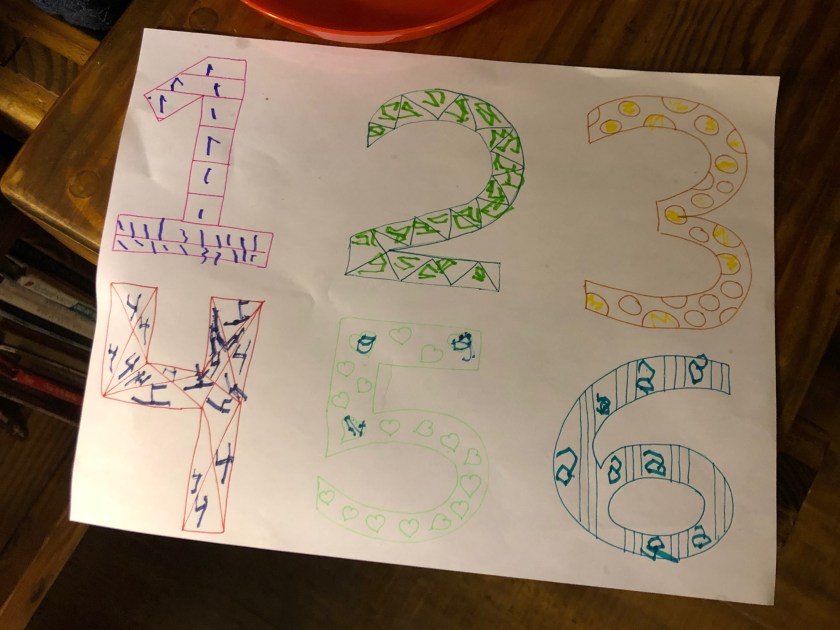
    IMG_5113
    Limerick’s coloring page – don’t be too critical of his handwriting! He is only 4 after all 🙂
  3. In addition to coloring numbers, Limerick likes me to make skip-counting number boards for him – this week alone we’ve made one that counted by 499, one that counted by 999, one that counted by 4, and one that counted by 1 but had all the multiples of 3 drawn in a different color. After a board is made we’ll play a game with it once or twice but then it is on to the next one! I sometimes think he just likes watching the numbers appear on the paper as I write them…
  4. Speaking of watching numbers, Limerick’s favorite book, You Can Count On Monsters by Richard Schwartz, gives him plenty of chances to do just that. He will sit for hours poring over every page of the book, noticing how the focal number of each page breaks down into its factors and figuring out how the accompanying monster illustration incorporates those factors (or the number itself, if it is prime). He’s been through it at least three times this week, taking 2-3 hours each time, and it doesn’t seem to be growing old yet.countonmonsters
  5. I pulled out a math workbook for Limerick this week also, thinking he might be interested, and so far he has just been turning the pages looking at all the numbers and math problems and shapes. He isn’t interested in writing anything down, but when I ask him about any of the problems he knows the answer instantly, or knows how to figure it out. There are some fractions later in the book that would be more of a challenge for him, though, so maybe that will catch his attention eventually. It’s a bit of a tightrope balancing between guiding him towards new information and allowing him the joy of freely exploring numbers without pushing or interfering.
  6. I did, however, get to explain different base systems to him this week! I just sat down at the table and started counting in hexadecimal on a piece of paper, and he glanced over and was immediately intrigued. We discussed what place value means in the context of the various base systems, and ended up writing out 1-32 in decimal, hexadecimal, binary, and base 6. I think binary was his favorite because there were so many 1’s and the numbers got long so quickly!
  7. One other fun book we’ve read through a few times (though not as recently) is Bedtime Math by Laura Overdeck. It’s been a great introduction to the application of numbers, and a challenge for Limerick to translate the words into the more familiar arithmetic. He’s actually quite good at tracking along with the question as I read it, deciphering the logical connections, and doing the math in his head – he can for most of the stories do even the most difficult problem on the page already!

All in all, I just have to echo Limerick and say that he really does love numbers the best 🙂 And he has, honestly, since he was 18 months old and would sit on the driveway drawing them in wide circles around himself until he was familiar with each one, and since he was 2 years old and would count the bites remaining on his plate at dinner and practice subtracting them as he ate. I’m looking forward to watching this love continue to grow with him in the years to come!

“When we set children against one another in contests – from spelling bees to awards assemblies to science “fairs” (that are really contests), from dodge ball to honor rolls to prizes for the best painting or the most books read – we teach them to confuse excellence with winning, as if the only way to do something well is to outdo others. We encourage them to measure their own value in terms of how many people they’ve beaten, which is not exactly a path to mental health. We invite them to see their peers not as potential friends or collaborators but as obstacles to their own success. (Quite predictably, researchers have found that the results of competition often include aggression, cheating, envy of winners, contempt for losers, and a suspicious posture toward just about everyone.) Finally, we lead children to regard whatever they’re doing as a means to an end: The point isn’t to paint or read or design a science experiment, but to win. The act of painting, reading, or designing is thereby devalued in the child’s mind.

Alfie Kohn, The Myth of the Spoiled Child, Chapter 4

competition

Posted in book lists, family life

literary explorations – traveling the world with picture books!

Inspired by the great resource Give Your Child The World, a globally-inspired picture book anthology by Jamie C. Martin, as well as by Rondel’s fascination with animals from around the world, we had a sort of Africa focus in our home a couple weeks ago. Martin is actually hosting a virtual book club spending one week on each world region over the summer, which I’m attempting to keep up with, but I’m woefully unprepared for Asia this week…

Anyway, Africa was a great place to start since most of Rondel’s favorite animals live there, and it was a natural connection to then begin reading stories involving those animals and the people who live near them. We also experimented with some African recipes (there is a huge variety of cuisines across the continent, so we were barely able to explore any of it and it still felt like a lot!) and crafts (but my kids don’t do so well with directed crafts). Of the books we could find from Martin’s recommendations at our library, two really stood out as our favorites: Bringing the Rain to Kapiti Plain, a Nandi folktale retold by Verna Aardema; and Wangari’s Trees of Peace, a brief pictorial biography of Wangari Maathai, a Kenyan Nobel Peace Prize laureate who helped restore land degraded by irresponsible logging (and in the process helped maintain peace and prevent poverty in her home country), by Jeanette Winter.

The biography of Wangari is written at a level that even Limerick, at 3.5, can understand and follow along with, so many of the details of her life have obviously been omitted – this is just the general arc of her story. But those spare elements have been woven together, with the help of beautiful images, to create a compelling narrative. Every time we read it (which was often, since Limerick kept requesting it), Rondel would be devastated when Wangari returns to Kenya after studying abroad to find the forests cut down, the village women walking miles for firewood and food, and desert encroaching upon the arable land. The boys’ eyes would widen, riveted on the book, when Wangari stands “tall as an oak” to protect the remaining forests, when the government officials beat her and jail her for protesting their course of action. And at the end, when millions of trees spread across Kenya again, the boys would be all smiles and laughter, imagining the birdsong in the forest. So I would highly recommend it as a brief introduction to Wangari and modern Africa for young children.

In addition, it has given me a point of comparison when talking with the boys about current events in our own country. When Wangari is jailed, the book tells us that “Right is right, even if you’re alone,” and the whole story demonstrates how the right thing to do can sometimes be the opposite of what the government or people in authority want to do. So when the boys heard our president talking for a few minutes before I changed the radio station (I usually only listen to talk radio when I’m alone in the car), and asked questions about what he was saying, I could explain his position and then also explain how I thought it was wrong, morally wrong if not legally wrong, and how his power and authority didn’t make all of his beliefs or actions morally right and good. And I was able to tell them that unlike Wangari, people like us would be able to peacefully protest those wrong things without fear of imprisonment, because our nation makes space for differing opinions and protests (ideally, of course, but since they’re 3 and 4 they get the idealized version on some things still).

Wangari cared deeply about her country – she loved it – and that’s why she was able to work for its improvement with such persistence, devotion, and passion. She started with small things she knew she could do (like physically planting new trees to replace the harvested ones), and let her love guide her into bigger and bigger forms of activism. And when I look around me and see people cynically apathetic about this country, it makes me want to instill in my children a love for their country and a passion to make it better, in small personal ways and perhaps even in big political ways. It is only with the love and dedication of people like Wangari that we can heal our culture, our environment, and our world; I’d much rather my children be like her than like the enforcers of government authority who beat and imprisoned her.

At this point I’m doubtful that any other picture book we find for this book club will influence our family quite as much as this one has! But every one we’ve managed to find so far from Martin’s anthology has been worth a second read at least; we’ve learned a lot, and we’ve laughed a lot, and we’ve filled our home with beautiful pictures and stories, and there isn’t much more to ask for from a picture book 🙂

At the time of posting, Amazon has Give Your Child the World available on Kindle for only $0.99! It is a resource worth far more than that.

Posted in musings, quotes

it seems that our school system is failing everyone these days…

As the teacher walkout continues here in Arizona I feel like I’m just beginning to process the events and come to an opinion about it all. It’s an interesting topic for me, since I’ve always been an outsider to the school system and maintain that self-directed learning is better ideologically than the authoritarian traditional educational model we have in the US – and yet, at the same time, I recognize that the majority of children are in public schools and as a Christian who desires the good of my neighbors and community I want those public schools to be the best that they can be for the sake of the children in them. In a perfect world the school system would be fundamentally different, and I believe it is important to work towards those deep system-level changes – but in the meantime, there are children in the schools now who deserve the best our society can give them instead of being neglected in the pursuit of future goals, and pragmatic changes for their short-term benefit are a good thing.

One of my friends shared the following image on Facebook: Continue reading “it seems that our school system is failing everyone these days…”

“…many parents, educators, and therapists prioritize academic achievement over instilling happiness, even if it greatly increases stress. In fact I have heard proponents of some approaches take issue with the idea of emphasizing happiness, arguing that for children with autism, it is far more important to develop skills than to be happy. In other words, instead of measuring happiness, we should be measuring skills.

“Not only is this way of thinking misguided, but it misses the point. Children – and all human beings – learn more readily when they are happy. They retain information more effectively when they feel positive emotion. When we try to learn under persistently stressful situations, we retain less, and it’s more difficult for us to access what we learned. But when we’re feeling a positive emotion, we’re more primed for a learning experience, and our learning is deeper and far more effective.”

– Barry M. Prizant, Uniquely Human

because academics isn’t the ultimate end

Posted in musings

freedom in learning

What is the goal of education? Or, for that matter, what is the goal of parenthood? Is our aim to shape the children in our care into a certain type of person, to give them specific skills, to qualify them for certain careers, to prepare them for expected circumstances? Do we envision their future selves as the complete products toward which we are currently laboring, and the ends which justify all the unpleasant activities we must force upon them in their childhoods?

IMG_8272

Or do we see our role as parents and educators to be one of providing opportunities to explore and grow, while allowing our children to choose the direction, rate, and nature of that growth? Are they like plants which we tend with loving care – providing soil, water, and space to flourish – but over which, ultimately, we have no true control? I remember one year planting peas, all in a row in a single garden bed; I watered them and fertilized them synchronously, and yet some sprouted days before their neighbors, and some grew to twice the height of others, lanky stems reaching up to the sky much farther in between each set of leaves and tiny tendrils. Nothing I did caused or could have eliminated the differences between those plants (though I certainly could have affected their development negatively by forgetting to water them, in which case the height difference may not have been so noticeable…).

IMG_8265

Perhaps it is the same way with children. Some will shoot out intellectually, reaching with insatiable desire towards the skies of knowledge and academic learning, constant thirst for the sunlight of information driving them onward. We could stunt that growth by neglect or empower it by attention, but we cannot create (and can only with great difficulty destroy) the passion that motivates it. Others may grow in more embodied ways, developing craftsmanship and skill in professions such as music, art, or manual trades, and pursuing the creation of tangible beauty rather than the acquisition of knowledge. While we can offer the opportunity to learn those skills to all children, not all will desire to hone them to mastery, and it is most likely counterproductive to attempt to force it.

The knowledge and skills that align with a child’s natural talents and inclinations will be the easiest for them to develop, as well as the ones most likely to bring them joy and success throughout their lives – regardless of how “one-sided” it may make them appear now.

IMG_8242

We may fear that, if children are allowed to choose the direction of their learning, they may choose incorrectly.

Does a tree choose the wrong place to grow a branch?

Does the blackberry bush extend its vines the wrong way?

Hardly.

To paraphrase C. S. Lewis (I believe from Mere Christianity), the tree and the bush are following the rules of their nature and are not wrong or incorrect in doing so, although they may be quite inconvenient indeed for us!

And while it is quite fine to trim back a plant for the sake of our comfort and convenience, it is not at all fine to trim back the growth of another person for the sake of our own convenience. Providing a trellis to support their growth is one thing; stunting or restricting that growth simply because it doesn’t fit our idea of what their growth should look like is quite another.

Children are human too, after all. And humans, we believe, in fundamental democratic terms, are entitled to life, liberty, and the pursuit of happiness (always being aware of how our actions infringe upon the rights of others, of course).

Coercive education – forcing a child to learn something in which he has no interest, for no purpose at all except the nebulous expectations of adult society, at the expense of time and energy that could have been devoted to the unique and explorative learning that his heart desires – seems to me to be quite far from those exalted human rights.

IMG_8240

We can attempt to control, and set ourselves and our children up for disappointment, failure, and bitterness – or we can let our children provide the directing and motivating force while we provide the rich and nourishing environment in which they can flourish in beauty and individuality. We can give them the gifts of freedom, acceptance, and support, and marvel at the different ways they blossom before our wondering eyes.

Posted in family life

fine motor delays and pre-reading skills

At Rondel’s evaluation for services with the school district, he scored low enough on his fine motor skills to be classified as having a moderate delay (which is significant enough to qualify for special services). When he draws or paints, he can’t seem to figure out how to hold his writing tool, switching up his grasp every few minutes, and even changing hands periodically. To put in simply, he looks like a much younger child – and his drawings reflect that: although he attempts to add depth and detail to his drawings (at a level up to or above the standard for his age), what he puts down on the paper is not recognizable as the object he is trying to create.

However, when he sits down with Duplos or Brain Flakes, he can build creations that are complex and true to form. His Duplo animals really look like the different animals he’s trying to make – he’s constructed dinosaurs, lions, spiders, owls, bats, and more, and a lot of them are very realistic and innovatively detailed (Duplos are a challenging medium for fine detail, after all). With the flakes, he’s currently working on making all the letters of the alphabet; in the process, of course, he is intimately familiarizing himself with the shape and orientation of each letter just as another child might through writing the letters over and over again on paper. Additionally, he is beginning to wonder about letters in general, and asked me tonight what letters were for. So he is still gaining valuable pre-reading skills, despite the fine-motor struggles – and he is doing so through a self-motivated, self-developed method, without any external pressure or stigma.

My desire as Rondel’s parent isn’t to mold him into some predetermined form but to help him find his own voice and his own path. If his life so far is any indication, it seems that all he needs to do that is access to means of expression that work with his strengths instead of taxing his weaknesses, and room to grow in a space of acceptance and accommodation.

Posted in musings

when tools come with tainted memories

I grew up hearing horror stories about public schools.

Every time we drove past one, my dad would comment on the chainlink fences, the buzzing alarm bells, or the thick small-windowed walls. He would tell us about Mrs. Weinstein, his fourth-grade teacher, who was so nasty as to apparently have burnt a traumatic scar into his memory. He would regale us with the tale of how in elementary school he would ask for a bathroom pass and just scream in the bathroom at the top of his lungs because he was so bored/pent up/overwhelmed by the classroom environment. He would call them “jails for kids” (although my mom would always gently reply that it was hyperbolic to go that far).

My mom didn’t have nearly so many negative things to say, but I knew that she dropped out of high school and worked her way through community college and university to get a master’s in engineering, and considered self-directed, intrinsically-motivated learning to be far more valuable and efficient than teacher-dictated, extrinsically-demanded education.

After I met my husband, I learned how he had been bullied through elementary school, to the point of being anxious, angry, depressed, and aggressive as even a young child – his innate friendliness met with rejection, and his self-confidence and self-esteem dealt crushing blows that he still sometimes struggles to overcome.

And so when the supportive, understanding, encouraging women in the special needs ministry at my church encouraged me to seek an evaluation through the public school district, to see if Rondel qualified for any free services, I was apprehensive, wary, and unsure. Now that his evaluation is past and I know that he does qualify – now that the registration and enrollment paperwork sits in front of me on the table – I am still all of those things.

The woman who would be his teacher is, from what I can tell, an energetic, passionate, and intelligent person, who deeply cares about her students and all their unique ways of being (of which there are certainly many in a special ed preschool!). Her classroom and schedule are well-designed, full of all the things young children enjoy and all the activities that strengthen and challenge their developing skills. She even told me that based on my description of Rondel she would ask the OT to do a sensory consult for him in class and potentially give him access to occupational therapy for his sensory difficulties and their emotional sequelae. My concerns do not rest with her, but with the whole philosophy of standardized, forced education in general.

During our IEP meeting, the evaluators kept mentioning that this or that skill would be “necessary for kindergarten next year.” To succeed in kindergarten, Rondel would have to learn to sit and pay attention, to be quiet and listen for the majority of the time, to participate in group activities instead of sitting on the edges doing his own thing, to hold a pencil or crayon with enough finesse to write letters and numbers, to respond to directions, and to speak intelligibly. And critically, he would need to learn all of those things by August. To succeed in life, it will be useful and courteous to know how to sit quietly and pay attention to other people; it will be beneficial for forming friendships to be able to engage in group activities and respond appropriately to social cues; it will be helpful to be able to write and draw, but not necessary in an increasingly technical world; and it will be of great importance to speak so that others can understand, particularly for a child who loves to talk as much as he does! But there wouldn’t be any deadline on his acquisition of those skills. Without the impending shadow of kindergarten hanging over him, there would be no rush for him to develop those abilities in his own way and at his own pace – with the exception of his speech.

And it is because of the integrated speech therapy that I am considering preschool as a viable option for Rondel at this point, despite the negative backstory I have for public schools, and despite my plan to homeschool. No matter where the rest of his life takes him or what learning and education look like for him, he will be able to do better, with less frustration and fewer tears, if he can communicate his needs and ideas with the people around him. I want to give him this opportunity now to learn the skills he will need to do that, while he can still do “school” for only 7.5 hours a weeks instead of being expected to fit his life around an all-day, every-day schedule of external demands and schedules. If he grows in his other areas of weakness along the way (especially in social and sensory areas) – so much the better! One fewer hurdle to overcome later!

And if it triggers his sensory issues to the point where he has increased anxiety and meltdowns, we can pull him out. Trying the system out, in an attempt to help Rondel, does not mean we are tied to it forever – or for any arbitrary length of time, honestly. It is all about what works best for him, at this moment, in this context. If to him it feels like a “jail”, if all he wants to do is run away and scream, if it feels like his heart is being crushed – well, unlike my parents and my husband, he won’t have to stay in that environment for years while it molds his character and personality. For us, it can be just another tool in our toolbox.

“We destroy the love of learning in children, which is so strong when they are small, by encouraging and compelling them to work for petty and contemptible rewards, gold stars, or papers marked 100 and tacked to the wall, or A’s on report cards, or honor rolls, or dean’s lists, or Phi Beta Kappa keys, in short, for the ignoble satisfaction of feeling that they are better than someone else.”

 – John Holt

the love of learning