Posted in musings, poems

side by side in the common good

What is the duty of the person who sees injustice, oppression, or need, and has some ability to protest or make amends?

Is it to step daintily around the problem, hoping that the filth and blood will leave your feet unstained?

Is it to click a few “Likes” on a Facebook page, or write a vaguely angry status, and then move on to happier thoughts without even a prayer?

Is it to give thanks for your own more comfortable situation, and avoid the suffering that your happiness may not be lessened by their pain?

Of course not.

It’s easy to see that, on paper; it’s harder to see it happening in your life, everyday, in the major decisions and the small choices: in your quickened steps and averted gaze as you walk past the homeless man with the cardboard sign; in your fear of personal heartache that prevents you from fostering or adopting a child in need; in your unobtrusive isolation from the other in jobs, neighborhoods, and churches made up of people who look and think like you. Every little thing builds up, until one day you have completely blinded your mind and numbed your heart to the ache of the world around you, content in your own personal happinesses, and you don’t even realize the small and withered thing you have made of yourself and your life – your one precious and beautiful life, that could have been a source of good to better the whole world.

In the 1950s, a poet named Maurice Ogden wrote a poem called The Hangman about a village where everyone is murdered, one by one, by an ominous hangman of whom they all live in fear. Each time another is hung, the rest of the villagers sigh in relief and continue with their lives, until at last only the narrator of the poem is left – and he realizes that the hangman has now come for him as well:

“…’I answered straight and I told you true,
‘This scaffold was raised for none but you.

‘For who has served me more faithfully
‘Than you with your coward’s hope?’ said he,
‘And where are the others who might have stood,
‘Side by your side in the common good?’

‘Dead,’ I whispered; and amiably,
‘Murdered,’ the Hangman corrected me.
‘First the alien, then the Jew…
‘I did no more than you let me do.'”

“Side by your side in the common good” – for we are not solitary and independent creatures, no matter how much our culture values individualism and autonomy. We need each other. We need to receive help from each other, and we need to give help to each other, both for the common good of our community and for the private good of our own soul. It is so easy to let our fear and our desire for comfort and convenience shutter us away from the needs and gifts of other people, especially people not quite like ourselves, but it leads to broken homes, neighborhoods of strangers, and the general fragmenting of society that is so painfully being put on display this election season.

I write this not as someone who is living this out well, and has the answers figured out. To be honest with you, I’m only just beginning to see how my own fear and selfishness have prevented me from following God boldly in the midst of a broken and hurting world. Will you come join with me, hand in hand, to learn again how to share our hurts, carry each other’s burdens, and sing each other’s songs of joy and of lament?

Posted in musings

restorers of streets to dwell in

Did you know that there are over 20,000 children in the foster care system in the state of Arizona alone? There are 21,455, actually, according to the newest release from the state. Even if you assumed the state average of 1.97 children per family, you have over 10,000 families disrupted and troubled in significant enough ways to warrant the state removing the children from the home.

I can’t even imagine that many people, in my own state, destroying their own lives, the lives of their children, the relational fabric of the family that should be the source of love and security for their children. It’s staggering.


I’ve lost count of how many times, over the past 2.5 years, I’ve commented to friends or coworkers about how incredibly lucky we are to have both my parents and my husband’s parents in town and willing to help us out. I’d say we’re even luckier that both of our parents are still married – so not only do we have the unconditional support of our families as we begin raising our own children, we have the example of a committed and enduring marital love to model and emulate.

In our state, last year, there were 40,005 marriages and 24,214 divorces, so I think it’s fair to say that most new parents don’t have the kind of familial role models my husband and I have in our parents. When these new parents are single, young, unemployed, or living far from extended family (or for other reasons don’t have the support of an extended family), it becomes even harder for them to consistently give their children the home and family life that they need and want. I don’t think my husband and I would be able to give our boys the family-centered, consistent, loving care we want for them without the support of our parents, at least not during this season of our lives, and so it makes sense to me that people without that support network are going to find themselves stretched to the breaking point: no respite, no role models, no encouragement, no margin, and the constant gnawing fear of failure and sense of inadequacy.


Unfortunately, it’s not just the breakdown of the family that hurts struggling families: the crumbling of the greater community is more damaging than we might think. If we don’t know our neighbors, if we don’t have close friendships with people who live near us, if we don’t have trusting relationships with people of different ages and in different stages of life than us, if we don’t have any groups of people with whom we can interact for mutual support and encouragement, the stresses of life are going to hit us like tidal waves, and there will come a day when they overpower us. With a community support system, a family is much more likely to be able to handle marital difficulties without seeking divorce, to weather unemployment without ending up on the streets, or to make it through chronic stresses without turning to drugs or alcohol or sex – and all of those things will benefit the children of that family, and thus in turn benefit generations to come.

But how do we rebuild a community that’s broken? How do we reform the social bonds that have been torn asunder, and step into the breach for the hurting and lost parents and children in our society?

I’m not totally sure.

We can start by getting to know our neighbors, and offering them a helping hand when they need one. While I’m sure there are tangible needs even in high-income neighborhoods, we might make more of a difference living in a lower-income or mixed-income neighborhood, where families tend to have less margin and more stress, and less disposable income to keep them out of the home and away from their neighbors. We can model strong marriages and loving families by putting God first in our own homes, and then by opening up our homes to our friends, our neighbors, and those in need. If we are creative, courageous, and hospitable, we can do a lot, by God’s grace, to rebuild the fabric of community in our local areas.


One of my friends, who works for a local foster care licensing agency, recently made me aware of a program called Safe Families that endeavors to create the kinds of social and community networks that could prevent family breakdown in the first place. They partner families together for support in crisis in several different ways. In the most drastic case, a family who wanted to help could be a host family, to temporarily take in children at a crisis moment in a situation that hasn’t escalated to abuse or neglect (in which case the state would step in) – maybe a parent is going to drug rehab, or is facing temporary homelessness and doesn’t want their children to be on the streets; maybe a couple needs a week to work through their difficulties and disagreements to keep their marriage together; maybe a single parent is going to be incarcerated and needs someone to care for his or her children for a month or so. By stepping in to help families at these junctures, host families enable parents to get the help they need to straighten out their own lives without losing their children to the state and the foster care system.

Another way of helping families and rebuilding the community through Safe Families is to become a family friend: someone who can babysit, mentor young parents, make a grocery run, be a listening ear at the end of a hard day, share meals together, or advocate for families seeking resources for their children. I have a feeling that while you might start doing this as a way to help people in a generic charitable way, you will probably end up being lifelong friends with at least one of the people you are partnered with! And having the program partner you with the other family removes some of the awkwardness fellow introverts may have in getting to know our neighbors in a meaningful way… 🙂


The social problems in our nation feel overwhelmingly large, sometimes. The divorce rate, the abortion rate, the sheer number of children in the foster care system, the increasing poverty rate, the fear and apathy and isolation – the numbers and emotions pile upon us like an avalanche of despair. And to be honest with you, I don’t think there is anything we can do on a top-down, national level. Human hearts aren’t changed by a new law, and our current presidential candidates don’t give me much hope for policies that will encourage human dignity, strong families, and tight-knit communities. But there is much we can do on a local level. We can transform the neighborhoods we live in; we can rebuild the communities around us, one person, one family at a time. I have been, time and again, too full of either pride or timidity to take action; but maybe, if we are faithful and unafraid, if we pour ourselves out for God in our communities, in years to come, this will be our memorial:

“And your ancient ruins shall be rebuilt; you shall raise up the foundations of many generations; you shall be called the repairer of the breach, the restorer of streets to dwell in.” – Is. 58:13

Posted in family life

a family valentine’s date

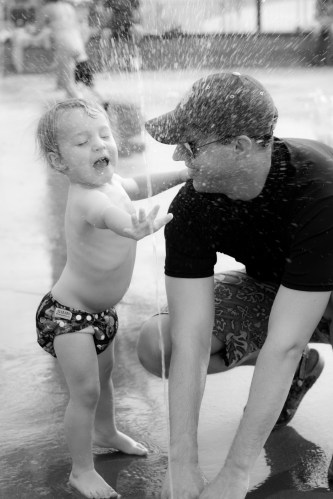
It was warm enough this afternoon for us to take the boys to the splash pad a few miles from our house – and warm enough that half the town seemed to have the same idea! It was crowded, exuberant, and refreshing.

IMG_3662.jpg

Limerick examined the whole splash pad and all the people playing in it very thoroughly and methodically, while Rondel ran back and forth from the fountains to me with ever-changing expressions and exclamations. We were there for close to two hours, only leaving when it was time for dinner, and it was so nice to be able to spend that special time as a whole family, enjoying our Sunday afternoon together.

Another neat thing about this particular park is how diverse the people are! I would guess that today it was about 50% Hispanic, 30% White, 15% African American, and 15% Native American, give or take 5% on each one. Granted, I’m a horrible estimator, but you get the general idea. I love that my kids get to see and play with kids who don’t look like them, especially since our church (despite having a black lead pastor) is primarily white. If they can grow up with diversity being part of their everyday lives, maybe they’ll be able to escape the undercurrents of white supremacy in our nation that give support to men like Donald Trump. Maybe they’ll be able to be proud of their traditions and culture while also valuing and loving the traditions and cultures of others who are not like them. Will they get that all from playing at a park? Of course not – but principles are absorbed into the heart and will through the daily experiences that confirm them.

How did you all spend your Valentine’s Day?

Posted in musings

Refugees, immigration, and the United States

I remember learning, as a child, about the ship St. Louis that sailed from Germany in 1939, carrying over 900 Jewish refugees to a Cuba that had just closed its doors. Turned away from her destination, the St. Louis asked President Roosevelt to give them safe harbor (a choice he could feasibly have made using the power of the executive order), but he never even replied. In the end, the passengers were scattered throughout Britain and Western Europe; half of those who returned to the continent were killed in the war. Hitler received the clear message that the rest of Western civilization was not particularly concerned about the fate of the Jewish people.

The "St. Louis," carrying more than 900 Jewish refugees, waits in the port of Havana. The Cuban government denied the passengers entry. Cuba, June 1 or 2, 1939.
The St. Louis at Havana. Courtesy of the United States Holocaust Museum.

Why was the United States so cavalier about the fate of these individuals, so cold to their plight? The USHMM has a good summary:

Despite the ongoing persecution of Jews in Germany, the State Department’s attitude was influenced by the economic hardships of the Depression, which intensified grassroots antisemitism, isolationism, and xenophobia. The number of entry visas was further limited by the Department’s inflexible application of a restrictive Immigration Law passed by the US Congress in 1924. Beginning in 1940, the United States further limited immigration by ordering American consuls abroad to delay visa approvals on national security grounds.

In short, substituting anti-Islamic sentiment for antisemitism, the United States was facing exactly the same attitudes in 1939 that she is today in 2015. Her citizens were afraid – afraid for their own economic security, afraid to be drawn into global problems, afraid of war, and afraid of people whose appearance, culture, and beliefs were different than their own. We have our own problems; let those people take care of themselves and leave us in peace.


In C.S. Lewis’s book That Hideous Strength, he allows the characters to muse for a while on the particular genius or defining characteristic of several different nations – in essence, the way in which those nations, despite the grime and decay of sin, most especially reflect some aspect of the coming kingdom of Christ.

He doesn’t make two blades of grass the same: how much less two saints, two nations, two angels. The whole work of healing Tellus [Earth] depends on nursing that little spark, on incarnating that ghost, which is still alive in every real people, and different in each. When Logres really dominates Britain, when the goddess Reason, the divine clearness, is really enthroned in France, when the order of Heaven is really followed in China – why, then it will be spring.

Since the first time I read that passage as a teenager I’ve wondered what could define the United States, my own country. It’s only now, as I consider the refugee crisis, that I think I see what is best, most characteristic, most beautiful about us – and what consequently is most violently attacked.

The United States, in theory, as a concept or an ideal, is a nation that welcomes the poor, the oppressed, the pioneer, the explorer, the entrepreneur, the “huddled masses yearning to be free,” and offers to each of them the opportunity to labor, live, learn, and love to the best of their ability. We’re not, historically, a country that supports and provides for each other well, but we are a country that provides opportunity well. In every age people have come here seeking that opportunity, and it has been here waiting for them. And as representatives from all nations and cultures have come here seeking that opportunity, we have taken them in and, though we have most definitely not always embraced the diversity they bring, we have given them the freedom to be and express who they are. With time, they become American, but they don’t need to lose their heritage to do so.

It is the same with God’s kingdom. All nations will come to it, seeking life, seeking love, seeking to learn and labor for a better future, and all those peoples will be assimilated into one people, His people, but they won’t have to lose their traditions and history to do so. We will be proudly and beautifully ourselves, carrying the full rich textured fabric of our past and our culture, as we walk into His kingdom, and all nations will be represented there in the fullness of their glory as well.


Is it any wonder, if this is the divine spark within our nation, that it should be so constantly besieged? It is always our fear that impedes us – our fear of the unknown future and our forgetfulness of the past.

Throughout our history there has been this countercurrent running, this voice that whispers fear in our ears. It tells us that letting in these new people will compromise our own position – steal our jobs, endanger our families, threaten our comfortable way of life. Having received opportunity for ourselves, our temptation is to withhold it from others. Having been born to privilege, safety, and relative wealth, we fear that offering the opportunity for others to work for those things will entail losing them ourselves. Having lived in freedom, we condemn others to oppression even as they beg at our feet for us to open our doors, or risk their lives to enter illegally.

I pray that this time, in this hour of need, our borders would open to those seeking shelter, desiring a new life, wanting simply the opportunity to pursue happiness and love that we have declared an inalienable human right; that we would overcome our fears of different cultures and religions and see the humanity behind them; that we would risk our comfort and security ever so slightly to save families and children from torture and death. I pray that we would not repeat our failure of the 1930s, ISIS terrorism standing in for Hitler’s Holocaust.

Is it too much to ask? I think not.

Posted in musings, quotes

thoughts on the principle of “respect for persons”

I’m doing my human research ethics refresher training at work this week and ended up rereading parts of the Belmont Report (the flagship document on the ethics of human subjects research in the United States, written in the 1970s in response to some of the atrocities uncovered during the Nuremberg trials as well as some of the horrors unearthed in our own history). The section of “Respect of Persons,” deemed a “Basic Ethical Principle” by the authorial committee, particularly stood out to me:

“Respect for persons incorporates at least two ethical convictions: first, that individuals should be treated as autonomous agents, and second, that persons with diminished autonomy are entitled to protection. The principle of respect for persons thus divides into two separate moral requirements: the requirement to acknowledge autonomy and the requirement to protect those with diminished autonomy.

An autonomous person is an individual capable of deliberation about personal goals and of acting under the direction of such deliberation. To respect autonomy is to give weight to autonomous persons’ considered opinions and choices while refraining from obstructing their actions unless they are clearly detrimental to others. To show lack of respect for an autonomous agent is to repudiate that person’s considered judgments, to deny an individual the freedom to act on those considered judgments, or to withhold information necessary to make a considered judgment, when there are no compelling reasons to do so.

However, not every human being is capable of self-determination. The capacity for self-determination matures during an individual’s life, and some individuals lose this capacity wholly or in part because of illness, mental disability, or circumstances that severely restrict liberty. Respect for the immature and the incapacitated may require protecting them as they mature or while they are incapacitated.” (emphasis added)

I wish this principle was applied more broadly in our society, and not merely codified into our human subjects research policies. Can you imagine what it would look like if, instead of shunting the homeless and mentally ill to the back or our minds and the sides of our communities, we considered them to be fully human agents able to make decisions and entitled to protection, not neglect or abuse, when incapacitated through disease or lack of opportunity, education, and health care? Maybe it would pave the way for people to reintegrate into society; maybe it would end some of the isolation and stigma surrounding people and their loved ones who are going through a situation in which they need help and aren’t fully able to advocate for themselves.

Can you imagine how the next generation would live if we raised our children with these principles of respect? If we valued their autonomy, took seriously their opinions and decisions, gave them the freedom to try and fail and learn and succeed, and equipped with the information and logical skills to choose wisely? If we stopped viewing them as possessions and status symbols and means to our own self-fulfillment, and instead truly considered them to be autonomous agents (immature and in need of our guidance and protection, yes, but not for us, or belonging to us, for our pleasure or our reputation)? We wouldn’t have the wounds of a child who can no longer live up to his parents’ expectations and feels like he’s going to bring their whole world crashing down, or of a child who is scared to try because he’s scared to fail and doesn’t believe he has the ability to think and act for himself, or of a child who is abused or neglected by parents thinking only of their own pleasure or convenience. And we wouldn’t have all those old wounds festering in the hearts of the adults who are leading our country, our businesses, our churches, and our families…

Can you imagine what the tender and vulnerable bookends of life could become if we viewed those people as entitled to our protection? Instead of the womb being a place where life only continues at the whim of another person, where the vulnerable human who cannot yet speak for himself or make his own decisions isn’t even given the basic protection of his own life, maybe it could become a place where the vulnerable are valued and protected with gentleness and love, preparing the baby within for the autonomy that will grow and mature within him. Instead of the last years of illness, frailty, and dementia being felt as a burden on the greater society, and the less autonomous being pressured to end their lives to reduce the strain on the community’s resources, maybe it could become an opportunity for the healthy and strong to learn love and sacrificial service in protecting and comforting the sick and dying.

Research isn’t the only thing that needs to be governed and informed by basic ethical principles.

Posted in family life, musings

unplanned pregnancies

I found out via Facebook that one of my young cousins is expecting a baby. She’s 21 now, so it’s not exactly a teen pregnancy, but she isn’t married to her baby’s father and neither of them have much in the way of education or career prospects, and they’re both still living at home. It doesn’t take much intelligence to deduce that this wasn’t a planned pregnancy.

But if my first reaction is to think, “how could she make such a stupid choice? why would she have s*x before getting married anyway? doesn’t she know that’s how babies happen? she should have made sure she was in a better financial position before moving ahead with a family” – then I really don’t believe, in my heart of hearts, the full truth of the pro-life position.

If, then, my second thought is along the lines of, “at least she’s keeping the baby instead of killing it – but this is going to make her life so much harder, and it won’t be good for the baby either, and honestly she deserves it for her foolish choices that brought this baby into existence in the first place” – then all my words about how babies are a blessing from God, how every baby should be valued and fought for and given the love of its parents, are empty and hypocritical.

Was it a poor choice to be intimate before marriage? Undoubtedly – there’s a reason God commands us not to do that. But that doesn’t mean everything that follows from that poor choice is a punishment, consequence, or negative outcome. God is in the business of forgiveness and redemption, after all, and maybe this gift of new life is part of His plan of giving grace and renewing all things.

Is it foolish, in the estimation of this world, to have a child before finances and jobs and future plans are all figured out? Yes, of course! Financial security is the idol of our culture, and a baby makes establishing that security more difficult than just about anything else. But God tells us that a baby is a blessing, not a curse: that the love that baby brings, and the joy of making a family, and the virtues that bloom as a family grows while following Him, are worth more than anything money could promise. Better is a dinner of herbs where love is, and all that. To set aside this opportunity for multiplied love in the name of money – to close our hearts and our bodies to a great blessing and pursue our own comfort and convenience instead – that is truly foolish.

Will having a baby right now make her life harder? Of course, of course it will. No matter when a baby comes, it makes life harder for its parents! Rather than glossing over her choice to keep the baby and focusing on her choices before the baby was conceived – rather than emphasizing her mistakes, in other words – our heart as pro-life Christians should be to praise her, to thank God for her courage and her strength, that despite the incredible hardship this baby may bring her as an unmarried, uneducated mother, she chose the right and the good at the cost of her comfort and convenience. She didn’t try to hide her mistakes, but let the world see, and know, and judge her, because she knew that the life of her baby was worth more than the pain of their judgments.

If we are truly pro-life, we will stand with my cousin and other women like her, without judging her for her mistakes, or shaming her for her “foolish, unplanned pregnancy”, or whispering behind her back about the stupidity and lack of character in these poor women who conceive children out of wedlock. Instead, we will congratulate her for the miracle of new life growing within her womb. We will praise her for the moral fiber and courage it took to choose life for that tiny and vulnerable baby over whom she held complete power and face the judgment of both the moralists and the materialists. And we will offer her whatever help she needs to continue to build a beautiful and blessed life for her baby and her family, for as long as she needs it.

Posted in links, musings

junipero serra

Today Pope Francis will canonize Junipero Serra – the first saint ever to be canonized on American soil, and one of only a relatively few American saints. I’ll be honest that I hadn’t heard of Serra before this year, and that I don’t know much about him yet. I’ve begun reading about him, though, and I’m impressed that this is the kind of man the Catholic Church would declare to be a saint. I’d always thought that the saints were essentially perfect people: maybe they had a rough beginning, like the Apostle Paul or Saint Augustine, but then following their conversion lived out their faith without fault and without controversy. Looking at Serra’s life, though, that seems to be a simplistic and naive idea, because his story is nothing if not complex.

291436_10150957485520496_867332852_o

Serra came to the Americas on the tide of Spanish imperialism – a brutal, unjust, and oppressive moment of history. Many (probably most) of the Spanish soldiers and colonizers considered the native peoples to be savages, less than fully human, and ripe for exploitation, similar to how other European colonizers viewed the African people. And Serra came here with those soldiers, on the wings of colonial power, and worked with them, and labored under their protection. Was he not in some way complicit in their crimes? Was his desire to bring his faith to the native people just a subtler form of imperialism, a way to dominate them more completely by erasing their traditional beliefs and culture?

To a post-modern observer, it can easily look that way. If all cultures and beliefs are equally valid, then Serra certainly had no right to try to push his religion on the native people at the expense of their own traditions, especially since his presence and faith were backed by the ominous and fearful shadow of a conquering army.

331683_10150957490550496_1220183791_o

From Serra’s perspective, though (and from the perspective of the Church today, I think), it looked somewhat different, simply because he believed his religion to be the fullness of the truth – the source of meaning, fulfillment, and joy in this life and for all eternity, and the only way for humanity to draw near to God. Deeply in love with God and with the Church, the desire of his heart was to share the message of that God and that Church with these people who had never had the chance to hear, who had never been able to receive the grace of the Sacraments or hear the clear truth of God’s Word. The imperial conquest of the Spanish wasn’t something he evaluated from a 21st-century perspective on the clash of cultures, but something he saw as a historically unparalleled opportunity for the proclamation of truth and grace.

(Incidentally, he was prepared to sacrifice quite a lot for the sake of this proclamation, and over the course of his life he did indeed do so – family, career, home, comfort, and health. He was willing to suffer greatly if through his sufferings more souls might come to know God.)

While he took advantage of the opportunity presented by the Spanish colonization, then, he didn’t come here with the same motivations or attitudes. He wasn’t looking for riches and power, but for a chance to serve and bring life. We might still not approve of everything he did, looking back over the centuries at his life from a modern perspective, but knowing his intentions adds a layer of complexity to the black-and-white picture of imperial injustice sometimes presented as the whole story.

334239_10150957491800496_1277279492_o

Looking at the details of Serra’s interactions with the native people of Mexico and California adds still more layers to the story. There are the troubling accounts of flogging and other corporal punishment used on the converted natives, and the fact that the mission compounds kept the converted people in a sort of indentured servitude. But there is also the consideration that the missions offered protection from the brutality of the Spanish soldiers, preventing the rapes and killings that would otherwise have been perpetrated. There is the enormous effort Serra undertook to remove a particular commander from his position following his rape of a native woman, and his ability to see the beauty in their culture at a time when most Europeans saw differences to be instances of sin.

291360_10150957500540496_1647360981_o

By canonizing Junipero Serra, the Church does not claim that every choice he made was the right one (how could any person or institution make that kind of claim anyhow?), nor does it place a seal of approval on the culture he came from and lived in. Rather, it acknowledges that in an incredibly complex time and place, fraught with new and confusing situations and ethical considerations, Serra consistently sought to live his life for the glory of God to the temporal and eternal benefit of the native people he encountered. Though a man of his own times in many ways, he rose above most of the societal and systemic sins of his own time and culture by striving to live for and in emulation of Christ.

In our own complex historical era, maybe we can learn from Junipero Serra. Maybe, like him, we ought to labor practically for the good of our neighbors at home and to the ends of the earth, to the best of our ability, out of love for God, in union with the Church and the saints that have gone before us, without worrying what accolades or condemnation we might receive because of our choices. It is better to act, if action is undertaken in such a way, than to remain in inaction because we’re unsure of the best or perfect course to take. Our actions, though imperfect, will most likely help someone in some way, while our inaction will at best merely do no harm.

Pray for us, Junipero Serra, as we experience a clash of cultures in the globalization of our times, that we may truly love those who are different from us, that we may see the beauty in their difference, labor for their healing and their good where they are broken and in need, willingly suffer on their behalf, and courageously bear witness to the truth.


(All the pictures are from a trip to the Grand Canyon several summers ago – they were the closest thing I had to California and Mexico pictures. But I thought at least the juniper berries were fitting.)

(One relatively informative site about Serra is the official site for his canonization, although it doesn’t have as many primary source documents as I would like. It does, however, link to a lot of articles that provide a balance for the rather negative picture painted by CNN and the New York Times, several of which are really quite good, and it gives information about why the Church has decided to canonize him and how the process works.)

Posted in musings, quotes

pro-life

“America needs no words from me to see how your decision in Roe vs. Wade has deformed a great nation. The so-called right to abortion has pitted mothers against their children and women against men. It has sown violence and discord at the heart of the most intimate human relationships. It has aggravated the derogation of the father’s role in an increasingly fatherless society. It has portrayed the greatest of gifts–a child–as a competitor, an intrusion and an inconvenience. It has nominally accorded mothers unfettered dominion over the dependent lives of their physically dependent sons and daughters. And, in granting this unconscionable power, it has exposed many women to unjust and selfish demands from their husbands or other sexual partners.” – Mother Teresa

Mother Teresa could say these words with both humility and courage because she radically lived out the principles behind them. She was not merely anti-abortion; she was, perhaps more than any other single person in recent history, intimately concerned with the whole life of every person, from the rich and famous to the outcast and marginalized. She did not seek merely to address the individual moral concern of each choice for or against abortion, but fought against cultural and systemic ways of viewing and treating some people as less than, or as somehow deserving of fewer rights. Are we who claim to be pro-life following in her footsteps, or is our “passion” and “conviction” limited to signing online petitions and righting self-righteous rants about a sin to which we have never personally been tempted? I pray that it would be the former, ever more and more, in our churches and our culture, until the whole contours of our society have changed.

Posted in links, musings

fake news

It’s Easy To Get People To Believe Fake “News.” Here’s How.

“…it is interesting if nothing else that people who will not believe tens of thousands of Syrians who say “We are fleeing the war” will believe a single, unnamed, unidentified “Syrian ISIS operative” who claims ISIS has placed agents all over Europe ready for orders.”

I’ve seen these ISIS stories shared on Facebook by friends that I had considered intelligent, mature Christians. What does it say about American Christianity that we are willing to believe any far-fetched article that purports to confirm our prejudices? And what does it say about us when we let fear for our own safety override the need to love and the opportunity to be like Christ?

Posted in musings, quotes

from darkness to darkness

Migration is not a new problem in the world. How could it be, when sin and hope both spring eternal in the human heart, in this valley between Eden and Paradise? There have always been evils to flee; there have always been havens of peace or places of freedom to seek. And for as long as there have been migrants, there have been doors slammed shut, walls erected, opportunities denied, and the ones who suffer the most are the innocent.

I remember the stories I grew up learning in the history books of the Irish immigrants to the US in the 1800s, fleeing unjust British landlords and the blight of the potato famine, who endured the cramped, unsanitary, steerage traveling quarters across the Atlantic at the hands of unscrupulous ship-owners; the dehumanizing ordeal of Ellis Island, running the gauntlet of rules and officials indifferent to human dignity or family unity; and the oppressing poverty and bigoted exclusion offered them in those big American cities that had promised from afar to be places of hope and potential.

Living relatively near the US-Mexico border, I remember the stories I’ve read in the news and heard from friends of the Mexican immigrants smuggled across that invisible boundary from one land to the other, facing heatstroke, thirst, and starvation under the fierce and wild desert sun, leaving loved ones, communities, and everything familiar behind, willing to forego the fullness of the benefits offered only to citizens – the health insurance, welfare, college opportunities, and most well-paying, skilled employment – because even the crumbs that fall from the table are, to them, worth the pain and the risk of the journey.

And now, from the other side of the world, the stories are coming of the refugees from Syria, escaping ISIS with maybe only the clothes on their back, their communities already shattered, their culture and traditions surviving only in the tenuousness of diaspora; the refugees from the civil wars of Africa, escaping terrorists and oppression, longing for the freedom to speak freely, to write freely, to think freely, without fear of death or imprisonment; all of them funneling through that historic sea, small in volume but great in its significance to so many civilizations and individuals, risking their own deaths and the deaths of the people they love most in all the world in the hope of a new home, a new life, a new freedom.

None of these immigrants ever asked for their homelands and communities to be torn apart; none of them desired to be oppressed, beat down, closed off from freedom and opportunity. They are human people, like you and like me, yearning for peace, for the love of family, for the solidarity of community, for the freedom to think and speak and act with authenticity and integrity and without fear, for the opportunity to both embrace our traditions and reach for the future. And their peace has been stolen from them; their families splintered; their communities devastated; their freedoms squeezed and shrunk; their ties with the past shaking like a weak thread; and their futures – if we shut our doors in their faces – destroyed. They risk their lives because the slim hope of a better future in a faraway land is the only thing they have left. The policies that make the journey more dangerous do not turn them away; they simply cause more death along the way.

Are we hypocrites for becoming passionate and incensed about other nations’ response to a refugee crisis on the other side of the world, when we turn a deaf ear and a blind eye to the cries for justice and hope in our own neighborhoods and on the other side of our border fences? Probably yes. But it is not hypocritical to care about the Syrian refugee crisis and the deaths on the Mediterranean and simply not know how to respond to either that migration crisis or the issues more close to home. It is not hypocritical to weep for the lives lost, the hopes shattered, the dreams destroyed, wherever the loss took place. On the contrary, to scroll past the images of what is happening with a dry eye and a complacent heart may be the signs of a cold and calloused conscience. May God give us the grace to mourn with those who mourn, and begin the labor of redemption and hope with tears and laments for what has already been.


Back in 2013 Pope Francis gave a message for the World Day of Migrants and Refugees that is still relevant in light of the escalating immigrant crisis. You can read it in its entirety here, but I particularly love these words of hope near the end:

“Every human being is a child of God! He or she bears the image of Christ! We ourselves need to see, and then to enable others to see, that migrants and refugees do not only represent a problem to be solved, but are brothers and sisters to be welcomed, respected and loved. They are an occasion that Providence gives us to help build a more just society, a more perfect democracy, a more united country, a more fraternal world and a more open and evangelical Christian community. Migration can offer possibilities for a new evangelization, open vistas for the growth of a new humanity foreshadowed in the paschal mystery: a humanity for which every foreign country is a homeland and every homeland is a foreign country.”

Where there is sin, where there is pain, there also is room for God’s grace and healing to come, through His people, to the broken world, for its restoration and redemption.


If you want to know what can be done to help with the Syrian refugee crisis specifically, Ann Voskamp did an excellent job compiling a list of ideas, organizations, and resources here. The pictures she’s compiled there, also, are heart-rending. Maybe if we open our hearts and move past our complacency, we can help make these migrants’ journey one of hope, ending with a better future, instead of the voyage from darkness to darkness that it all too often has become.