Posted in musings, quotes

letting go

My therapist used to tell me, “it isn’t your business what other people think of you.” I’m still not sure I completely agree with her, since what other people think can occasionally have fairly large consequences on a practical level (promotions at work, for example) – but in general it’s correct. I’m entitled to my beliefs and opinions, and other people are entitled to theirs. Someone else might think I’m antisocial or making poor parenting choices because I want to homeschool; I might think someone is arrogant and disconnected from local community because they are a snowbird. But if I choose to live my life based on the thoughts of others about me and my decisions, I’ll be miserable (just like all those snowbirds would be, sweltering here all summer without the communities they grew up in, or being shut in all winter there because they can’t shovel themselves out anymore).

I have to let it go. Continue reading “letting go”

Posted in musings

pastor barbara and the out-of-sync girl

Once upon a time there was a church which had a female pastor. Now, this pastor wasn’t the lead pastor, or even the primary teaching pastor; she led the family and children’s ministries, actually, and spent most of her ministry time with women and youth. But she had the title of pastor – Pastor Barbara.

She was beautiful. She had long, curly brown hair and a nose with that perfect spark of defiance bringing its straight lines singing up from her face. She had a gentle way of moving – never too fast or too sudden – and a gentle way of speaking – never too loud or too harsh. And when she saw the children she loved and taught and prayed for, her whole body would glow with that love and light, like an emanation of the Holy Spirit through her presence.

There was a small girl at this church who adored Pastor Barbara wholeheartedly and unstintingly, although mostly from a distance as she was a quiet child. She enjoyed above all the new songs that Pastor Barbara would sing with them! For her, songs were a release from the uncertainty of social interactions, because the songs (at least the children’s songs that she knew) would specify how you were supposed to act. Take for example “Father Abraham:” no one would ever move that way in everyday life, but the song says to do it so everyone does it and no one has to worry about being out of sync.

Continue reading “pastor barbara and the out-of-sync girl”

Posted in sqt

{SQT} – first week home

It’s been a long time since I remembered about the Seven Quick Takes link up far enough in advance to write a post for it! This is a good week for it, too, since it was my first week as a (mostly) SAHM…

Also, after writing these I realized that every point on the list can serve as an example of some autism characteristic. I suppose it supports the argument that autism is an integral part of who an autistic person is – informing their strengths, joys, temptations, and weaknesses. Bonus points if you can name the trait that is on display in each quick take 😛 Continue reading “{SQT} – first week home”

Posted in family life, information, musings

acceptance vs. awareness

I’ve been spending a lot of time on Pinterest lately, in an effort to avoid Facebook (and while waiting for my books on hold to become available!), and I’ve found some really encouraging, helpful, and inspiring posts! I’ve also found quite a few off-the-wall recipes that I’ve made to varying familial approval… but let’s not dwell on that.

I think the following two images which I found there are amazing examples of the difference between awareness of autism and acceptance of autism (the first was uploaded directly to Pinterest by a user, and the second is from the Thirty Days of Autism blog):

Notice how in the first poster only the negative effects of autism are mentioned: meltdowns, avoidance, tears, frustration, worry, and stress. Autism is an evil, something that one needs to fight through with hope and prayer, like a sickness that needs to be overcome and that left unchecked would destroy one’s life. (And if it were a sickness, like cancer, that would be more than fine! As it is actually a neurological and developmental difference that is always going to be part of who a person is, however, this attitude can feel like a personal attack on an autistic individual’s identity.)

In contrast, the second poster focuses on the unique behaviors caused by autism – things that are different from normal, but neutral rather than negative: parallel play, a need for space, deep focus and passion, love of technology, and stimming. Autism is portrayed as a part of who that family is – something for which they love each other, not something despite which they love each other. Acceptance gives them the freedom to be themselves, however autistic that self might be, while still receiving unconditional love and support in the midst of their individual needs and struggles.

Let’s just say I know which lens I’d rather be seen through – and therefore, which perspective I want to take when raising my differently wired child.

Posted in family life, musings

stepping outside of routine

Change is hard. Routines give life structure and reduce anxiety. This is probably especially true in a partially autistic household…

But sometimes, you have to swallow your fears and set out into the great wide somewhere, without knowing what might happen, even expecting that something may happen for which you are utterly unprepared.

IMG_8777

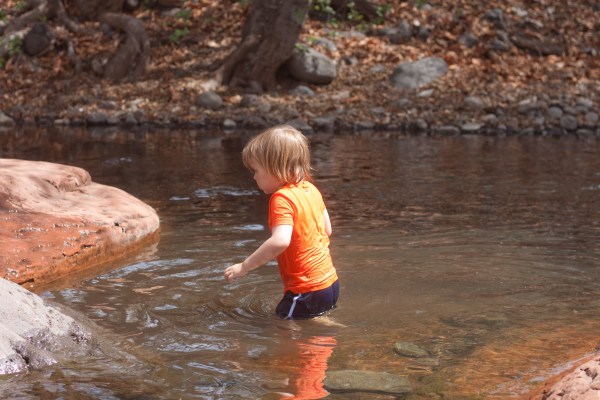
And then, sometimes – more often than your fears would lead you to believe – there is freedom, and there is joy.

IMG_8870

There are places and times when the beauty and the wonder overcomes the discomfort of uncertainty or freezing water, and happiness can reign uncontested.

There are moments when the lure of the next rock over proves greater than your apprehension about the deep pool that lies between you and it, and moments when crossing over through your fears ends up being one of the best parts of your day because that thing you were so worried about is actually something you love, that brings out the adventurer in your soul.

IMG_8865

IMG_8868

It takes a lot of energy to step outside the normal and comfortable patterns of everyday life; I’ve discovered that I need to plan for a day of rest and recovery afterwards. But the thrill of living more fully, more expansively, less bound by our anxieties and routines, is very often worth it.

And for me, the scent of the clean air, the caress of the warm sun, the rhythm of the flowing water, the strength and grace in every line of plant and rock – those things are always worth the effort it takes to find them.

(Many thanks to the friends who made this possible by inviting us along and giving me a safety net to quiet my anxieties! I wouldn’t have gone without the assurance of helping adult hands, since my husband wasn’t able to come along, and now I know that I am capable of handling this kind of adventure on my own in the future. Your support was invaluable for the moment as well as for the moments that are still to come.)

“…many parents, educators, and therapists prioritize academic achievement over instilling happiness, even if it greatly increases stress. In fact I have heard proponents of some approaches take issue with the idea of emphasizing happiness, arguing that for children with autism, it is far more important to develop skills than to be happy. In other words, instead of measuring happiness, we should be measuring skills.

“Not only is this way of thinking misguided, but it misses the point. Children – and all human beings – learn more readily when they are happy. They retain information more effectively when they feel positive emotion. When we try to learn under persistently stressful situations, we retain less, and it’s more difficult for us to access what we learned. But when we’re feeling a positive emotion, we’re more primed for a learning experience, and our learning is deeper and far more effective.”

– Barry M. Prizant, Uniquely Human

because academics isn’t the ultimate end

Posted in information, musings

Autism Acceptance Month

Did you know? April is officially Autism Acceptance Month!

(It’s ok, I didn’t know either until this year. Really the only month I ever remember is Black History Month in February.)

But this year I plan to do something about it! (Not sure exactly what yet, in the offline world, although Chris Bonello of Autistic Not Weird has some good ideas here.)

You may have heard some of the larger autism groups promoting April as Autism Awareness Month, and as a result wonder why I am using the word “Acceptance” instead.

Well…

It is because when I search for “vocal stimming” to find out what forms it takes and how it feels to those who do it (since I do not share this aspect of Rondel’s behavior), the entire first page of search results is geared towards how to make the stimming behavior stop.

It is because the majority of websites that refer to stimming, outside of autism advocacy pages, do so in an incredibly depersonalizing way, discounting the significance of the behavior to the autistic individual and seeing only the oddity of the action in a neurotypical world.

It is because most people have already heard the word autism and know that rates of diagnosis are increasing. The “Awareness” part of the job has already been done!

It is because no amount of “services”, supports, or therapies for autistic children will be sufficient in the long run if society isn’t able to reshape itself to accommodate the autistic way of being – those children all grow up to be adults, after all.

It is because the neurotypical world will lose out on all the beauty, humor, and insight that can come from a different way of looking at things if it keeps trying to fit everyone into a single narrow acceptable mold.

It is because, one day, I hope that every child and every adult will have the freedom to be different – to be openly and proudly autistic, ADD, introverted, extroverted, etc. – without inviting bias or feeling shame.

And after all, autism does not involve a breach of the moral code. There are no objections I can think of to the existence and self-expression of autistic people besides the differences that may make neurotypicals uncomfortable or inconvenienced. Maybe if the neurotypical world could meet the autistic world with genuine acceptance and unconditional love (autists already bend their whole lives around neurotypical systems, after all), the two could create a greater whole.

Posted in family life, musings

the value of a diagnosis

As we proceed with Rondel’s diagnosis (since the school district is unable to provide an actual medical diagnosis in their evaluations), we’re using an innovative diagnostic app developed by a local children’s hospital, which involves capturing multiple videos of Rondel’s actions and interactions in specific situations. I like the concept a lot, as it lets the doctors see into Rondel’s everyday life and observe him unnoticed for far longer than would be possible in an office setting! However, as I’m going through the videos to trim and upload them, I keep wondering if the specialists will see the differences that we believe are present – or if they will tell us that his struggles are due to something like poor parenting. Maybe if I were stricter, or reinforced acceptable behaviors more consistently, or provided him with a more stable routine, or cleaned up our diet, or or or or…

IMG_8588

…then maybe he would be fine, maybe he would be normal, maybe he would fit in with all the other kids instead of sticking out uncomfortably.

He just isn’t so significantly different that it’s obviously a medical problem to a layperson. His differences are hidden, partially masked, behind his gregariousness and intelligence and creativity, until he’s used up all his energy on coping and he falls apart. So when people see him melting down or acting out, it’s easy for them to assume he is doing so willfully, or to think that he is simply being “spoiled” and “self-centered.” Even I, who see him every day, wonder sometimes if the difference is truly there, all the way down, no matter what, or if I could find some parenting technique that would work better for him and “catch him up” to his peers.

But I wonder that about myself also. Do I fail to maintain relationships or engage in neighborhood community-building because I am selfish, lazy, and don’t care about other people? If I were a better Christian, could I overcome my introversion? Many people do, after all, and are able to make time to recharge themselves. So am I guilty of using my social anxiety as an excuse to cover up for my vices or inadequacies?

Similarly, before I was diagnosed with depression (and honestly sometimes still), I would tell myself that if I just tried harder – if I prayed more, exercised more, ate better, spent more time in self-care, spent more time with close friends, practiced the right mental exercises, etc – I could get through the negative feelings and be fine. Getting the diagnosis was one of the best days of my life, because of what it meant to me: that I wasn’t an awful person taking advantage of the people around me, just a sick person who was trying as hard as possible to find joy and light but needed some extra help.

IMG_8585

And my hope is that a diagnosis will be a similar gift to Rondel: a confirmation that his differences are real, and valid, and significant; a reminder that some things will be harder and it will be ok to seek and use help and support; and a shield against the barbs of guilt and shame that always accompany deviations from social and cultural norms. The alternative – refusing to acknowledge and name the neurological differences that give rise to his behavioral differences – is only a recipe for disaster as he grows older and begins to notice his differences without a framework for comprehending and addressing them. How much better to provide him with a framework of informed understanding, acceptance, support, and unconditional love!

Posted in family life

meltdowns

People are hard for me.

Last weekend was filled with people – a water system sales guy came over right after work on Friday, we had our church small group on Saturday morning, I took the kids to a park Saturday afternoon, we went to church Sunday morning, and we visited my parents Sunday afternoon. So – a complete stranger in my house for several hours, and a crowded, noisy, open-plan park, on top of a weekend already social-heavy, with the looming threat of preparing for the babysitter to come Monday morning, was not a good situation.

Unexpected changes of routine are also hard for me.

Last weekend had a lot of those also. I had hoped to celebrate Candlemas with the boys on Friday after work by melting some beeswax and making earth candles in the planter out front (I had even managed to find my old candle-making supplies from high school!). But then my husband made the appointment with the water system guy (for the promise of a Home Depot gift card, which is always useful), which started 30 minutes earlier than I had thought and went considerably longer than I had expected. So because of a misunderstanding about the start time I didn’t get home until shortly after he arrived, meaning my normal coming-home rituals and reconnection with the kids were hampered; the length of time he stayed meant we didn’t get to make candles and didn’t even get to have time together as a family until dinner (which I had to throw together last minute as soon as the sales guy left).

In addition to that, I forgot how crowded the parks around here are on Saturdays this time of year, and this was a new park for us. That in itself was stressful, because we didn’t have a routine for where we would go first, what we would do next, etc., and what favorite corners we would end up in, and it is hard to develop those routines when there are so many other people around. But it became exponentially more stressful when Rondel didn’t stay put while I maneuvered the stroller around an awkward spot, and wandered off into the crowd. Those 5-10 minutes before I found him (ensconced in the arms of a mother with an older daughter, who had come across him panicking and offered to help him) were some of the worst I’ve ever lived through, as I’m sure any parent would agree!

Then, Limerick had a low fever and runny nose Saturday night/Sunday morning, so my husband stayed home with him while I took the other two to church by myself – which was not really that stressful, but it did change things up and force me to make a lot of logistical/efficiency decisions that I don’t normally need to. Not a big deal in itself, but not ideal after the two days prior.

So… I crashed, Sunday night. As in, I laid myself down on the bed after dinner and cried, leaving everyone else to fend for themselves. I had spent all my energy on small talk, relationships, social navigation, people in all their myriad forms, and I had none left to craft the semblance of “engaged parent” for even the remaining hour or two till bedtime.

We hear/talk a lot about children having meltdowns – how to help them, how to distinguish meltdowns from tantrums, how to prevent meltdowns from happening in the first place – but we seem to think that once someone is an adult, they’ve somehow managed to outgrow them. Well, adults can still be introverted, socially anxious, and sensitive to sensory and emotional stimuli. We can still push ourselves too far. We can still collapse, now, just like we did when we were children – and the best way to help us is with space, rest, patience, and gentleness.

(Protip: it is not helpful, in the moment where a meltdown is happening, to try to identify a specific trigger and explain all the ways that trigger is really insignificant or fixable and therefore unworthy of causing said meltdown. Did you notice how many things I mentioned in this post that contributed to my meltdown? And yet the apparent in-the-moment trigger was a whiny baby during dinner. When someone is emotionally collapsing and feeling completely overwhelmed, they aren’t going to be able to give you the blow-by-blow account of the multiple days’ events that led up to the meltdown.)

(Another protip: It is also not helpful, if you see a person supporting someone else through a meltdown, to start talking to the support person about how you don’t understand what’s going on and really don’t know what to do, with a shocked, confused, and/or repulsed look on your face. The support person is busy taking care of someone in clear emotional/sensory need; they most likely do not have the time or bandwidth to simultaneously coach you through the ins and outs of what a meltdown is, why this particular individual is experiencing one, and how he/she prefers to be assisted through it. If you want to learn, bring it up another time. But in the moment, shut up and give the individual some space and privacy unless they indicate otherwise.)

Things to remember:

  1. I (or my child) am not necessarily melting down because I dislike you, the people in my immediate vicinity. In my experience, meltdowns occur more around trusted friends and family.
  2. I (or my child) am most likely not melting down because of something you did personally, but because of some environmental factor pushing us over the edge. This could include:
    1. Physical discomfort (itchy clothes, hot/cold feelings, allergies, hunger, fatigue, etc.)
    2. Sensory overload (large groups of people, loud noises, irritating noises, bright lights, strong/unpleasant/unusual smells, etc.)
    3. Anxiety (crowds, unfamiliar locations, unexpected changes to routine, uncertainty with how to navigate the social terrain, etc.)
  3. I (or my child) would very much rather not be melting down, especially in front of you, and are trying our hardest to contain, control, and calm ourselves.
    1. For example, Rondel, today, when I asked him to try communicating without screaming, told me that screaming was the only way he could tell me how he felt. This statement is not always true of him – but in that moment, with the emotional capacity available to him in his meltdown, it was true, and I needed that reminder.
  4. I (or my child) would appreciate it if you could minimize reference to meltdowns and welcome us back with open arms when we are ready to rejoin you.
    1. If you help us avoid triggers, pace ourselves, and prevent collapse – without making us feel like incompetent and defective human beings by snide/cutting remarks or tones – that would be amazing. That would feel like full and complete acceptance and love. But I understand how hard that is in an ableist culture. It is still hard for me not to address myself with negative and shaming thoughts following a meltdown, given how much our society values self-control, self-sufficiency, and outward appearances. So I don’t expect otherwise from you – but if you can consistently provide otherwise, you will become one of the few people I implicitly trust, and around whom I can step out from behind my layers and facades.

Meltdowns happen. Rondel had one just today, victim to another over-scheduled weekend (which was partly my fault, and I feel awful about it). We can try to suppress them with feelings of shame, isolating the individual for their socially inappropriate behavior, or we can support the individual through them, and learn from them so that we can be better prepared for the future. I know which choice I’d rather make – for myself, and for my children.

“Asking if I want to be healed is like asking if I want to like anchovies. I cannot imagine what liking anchovies would feel like, what taste they would have in my mouth. People who like anchovies tell me they taste good; people who are normal tell me being normal feels good. They cannot describe the taste or the feeling in a way that makes sense to me.”

– Elizabeth Moon, The Speed of Dark

liking anchovies