Posted in family life, phfr

{pretty, happy, funny, real} – in which some oddities of my family are revealed

Let me preface this week’s edition of {p,h,f,r} by telling you that all these pictures come from the same day, and that this day is not really that extraordinary of a day for us – I just happened to have my camera on hand for most of it. I feel like my goal is calm, ordered, semi-normal routines, but the reality of our family life is spontaneous, diverse, and weird. Or maybe it is just the things that fill in the routines that are strange… we still do have normal activities each day like naps and meals and baths 😛

{pretty}

On this particular day we visited the zoo for my nephew’s birthday. I am not a huge fan of large groups of people with small children trying to do the zoo together, but it worked out alright and we were able to go at the kids’ pace. We saw the flamingos and the monkeys and got to go inside the aviary, which are all highlights for my boys. One thing I love about the zoo is getting to see the incredible beauty and diversity of the animal kingdom!

IMG_3966
Their eyes are a bit unnerving, but I love the graceful curve of their necks and the soft overlay of their feathers.

{happy}

Another nice aspect of our local zoo is that it has a small splash pad just right for smaller kids – it is a great way to unwind and cool off before heading home, especially when the weather is warmer. Limerick was already past his nap time but the water (and birthday cake) gave us an extra 30-45 minutes with the extended family.

IMG_3992
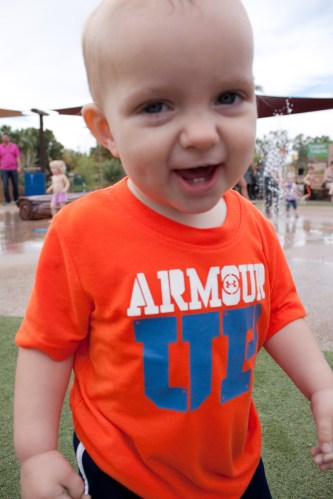
Rondel hung back at first but about 10 minutes later he was down to his diaper, running and dancing and laughing in the water.
IMG_4026
Limerick ran right at the camera with his signature goofy grin 🙂

{funny}

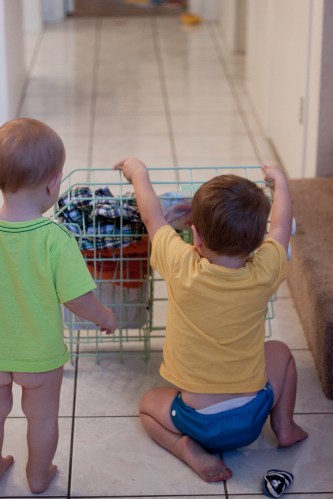
After nap we had a pretty relaxed afternoon, reading books, playing at home, etc., and while I was making dinner I left the kids to their own devices.
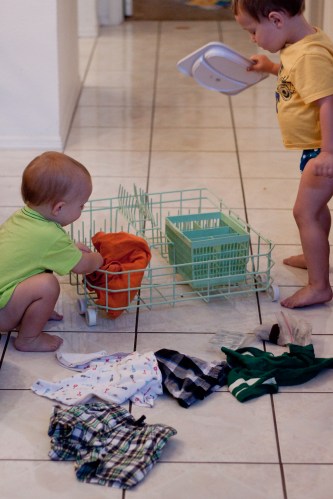
IMG_4040Maybe that wasn’t the wisest idea.

IMG_4036

But it was certainly amusing! And we don’t use the dishwasher, so I didn’t really mind the boys playing with the rack. Later that evening I found a pile of random objects behind the office door and Rondel informed me that they had been recycled by his stuffed monkeys, who carried them there in their dump truck (the dishwasher rack).
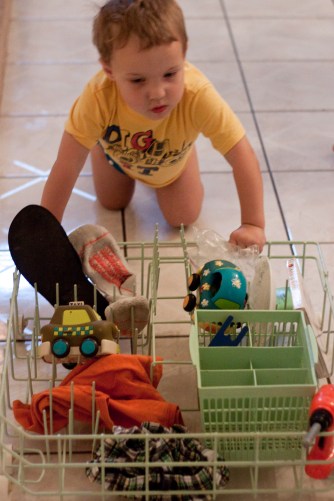
IMG_4052

Could there be a more random assortment of items?

{real}

This was part of dinner cooking in its early stages – baby gold potatoes cooked in chicken broth. Everything was going well and then I got distracted by the kids’ creativity and hilarity and came running back to the kitchen to discover all the broth evaporated (which was supposed to happen) and the potatoes all sticking to the skillet (which was not supposed to happen). Sigh. They still tasted good though! In my dream house, the kitchen wouldn’t be a little closet of a room disconnected from everything else…

IMG_4043

There would also be better lighting for indoor picture-taking, I think. You know, if we’re dreaming here 🙂 One of the drawbacks of a town home is that there aren’t many available walls for windows!

Head on over to the link up at Like Mother, Like Daughter and check out some of the other blogs! It’s always fun to see the craziness that goes on in other people’s families, to know we’re not the only ones 🙂

Posted in musings, quotes

when fear skews our ethics

“…a growing body of research suggested that investing in education and work for women propelled economic development and led to lower birth rates. Later in the 1967 meeting University of Chicago sociologist Philip Hauser alluded to this research when he asked the delegates: ‘Do we really know whether the classical approach of family planning propaganda and clinical services is more useful in reducing birth rates than the same effort spent on building a road into the village or constructing a soap factory where women can work or furthering education for girls?’ But population control activists tended to dismiss an emphasis on female workforce participation and education as a strategy dreamed up by unrealistic feminists. And Polgar [head of research for Planned Parenthood Federation of America] didn’t mention the alternative approach from the podium. Instead, he gazed out at the delgates and, according to minutes from the meeting, ‘urged that sociologists stimulate biologists to find a method of sex determination, since some parents have additional children in order to get one of specified sex.'” – Mara Hvistendahl, Unnatural Selection: Choosing Boys Over Girls, and the Consequences of a World Full of Men, pg 99-100

“Others talked about the necessity of an Asian pregnancy police, foreshadowing China’s system of birth permits under the one-child policy, and suggested flying planes over India once a year to spray it with a ‘contraceptive aerial mist.’ And the racist application of birth control was no longer confined to the developing world. In 1973 African American and Native American women across the American South and Southwest alleged in federal district court that they had been sterilized under threat of their welfare benefits being withdrawn. Gerhard Gesell, the judge who heard Relf v. Weinberger, concluded in his ruling that the women had been coerced. He estimated that between 100,000 and 150,000 poor American women had been sterilized under federal programs, adding, ‘the dividing line between family planning and eugenics is murky.'” – Ibid, pg 104

The idea was that families would have fewer children if they didn’t have to keep trying and trying to have a child of the sex they desired. Instead of a family having 3 or 4 or more daughters before having a son, and having 4 or 5 total children, the parents could eliminate those daughters, or most of them, and end up only having 1 or 2 children. In the 1960s, when the world was as scared of population growth as we are of climate change, that reduction in the birth rate was the pot at the end of the rainbow. But instead of choosing to support economic development and female empowerment (which has historically led to lower birth rates on its own), Western nations and foundations decided to tie their aid money to population control programs, leading to mass sterilizations, countless abortions, and the eventual skewing of the gender ratios across the world due to Polgar’s final vague and understated observation above.

Was it all just a response of fear to the specter of a world overfilled with people, starving and suffering and dying? While I think that played a role, there was a definite racial component to the issue, as the decreasing birth rate in the West combined with the economic development of the rest of the world struck fear into the hearts of white Americans and Europeans worried about losing their hold on global power and wealth. And the result of those fears, both the altruistic and the selfish racist fears, was death and suffering – for the men who underwent forced sterilizations during Indira Gandhi’s rule in India, for the women whose babies were aborted because of the one-child policy in China, for the aborted babies themselves (mostly girls), for the men who are growing up to find themselves consigned to singleness due to a shortage of women.

It is never wise to forsake the path of righteousness in response to fear. We must have a more constant moral compass than that of pragmatism and self help, or the very things that we think good, in our efforts to avoid what we fear, will end up hurting us (or others) in ways we never dreamed of, just as much or even more than the things we were trying to avoid. Such a moral compass will also help us determine whether or not our fears are ethically just – as a fear of humanity starving and suffering would be, while a fear of the global gains of other races would not. Population control wasn’t the solution for the fears of the 1960s; economic development and education accomplished the same ends without the oppression and injustice. Maybe Christianity was right when it said that children are blessings; and maybe if we worked together for the common good instead of seeking our own good at the expense of other human beings we could conquer the evils we fear without causing greater evils yet to roam the earth.

Posted in musings, quotes

the politics of anger

I have been trying not to post much overtly political content on this blog, because it’s not my area of expertise and because it’s not what I typically enjoy writing about.

However, I wanted to share a quote from Mitt Romney’s recent speech condemning the candidacy of Donald Trump, because I thought it was particularly eloquent and historically informed.

I understand the anger Americans feel today. In the past, our presidents have channeled that anger and forged it into resolve, into endurance and high purpose, and into the will to defeat the enemies of freedom. Our anger was transformed into energy directed for good.

Mr. Trump is directing our anger for less than noble purposes. He creates scapegoats of Muslims and Mexican immigrants. He calls for the use of torture. He calls for killing the innocent children and family members of terrorists. He cheers assaults on protesters. He applauds the prospect of twisting the Constitution to limit First Amendment freedom of the press.

This is the very brand of anger that has led other nations into the abyss.

When I was younger, and would think about the beginnings of WWII, I always wondered how the leaders of those nations had risen to power. What was there about Francisco Franco, Benito Mussolini, or Adolf Hitler that appealed to the average citizen in their countries and enabled their positions? Believing (naively, I suppose) in the basic decency of humanity, I couldn’t understand the draw of a strongman manipulating society’s anger and discontent for hateful and violent purposes.

To be honest, I still don’t understand. I know that Germany was broken after WWI, poverty-stricken, ripped of her national pride, and that there was an easy opening for a leader who could ride that anger to power without the constraints of conscience. But that anger could just as well have turned to national reform, to the iron strength of will needed to accomplish the slow and difficult task of national transformation – as in fact it did in the years following WWII. Did the anger lead to all that evil simply because one man decided to use it for his own advantage, for the fulfilling of his own twisted ideology and vendettas?

This election cycle is forcing me to admit that my people, my fellow Americans, are not at heart such a good people as I had always hoped and believed them to be. They are angry – maybe justly, maybe not – and they are letting that anger carry them away, without watching their feet, without taking care to stay within the boundaries of morality and good conscience. The strongman is playing off their emotions, using and manipulating them for his own purposes, and they don’t see it. Or maybe they do see it, and they don’t care, because it feels so good to be able to openly blame someone else for all their problems and struggles, whether or not that scapegoat has any rational basis. So anti-Mexican rhetoric is spewed forth in the southwest, anti-Cuban tirades in Florida, and anti-Muslim attacks on a national level. What happened to liberty for all, my racist conservative compatriots? Does freedom only extend to those who look and think like you?

I used to think that America was a great nation because her people were great, because her people held a basic set of principles that were good and noble. Maybe she was, once, but she is not anymore, because her people have forsaken their calling and their creed. Maybe she will be again, if enough people care enough to begin rebuilding the traditions and principles that gave her beauty and strength through the centuries, but when the siren of the strongman sounds so sweetly in the ears of her people, I fear for when it comes time to pay the piper.

Posted in family life

rondel’s tools

Rondel has discovered the power of tools and is accordingly deeply fascinated with anything that can be described as a tool in some sense or other. He’s unearthed a play tool set his uncle bought for him a couple Christmases ago and has been fixing everything in sight with them:

He also spent the whole afternoon on Monday, while I was at the doctor with Limerick, watching his dad (for whom I still don’t have a good blog name) fix his bike, and doing his best to help in the process with both his own tools and Daddy’s tools 🙂

I think the whole concept of things as tools is a good one for him, because it elevates his play from something trivial to something valuable, practical, and helpful – not that I think any of his play is trivial, or course, but the word “toy” does tend to give a thing or an activity a feeling of lesser importance. In using tools, he’s modeling what he sees in the world around him, and practicing in his own pretend world the skills he wants to copy from the adults around him. It’s just another type of play, like imaginative play, or pretend social play, or physical play, or musical play, and it’s neat to see him diving into different areas like that without prompting, and developing in different ways because of it.

The vocabulary of tools is also helpful for me when I’m teaching him how to use something safely, or having to take something away from him that’s not appropriate for him to use yet – like knives, scissors, markers, tweezers, and so on. Instead of having to just tell him he’s not allowed to use something, I can tell him that it is a tool with a specific purpose and a specific set of safety and use instructions 🙂 So some tools he can use almost anywhere, but others can only be used when Mommy is there, or can only be carried at a walk and held in a certain way. The instructions have a context then (the context of tools), so it’s easier for him to remember them and less likely that he’ll challenge them. It’s always nice to stumble upon little parenting hacks like that… 🙂

I wonder if this interest in tools is just a phase of life-discovery for him or if he’s going to be one of those boys who figures out how to take everything apart and rebuild it – he certainly would come by it naturally, with the mechanical sense that both my mom and my husband have! I suppose I’ll just have to wait and see.


Posted in family life

sick baby

We had a rather frightening virus (most likely) settle in on Limerick earlier this week – his temperature kept going up to around 104 every time his fever reducers started to wear off, for about 4 straight days. The third day was a Monday so I took him in to the doctor’s office, where they measured his fever at 104.4 (so nice to have proof that the fever really is as high as you claim – they never seem to believe me otherwise). Flu and strep tests both came back negative, and fortunately the fever cleared up Wednesday morning so our best guess is a virus (and not a highly contagious one at that, thankfully).

Limerick spent most of his time nursing, sleeping, and wanting to be held, but when his meds were keeping his temperature down his buoyant nature bubbled back up and he did his best to keep up with Rondel like normal.

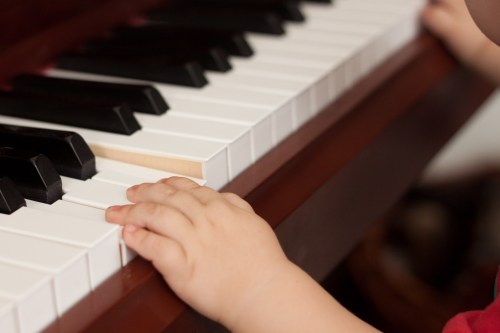
He pulled a stool up to our piano all on his own and spent a relatively cheerful 15 minutes making music while Rondel sang along 🙂

IMG_3961

IMG_3957

His little face was still so tired and sad though 😦 It’s quite nice to have him feeling himself again and running around wreaking havoc all over the place!

Posted in musings, poems

side by side in the common good

What is the duty of the person who sees injustice, oppression, or need, and has some ability to protest or make amends?

Is it to step daintily around the problem, hoping that the filth and blood will leave your feet unstained?

Is it to click a few “Likes” on a Facebook page, or write a vaguely angry status, and then move on to happier thoughts without even a prayer?

Is it to give thanks for your own more comfortable situation, and avoid the suffering that your happiness may not be lessened by their pain?

Of course not.

It’s easy to see that, on paper; it’s harder to see it happening in your life, everyday, in the major decisions and the small choices: in your quickened steps and averted gaze as you walk past the homeless man with the cardboard sign; in your fear of personal heartache that prevents you from fostering or adopting a child in need; in your unobtrusive isolation from the other in jobs, neighborhoods, and churches made up of people who look and think like you. Every little thing builds up, until one day you have completely blinded your mind and numbed your heart to the ache of the world around you, content in your own personal happinesses, and you don’t even realize the small and withered thing you have made of yourself and your life – your one precious and beautiful life, that could have been a source of good to better the whole world.

In the 1950s, a poet named Maurice Ogden wrote a poem called The Hangman about a village where everyone is murdered, one by one, by an ominous hangman of whom they all live in fear. Each time another is hung, the rest of the villagers sigh in relief and continue with their lives, until at last only the narrator of the poem is left – and he realizes that the hangman has now come for him as well:

“…’I answered straight and I told you true,
‘This scaffold was raised for none but you.

‘For who has served me more faithfully
‘Than you with your coward’s hope?’ said he,
‘And where are the others who might have stood,
‘Side by your side in the common good?’

‘Dead,’ I whispered; and amiably,
‘Murdered,’ the Hangman corrected me.
‘First the alien, then the Jew…
‘I did no more than you let me do.'”

“Side by your side in the common good” – for we are not solitary and independent creatures, no matter how much our culture values individualism and autonomy. We need each other. We need to receive help from each other, and we need to give help to each other, both for the common good of our community and for the private good of our own soul. It is so easy to let our fear and our desire for comfort and convenience shutter us away from the needs and gifts of other people, especially people not quite like ourselves, but it leads to broken homes, neighborhoods of strangers, and the general fragmenting of society that is so painfully being put on display this election season.

I write this not as someone who is living this out well, and has the answers figured out. To be honest with you, I’m only just beginning to see how my own fear and selfishness have prevented me from following God boldly in the midst of a broken and hurting world. Will you come join with me, hand in hand, to learn again how to share our hurts, carry each other’s burdens, and sing each other’s songs of joy and of lament?

Posted in musings

anger

Anger is quite a useful emotion.

When I’m angry, I can stop feeling sad, anxious, apprehensive, melancholy, stressed, guilty, inadequate, or uncomfortable – the anger drives all other emotions out before it like a scouring wind.

If my husband is tired and stressed about school and the kids, it can be hard for me to simply be present with him as he’s feeling that dissatisfaction and frustration; his emotions make me uncomfortable, on the one hand, and on the other, I’m jealous of the time he has with the kids. Simply being angry at him – for having the emotions that I dislike, and for not appreciating what he has right now that I wish I could have – is far easier than being with him and supporting him. It’s less complex and more comfortable.

The same principle applies with my kids, my coworkers, the situations and instruments I deal with at work, and even myself. The intricate web of emotion created by daily life is confusing and uncomfortable for me, and getting angry gives me an emotion I can understand while pushing away all the other emotions that are so hard to handle.

Unfortunately, of course, this kind of irrational and unjust anger is incredibly damaging to my relationships with people. It’s not great for a marriage when a wife gets angry every time her husband has an emotion that’s not positive! And it doesn’t result in a secure and happy childhood when a mother flips out at her children, inconsistently and impulsively, for normal childish behaviors. I know this, so I try to control my anger. It might be the easiest emotion, my default emotional response, but it isn’t the emotion that I want to characterize my relationships at home or at work.

My primary strategies these days are two-fold: a preventative strand, that works on creating margin in my life so that I can better handle uncomfortable emotions; and a crisis management strand, that gives me ways to pause the anger response pathway and hopefully step out of it. Prevention involves things like regular prayer, consistent time in the Word, and sufficient sleep and time outside. Crisis management looks like counting to ten when I feel my anger rising, or offering up quick and instant prayers for peace or grace (written/memorized prayers are really helpful here, but sometimes just a wordless prayer – a silent plea to heaven, eyes raised, soul yearning – is all I can lift up in the moment).

What are some of your tactics for keeping anger from running (and ruining) your life?

Posted in musings

stifled prayer


I live my life with a wall around my heart.

It’s not that I don’t love people, or care about people – I just don’t want people to know my weaknesses. I don’t want to admit those weaknesses to myself.

When hard things happen, whether it’s a chronic struggle like mental illness in a loved one or working while my husband gets more time at home with the babies, or an acute problem like a sick baby or a lost iPod, my brain immediately starts calculating all the different options I have. All the ways I could respond to the problem, all the potential outcomes, all the strategies and decisions and backup plans. I want to be the strong and competent woman, who meets life with confidence and grace, and never lets her head fall under the waves.

And I bring that attitude with me before God.

I keep that wall up even when I pray. Walls tend not to be easily assembled and disassembled, after all.

Limerick has been dealing with a high fever since early Saturday afternoon and I didn’t think to pray about it until tonight (Sunday night). I was just so wrapped up in nursing him, taking his temperature, giving him fever reducers, making him comfortable, and wondering what was making him sick to think about it. The plans, the automatic response of confidence and control, took over. I didn’t doubt my ability to take care of him well, so I didn’t feel the need strongly enough to pray about it. Do you hear how strange that sounds? I believe in a God who can heal the dying, and I believe that He cares about every detail of life, and instead of taking my sick baby to Him I try to handle it all on my own?

My worry, my need to be strong and take care of the people I love, prevents me from doing what they need most: interceding for them to God, lifting them up to Jesus. My desire to keep things under control and handle situations calmly and competently interferes with what ought to be my first line of response.

Soften my heart, Lord, and tear down my pride. Let me come to You humbly at all times and in everything, not only when the need is too great for my own strength and intelligence; let me put my fears to rest trusting in Your providence. Loose my tongue and gentle my heart, that I might lift the needs of the world to You instead of trying to fix them on my own.

Posted in musings

orange blossoms in the spring

The orange blossoms are beginning to open.

IMG_3872

The scent of them in the air – spicy, sweet, alluring, richly complex yet somewhat warm and light – is one of my favorite things in the whole world. I can’t think of another smell quite so wonderful (although the smells of yeast bread rising and new babies snuggling come pretty close).

In the sunshine, in the middle of the day, in the backyard or kitchen just feet away from our tree, the smell makes me want to bask in the sunlight, dance with my boys, overflow with hugs and kind words – it elevates the positive, surrounds me with energy, fills my heart with simple joy.

In the twilight, caught on the edge of the cooling breezes, it makes me think of balconied rooms hung with muted orange, lit with candles, where a woman awaits her lover as the curtains rustle over the open window. It is the seductive, entrancing scent of the blossom that hints at love as it breathes in on the wind.

(I told my husband these thoughts and his eyebrows shot pretty far up… he brings me back to earth pretty quickly sometimes 🙂 )

IMG_3874.jpg

The bees are loving the blossoms as well. Our tree has more blossoms than any other tree I’ve seen around town, so there isn’t much out there to draw the bees away from us yet. But so far they ignore the babies, and the babies notice them just enough to say “bumblebee! buzz buzz buzz” and then move on 🙂 Hopefully we’ll make it through the spring without any stings! If not, I suppose bee stings are a part of life.

What is blooming near you all?

Posted in family life, musings

unplanned babies (the blessing of limerick)

After Rondel was born, we struggled a lot with the transition from “couple” to “family.” I had PPD for months, my husband was exhausted from being up with a sleepless baby and trying to encourage a miserable wife, and Rondel was becoming anxious and easily overstimulated. We were all on edge and our margins were just about the lowest they’ve ever been. And so, clearly, we thought it was the worst imaginable time to have another baby.

Although at that time I didn’t quite grasp the theology of the body that informs the purpose and ethical applications of sex, I had an instinctual dislike of contraceptives, for various reasons: I didn’t like having to take a pill everyday with hormones that were going to influence far more than just my reproductive system, barrier methods felt awkward and incomplete, like we weren’t actually coming together in the one flesh of marriage, and we obviously weren’t at a point to consider permanent sterilization as a means of contraception. So we were charting and tracking and being really careful – and then we found out we were pregnant, just 7 months after Rondel was born.

It wasn’t our plan at all. Looking back at the charts, it makes no biological sense that we got pregnant when we did.

But you know the beauty of it? Because it wasn’t our plan, because we were walking through the tension of stewarding our resources well while remaining open to God’s plan for new life, we were relieved of the constant fear that we’d made a mistake every time that things were difficult. This baby wasn’t our choice – he was God’s choice, and God is someone we can trust.

And as the months went by, we saw the profound good that Limerick brought to our family: the pregnancy hormones that snapped me out of PPD, the reevaluations of my lifestyle and parenting choices that made me a gentler and less anxious mother, the small and vulnerable baby that showed Rondel how to care for someone weaker and more needy than himself, the bold and mischievous toddler who is helping Rondel learn to share, negotiate, and adapt even as he learns those things himself.

If we had made it about our plan and our wisdom and our choices, Limerick wouldn’t be here, bringing his incredible blessing into our family – and that is a huge reason why, now, I would not choose to contracept or sterilize. Who knows what other unforeseen good God wants to bring into our lives? Why would I want to close myself off to that blessing, just because I cannot picture it clearly in my mind now?