Posted in wwlw

what we’re learning wednesday: episode 4

Rondel and Limerick are very different academic beings. Rondel’s first love is stories – he tells them, he listens to them, he invents them, he demands them, he constantly (since before he could talk) brings us books so he can hear their stories too. He soaks up facts about animals, and then populates his worlds with monsters generated from conglomerations of the different animals he loves. Limerick, on the other hand, has always been intrigued by symbols and patterns. He knew all (and could write most) of the letters and numbers by 18 months, spent a good 6 months nearly inseparable from a Duplo pattern board he created, and currently puts a lot of energy each day into creating symmetrical designs and exploring the world of numbers.

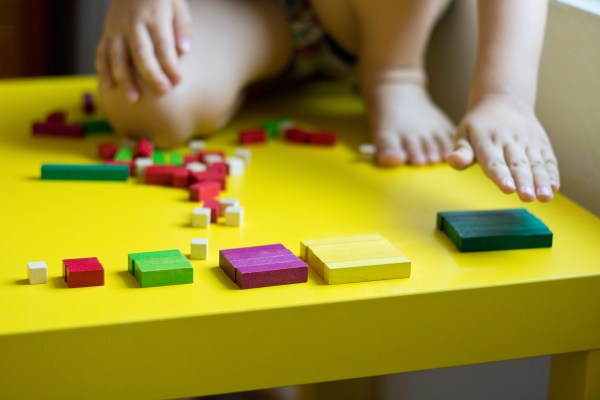
When we introduced Cuisenaire rods (a really great math manipulative, by the way – I grew up using these with the Miquon math curriculum and have always felt that they gave me a strong conceptual foundation in mathematics) for the first time this week in preparation for more kindergarten-type activities, this difference in their inclinations was immediately evident.

Limerick went through each color rod, noticing how long each one was as compared to the small white unit blocks. When he reached the longest rod, he began to line up the smaller rods next to it, to see how he could split it up. Ten is ten groups of one, he realized, and five groups of two, but when you try to split it into groups of three you end up with one empty space.

We made squares (one group of one, two groups of two, three groups of three, etc.) and talked about the difference between the perimeter of a shape (how long all the edges are, put together) and its area (how many white unit squares could fit inside it).
IMG_0239.jpg

Meanwhile, Rondel was using different sizes and color of blocks to retell the story of the Three Little Pigs with house-building fleas and a predatory lion (I think he chose fleas because they are too small to see, and he didn’t have any prey animal toys on hand to use with the lion figurine). He went through all the steps of the story with sound effects and drama, creating and destroying as necessary, completely immersed in his imagined world.

When the boys play together, I see these inherent differences leading to growth in each of them. Rondel’s love of imagination draws Limerick along with him into wildly creative and unrealistic pretend games, while Limerick’s fascination with numbers and patterns motivates Rondel to learn the vocabulary and concepts of math also. It makes me glad all over again that they have each other to grow up with.

So what are we learning, this Wednesday? We are learning about how numbers work together, how they split apart and recombine in consistent ways. We are learning about the trial and error it takes to finally build a house that can keep out a powerful lion. And we are learning about each other, and how we can help each other learn in grow in different ways.
Posted in book lists, family life

book-based activities: troll cupcakes!

The main branch of the Mesa public library system – our family’s current go-to library – does an excellent job of displaying children’s picture books to catch the attention of kids and parents alike, and additionally of rotating those picture books to highlight different excellent choices every week. I’m sure if I went to the library two days in a row I would notice at least some of the same options on display, but with our current 1-2 week interludes they are always all unique. With three little ones to keep an eye on, it is much easier for me to grab a few of the display books that look promising than it would be to scan the shelves (although I try to do that too, usually when we’ve found an author we enjoy).

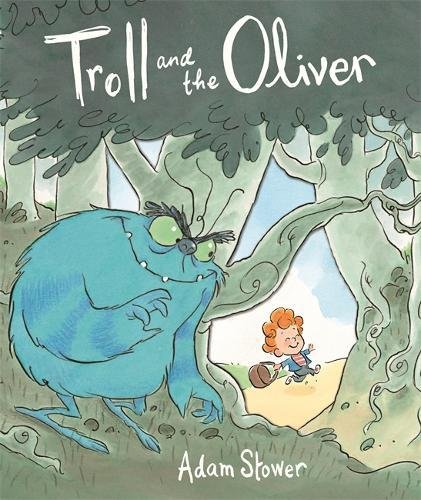
On our most recent trip to the library, we noticed a book that caught my eye for both its artwork and the clever twist hidden in its title:Β Troll and the Oliver, by Adam Stower.

trolloliver

It’s just a little thing, using the article for the person in the story instead of the monster/troll/villain, and it made the boys laugh too.

The story is that of a troll attempting to catch a small boy named Oliver, who continually eludes him while singing songs about it. At the end of the book, after a hilarious turn of events, the two of them discover that trolls love cake, and they end by baking cakes for all of the trolls in the woods. And after the story ends, the author includes a recipe for cupcakes, along with ideas for decorating them to look like trolls! Needless to say, my boys were adamant that troll cupcakes had to happen.

So, with a few alterations to the recipe (which had no leavening agent – is that normal?), and a trip to the grocery store for some cupcake topper decorations, we made it happen!

IMG_0253.jpg

I have a tendency to let myself get carried away in the current of the kids’ excitement, so per their request we made twelve different colors of frosting (one for each cupcake) so that each troll could be truly unique. Rondel made sure that everyone got to pick the colors they wanted without choosing a color someone else already had, Limerick discussed the intricacies of color mixing, and Aubade tried to eat the frosting by the spoonful every time I glanced away from her.

Somehow we managed to get frosting on all the cupcakes without completely covering the kitchen in it, and we even were able to decorate the cupcakes instead of simply eating all the decorations plain first! (You should see the kids when we decorate Christmas cookies… the vast majority of the sprinkles seem to end up inside them rather than on the cookies.) Rondel decorated all of his, Limerick and Aubade each did one, and I did the rest. Aubade ate hers before I got a picture, unfortunately… although to be honest it is good she ate it right away because she had managed to lick the whole top of it before I frosted it!

Aren’t they adorable? The fuzzy ones have shredded coconut for their fur – I liked especially the texture from the extra wide flakes. I do think overall that either slightly bigger cupcakes (these were quite small, even on top) or slightly smaller decorative objects would make things easier, as would slightly moister frosting (and more of it per cupcake) to help things stick.

All in all it made for a fun morning, if also a lot of dishes πŸ™‚ Rondel is already asking when we can make them again, and it’s only been three days! And I have to say, tying a book into normal life in such a fun and memorable way can only serve to make reading even more appealing and exciting than it already is.

What are some of your favorite picture books to bring to life, and what do you love to do with them?

Posted in musings

rereading 1984

I first read Orwell’s 1984 when I was 12 or 13, in 8th grade, around the 9/11 terrorist attack, and I read it again, in high school, but I hadn’t read it since until this year because of the intense emotional memories I have associated with it. As a young teenager reading the novel, I missed a lot of the subtlety and was simply struck with the horror of a system that was so completely in control of people that it could torture and brainwash them into not just obedience to, but complete assent with and even love of that system. Having grown up in a privileged and comfortable environment, it was difficult for me to comprehend that there could be a society so completely without hope, or that there could be people and governments in the world who inflicted suffering intentionally for their own twisted pleasure – I don’t think the possibility had ever occurred to me before.

Reading the book again now, however, it came to me that the book is (in a backwards, dystopian way, of course) about the nature of humanity and the priceless value of human dignity. Even in the most absolutely totalitarian state fathomable, in a society where all the biological and spiritual impulses of the person are quelled or redirected into emotional and political reactions, humanity bubbles up in quiet wondering, solitary dissatisfaction, fearful reconsiderations. One of the most hopeful moments of the book, to me, was one in which Winston simply observes another human being, noticing all the things that are most beautiful and universal about her, drawing to the forefront her dignity and unique humanity:

“Tirelessly the woman marched to and fro, corking and uncorking herself, singing and falling silent, andΒ pegging out more diapers, and more and yet more. He wondered whether she took in washing for a living or was merely the slave of twenty or thirty grandchildren. […] As he looked at the woman in her characteristic attitude, her thick arms reaching up for the line, her powerfulΒ mare like buttocks protruded, it struck him for the first time that she was beautiful. It had never before occurred to him that the body of a woman of fifty, blown up to monstrous dimensions by childbearing, then hardened, roughened by work till it was coarse in the grain like an overripe turnip, could be beautiful. But it was so, and after all, he thought, why not? The solid,Β contourless body, like a block of granite, and the rasping red skin, bore the same relation to the body of a girl as the rose-hip to the rose. Why should the fruit be held inferior to the flower?

“[…] He wondered how many children she had given birth to. It might easily be fifteen. She had had her momentary flowering, a year,Β perhaps, ofΒ wild roseΒ beauty and then she had suddenly swollen like a fertilized fruit and grown hard and redΒ and coarse, and then her life had been laundering,Β scrubbing, darning, cooking, sweeping, polishing, mending, scrubbing, laundering, first for children, then for grandchildren, over thirty unbroken years. At the end of it she was still singing.”

Of course for Winston it is all just a temporary interlude, this quest for truth, beauty, and individuality. When every action is observed, it is difficult to step out of line and escape for long – and Winston has no idea of where to look for help, or what actions to take, except to follow the confused and tangled pathway of his beaten-down heart and neglected spirit. It is inevitable that he should be caught, and broken, and converted, no matter how he tries to resist. And while they are torturing him, they share with him one of their secrets – the truth, to be honest, of the opposite aspect of humanity from what Winston saw in the poor washer woman. For humanity has ever been a two-sided coin: created in perfection, fallen into all kinds of cruelties and apathies.

“‘Power is not a means; it is an end. One does not establish aΒ dictatorship to safeguard a revolution; one makes the revolution in order to establish the dictatorship. The object of persecution is persecution. The object of torture is torture. The object of power is power.

“‘[…] How does one man assert his power over another, Winston?’

“Winston though. ‘By making him suffer,’ he said.

“‘Exactly. By making him suffer. Obedience is not enough. Unless he is suffering, how can you be sure that he is obeying your will and not his own? Power is in inflicting pain and humiliation. Power is in tearing human minds to pieces and putting themΒ together again in new shapes of your own choosing.'”

It isn’t hard, these days, to think of all kinds of situations in which those words ring true. It is the expression of our worst impulses as parents, teachers, or employers. It is present every time innocent or ignorant people are tortured for information, or held without trial, by countries that claim to be just. It runs insidiously through the background of every attempt to rationalize policies that are needlessly harsh, or that sacrifice human dignity to efficiency and social order.

In the end, of course, Winston dies loving Big Brother. Thirteen year old me was shell-shocked by that for a long time. I have an inkling of an understanding, now, how hopelessness can finally drive a person so far down that they sabotage their own being to escape its torment. But when we live in a society that still claims to value justice and mercy, it is our crucial purpose to hold fast to Winston’s initial realization that there is beauty in everyday family ties, in the resilience of the human person enduring in love. It falls to us to close our eyes and ears to the seduction of power, and (as much as lies in our power) to prevent our society and government from falling prey to those sirens. For us, in the real world, where hope still lives, the loss of all that is good and true and beautiful about humanity is not yet inevitable.

Posted in musings

accepting autism when I want to be normal

I remember the first time I revealed my depression to another person, and the first time I admitted that I had wanted to commit suicide. It’s not an easy thing to be open about; it’s shameful, and dark, and has the potential to hurt the person you’re talking to quite a bit (especially if they knew you when you were going through it and didn’t open up to them until years later). I’ve found a way to accept it as a part of my story and talk about it now, though, and I hope when I talk about it that I can encourage others who experience it. I have a mental illness, I can say, without being ashamed or guilty. I have been in these dark valleys, and heard these poisoned voices, and felt the dank stagnant breath of despair on my face. If you are there, I can say, where hope seems entirely absent and all light is lost, where you are lost in a pathless wilderness and the very thought of finding a way out seems pointless, I have been there too, and I am a witness that it is possible to return to the land of the living.

Autism has been a more difficult name to claim for myself. While I don’t have a medical diagnosis, it’s not doubt about the validity of the label that stops me; I can see every symptom in my autistic son mirrored in myself, I score well above the cutoff for every ASD questionnaire I’ve ever taken, and it’s evident to others to the point that my husband laughed at me when I told him I wasn’t sure if I could be autistic myself.

Instead, I think what makes it difficult for me is the admission, in accepting this diagnosis, that I may struggle with certain things for the rest of my life without a “fix.” That some of the aspects of myself I’ve always hated, some of the traits I’ve never accepted, are part of my neurology that will never go away. I can take a pill to shut out the blackness of my depression; there is no pill that will help me fit in with a group, or know how to move my face the right way when I listening to someone talk, or recognize when a friend is being sarcastic and when they’re being serious. I can go to a therapist to talk through unhelpful thought patterns and try to replace them with healthy and positive ones so that a depressive trigger won’t need to set off a ruminative episode of self-hatred; I can’t go to a therapist to talk away the irritability caused by spending all day with three kids whose normal play and conversation feels like an assault of noise, or the emotional breakdown induced by a last-minute schedule change, or the heights of anxiety scaled every time a new event or social appointment is upcoming. I mean, a therapist could potentially help me find ways to cope with those physical and emotional reactions – but they are still always going to be there.

As we’ve gone through the process of Rondel’s diagnosis and my accompanying self-discovery, I’ve read and read blogs and articles from the #actuallyautistic community – I’ve sought to have my understanding shaped by the words of autistic adults and self-advocates. So I know that autism is just a different wiring, a different way of perceiving the world and being in the world. I know that very often it is social norms and expectations that make autism difficult, not autism itself – that is, the difficulties do not exist because autism is bad, but because it is different in a world not designed to accommodate differences. I love that autism has given me a mind like a database and an unfailing eye for patterns. I think I can give autism some credit for saving me from the girl drama of middle school and high school, for giving me dedicated and focused attention on things of interest and importance to me, for helping me to be an honest and trustworthy person, for developing my (often repetitive) love of books and reading.

But sometimes it is just hard. I don’t want to be a different person, but sometimes I’d love to be part of a conversation without constantly having to evaluate and compare my responses with the responses of the other people involved, without having to laugh at a joke even if I don’t get it at all, without having to guess whether a statement was meant to be funny or sarcastic or not. Sometimes I’d like to be invited when church friends or coworkers have a BBQ or a game night – and sometimes I’d like to receive an invitation with casual nonchalance instead of panicked uncertainty. Sometimes? – I wish I could actually be normal instead of just pretending to try to fit in.

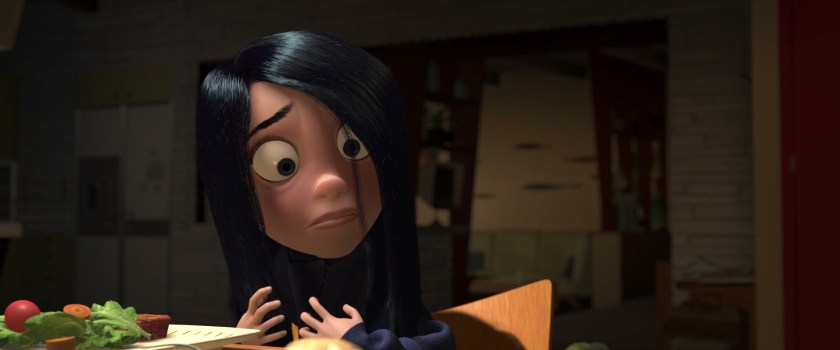
violet_incredibles
“Normal? What does anyone in this family know about normal? […] We act normal, Mom, I want to be normal!” – Violet Parr,Β Incredibles
But maybe it is harder to try to be someone I’m not, and waste my life wishing I were that other, neurotypical, person, than learning to accept and embrace who I am, struggles and all. Maybe it is harder, in the long run, to wear a disguise every day of my life and pretend that I never need help or support. I just know that right now I’m still too scared to take off that mask.

Posted in sqt

{sqt} – reclaiming joy

I noticed this week that my children never want to go to bed, because they are just having so much fun and don’t want the day to end, and they wake up each morning full of excitement about the day ahead.

My husband and I, on the other hand, have entered that exhausted parent state where we spend all day waiting for night to come so we can have some quiet space and rest. It makes sense that we end up there, but constantly looking forward to the evening has a tendency to rob the day of its joy.

How can I reclaim some of that joy I had as a child about the new day ahead of me, full of potential for discovery and adventure, for beauty and love?

I’m not entirely sure, but today’s seven quick takes are going to be some ideas I want to implement in my own life this upcoming week. Head over to This Ain’t the Lyceum for the rest of the {sqt} link-up!

  1. Reframe the moment: when something is irritating or inconveniencing me, is there a way to look at the situation through different eyes? For example, when one of my children is whining and flopping around about something, I tend to be instantly triggered into frustration. I want to yell at them to pick themselves up and show some independence! At the very least I want to ignore them until they stop whining. But though that is my automatic response, a change in perspective can help me build a more compassionate and helpful response. If I can hear the whining and think, “here is an opportunity for me to love and serve this child like God loves and serves me,” then I can help them with their needs and wants with more gentleness and joy (although I will still ask them to try using a different tone of voice!)
  2. Pause: this goes along with the first point, since a pause can be a good time to try to reframe a situation. But it is good and useful all on its own, also. Instead of coasting through my day on autopilot, pausing for all sorts of reasons can help me see the beauty and feel the joy of everyday life. I can pause to watch with pride as my children take turns with their favorite water bottle; I can pause and count to ten when I hear angry voices coming from the play room to prepare my heart before they come running out to me; I can pause; I can pause when the baby has made yet another awful mess and make the cleanup something we can do together rather than something to make her feel ashamed about. I can pause to breathe out a prayer and breathe in grace when life is overwhelming.
  3. Put the phone away: except for when I’m reading a good book or listening to a good podcast (things I can mostly only do when I’m alone anyways), phone time tends to be an escape from reality and as such hinders any attempt to find joy in my current reality. It distracts me from the good and happy moments of the day especially, since those are the times when the kids are least demanding of my attention – and so it blinds me to the everyday beauty of their growing relationships and maturing character.
  4. Have a plan: if I know at the start of the day something fun that we’re going to do later, the anticipation and enjoyment of that event can easily spread throughout the rest of the day. And if we don’t follow through with the plan because we’re having too much fun doing other things, that is also a source of joy πŸ™‚ It also eliminates some of the tension of looking forward through 12 empty hours not knowing what to expect and thus how to mentally prepare, and it breaks up the cabin fever the kids sometimes get when we’ve been in the house hiding from the heat all day. This could be some sort of outing (like the park or the library or even the grocery store), but it could also just be an activity or craft that we don’t do as often because it requires more set-up (like water balloons or finger-painting).
  5. Go to bed on time: because if I’m tired, it’s going to be a lot harder to feel happy. It’s going to be a lot harder to make the mental effort to reframe each moment. It’s going to be a lot harder to pause instead of reacting emotionally. And it’s going to be a lot harder to be present and engaged instead of sinking away into the virtual reality of my phone.
  6. Play with the kids: play is where they are finding their happiness, joy, and intellectual fulfillment right now, at this age. And they still want me to play with them a lot of the time! Essentially, they are inviting me into their happiness. All too often, being a boring (and tired) adult, I turn them down and find other “more important” tasks I need to do. But if I could let myself go – relax my body, forget the to-do list, ignore the “should’s”, suspend my disbelief – and play with them, even for a little while, I could in those moments have the presence and the joy that they have, and connect with them through it.
  7. Sing!: and dance! Move my body, stretch out of my comfortable shell, and make music! Music is so good for all emotional states – it expresses sorrow and anger, passion and despair, joy and silliness, peace and contentment, and in the expression elicits and draws out those same feelings in us, helping us experience them more deeply and process them more fully. So going back to point 4, I’mΒ planning on having a dance party to silly kids’ songs at least one day this week, and I’m not going to care if my kids think I’m crazy!

What about you? How do you find joy when life is monotonous or stressful?

Posted in wwlw

what we’re learning wednesday: episode 3

Today we went to the grocery store and learned about the way peaches smell when they’re ripe and good to eat (and also plums). I learned that Limerick will pull the leaves off of strawberries before he eats them, while Aubade will eat them leaves and all.

We learned about the strength of the wind in a storm when we saw huge branches torn off of trees by the monsoon that came through last night.

We learned about the hiddenness of the wind, how it can only be inferred by the consequences of its presence, last night as we watched that storm crash down the street and read Christina Rosetti’s poem about the wind:

Who has seen the wind?
Neither I nor you:
But when the leaves hang trembling,
The wind is passing through.

Who has seen the wind?
Neither you nor I:
But when the trees bow down their heads,
The wind is passing by.

Rondel wondered at how we can feel the wind when it presses against us even though we can’t see it coming with our eyes.

Today, we talked about how scary things can be when they are new and unfamiliar and unknown, when really they are good and beautiful things, because we discovered some books on that theme at the library:Β Tiny’s Big Adventure by Martin Waddell,Β What Do You Do With a Chance? by Kobi Yamada, andΒ Little Frog and the Scary Autumn Thing by Jane Yolen.

Earlier this week we made a 10×10 number chart and discovered that if we covered up all the odd numbers with flakes (all the numbers that can’t be split into two groups, as the boys say), the even numbers that were left all lined up in neat columns and had 2, 4, 6, 8, or 0 in their ones place. We also spent a lot of time figuring out which numbers would be visible if we covered up the ones that couldn’t be split into three groups, but we didn’t discover a reliable pattern yet for those numbers. (Limerick loved figuring it out for each number though, so I’m sure he’ll find the pattern pretty soon).

Rondel watched a documentary about the Galapagos islands and learned about an iguana that laid its eggs in nests of volcanic ash and so couldn’t leave the volcano summit of one of the islands, and also learned about the blue-footed booby for the first time and was impressed by how blue its feet really are!

And I learned that the best way to turn around a bad day is to apologize directly for my irritability and impatience, instead of just hoping it will go away and be forgotten.

Those are our recent highlights! What have you all been learning and discovering in your lives lately? What riches of knowledge and adventure have your curiosity and hunger to learn unearthed for you?

Posted in musings

because prejudice ends up hurting everyone

Recently, when I mentioned I wasn’t yet part of any homeschooling support groups, a (non-homeschooling) friend mentioned a local co-op called Branches, so I looked it up. It is far more structured and school-like than I am interested in, and also has several concerning (to me) points in its code of conduct and statement of faith. When choosing a homeschool group, as when selecting a private school, it is important to read through to that level of detail because no matter where the co-op or school falls academically, it will be detrimental to your child if its culture differs dramatically from your home culture or endorses cultish or prejudiced beliefs.

Some of those concerning aspects were (unfortunately) fairly familiar to me – the parent must sign a strict statement of faith, and must cede to the group’s board the final word on the interpretation of that faith. Considering they are not my pastors, nor theologians, nor even members of my church, I don’t think they can legitimately claim to have that level of authority. I did appreciate their honesty, however, in stating that while they believe the Bible is the final authority it is their interpretation of that authority that will have the ultimate say… it reveals a weak point in Protestant understandings of religious authority in general.

However, one point that I had not run across before was as follows. In a list of forbidden behaviors, along with things like cheating and bullying, the group prohibits “personal appearance and behavior contrary to one’s biological sex.”

Interesting.

That is so broad and vague. While it was most likely intended in a transphobic manner, it is so loosely worded that it essentially prohibits all display of non-gender-stereotypical behavior. So… apparently in this group, math is only for boys, and the girls can’t be competitive in STEM topics or hope for a career as a scientist. Apparently, it’s inappropriate here for little boys to wear pink and purple shirts, or play house, or take care of baby dolls (because heaven forbid they grow up to be engaged and involved fathers when they have babies of their own). Apparently, girls need to wear makeup, do their hair neatly, wear skirts, and make sure they stay clean when they play; boys on the other hand should probably get muddy every so often to avoid an appearance of girliness. According to the words in this code of conduct, it is ok for girls to giggle and cry with each other, but boys should stick to anger and aggression if they have strong emotions. If a girl does just happen to be athletic, she should definitely stick with acceptable sports like gymnastics and volleyball, and avoid playing pick-up basketball or touch football with the boys. And just to be on the safe side, boys should play with boys, and girls should play with girls, to ensure that all the play is happily gender-conforming.

How can a child feel free to explore the fullness of the world around them if they have to be worried about stepping over a (socially-constructed, averages-based, generally-applicable, ambiguous) line all the time? Even a feminine, female-identifying, biologically female individual is going to have some aspects of their personality and behavior that fall outside female gender-stereotypical lines (for example, I am a cis-gendered female who likes my hair cut very short, does not wear makeup or heels, and has a career in the hard sciences). In this group, would that behavior be censored in a (transphobic) attempt to force all people into one or other of two black-and-white categories? I’m guessing it wouldn’t be – but the exceptions would be tolerated in an unpredictable, social-norms-based way (kind of negating the whole emphasis on biological differences) instead of by any sort of reliable and consistent rubric, which creates confusion and has the potential to lead to shame or stigma.

And finally, because this is what this kind of discriminatory rule is really intended to address, what happens to the child who actually struggles with gender dysphoria? Here, they would not be met with support and help, but with shame and rejection. Here, they would be told that because their brains and their bodies aren’t in sync, they are unfit to be part of an educational activity with other children (a mixed-gender educational activity, no less). Here, they would be told that the shape of their body is more important than their identity, their natural inclinations, their talents and giftings, and their mental health and emotional well-being.

That isn’t ok with me.

Trying to discriminate against one group of people usually ends up this way, with the implementation of vague social rules that constrain and restrict all sorts of unintended behaviors while adding to the stigma and isolation faced by the target group. I would rather be with people who may not always act as I would, but who accept and love each other anyway, around whom I can be my authentic self and know their authentic selves. While this co-op may have good things to offer, they don’t outweigh the negatives of prejudice and social control. After all, we are homeschooling in part so that our children can be free to explore, learn, and grow in their own time and in their own way; we don’t need a group of self-appointed parental “experts” trying to shape us into their acceptable mold anymore than we need the public school system doing so. And I am sure that in the right time, we will find the right group and homeschool community for our family.

Posted in sqt

{sqt} – emotional self-regulation

In our house, we haveΒ big emotions.

It’s not too surprising, all things considered. Paul likes to attribute my temper to my “Cuban spice” (which is always highly embarrassing), and I tend to believe it is related to my autism (see an amazing article here which could have been written by me if only I were that insightful and eloquent), but wherever it originates from it comes on quickly and lasts indefinitely (forever really, unless I put in a lot of mental and emotional effort). Rondel is similar – flaring up like a match at an unexpected change or a trivial argument or finding out he was wrong about something he thought was a fact – although I’m not yet sure if he will be a grudge-holder like I was as a child. Limerick is constantly pushing himself, and will break down in frustration if he can’t accomplish something he feels he should be able to do. Aubade still uses shrieks and screams to communicate most of her (very strong) opinions and feelings, since she’s only just starting to take off verbally.

So right now, while academics are important and interesting and fun, I feel that emotional intelligence and self-regulation are also a very important area of emphasis for us. It may not come naturally for most of us in this household, but as I have learned over the years it is very helpful in life overall, so it’s something we’re consciously working on together: and these are some of the ways we’re doing that.

  1. Affectionate Physical Touch (e.g., hugs, snuggles, and read-alouds): Little kids are very physical creatures, and so making sure we have lots of time snuggled up together reading books, or letting them lounge on top of me while we’re playing with toys, or making a comforting hug the priority in a meltdown situation, is helpful in a number of ways. It acts as a preventative, helping keep emotional systems running smoothly so that crises are less likely to occur; and it acts as a balm, soothing and quieting the overwhelmed nervous system so that the rational brain can regain control and come up with a solution to the triggering problem. All three kids will come to me throughout the day for a hug when they are feeling sad, overwhelmed, or disconnected.
  2. Physical PlayΒ (e.g., running, wrestling, jumping on the trampoline): Going back to the physicality of children – but also appealing to research on the value of exercise for emotional health – wild, active physical play is also very helpful for learning to handle big emotions. Especially on days when everyone is struggling with irritability, and small triggers are escalating into large events, running and wrestling together seems to help us all shake off the mood fog and reconnect with each other in a positive way. So far this has been something I’ve had to initiate, as the kids seem to forget how good it feels to be active when they are grumpy and quarrelsome, but I’m hoping that as they grow they’ll be able to choose it on their own more often, as their bodies let them know they need it.
  3. Bodily NeedsΒ (sleep, food, water, sensory peace): This is kind of a broad one, but basically it is hard for a brain, especially a young developing one, to focus on managing emotional responses when a more urgent physical need is unmet. So meltdowns tend to happen more frequently when people are tired or hungry, or in overstimulating environments (crowds, loud noises, unpredictability, flashing lights, information overload, uncomfortable clothes, etc.). There are some easy physical ways to reduce the burden on your brain in these situations, such as never leaving home without snacks and water bottles, and never forcing yourself or your children to stay in an environment that is stressful and uncomfortable. For example, I let Rondel wear T-shirts and athletic shorts to church and take off his shoes in class, and the church has noise-reducing headphones that he can wear if the noise is bothering him. These accommodations reduce the amount of negative input his brain is dealing with, which in turn enables him to use more energy on social and emotional functions.
  4. Mindfulness: Ok, but sometimes you can’t prevent the emotions or avoid the triggering situation, and you still have to learn how to control your own reaction to the event. This can beΒ so hard when your emotional reactions tend to hit you like a punch in the stomach with no prior warning… but what I have found to be very helpful for me is simple mindfulness practice. When I am present in the current moment and aware of my body, I can begin to detect clues that my negative emotions are building up, and try to take steps to defuse them before they explode. I can choose to close my eyes, breath deeply, and focus on the breathing for a few seconds, letting my diaphragm trigger my vagus nerve to calm my body, mentally stepping away from the situation I can’t truly leave in the moment, giving myself a space to think and decide how I want to react before the words leave my mouth. I don’t think my kids have quite figured out how to take deep breaths yet, but we’ve worked on taking that space before reacting (in real time with conflict situations) and it was helpful for them as well.
  5. Mediation and Modeling: Since my kids are still so young, I find myself stepping in when arguments begin to escalate into more emotional conflicts. My goal in these moments is not to solve their conflict but to walk them through the process of resolving it themselves. I hug them, I listen to each one of them tell me what is going on from their perspective, and I attempt to rephrase the situation so that they can both agree that I understand (my initial understanding is often incomplete, and they will correct my phrasing until they are satisfied I understand). Then I will ask each of them in turn what idea they might have for moving on from the conflict, and help them come up with ideas if necessary until they can both agree on one. Sometimes they are able to go through this process independently, and I am so, so proud of them when they do!
  6. Peacemakers Cards/Time-in Toolkit from Generation Mindful: This tool for emotional development has been more than worth the cost for us. Currently, we primarily use the peacemakers cards and the accompanying poster and stickers. I will hold out the deck of cards and let the boys take turns choosing ones, and we’ll spend time talking together about what the cards say: phrases such as “I am kind,” or “I stick with things and get things done,” or “I am adaptable – let’s move and dance!”
    peacemakers_dolphin_cards_amazon_photo_2017_1024x1024
    The “Peace Dolphin” overview card, with the five individual cards from the poster. We recently did Peacemakers after a big fight and randomly pulled three dolphin cards in a row… they were extremely helpful in processing the event, handling the emotions, and planning for the future.

    We talk about ways the boys have recently lived out those phrases, or times when we saw examples of it in a book we love, or situations where it might be challenging to embody them. For card with an action, like the last one in the list above, we’ll get up and act it out (it’s always fun to start silly dancing around the bedroom, after all!). I realize this may sound dull but the boys ask me if we can do Peacemakers cards on a regular basis, and it has led to some great conversations.Β he other poster in the toolkit has a lot of suggested strategies for calming down in emotional crisis, as well as a few charts representing different feelings in comparison to each other, and those have been helpful as well. Sometimes it’s hard to think of a coping strategy in the moment, so having the visualization on hand can be useful.

  7. Prayer: Of course prayer. Always prayer. Prayer for the fruits of the Spirit in my life each day. Prayers for peace, almost as a mantra, over and over again in the worst times. I remember when Limerick was little and I’d be hit by a wave of anxiety or stress that I would pray “Father, give me peace. Jesus, give me peace. Holy Spirit, give me peace.” Simple enough to repeat when I had no head space for words or complex thoughts, powerful in its reminder to me of the Trinity in all His love and presence. Prayer for connection with my Father, just as important for me emotionally and spiritually as is my young children’s connection to me and Paul is for them. Prayer to the saints,to have their community and support with me when things are too overwhelming for me on my own. Prayer to Mary, the mother of the church, who loves me and my children and helps me to be a better mother to them. Scripted prayers when I’m feeling disconnected and my own words won’t flow; spontaneous prayers when my heart is crying or rejoicing. Emotional regulation isΒ hard for me, and probably always will be – I can never seem to find the middle ground between keeping everything in and letting everything out! But as in every other area of life, God in His grace is sufficient in my weakness: loving me as I am and helping me to grow.

This doesn’t even go into things like self-care and quiet time and community, which are all so helpful for lowering one’s negative emotional baseline and raising one’s trigger threshold – there are so many ways to help develop these skills and create a protective buffer around areas of weakness to keep them from causing damage and regrets. But these seven are some that I found particularly valuable for our family in this season of life, and I hope that they are helpful for you as well!

I’m linking up withΒ This Ain’t the Lyceum today, so head over and read some of the other Quick Takes!

What are some strategies you use for keeping your emotions from getting out of control? What helps you the most in moments of overload or anger?

Posted in wwlw

what we’re learning wednesday (episode 2)

Limerick is currently in love with numbers.

He counts everything he can, comparing amounts and sizes: he counted all the straps on the plastic pool chairs at the public pool Saturday afternoon, at least ten times in a row; he makes long chains of flakes and counts them over and over again as he builds to find out how long they are and which color is the longest; he counts the number of bites or slices on his plate and recounts each time he eats one. Essentially, he is spending time with the numbers and quantities, becoming friends with them, getting to know how they interact with each other and discovering their unique qualities.

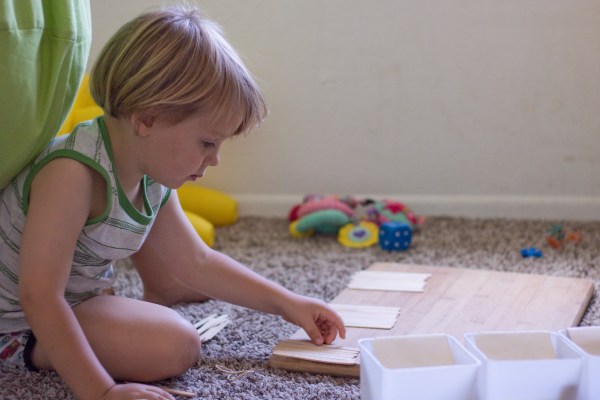
IMG_0210
Limerick figuring out how many sticks could fit on the length of our big wooden cutting board – I think it was somewhere around 40.

He will break numbers down into their component groups: if he builds a tower with fourteen wooden blocks, he will tell me proudly that it is two groups of seven. When he expanded his tower to eighteen blocks, I asked if it could split into two equal groups and he lined them up into two equal lines and counted each one to make sure that they both contained nine blocks. When I then asked if it could split into three groups, he made many little groups of three blocks and found out there were six of them – so, six groups of three and three groups of six. Since he’s been doing this on his own anyway, I introduced the vocabulary of “even” and “odd” to him.

“See this group of seven? I can’t break it into two groups of the same size – one of them is always bigger than the other. Numbers like that are called odd.”

Limerick pondered, then declared, “But eight is two groups of four!”

“Exactly! Numbers that can be split into two groups of the same size are called even!”

“Nine would be five and four,” Limerick told me with a slight frown, “but ten would be five and five!”

“So nine is odd, and ten is even!”

We’ll see if he remembers – he tends to hold a new word to himself for a week or so after he learns it, before he brings it out for everyday use.

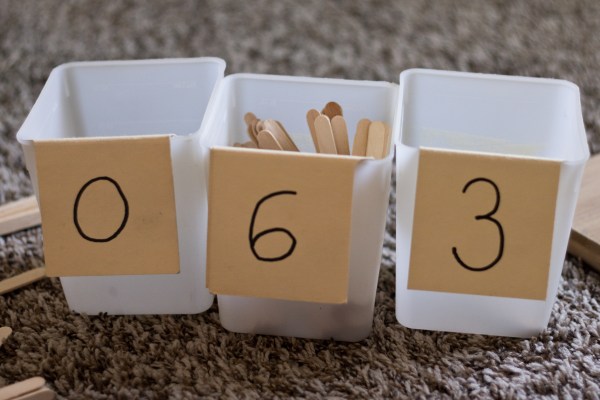
Emboldened by all the math talk going on, I pulled out one of my favorite math tools from my own childhood (one that I believe my mom created, and that she now uses in her job as a remedial math professor at the community college):

IMG_0214

It’s a physical representation of place value – the numbers on the cards in front show what the number would look like written down, while the buckets hold the appropriate number of craft sticks. In this picture, there are three single craft sticks in the box on the right, six bundles of ten craft sticks each in the middle box (the tens place), and nothing in the box on the left (the hundreds place).

We pulled out some huge foam dice and decided to take turns rolling and adding the number we rolled to the number already in the buckets:

Sometimes the boys knew right away what the answer would be; other times they would line up all the sticks to count them to make sure, and to bundle up the new ten-pack if needed.

IMG_0207
Limerick verifying that the three bundles of ten sticks in the tens place bucket really did equal 30 total sticks! I liked how he lined them up in groups of ten instead of just all in one big pile.

Before this we hadn’t done much with written numbers – the boys know all the digits, but they didn’t understand double digit numbers. So it was a bit confusing at first for them, but by the time we stopped I think they were beginning to understand what the numbers meant and looked like, which is really cool!

Math tools and games like this aren’t necessary for learning math – Limerick has certainly been picking up on concepts ranging from quantitative comparison to division (with even a touch of fractions) just from everyday conversations about the numbers around us – but they are definitely helpful for illustrating a specific concept, challenging the mind to use a concept in a new way, or just having fun together with numbers! And since all you need for this particular tool are buckets, sticks, and paper, it doesn’t get much easier πŸ™‚


Posted in family life

and just like that he’s five

This month, my baby boy turned five years old. Five years ago now I heard his choked little cry before the nurses cleared out his throat, and saw his little round and red face scrunched up at me for the first time. Five years ago I fell completely, deeply, in love with this tiny new person, and he fell completely and deeply back in love with me (as babies are wont to do; the reciprocity is helpful for both parties πŸ˜› ). And as he grows older, and as I learn more about him as he comes to understand himself and discover the world around him, I find that I only love him even more.

IMG_0113

It is so wonderful to watch him as he grows in every way – social, emotional, intellectual, spiritual, and physical. This year he has begun singing, albeit in more of a “sustained talking” manner to borrow fromΒ The Music Man, and even sung Happy Birthday to his Bisabuela Carmen on the phone for her birthday! He is learning how to compromise and be flexible when playing with others (though I think people never stop needing to improve here), and how to establish rules and set patterns that minimize the chances of unexpected necessary compromise or change. He and Limerick have begun to do things in alternating patterns – who gets to snuggle with me at bedtime, for example, or who gets to pick first when they’re selecting toys – so that the negative event isn’t a surprise and the positive event can be anticipated. He even told me the other day that sharing (by which he meant both of them drawing from the same pile of toys) was hard for him, but when they could sort the toys into two piles first it made it a lot easier for him to play with Limerick, and I was proud of his self-awareness.

He has a keen and accurate memory, often reciting back to me his favorite books, or using phrases he’s heard from me in conversations with others. He’ll also take a plot line or a story from a book and alter it ever so slightly to make a new story – for example, retelling the tale of the Three Billy Goats Gruff with a different animal like a pig or a cow for the main character. As the elements of the story become more comfortable to him, he’ll start altering them even more: building bridges with his toys and having a T-Rex lie in wait underneath them, for instance. It is so fascinating to me to watch his play incorporate the events, stories, and discussions of his life, giving him the chance to explore, process, and understand them in more depth.

He is an ardent collector of both facts and things, storing up information in his database of a mind, and storing up found treasures in a many-compartmented fold-open fishing box that he received for his birthday. Anything interesting or strange or beautiful, whether a concept or an object, is bound to end up in his collection, to be catalogued, admired, and shown to others with the excitement of revealing something precious and wonderful.

He is quick to anger, a trait he inherited from me, but his temper is paired with a compassionate heart. He is quick to apologize, and is often angry not on his own behalf but because someone else is hurt. I have seen him yell at Limerick because Limerick made Aubade cry; I have been lectured by him if I have been too rough and made Limerick upset; and he will physically attack anyone who hurts someone he loves. Unlike me, he seems willing to let his anger go as quickly as it comes – but like me, he can be moved to tears by the plight of even a fictional character (he was so devastated when he realized Littlefoot’s mother dies in Land Before Time… he tried to deny it and ended up crying in my arms.)

He is probably going to lose his idiosyncratic pronunciations of words soon, as he grows older, and I’m going to miss a lot of those. I mean, he’ll be easier to understand, but the way he says “booga” for “beluga” makes me smile every time I hear it πŸ™‚

He has become an adept builder this year, with Viahart brain flakes as well as with Duplos, Legos, and wooden blocks. He can make representative animals with Duplos that are as good as anything I can create, and invents dragons and monsters with the brain flakes that incorporate features from around the animal kingdom – crest feathers, spikes, beaks, wings, tails, and so on. And everything he builds has a voice and a name and a place in his imaginary world for the day; he has shown little interest in the symmetrical shapes, stars, and patterns Limerick and I design.

And of course, he loves animals (though, as he would say, not as much as swimming or Mommy) – animals close and tangible, animals at the zoo, animals in books, animals in movies, animal toys, animal pretend games. He remembers which animals give birth to live young and which lay eggs; he remembers which animals hunt and which prey they are able to catch; he remembers what size many animals are, and which animals live near each other. Sometimes if I don’t remember some detail about an animal, but suspect that it had come up in one of the documentaries he loves, I’ll ask him about it, and more often than not he’ll know the answer. He also creates his own animals, absurd menageries of bears as big as a million houses, or monster fish who can hunt blue whales, and regales us with tales of their adventures.

IMG_0109

His energy and imagination are abundant and bursting with life – which is pretty much just how things should be when a person reaches five years old – and he knows how to lose himself in happiness and wonder. It’ll be exciting to see where this next year takes him!