Posted in family life, quotes

different

Learning to love ourselves, to be humble enough to admit our limitations, to truly appreciate the gifts our differences bring while also being willing to accept help and healing for the most painful ones, gives us greater mental, emotional, and spiritual health. […]

We are so often encouraged to fit into the boxes of academic achievement, intellectual prowess, recognizable achievements, personality profiles, status, money, power, external significance—to perform, to fit in the box, to be acceptable. Yet our wonderful God loves us unconditionally, now and forever. We do not have to work to please Him. He values us for what is inside our hearts—our character and integrity, our ability to love, to be faithful, to help others, and to show compassion. Our individual personalities are a gift of His design so that we might add color and variety to the world. And He can use our unique combination of circumstances—even the painful ones like mental illness—for our good and His glory.

Sally Clarkson, Different

One of the most romantic and wonderful things about my husband is that from the very beginning of our relationship he has valued me for my character and heart more than for my intelligence and knowledge. I’ve always been smart and been perceived as smart, and while it wasn’t a difficult appearance to maintain (because, at least when it comes to academics, I am quite smart), it always left me feeling somewhat empty when that was all people would see. Intelligence was a gift, a talent, but not me. So when I found this man who loved me for who I was, who saw all the other aspects of my character and personality and delighted in them, I was profoundly and deeply touched. It helped me understand God’s unconditional love; it helped me begin to love and accept myself as God made me; it is helping me now learn to love my children with that kind of acceptance and delight in all their uniqueness – even when those unique traits are difficult to understand or tame.

Different is a book written by a mother and son together, telling the story of a different and difficult childhood and the love and acceptance that carried their family through their struggles. After reading the first chapter (available here) and listening to an interview with both authors on the Read Aloud Revival podcast (available here), I’ve decided that I need to get my hands on the whole book and read the rest of it! I want to learn how to love my children as they are, while still guiding them towards maturity; I want to learn how to help them flourish best without coddling or overprotecting them. I want to stop listening to the critiques and judgments of the ignorant world and start listening to the needs and dreams of my children’s hearts: it was God who made them with those needs, God who gave them their deepest longings and most beautiful dreams, and I am only His steward, raising these children for a time, so who am I to ignore their truest selves or demand that they be other than He created them to be?

Posted in musings, quotes

the social underpinnings of racism: Trump and the 1950s

In the wake of Trump’s ascension to the presidency, a lot of people like me were left wondering how so many Americans could be so angry and feel so wronged that they were willing to tolerate blatant racism and misogyny in their leadership. There’s been a lot of confusion and a lot of anger, and not a lot of dialogue; each side tries to defend its beliefs by reciting wrongs against itself, or attempts to seize the moral high ground and demonize its opponents instead of listening to their grievances. It’s one of the reasons I’ve had to severely limit my social media time…

But as I was reading The Family Nobody Wanted, by Helen Doss, written before the height of the Civil Rights Movement, in the aftermath of the Japanese internment camps of WWII, I came across a passage that seemed quite relevant today:

First, prejudice is a contagious disease, as easily caught as measles, the babe from his parents, the school child from his playmates, the adult from his fellow workers and neighbors. To compound the social tragedy, prejudice once caught is hard to cure, since it unwittingly serves a number of morbid purposes. When a man is picked on by his boss, he can slam home and take it out on his family, and frequently does; however, a more socially approved outlet is to turn around and release the feelings of hate and anger on those of a minority racial group. If denied certain yearned-for opportunities and privileges, there is a devilish quirk within man which gives him perverse satisfaction in seeing that at least one segment of the population enjoys even less opportunities and privileges than he.

If a person feels socially or mentally inferior, has a persecuted feeling that society is crushing down on him, it is easy to bolster waning self-confidence by convincing himself, “At least there are whole groups of people socially, mentally, economically inferior to me.” Worse yet, he will try to keep minority groups in a deprived and subjugated position, to prove what his ego wants to believe.

Psychologists and psychiatrists have long told us that bottled-up feelings of aggression and anger can be dynamite to the happiness and well-being of the individual who refuses to recognize real causes behind his maladjustments. Multiply these fearful and emotionally tense individuals by thousands, by even millions, and you have social dynamite… Hostility will be exploded in any area where society permits it…

War has always been a socially glorified outlet for pent-up angers and frustrations of whole peoples. In America, our Negroes have provided another scapegoat, and so we have had race riots, Jim Crowism, and the Ku Klux Klan. On the West Coast first the Chinese, then the Japanese, provided another handy outlet for our inner tensions, and we have had discrimination in jobs and housing, an Orientals Exclusion Act, and the “relocation centers” of World War II.

The anger and other negative emotion of the dissatisfied people who voted for Trump is real. Many people felt disenfranchised, ignored, stuck in a world they didn’t ask for, unable to change their fate, feeling like their communities and families were broken. And Trump acknowledged those emotions when most other politicians were oblivious to them. Would these people on their own have decided to take out their anger on immigrants, women, and other minorities? I’m not sure; in many cases, I don’t think so. I know a lot of good people, who care deeply about human dignity and equality, who voted for Trump for one reason or another, trying to look past his faults. But Trump himself has most definitely established those groups as “acceptable” targets for the pent-up anger of anyone who feels ignored, overlooked, or under-appreciated; he has made them the scapegoat of the failures and frustrations of the majority.

Like it or not, whether you as an individual are racist or not, Trump has bolstered the cause of racism by making it more socially acceptable once again; he has directed the force of social anger towards some of the most vulnerable and unrepresented groups of all; he has given hostility a safe place to explode, and so set our country back in its fight against racism and for the equality of all. Racism is in so many ways a systemic issue, not an individual issue; that is why the attitude of the president is so powerful and influential. That is why it matters so much, especially now, to speak up against racism, to push social pressure against it as much as possible.

Posted in musings, poems, quotes

remembering Christmas

There has fallen on earth for a token
A god too great for the sky.
He has burst out of all things and broken
The bounds of eternity:
Into time and the terminal land
He has strayed like a thief or a lover,
For the wine of the world brims over,
Its splendor is spilt on the sand.

Who is proud when the heavens are humble,
Who mounts if the mountains fall,
If the fixed stars topple and tumble
And a deluge of love drowns all –
Who rears up his head for a crown,
Who holds up his will for a warrant,
Who strives with the starry torrent,
When all that is good goes down?

For in dread of such falling and failing
The fallen angels fell
Inverted in insolence, scaling
The hanging mountain of hell:
But unmeasured of plummet and rod
Too deep for their sight to scan,
Outrushing the fall of man
Is the height of the fall of God.

Glory to God in the Lowest
The spout of the stars in spate –
Where thunderbolt thinks to be slowest
And the lightning fears to be late:
As men dive for sunken gem
Pursuing, we hunt and hound it,
The fallen star has found it
In the cavern of Bethlehem.

Christmas is past, but it need not be forgotten. How do we move forward from Christmas and carry it within us as we go? Chesterton hints at the answer here, I think: that it is to continually throw ourselves downward, as did God Himself in the Incarnation, in love, service, sacrifice, and humility. It is those who are afraid of falling who fall in the worst way possible; those who cast themselves into the downward rush of grace will find they have nothing to fear in even the farthest fall and the greatest humiliation. One of C.S.Lewis’s most powerful images comes to my mind, here, from The Great Divorce: that of the great waterfall in Heaven, thunderous and beautiful, which is more than just a waterfall, standing as one crucified, pouring himself over the edge in glorious self-giving.

That is God. That is Christmas. And that is how we ought to live in God long after the songs and nativities are packed away and out of sight: because His plunge to servitude and sacrifice doesn’t end with the season.

Posted in musings, quotes

patriotism vs. the presidential election

As the weeks go by, my hope for our nation in the upcoming presidential election is steadily eroding. We’ve narrowed the race down to two people who are known to lie and manipulate events for their own gain; one of them is, in my opinion, of significantly worse character and far more dangerous as a leader, but I honestly would rather have neither of them. I suppose the difference for me is that while I can find some things to respect about Clinton, despite my utter disagreement with her on abortion, I haven’t been able to find anything to respect about Trump. Being rich and marrying attractive women, his sole accomplishments in life, are not particularly worthy of respect in my opinion…

And the thought of Trump winning the presidency and representing my country on the global stage makes me blush with shame – to the point where I am tempted to abandon my country, flee somewhere else, attempt to build a new identity and integrate into a different nation, one that actually valued honesty, self-control, responsibility, and community. But these words keep coming back to me, the words of G.K. Chesterton that I’m sure I’ve quoted before:

My acceptance of the universe is not optimism, it is more like patriotism. It is a matter of primary loyalty. The world is not a lodging-house at Brighton, which we are to leave because it is miserable. It is the fortress of our family, with the flag flying on the turret, and the more miserable it is the less we should leave it. The point is not that this world is too sad to love or too glad not to love; the point is that when you do love a thing, its gladness is a reason for loving it, and its sadness a reason for loving it more. All optimistic thoughts about England and all pessimistic thoughts about her are alike reasons for the English patriot. Similarly, optimism and pessimism are alike arguments for the cosmic patriot.

Let us suppose we are confronted with a desperate thing—say Pimlico. If we think what is really best for Pimlico we shall find the thread of thought leads to the throne or the mystic and the arbitrary. It is not enough for a man to disapprove of Pimlico: in that case he will merely cut his throat or move to Chelsea. Nor, certainly, is it enough for a man to approve of Pimlico: for then it will remain Pimlico, which would be awful. The only way out of it seems to be for somebody to love Pimlico: to love it with a transcendental tie and without any earthly reason. If there arose a man who loved Pimlico, then Pimlico would rise into ivory towers and golden pinnacles; Pimlico would attire herself as a woman does when she is loved…  If men loved Pimlico as mothers love children, arbitrarily, because it is theirs, Pimlico in a year or two might be fairer than Florence. Some readers will say that this is a mere fantasy. I answer that this is the actual history of mankind. This, as a fact, is how cities did grow great. Go back to the darkest roots of civilization and you will find them knotted round some sacred stone or encircling some sacred well. People first paid honour to a spot and afterwards gained glory for it. Men did not love Rome because she was great. She was great because they had loved her.

 – G.K. Chesterton, Orthodoxy

What our country needs is not for us to wring our hands in fear, or throw them up in dismay, or give up in despair; what she needs is for us to love her and to labor for her restoration and beauty. It is a harder and a more painful task, especially when faced with the anger and resentment of so many who don’t love their country or their communities, but a necessary one if true and worthwhile change is to take place. And this is where the virtue of patriotism lies, not in praising our country or her leadership no matter what poor choices are made, but in loving her enough to care about even the poorest and least likable of her people, to make right the things that are broken and rotting in her systems and communities, to see both her beauties and her flaws and admire the one while acknowledging and working to change the other.

Posted in musings, quotes

looking up at the heights

“Dear me! We Tooks and Brandybucks, we can’t live long on the heights.”

“No,” said Merry. “I can’t. Not yet, at any rate. But at least, Pippin, we can now see them, and honour them. It is best to love first what you are fitted to love, I suppose: you must start somewhere and have some roots, and the soil of the Shire is deep. Still there are things deeper and higher; and not a gaffer could tend his garden in what he calls peace but for them, whether he knows about them or not. I am glad that I know about them, a little.”

Like Merry, I have grown in a deep, rich soil; my mind, my heart, and my soul have been nourished well by the people, books, and experiences I’ve had. And I’m thankful for that! But sometimes I catch glimpses of the things that are deeper and higher: the beauty, the truth, the holiness that stands guard around the simple things I know and love, and sanctifies and transforms it. Can I see it fully, or remain there long? Not yet. But I am glad for what I can see, and hope to see more someday – and maybe grow into those greater things myself, at some point.

Merry’s deeper understanding of the great and true things around him leaves him not with a contempt or disdain for the little things and the simple everyday things that characterized his life in the Shire, and I think that’s an important point. It is a sign that we have strayed away from beauty and truth when we begin to feel that contempt, I believe, as Saruman did when he chose to pursue power, knowledge, and control instead of wisdom, goodness, and beauty; true growth will leave us instead with a deeper appreciation for all that was good and noble in what we knew before.

Posted in musings, quotes

prayer for a new day

Sometimes the best prayers are short and simple, expressing in a few words what I struggle to communicate, capturing the essence of what I desire to offer to God and become in Christ without turning into a litany of praises or requests. And first thing in the morning, when I’m foggy from too-little sleep and worried about the day to come, a simple prayer can remind me of the perspective that truly matters.

“At the dawn of a new day, fill us with your mercy,
That the whole day may be a day of joy and praise.” – from the Divine Office

Isn’t that such a beautiful way to look at the beginning of a new day? That we may be filled with God’s mercy and so live out the day in joy and praise – that we may be filled with Christ and thus live in Christ and for Christ – that our unity with Him may be increased, that all the good that is in Him might be in us and in the world through us.

Posted in quotes

let my love for you grow deeper

This is how to reach for perfection: not by our own strength or goodness, but by the grace and love of Christ. This is the perfection to reach for: not our own success or fame, but the fullness of knowing and loving God.

O God, let me know you and love you so that I may find my joy in you; and if I cannot do so fully in this life, let me at least make some progress every day, until at last that knowledge, love and joy come to me in all their plenitude. While I am here on earth let me learn to know you better, so that in heaven I may know you fully; let my love for you grow deeper here, so that there I may love you fully. On earth then I shall have great joy in hope, and in heaven complete joy in the fulfillment of my hope.

St Anselm, from the Proslogion

May my life be pointed to heaven, and thus to Christ, for the wonder of heaven is the fullness of our relationship with Christ and our closeness to Him; may I not think of heaven as just a happy place to do my own thing for eternity, but as the fierce joy and fulfillment of wild hope that it is, where there is finally no sin pulling me away from the God I love; and may my focus on heaven lead me each day to know and love God more deeply here on earth.

Posted in musings, quotes

vocational marriage

I’ve been thinking about marriage for a few weeks now, in a conceptual sort of way, and I liked this quote I ran across:

Marriage is a vocation, inasmuch as it is a response to a specific call to experience conjugal love as an imperfect sign of the love between Christ and the Church. Consequently, the decision to marry and to have a family ought to be the fruit of a process of vocational discernment.

– Pope Francis, Amoris Laetitia

It’s easy to think of marriage in terms of romance and pleasure, or in terms of stability and security. Those, at least, are the common ways in which I see it presented. But both of those paradigms have a tendency to fall apart and betray us… the romance fades, we begin to seek (and find) pleasure in other people, emotional tensions escalate to the point where they’re not a fair trade even for financial security.

When marriage is viewed as a sign of the love between Christ and the Church, however, it doesn’t so easily crumble. After all, Christ never stops loving the Church no matter what crazy circumstances life throws at Him (or us)! There is a call to faithfulness, a commitment to sacrifice, that demands everything we have – so if we enter into marriage prepared with that mindset, our marriages are far more likely to endure. This mindset also suggests, however, that one should approach marriage with the same sort of serious deliberation with which one approaches faith or a call to religious life, understanding that this is a covenant and pledge which will change and shape the rest of one’s life: hence, of course, Francis’s encouragement to discern if it is truly one’s vocation before entering into it.

Do we do this? Or do we treat marriage as our automatic life plan, assuming we can find a partner? Do we say, well, I want the romance and the intimacy and the security and the friendship and the tax benefits and maybe a kid or two as well, so marriage sounds like the way to go – or do we say, am I ready, am I mature enough to sacrifice myself for another person, am I truly called to enter into this covenant, am I prepared to open myself up to new life?

Posted in musings, quotes

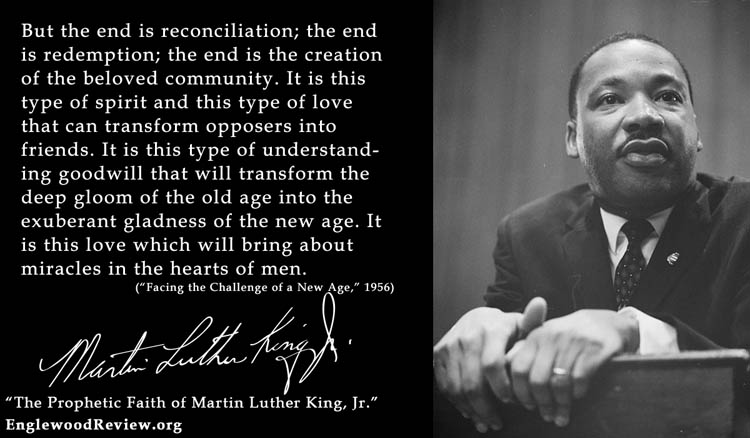
in memory of martin luther king jr

Today we remember the assassination of Martin Luther King Jr.

In the early church, people memorialized the martyrs by celebrating the day on which they died, because it was on that day that they were born into the fullness of new life in Christ and freed from the sinful tendencies of the flesh. In that spirit, then, today would be the appropriate feast day and memorial for Martin Luther King Jr., commemorating the death he died fighting for the freedom of his people, a fight that was both informed and characterized by his faith.

Of all the things that impress me about MLK, the ones that I think amazes me most are the tenacity with which he held to his faith in the face of the fear, antagonism, oppression, injustice, violence and hatred aimed at him by people who claimed to share that same faith, and his insistence at operating peacefully and striving for love when he was receiving all of that in return. How close he must have been to Christ, to keep living for Him in the midst of that storm of darkness! How strong his character must have been, forged in trials and infused by the Spirit Himself, to not waver on his principles or beliefs through all of his years in the civil rights movement!

I can tell you honestly that I don’t think my faith and character would hold up to the trials he faced. I can guarantee that I wouldn’t have faced those situations and people with the same combination of boldness and grace – I would have been running and hiding and hoping no one noticed me.

But his faith sustained him, his love directed him, and his courage kept his feet on the hard and beautiful path he had set out on. May we follow his example, and never by our silence, fear, or ignorance be complicit in the injustices he battled against.

MLK-Quote1