
Watching my children play, I am reminded of the wonder and beauty of small and simple things. There is enough joy in a glass of milk to send a three year old dancing around the kitchen; there is enough beauty in a well-done coloring page to keep a distractible, active four year old still and entranced watching it happen; there is enough passion in a stuffed animal to occupy the full attention and imagination of the one year old who walk around snuggling and protecting it. Continue reading “wonder”
Category: family life
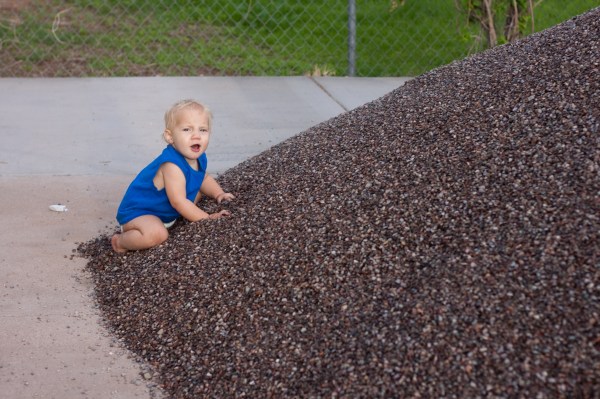
pea gravel!
When we moved into our new house last summer, the home had been mostly fixed up (aside from a few plumbing issues that surfaced in our first month living here… old pipes) but the yards were completely flat dirt. Horrible dusty barren dirt, too, filled with trash; even the Bermuda grass could only survive in a few patches.
We’ve been slowly trying to make the space both aesthetically pleasing and functional, so towards that end we got twenty tons of pea gravel delivered one weekend, to fill in a play area in the back yard.
acceptance vs. awareness
I’ve been spending a lot of time on Pinterest lately, in an effort to avoid Facebook (and while waiting for my books on hold to become available!), and I’ve found some really encouraging, helpful, and inspiring posts! I’ve also found quite a few off-the-wall recipes that I’ve made to varying familial approval… but let’s not dwell on that.
I think the following two images which I found there are amazing examples of the difference between awareness of autism and acceptance of autism (the first was uploaded directly to Pinterest by a user, and the second is from the Thirty Days of Autism blog):


Notice how in the first poster only the negative effects of autism are mentioned: meltdowns, avoidance, tears, frustration, worry, and stress. Autism is an evil, something that one needs to fight through with hope and prayer, like a sickness that needs to be overcome and that left unchecked would destroy one’s life. (And if it were a sickness, like cancer, that would be more than fine! As it is actually a neurological and developmental difference that is always going to be part of who a person is, however, this attitude can feel like a personal attack on an autistic individual’s identity.)
In contrast, the second poster focuses on the unique behaviors caused by autism – things that are different from normal, but neutral rather than negative: parallel play, a need for space, deep focus and passion, love of technology, and stimming. Autism is portrayed as a part of who that family is – something for which they love each other, not something despite which they love each other. Acceptance gives them the freedom to be themselves, however autistic that self might be, while still receiving unconditional love and support in the midst of their individual needs and struggles.
Let’s just say I know which lens I’d rather be seen through – and therefore, which perspective I want to take when raising my differently wired child.
fear of change
After eight years of working in a genomics research center, I’ll be transitioning to being a stay-at-home parent a week from now. Technically I’ll be working eight hours a week, in a sort of consultant role, which will keep me connected to the science – but it will still be a big change. It’s what I’ve been wanting ever since Rondel was born almost four years ago – but as it approaches, I find myself becoming more and more anxious.
I like my job, and I am good at my job. My supervisor respects me and my opinions; the researchers who rely on the services our facility provides respect me and my scientific knowledge and experience. I know what types of problems are most likely to arise, and I have tools and strategies for troubleshooting them. And I know that if I put in time, effort, and energy, I will have a successful outcome.
To be totally honest, I really like having the respect of other professionals whose opinion I value and who do innovative and important research. It gives me self-confidence: I may be a complete wreck if I have to call my doctor to schedule an appointment, but when I sit down with a researcher to discuss their experiment and figure out the best plan for them to take moving forward, I am completely at ease. It also gives me a sense of identity and self-definition: when acquaintances ask what I do, I can tell them about the science and feel that I’m doing something of worth, something that uses my talents and gifts, something beyond just staying at home and cleaning and cooking like any other person could do.
At the heart of my nervousness about the transition, then, I think, is a fear of losing that respect and identity – of becoming part of the crowd, no one in particular, no one with any valuable skills or gifts to offer my community. When I spend time with other moms, I feel so inadequate in the areas they are gifted in: my home is rarely clean, laundry and meals happen on an as-needed basis rather than with planning, small talk eludes me, playdates terrify me, schedules and extra activities overwhelm me, my children are dirty and wild. My mind is usually lost in a book, or an idea, or a project, instead of focusing on the people around me. I say nothing and feel isolated, or I say too much and still never manage to connect with anyone else. I simply don’t have the skills that these other women have, and without them, I’m not sure where I can fit in or belong in the mom world (especially the homeschool mom world… those women are so organized that I give up just at the thought of trying to be like them).
In the workforce, in academia, where everyone is a bit weird and everyone is valued simply for the expertise they offer, I knew where I fit in and I knew how I could flourish.
In this new world, I’m afraid I won’t ever be able to flourish – and that in my lack of flourishing, I will stunt my children’s future as well.
I’m not going to let my fears make a decision for me, when I believe on principle that a self-directed education is ideal for children, and when I observe pragmatically the stress that a classroom environment would add to our family life. I’m going to choose to let my love for my family be the motivating factor here instead!
But I’m still afraid.
his hands were dancing
Hands are useful communicators.
Sometimes we use them deliberately, pointing at an object of interest or gesturing to show how large or small an item is.
Other times they are less intentional – for example, someone may scratch their head or rub their chin while thinking, subtly communicating to others that now is not a good time to interrupt them, or that the pause in the conversation doesn’t mean they aren’t paying attention!
Sometimes we are able to communicate emotions or needs with our hands faster than we are able to share them verbally.
My husband and my mom will both notice when my hands drift to my arms and start picking (a sign of escalating tension or anxiety, typically), and try to address whatever is going on; it would be very difficult for me to break into the flow of the conversation to bring up my anxiety until I was much closer to a meltdown.
Another good example of this is from Rondel the other afternoon, when he saw a bee near Aubade in the kiddie pool and started flapping his hands frantically until I came over and asked what was wrong; he told me later that his hands were telling me that he needed me. The worry of the moment made it difficult for him to access the relevant words, but his hands were able to alert me that something was going on.
Probably my favorite expression of hand communication, however, comes from a moment when Rondel’s hands were demonstrating a thrill of joy.
We were stopped at a red light waiting to turn left out of our neighborhood, and the boys asked me why we weren’t moving. “We’re waiting for the light to turn green,’ I explained, and showed them where to watch for the green light. When it finally turned green, Rondel’s hands went crazy waving around – and a minute later, when he had calmed down, he told me (referring to himself as “you”) that “Your hands were dancing because you were so excited that the light turned green!”
His hands were dancing.
I can’t really think of a more beautiful way to express the unadulterated, uninhibited demonstration of joy and excitement that is Rondel’s happy hand flapping. His hands were communicating to me the rush of pleasure that he was feeling, allowing me to share in it more deeply than a verbal declaration would have accomplished.
stepping outside of routine
Change is hard. Routines give life structure and reduce anxiety. This is probably especially true in a partially autistic household…
But sometimes, you have to swallow your fears and set out into the great wide somewhere, without knowing what might happen, even expecting that something may happen for which you are utterly unprepared.
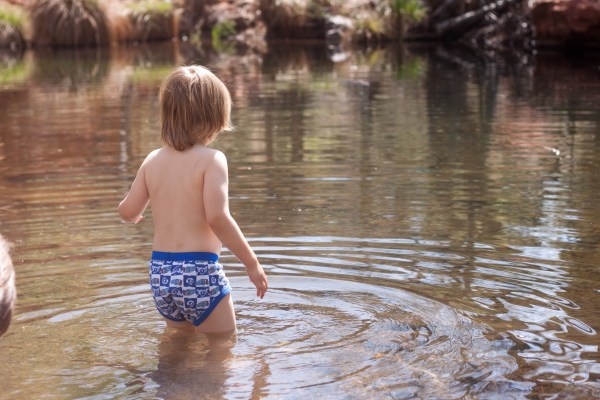
And then, sometimes – more often than your fears would lead you to believe – there is freedom, and there is joy.

There are places and times when the beauty and the wonder overcomes the discomfort of uncertainty or freezing water, and happiness can reign uncontested.


There are moments when the lure of the next rock over proves greater than your apprehension about the deep pool that lies between you and it, and moments when crossing over through your fears ends up being one of the best parts of your day because that thing you were so worried about is actually something you love, that brings out the adventurer in your soul.
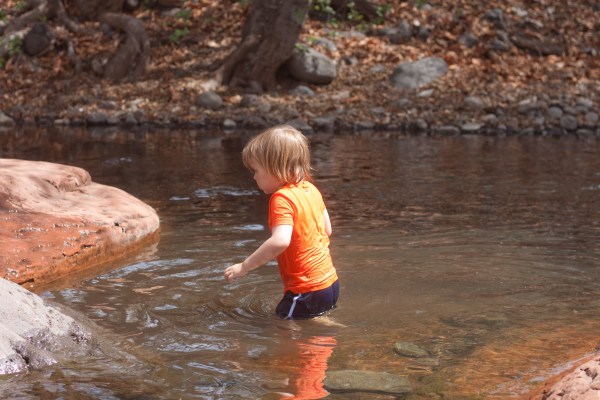

It takes a lot of energy to step outside the normal and comfortable patterns of everyday life; I’ve discovered that I need to plan for a day of rest and recovery afterwards. But the thrill of living more fully, more expansively, less bound by our anxieties and routines, is very often worth it.
And for me, the scent of the clean air, the caress of the warm sun, the rhythm of the flowing water, the strength and grace in every line of plant and rock – those things are always worth the effort it takes to find them.
(Many thanks to the friends who made this possible by inviting us along and giving me a safety net to quiet my anxieties! I wouldn’t have gone without the assurance of helping adult hands, since my husband wasn’t able to come along, and now I know that I am capable of handling this kind of adventure on my own in the future. Your support was invaluable for the moment as well as for the moments that are still to come.)
little problems, big feelings
We had some frustrations, today, as we went about our normal adventures.
Someone was upset to the point of tears because the cars in the lane next to us were moving and we weren’t and this child didn’t understand why (they had a left turn arrow…).
Someone broke down because their brother finished the bag of goldfish, even though they’d been able to eat an equal amount.
Someone sobbed and wailed in the grocery store because they were thirsty but didn’t want to drink from the water fountain.
Someone screamed and threatened because their brother put in the puzzle piece they wanted to do (make that two someones…)
Someone ran across the playground hiding their face in their hands because I wouldn’t let them push another kid off of the equipment they wanted to use.
Honestly, most of these moments involved fairly trivial triggers, at least from my perspective. It’s been a long time since forgetting a cup for my water and having to use a fountain instead brought me to tears… But for my children, these “little” things have a big impact. Something in their world isn’t functioning the way they expect or want it to, and it throws everything off kilter emotionally.
And when it does, I have the incredible privilege of being able to support and comfort them without being pulled underwater by my own equally strong emotions, since the things that bother them no longer affect me in that way. I can be the pillar of strength and the promise of unconditional love in those moments when they are falling apart, using those struggles as an opportunity to connect with them and deepen our relationship, instead of mocking or shaming them for “overreacting” to something so small. All I have to do is remember how vastly different their perspective is from mine, how much less experience they have to understand the world around them, and how little control and independence they have in their lives, and respond to them accordingly.
the value of a diagnosis
As we proceed with Rondel’s diagnosis (since the school district is unable to provide an actual medical diagnosis in their evaluations), we’re using an innovative diagnostic app developed by a local children’s hospital, which involves capturing multiple videos of Rondel’s actions and interactions in specific situations. I like the concept a lot, as it lets the doctors see into Rondel’s everyday life and observe him unnoticed for far longer than would be possible in an office setting! However, as I’m going through the videos to trim and upload them, I keep wondering if the specialists will see the differences that we believe are present – or if they will tell us that his struggles are due to something like poor parenting. Maybe if I were stricter, or reinforced acceptable behaviors more consistently, or provided him with a more stable routine, or cleaned up our diet, or or or or…

…then maybe he would be fine, maybe he would be normal, maybe he would fit in with all the other kids instead of sticking out uncomfortably.
He just isn’t so significantly different that it’s obviously a medical problem to a layperson. His differences are hidden, partially masked, behind his gregariousness and intelligence and creativity, until he’s used up all his energy on coping and he falls apart. So when people see him melting down or acting out, it’s easy for them to assume he is doing so willfully, or to think that he is simply being “spoiled” and “self-centered.” Even I, who see him every day, wonder sometimes if the difference is truly there, all the way down, no matter what, or if I could find some parenting technique that would work better for him and “catch him up” to his peers.
But I wonder that about myself also. Do I fail to maintain relationships or engage in neighborhood community-building because I am selfish, lazy, and don’t care about other people? If I were a better Christian, could I overcome my introversion? Many people do, after all, and are able to make time to recharge themselves. So am I guilty of using my social anxiety as an excuse to cover up for my vices or inadequacies?
Similarly, before I was diagnosed with depression (and honestly sometimes still), I would tell myself that if I just tried harder – if I prayed more, exercised more, ate better, spent more time in self-care, spent more time with close friends, practiced the right mental exercises, etc – I could get through the negative feelings and be fine. Getting the diagnosis was one of the best days of my life, because of what it meant to me: that I wasn’t an awful person taking advantage of the people around me, just a sick person who was trying as hard as possible to find joy and light but needed some extra help.
And my hope is that a diagnosis will be a similar gift to Rondel: a confirmation that his differences are real, and valid, and significant; a reminder that some things will be harder and it will be ok to seek and use help and support; and a shield against the barbs of guilt and shame that always accompany deviations from social and cultural norms. The alternative – refusing to acknowledge and name the neurological differences that give rise to his behavioral differences – is only a recipe for disaster as he grows older and begins to notice his differences without a framework for comprehending and addressing them. How much better to provide him with a framework of informed understanding, acceptance, support, and unconditional love!
going to the zoo!
The boys – especially Rondel – have been deeply interested in dinosaurs for quite a long time now, and are beginning to branch out into animals of all types. It really began with the Planet Earth documentaries that I would put on for them during Aubade’s nap times, and has continued with a short series called Africa’s Deadliest that is just as overly dramatic as the name suggests but which contains some great footage of wild animals as well as a lot of scientific facts. When we found and caught a lizard (well, rescued it from a bowl it had fallen into, to be more accurate) not too long ago, he was entranced: he understood intuitively how to hold it gently and carefully, and let it climb all over him with no fear, and ended up playing with it for 45 minutes before releasing it so it could return to its natural habitat.
So I was not surprised when he asked to go to the zoo this week, nor when he actually showed in interest in seeing the animals instead of just the dinosaur exhibit and the splash pad! And it was a good day to go!
We did of course have to visit the dinosaurs:


Obviously we couldn’t observe any live, wild, natural animal life here – but we had some discussions about the different types of nests made by different dinosaurs (we compared the twig nest of the Citipati – a feathered broody dinosaur – to that of the Diabloceratops, which was too large to brood its eggs and most likely made a mud nest like a crocodile), as well as about how the different types of dinosaurs might react if they saw us!
From the dinosaur trail the bighorn sheep exhibit is also visible, and Aubade got very excited when I pointed them out and told the kids what they were. She leaned forward in the stroller as far as she could, waving and yelling, “Hi!” – and then she turned to me, smiled, and matter-of-factly said, “Baa!” It was neat seeing her make the connection between the distant animal on the mountainside and the fuzzy white blob in her Moo, Baa, La La La board book by Sandra Boynton.
When we left the dinosaur trail, it seemed like a lot of the animals were active and awake – we got to see baboon, mandrills, oryx, cheetah (unfortunately they were difficult to see, but we did manage to spot them), otters, flamingos, zebras, and more! The flamingos were standing right by the fence, so we stood on one leg like they did, and noticed how they could turn their heads all the way around backwards to use their back like a pillow, and wondered why their large beaks only ever opened a very small amount.
Per Rondel’s request, after a cool-down break at the splash pad we visited the Tropical Birds trail, which includes a small aviary. Apparently, it is mating season at the zoo – so all the birds were awake and showing off their finery! The male peacock had his full tail fan extended, and kept shaking it at the peahen, making a surprisingly loud rattling noise when he did so. In the aviary, the male argus pheasant was strutting around on the path, making a call that the zoo keeper told us he only made during this season, instead of hiding in the back corners as he tends to do the rest of the year.
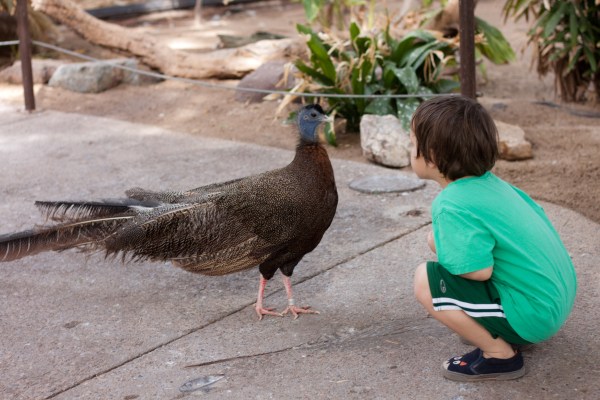
Rondel was absolutely captivated. He approached the bird slowly and quietly, and held his hands tightly back so he wouldn’t accidentally touch it (he would jump out of the way if the bird turned around so that he wouldn’t end up touching his long tail feather!), and just squatted down gazing at him for a long time, as other groups of people came and went.
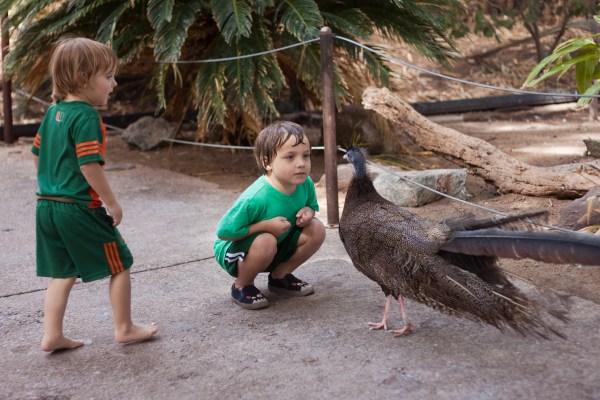
Limerick was a little less certain, but he eventually went over as well. I was super proud of both of them – they are often very impulsive and active kids, and they had no trouble at all adjusting their behavior to what was needed by the animals. We talked a bit here about how a lot of viruses can jump between birds and people, so if we touched the birds we could get them sick or they could get us sick… my molecular biology background always ends up showing itself somehow 🙂
We finished up with the tiger and the Komodo dragon. I had never actually seen the Komodo dragon exhibit at our zoo, but Rondel instantly remembered them from the new Planet Earth series and was incredibly excited about them. They weren’t moving much – just soaking in the sun – but they are impressive creatures. We noticed how it was basking in the sun to soak up the energy it needs as a cold-blooded animal, and counted its claws (five on each foot, just like us, in case you wondered).
And of course we played on the Komodo dragon statue for a while!
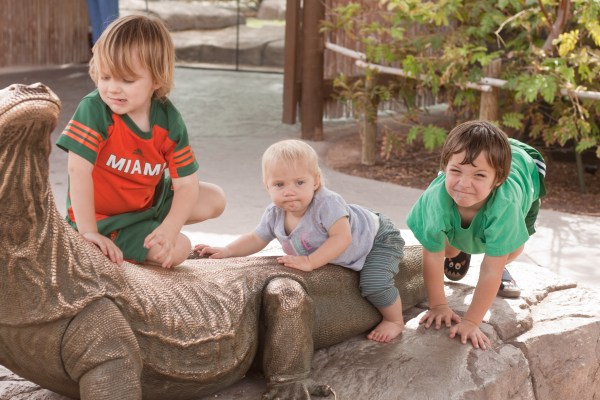
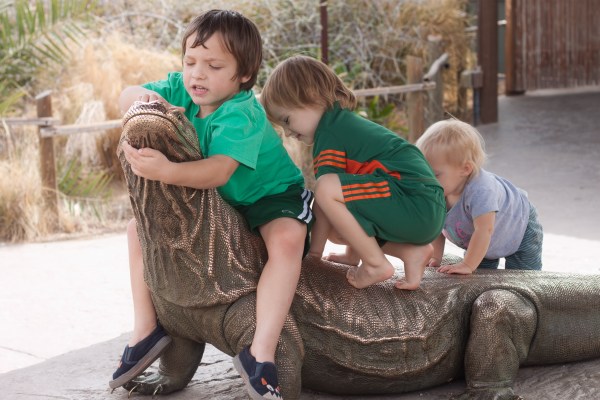
The most wonderful thing about homeschooling is the ability we have to follow our interests – obviously in going to the zoo for a whole morning instead of adhering to a lesson plan or a class schedule, but also in deciding when to linger at an exhibit and when to move on, when to talk about the details of how an animal lives and when to stick to the basic overview, when to focus on the live animal exhibits and when to simply just have fun. The experience we had today was so real and so rich that I wouldn’t trade it for any classroom I’ve ever known.
the many faces of Aubade
My daughter is an incredibly expressive little girl, despite still being pre-verbal! She can communicate so much with just a gesture, a turn of her head, or a change of expression.
When she sees the bag of frozen blueberries she starts breathing very rapidly, bouncing up and down, and sometimes flapping her hands by her face; when I give her a bowl of them, she chuckles in joyous anticipation.
When I ask her if she wants to pick clothes to get dressed, her eyes get wide and she runs to the bedroom. If I try to direct her choices, she will throw the outfits I’ve picked to the side and insist that I put on the clothes she’s chosen, laying herself down on the floor and lifting her feet to go inside the pants she wants.
When I tell her “no more” and she knows there’s no room for negotiation, she flings her hands down to her sides, whirls around away from me, and marches off as quickly as she can, her whole face contorted and red.
She smiles readily and protests equally readily, knowing that her voice will be listened to even when she doesn’t have the words to tell us what she wants and needs.
And when she plays, her face lights up our whole home.


Image description: grid with four pictures of a blond baby playing in a kiddie pool, with various expressions of focus, silliness, and happiness.
 little thoughts