Posted in family life

Finding an OB

For my first two pregnancies, I did my prenatal care with a nurse midwife through a birth center, aiming for a non-medicated delivery. With both of them, for different reasons, I had to transfer care during labor and gave birth in a hospital with an epidural. So this time I thought I might as well prepare for that by choosing an OB for prenatal care, so that I could establish some history with my delivering doctor before the delivery!

From previous experience I knew which local hospital I wanted to deliver at (they are very well-equipped for non-medicated labor), which helped narrow the list down a little, but meeting and selecting a new doctor is still rather nerve-wracking for me! I decided to try first a pro-life, Catholic practice, but I was nervous that it might be an instance where a principled agenda excluded a general compassion, courtesy, and quality of care. Maybe I’ve been reading too many cynical articles lately… but that was one of my fears.

Last month I met the PA who will be alternating visits with the OB, and got a good overall impression of the office, but I didn’t actually meet the doctor until yesterday. And all my fears were proven unfounded. I have never been to a practice more respectful of me, the patient, as a human person.
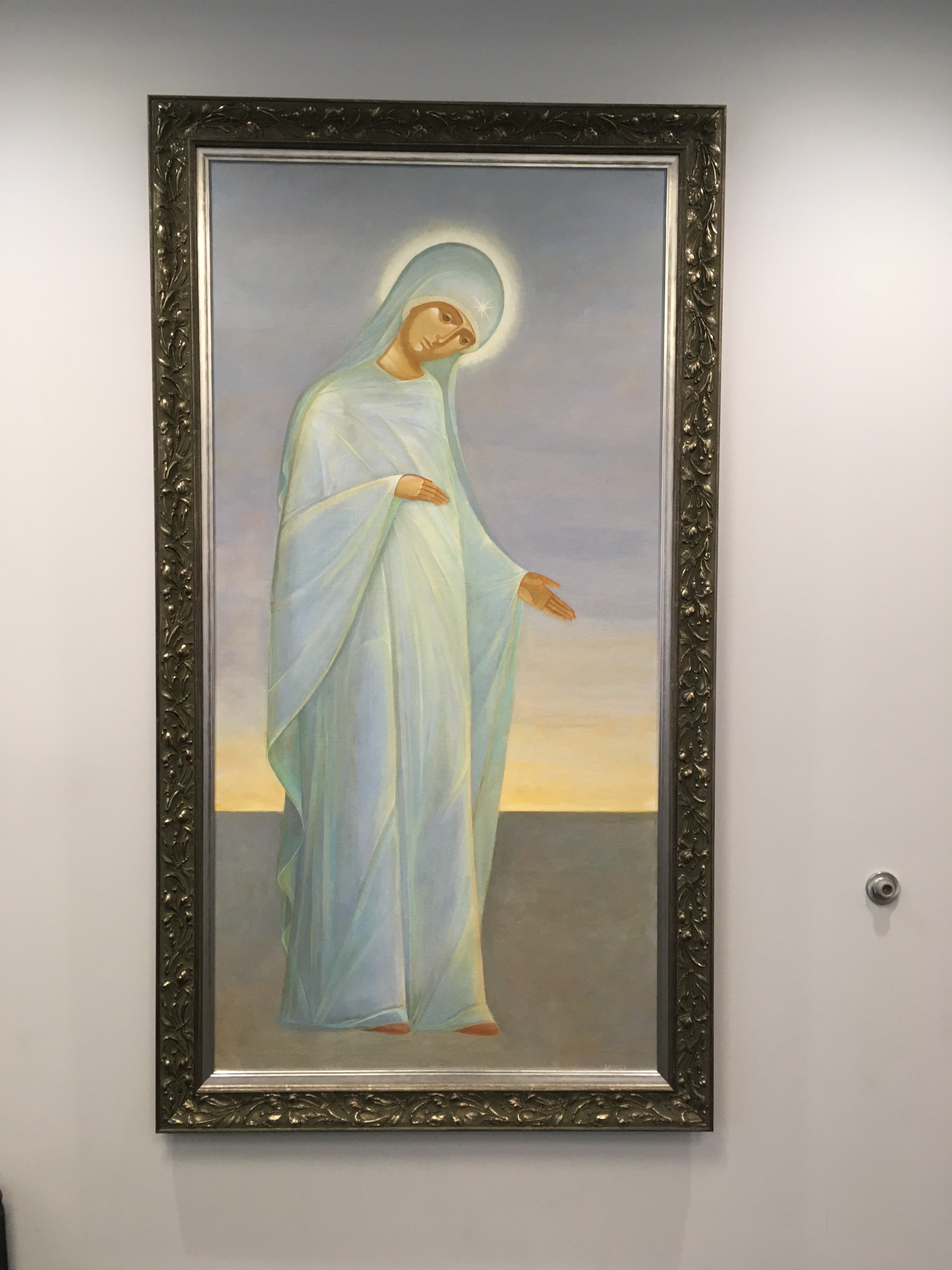

Before the general examination I told the doctor that I was quite anxious and had a hard time physically relaxing during exams, and he first asked if they tended to be painful and then if I was a praying person. When I said yes, he literally prayed that the exam would go painlessly and that I wouldn’t have the anxiety, and thanked God for the new life inside me – and then proceeded with the gentlest Pap smear I’ve had in my life. (My mom always did say that male OBs were gentler!)

It blew me away.

All the little details of the office show the same respect for human dignity: the courtesy of the staff, the friendliness of the medical assistants, the closets for storing personal items and clothing during exams, and the timeliness of care (my whole appointment, including wait time, was 30 minutes – at other OBs I have waited longer than that just to be called back).


It brings me peace to know that my baby will be seen as a blessing and a gift even if they have special needs, that birth control won’t be pushed on me while I’m still in a postpartum haze, and that they care about the wellbeing of my whole person and not just my reproductive parts. This kind of care makes even the thirty minute drive worthwhile 🙂

Posted in musings, quotes

when fear skews our ethics

“…a growing body of research suggested that investing in education and work for women propelled economic development and led to lower birth rates. Later in the 1967 meeting University of Chicago sociologist Philip Hauser alluded to this research when he asked the delegates: ‘Do we really know whether the classical approach of family planning propaganda and clinical services is more useful in reducing birth rates than the same effort spent on building a road into the village or constructing a soap factory where women can work or furthering education for girls?’ But population control activists tended to dismiss an emphasis on female workforce participation and education as a strategy dreamed up by unrealistic feminists. And Polgar [head of research for Planned Parenthood Federation of America] didn’t mention the alternative approach from the podium. Instead, he gazed out at the delgates and, according to minutes from the meeting, ‘urged that sociologists stimulate biologists to find a method of sex determination, since some parents have additional children in order to get one of specified sex.'” – Mara Hvistendahl, Unnatural Selection: Choosing Boys Over Girls, and the Consequences of a World Full of Men, pg 99-100

“Others talked about the necessity of an Asian pregnancy police, foreshadowing China’s system of birth permits under the one-child policy, and suggested flying planes over India once a year to spray it with a ‘contraceptive aerial mist.’ And the racist application of birth control was no longer confined to the developing world. In 1973 African American and Native American women across the American South and Southwest alleged in federal district court that they had been sterilized under threat of their welfare benefits being withdrawn. Gerhard Gesell, the judge who heard Relf v. Weinberger, concluded in his ruling that the women had been coerced. He estimated that between 100,000 and 150,000 poor American women had been sterilized under federal programs, adding, ‘the dividing line between family planning and eugenics is murky.'” – Ibid, pg 104

The idea was that families would have fewer children if they didn’t have to keep trying and trying to have a child of the sex they desired. Instead of a family having 3 or 4 or more daughters before having a son, and having 4 or 5 total children, the parents could eliminate those daughters, or most of them, and end up only having 1 or 2 children. In the 1960s, when the world was as scared of population growth as we are of climate change, that reduction in the birth rate was the pot at the end of the rainbow. But instead of choosing to support economic development and female empowerment (which has historically led to lower birth rates on its own), Western nations and foundations decided to tie their aid money to population control programs, leading to mass sterilizations, countless abortions, and the eventual skewing of the gender ratios across the world due to Polgar’s final vague and understated observation above.

Was it all just a response of fear to the specter of a world overfilled with people, starving and suffering and dying? While I think that played a role, there was a definite racial component to the issue, as the decreasing birth rate in the West combined with the economic development of the rest of the world struck fear into the hearts of white Americans and Europeans worried about losing their hold on global power and wealth. And the result of those fears, both the altruistic and the selfish racist fears, was death and suffering – for the men who underwent forced sterilizations during Indira Gandhi’s rule in India, for the women whose babies were aborted because of the one-child policy in China, for the aborted babies themselves (mostly girls), for the men who are growing up to find themselves consigned to singleness due to a shortage of women.

It is never wise to forsake the path of righteousness in response to fear. We must have a more constant moral compass than that of pragmatism and self help, or the very things that we think good, in our efforts to avoid what we fear, will end up hurting us (or others) in ways we never dreamed of, just as much or even more than the things we were trying to avoid. Such a moral compass will also help us determine whether or not our fears are ethically just – as a fear of humanity starving and suffering would be, while a fear of the global gains of other races would not. Population control wasn’t the solution for the fears of the 1960s; economic development and education accomplished the same ends without the oppression and injustice. Maybe Christianity was right when it said that children are blessings; and maybe if we worked together for the common good instead of seeking our own good at the expense of other human beings we could conquer the evils we fear without causing greater evils yet to roam the earth.

Posted in musings

sanctity of life

Because of the anniversary of Roe v. Wade, many Christians celebrate the month of January as “sanctity of life” month, or at least this past Sunday as “sanctity of life” Sunday. My church had a local pro-life activism group come and speak and set up a table in the atrium, for example. But sanctity of life has to do with a lot more than just abortion.

Sanctity of life means valuing and respecting the incredible dignity and worth of every other human being, not for any characteristic or behavior or ability, but simply because they are human.

It means that I don’t take advantage of my wealth or privilege to destroy another person’s reputation or livelihood.

It means that I greet an elderly person, a disabled person, a homeless person, a child, or a transgender person with the same kindness and courtesy with which I would like to be addressed.

It means that I give, of my time or my money, to keep people off the street, away from crime, in families and communities that love and support them.

It means that I treat the potential of new life in my own family as a great gift and blessing instead of a burden and a pain.

It means that I prepare financially and emotionally to care for my own parents or my husband’s parents as they reach old age and return to dependence and need, as they once cared for me.

It means that I listen – genuinely listen, seeking to understand – to the stories of people whose worldviews are diametrically opposed to my own, instead of resorting to personal insults or deaf ears.

It means that I care about the vulnerable around the world – the oppressed in my own country, the immigrants, the refugees, the orphans and the widows – and use the opportunities I have to make a difference for them, even if sometimes it can only be through writing and prayer.

And yes, it means that I fight for the lives of the unborn, the voiceless among us, equally human, most vulnerable and yet least protected.

We should not forget about the reality of abortion, the pain and horror of it for everyone involved – the mother and father robbed of their parenthood, the medical personnel betraying their healing profession, the baby robbed of life itself. It is good to be reminded of those things, to renew our strength for the long work of protecting the unborn. But we should also remember that life continues after birth, and that the ideal of sanctity of life can only truly be fulfilled when humanity is respected through all the long or short years of that life.

Posted in musings, quotes

thoughts on the principle of “respect for persons”

I’m doing my human research ethics refresher training at work this week and ended up rereading parts of the Belmont Report (the flagship document on the ethics of human subjects research in the United States, written in the 1970s in response to some of the atrocities uncovered during the Nuremberg trials as well as some of the horrors unearthed in our own history). The section of “Respect of Persons,” deemed a “Basic Ethical Principle” by the authorial committee, particularly stood out to me:

“Respect for persons incorporates at least two ethical convictions: first, that individuals should be treated as autonomous agents, and second, that persons with diminished autonomy are entitled to protection. The principle of respect for persons thus divides into two separate moral requirements: the requirement to acknowledge autonomy and the requirement to protect those with diminished autonomy.

An autonomous person is an individual capable of deliberation about personal goals and of acting under the direction of such deliberation. To respect autonomy is to give weight to autonomous persons’ considered opinions and choices while refraining from obstructing their actions unless they are clearly detrimental to others. To show lack of respect for an autonomous agent is to repudiate that person’s considered judgments, to deny an individual the freedom to act on those considered judgments, or to withhold information necessary to make a considered judgment, when there are no compelling reasons to do so.

However, not every human being is capable of self-determination. The capacity for self-determination matures during an individual’s life, and some individuals lose this capacity wholly or in part because of illness, mental disability, or circumstances that severely restrict liberty. Respect for the immature and the incapacitated may require protecting them as they mature or while they are incapacitated.” (emphasis added)

I wish this principle was applied more broadly in our society, and not merely codified into our human subjects research policies. Can you imagine what it would look like if, instead of shunting the homeless and mentally ill to the back or our minds and the sides of our communities, we considered them to be fully human agents able to make decisions and entitled to protection, not neglect or abuse, when incapacitated through disease or lack of opportunity, education, and health care? Maybe it would pave the way for people to reintegrate into society; maybe it would end some of the isolation and stigma surrounding people and their loved ones who are going through a situation in which they need help and aren’t fully able to advocate for themselves.

Can you imagine how the next generation would live if we raised our children with these principles of respect? If we valued their autonomy, took seriously their opinions and decisions, gave them the freedom to try and fail and learn and succeed, and equipped with the information and logical skills to choose wisely? If we stopped viewing them as possessions and status symbols and means to our own self-fulfillment, and instead truly considered them to be autonomous agents (immature and in need of our guidance and protection, yes, but not for us, or belonging to us, for our pleasure or our reputation)? We wouldn’t have the wounds of a child who can no longer live up to his parents’ expectations and feels like he’s going to bring their whole world crashing down, or of a child who is scared to try because he’s scared to fail and doesn’t believe he has the ability to think and act for himself, or of a child who is abused or neglected by parents thinking only of their own pleasure or convenience. And we wouldn’t have all those old wounds festering in the hearts of the adults who are leading our country, our businesses, our churches, and our families…

Can you imagine what the tender and vulnerable bookends of life could become if we viewed those people as entitled to our protection? Instead of the womb being a place where life only continues at the whim of another person, where the vulnerable human who cannot yet speak for himself or make his own decisions isn’t even given the basic protection of his own life, maybe it could become a place where the vulnerable are valued and protected with gentleness and love, preparing the baby within for the autonomy that will grow and mature within him. Instead of the last years of illness, frailty, and dementia being felt as a burden on the greater society, and the less autonomous being pressured to end their lives to reduce the strain on the community’s resources, maybe it could become an opportunity for the healthy and strong to learn love and sacrificial service in protecting and comforting the sick and dying.

Research isn’t the only thing that needs to be governed and informed by basic ethical principles.

Posted in family life, musings

unplanned pregnancies

I found out via Facebook that one of my young cousins is expecting a baby. She’s 21 now, so it’s not exactly a teen pregnancy, but she isn’t married to her baby’s father and neither of them have much in the way of education or career prospects, and they’re both still living at home. It doesn’t take much intelligence to deduce that this wasn’t a planned pregnancy.

But if my first reaction is to think, “how could she make such a stupid choice? why would she have s*x before getting married anyway? doesn’t she know that’s how babies happen? she should have made sure she was in a better financial position before moving ahead with a family” – then I really don’t believe, in my heart of hearts, the full truth of the pro-life position.

If, then, my second thought is along the lines of, “at least she’s keeping the baby instead of killing it – but this is going to make her life so much harder, and it won’t be good for the baby either, and honestly she deserves it for her foolish choices that brought this baby into existence in the first place” – then all my words about how babies are a blessing from God, how every baby should be valued and fought for and given the love of its parents, are empty and hypocritical.

Was it a poor choice to be intimate before marriage? Undoubtedly – there’s a reason God commands us not to do that. But that doesn’t mean everything that follows from that poor choice is a punishment, consequence, or negative outcome. God is in the business of forgiveness and redemption, after all, and maybe this gift of new life is part of His plan of giving grace and renewing all things.

Is it foolish, in the estimation of this world, to have a child before finances and jobs and future plans are all figured out? Yes, of course! Financial security is the idol of our culture, and a baby makes establishing that security more difficult than just about anything else. But God tells us that a baby is a blessing, not a curse: that the love that baby brings, and the joy of making a family, and the virtues that bloom as a family grows while following Him, are worth more than anything money could promise. Better is a dinner of herbs where love is, and all that. To set aside this opportunity for multiplied love in the name of money – to close our hearts and our bodies to a great blessing and pursue our own comfort and convenience instead – that is truly foolish.

Will having a baby right now make her life harder? Of course, of course it will. No matter when a baby comes, it makes life harder for its parents! Rather than glossing over her choice to keep the baby and focusing on her choices before the baby was conceived – rather than emphasizing her mistakes, in other words – our heart as pro-life Christians should be to praise her, to thank God for her courage and her strength, that despite the incredible hardship this baby may bring her as an unmarried, uneducated mother, she chose the right and the good at the cost of her comfort and convenience. She didn’t try to hide her mistakes, but let the world see, and know, and judge her, because she knew that the life of her baby was worth more than the pain of their judgments.

If we are truly pro-life, we will stand with my cousin and other women like her, without judging her for her mistakes, or shaming her for her “foolish, unplanned pregnancy”, or whispering behind her back about the stupidity and lack of character in these poor women who conceive children out of wedlock. Instead, we will congratulate her for the miracle of new life growing within her womb. We will praise her for the moral fiber and courage it took to choose life for that tiny and vulnerable baby over whom she held complete power and face the judgment of both the moralists and the materialists. And we will offer her whatever help she needs to continue to build a beautiful and blessed life for her baby and her family, for as long as she needs it.