Posted in musings

on giving advice

The longer I parent, the more radical my parenting style and ideals seem to become. I’ve been heavily influenced by the concepts of respectful and trustful parenting, to the point where I’m leaning towards unschooling and trying to lead as a guide and experienced companion instead of attempting to direct and control my children. My emphasis is on connection and understanding, and I’ve put down some hard lines for myself on the topic of punishment. And I’m far from perfect in my implementation of these ideals, but I really do think they are best for children.

The awkward moments come when a friend will post a general plea for advice on Facebook. How do I advocate for respectful parenting and try to point out the child’s needs and perspective without sounding judgmental of a person who I know loves and sacrifices incredibly for her children? Worse still, what do I say when other friends are framing developmental struggles as sin and normalizing spanking? Diplomacy is hard when it comes to things I believe strongly…

One thought that’s been helpful for me lately comes from the Catholic side of the aisle: the concept of an age of reason, below which children (though still imperfect and marred by the human condition of original sin) are not culpable of sin because they lack the capacity to understand or control themselves for simple developmental reasons. It helps to see one’s child as a learning, growing, incomplete being instead of a defiant, rebellious sinner. Unfortunately I’m not sure how to translate that idea for my Protestant friends!

How do you all handle situations where it’s appropriate to give advice (like a generic request for suggestions) and you know your parenting principles differ significantly from the person asking? I generally just try to gently plant alternative ideas without getting too radical but I wonder if I should say more…

Posted in musings

resurrected imperfection

Then He said to Thomas, “Put your finger here; see My hands. Reach out your hand and put it into My side. Stop doubting and believe.”

– John 20:27

The brief descriptions of the resurrected Jesus are all we have to base our imagery and understanding of our resurrected bodies on. And the picture that appears is somewhat confusing.

Jesus, after His resurrection, could apparently teleport and walk through locked doors – but still was able to eat real food and still even bore on his body the marks of His suffering and death. His body was in some ways changed and in other ways still the same. Was it, then a “perfect” body?

What would a perfect body even be? Would it be defined by some precise weight, or height, or appearance? By some level of functionality or some lack of disability? Would the person born without legs have legs in the resurrection, or the deaf be given hearing? What does that imply for the identity that individuals build for themselves in response to their embodied existence – and what does it imply for the relative worth, here and now, of those whose bodies are farther from that perfect ideal?

As the owner of a decidedly imperfect body, I’ve often thought about what the bodily resurrection would entail for me personally. Would it mean my myopic eyesight would be healed? Or that my thyroid would function correctly – or that things like thyroid hormones would be irrelevant? Would it mean freedom from debilitating depression and anxiety, or are those things a part of my soul as much as my body, a part of my being that can be redeemed and made meaningful but not cut out?

As I mature in my understanding of myself, and as I see how my body and mind affect both each other and my faith, I am starting to think that maybe our “deficiencies”, our brokennesses and scars, will remain with us in the resurrection – at least the ones with meaning and significance to our story and the story of God in the world. Just as Jesus kept the scars of His crucifixion, so maybe the mother will retain her softened abdomen and the scars of childbirth. Maybe I will always have the scars on my arms from my skin excoriation disorder, no longer marks of shame and anxiety, but testimonies to the love and redeeming, healing power of the God who brings beauty out of ashes.

Maybe the new creation, the resurrected body, isn’t perfect any more than our current bodies – and maybe perfection should never have been our goal.

Posted in musings, poems, quotes

success

It’s easy to feel like a failure when you don’t have a clear picture of what your success would be.

In the academic sphere where I work, success is measured as the achievement of either a PhD and a professorship or a competitive job in the biotech industry. And here I am with a bachelors and seven years of experience as nothing more than a technician, without even a good salary to show for it. Does that make me a failure?

When well-meaning adults see talents they admire in children, they often forecast futures of greatness related to those talents – so a musical parent might overpraise her musically inclined children but ignore the athletic achievements of her other child. One of my friend’s moms always said that she thought I could find a cure for breast cancer. But I’m not pursuing that path, and will probably never have a scientific breakthrough to my name – does that make me a failure?

Many of the moms I admire online and in person, advocates of respectful parenting and unschooling, both Christians and not, emphasize the difficulty of raising children with freedom and dignity when both parents are working outside the home. And I’m caught between my desire for their best and the exercise of my own skills and gifts. I’ve worked their whole lives, so far – does that make me a failure?

I still don’t know what success looks like for me, or what it will look like for my children, but I found a poem this week that gives, I think, a good foundational definition to build on.

To laugh often and much;
to win the respect of the intelligent people
and the affection of children;
to earn the appreciation of honest critics
and endure the betrayal of false friends;
to appreciate beauty;
to find the best in others;
to leave the world a bit better
whether by a healthy child, a garden patch,
or a redeemed social condition;
to know that one life has breathed easier
because you lived here.
This is to have succeeded.

– Ralph Waldo Emerson

Posted in family life, musings

a bedtime routine

Lights turn off for bedtime. The small flashlight flickers on but it’s not enough to play by, not enough to hide the scary shadows of a child’s imagination. I don’t stop to argue, don’t invite the protests, tonight. The baby is fed and warm in her daddy’s arms so I linger with the big boys, so tough and independent in the bright daytime light, all full of fears and doubts and unnamed dreads in the dark. I lie down on the bottom bunk and feel the lithe warm body of a little boy press against my back, strong and wiry and small and vulnerable in the drowsiness of just-before-sleep.

Softly, in the dark, I hear the gentle murmur of a snore, and I peek over my shoulder to see him lying there asleep, empty sippy cup tucked in against his elbow, Grandma’s handmade quilt pulled up over his belly, legs poking out the side with the knees up and the feet tucked under my hip. I sneak out of the room. I am eager to have some time with my own thoughts, to create, to be, without any demands or expectations on my time.

But there is still the food from dinner to be put away; the dishes are done but the food, too hot before, was waiting until after the bedtime rush, and as I scoop the leftovers into Tupperware, mindlessly, inefficiently, trying to read a book at the same time, I hear the baby crying, waking up for a last feed before settling into the deep sleep of nighttime.

I pick her up, lay her next to me on the bed, and she curls into me, little hands reaching for me, little feet tucking themselves into the curve of my belly, little mouth open and eager, little tear-stained eyes sleep-heavy and drooping closed. Her frantic energy lessens, breathing calmed, until at last I roll her back over to her crib. For a moment her whole body drapes across mine and I feel that soft cheek pressed up against me, the total trust and relentless love of an infant for their mother, and I’m the mother, and it hardly seems real, scarcely seems believable, like the whole crazy world is just too beautiful to be possible.

Most nights I stay here, worn out myself, caught up in the sweet beauty of the love a mother receives from sleepy children in need of snuggles and presence, unable to stop watching a baby or a toddler or a preschooler still and peaceful at long last, barely daring to breathe lest it all fall apart, amazed that such a life could be mine. But tonight I pull myself up. There are words to write, pictures to curate, cookies and milk to be eaten, and thoughts to be wrung out from ethereal unformed space to concrete actuality on the screen of my computer.

Posted in art, family life, links, quotes

lunarbaboon

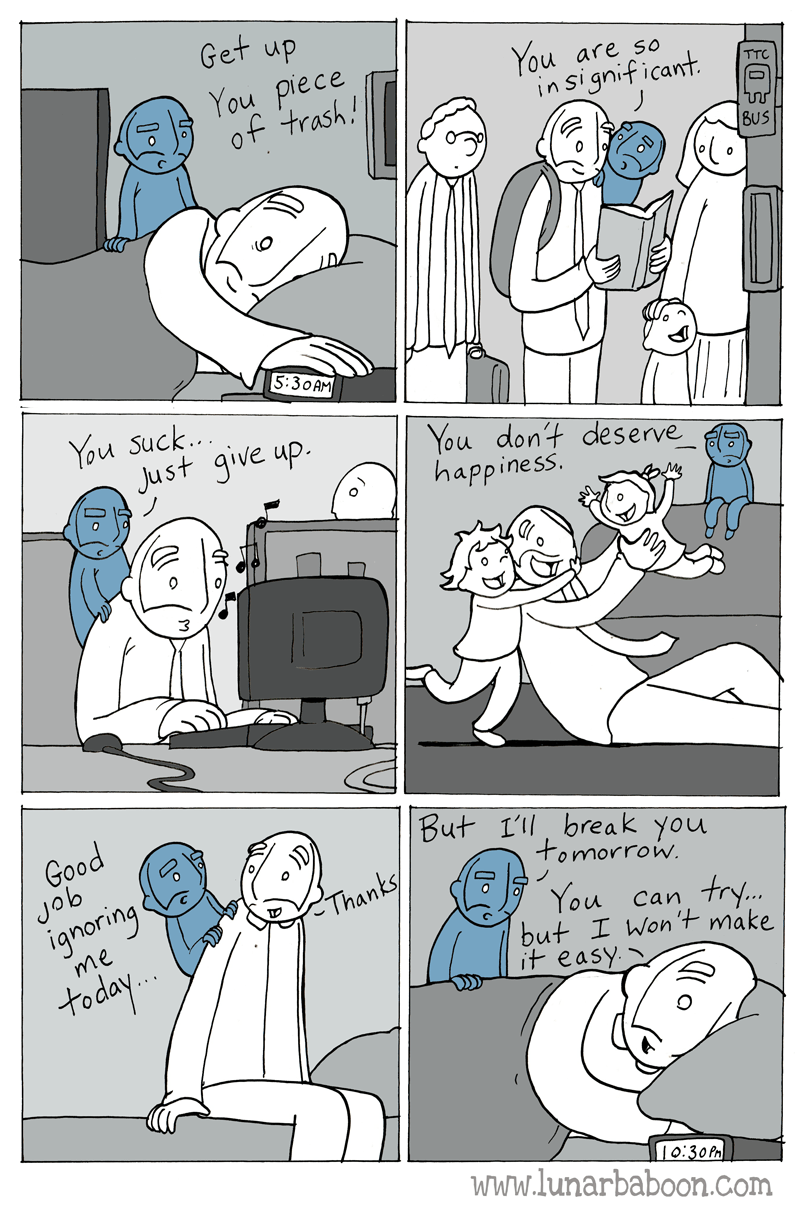
I have discovered a new favorite webcomic, Lunarbaboon. They seem to exist on the intersection of parenting, mental illness, and nerdiness, so I identify with and heartily enjoy almost all of them. One from January, titled “Enemy”, caught my attention as a particularly apt description of what it is like to be functional despite depression:

comiceveryday

The techniques taught in therapy are designed to help us ignore that inner enemy with more and more success – to make it harder for him to tear us apart each day. That’s why I’m so thankful for them, for the pills that give me the energy and positivity to keep fighting, and for the family and faith that give me a reason to fight and a hope for the future.

Posted in musings

the girl who became a warrior

Once upon a time there was a little girl who worried. She didn’t worry about practical things, like fires and robbers; she trusted her mom to handle things like that. But she worried about heaven, and how to know what happens when you die. She worried about wanting to be alone and making her friends feel hurt. She worried about being the littlest and the last and being left out because she was too late. She worried about losing her stuffed bunny that kept her company in the dark at night.

When she grew up, her worries didn’t really leave; they just changed to fit her new grown-up circumstances. She still worried about death, and wondered just what she would find after passing through that painful door. She worried that her introversion made her less of a good Christian by crippling her witness to Jesus’s love and grace. She worried about never measuring up to the people around her; she worried about missing out on something important by showing up late to anything. And she worried about losing the people closest to her, the relationships that mattered most, the love that kept her feeling safe in the dark at night.

This little girl didn’t realize, for years and years, that she worried about all these things. She thought that because she didn’t care about what other people thought of her, and wasn’t anxious about the future, and didn’t get nervous for doctor appointments or tests, and could handle large crowds and speaking in public (although it wasn’t enjoyable), that she wasn’t a worrier. She prided herself on her ability not to worry, to trust God with the outcome, to embrace new situations and attack new problems with confidence. But the worries were always there, in the dark corners, ignored but not silent.

They were there in the moments she wanted to speak but couldn’t open her mouth for fear of saying the wrong thing; they were there in the Psalms of trust and strength she memorized and would recite over and over again before getting out of the car and walking back into the relationships that mattered so much they hurt; they were there in the nights lying sleepless in bed aching over a careless word that might have damaged a friendship; they were there in the years and years of picking away all the bumps and scabs and scratches on her arms. But it wasn’t until they grew so strong that she couldn’t leave her house without physical panic that she admitted they were there, and that she wanted to let them go and help them rest in peace.

Worry grows like a climbing plant, wrapping its tendrils tightly around the support bars of your heart, cracking stone, weakening foundations, inserting itself into every nook and cranny and taking hold. Removing it is not the task of a day, nor an effort for the faint-hearted. Sometimes, this grown-up girl worried that it would be an futile effort, not worth the time and energy it demanded. But now that she knew how deeply it could incapacitate her if allowed to grow freely, she could see that even just keeping it fought back and somewhat maintained was a necessary (if unrewarding and unending) task. Left to itself, it would destroy everything else.

Worry builds unseen walls around the tended places of your heart, sealing them in, claiming to protect them from danger and harm. But all the time, as it builds, it pricks and pokes and pierces those vulnerable and intimate areas with images of all the possible scenarios that could bring about your devastation and despair. You may be safe from the actual event you fear, but you are locked in a dungeon with your worst tormentor of all. It took years of patient love, proving the worries false and unfounded, to open doors in those walls and coax the frightened areas of this girl’s heart out into the wild and beautiful free world again, and still she finds herself drawing back into those confines in moments of fear or anger. But now she knows the feeling of warm sun, fresh air, and flowing water in the deepest part of her being; now she knows the peace that comes from leaving behind worry’s dark and fearsome fortress.

Worry tried to convince this girl, through all these years, that she was unable to control the forces surrounding her life, and that events were sure to overwhelm her at some point or another. It tried to tell her that she could never hope to be enough, to break her spirit and close her in. But the deeper story, the more lasting truth, is that worry has trained her to be a warrior, fighting for her own joy and peace and love and beauty, and for all those things for the world she lives in: a warrior who will never give up, who knows her enemy is a liar and a coward – a warrior who fights with hope.

Posted in musings

avoidance-based parenting

I wonder if we all parent the way we do in response to our own internal demons.

The mother who feels lonely and insecure, who desires above all to feel a sense of connection and belonging – maybe she is the mom attracted to attachment parenting, because she hopes to give her baby the feelings of security and unconditional love she longs for herself.

The father who always felt distant from his own parents, who never had a listening ear for his stories and ideas – maybe he is the the dad who gets excited about his children’s hobbies and learns enough about them to engage in meaningful discussion about their activities and interests.

The mother who is constantly driven by shame and perfectionism, who tends toward depression and feelings of inadequacy – maybe she is the mother who parents permissively, attempting to free her children from the heavy emotional burdens she carries.

The father who grew up in an unpredictable and sometimes violent environment, for whom love was an unstable things – maybe he is the father who disciplines his own children harshly to try to maintain the control and order he needs to keep his own painful childhood memories from being triggered.

Probably many people, from both healthy and broken childhoods, parent well through common sense or the mentoring aid of more experienced friends. I don’t really think that we all choose our parenting methods (at least in part) through some desire to avoid passing down our own problems! But it is a struggle for me.

What I am realizing, though, is that it isn’t enough to parent out of an avoidance or fear, any more than it is enough to build one’s own self that way. My therapist showed me the importance of creating a positive image to move towards in my own personal development, and maybe that would be a beneficial exercise in parenting as well. What kind of parent do I truly desire to be? What atmosphere and attitudes do I want to cultivate in my heart and home? What qualities do I want to characterize my interactions with my children?

Not only will answering those questions give me a more defined vision than simply parenting in hopes that my children will not be depressive perfectionists because of me, but it will also give me freedom from the vague feelings of inadequacy and shame that come from never being sure of the goal I’m aiming for. And that can only have good effects on both my life and my parenting!

In the next few weeks, I’m going to try to come up with a positive description of how I want to parent, and if I can I’ll share it here! I may even do a link-up party if anyone else is interested in writing about the topic – just comment here to let me know!

Posted in book lists

Kristin and Antonia: learning from my literary sisters

Over the past month I read both Kristin Lavransdatter, by Sigrid Undset, and My Antonia, by Willa Cather, for the first time. I couldn’t help but mentally compare the two eponymous protagonists as I was reading, as both are Catholic women written by female authors, but are in temperament and circumstance very different.

91Hp6MKOiRL.jpg

Kristin Lavransdatter, despite being raised in a noble and loving family, enters adult life unprepared and unwilling to battle her passions and bosom sins, pursuing her own whims regardless of the shame and inconvenience it causes the people who love her and sacrifice for her. It is not until near the end of her life that she is sufficiently humbled and matured to look back with repentance rather than mere regret, and to make the hard changes in her own life that following God and living rightly demand of her. I often found it difficult to read Kristin’s story compassionately or even patiently, because her struggles and misfortunes were so frequently caused by her own headstrong will and lack of self-control, when she should have known better than to act that way! But in that judgmental stance I was often rebuked by the gentleness and guiding love of her old village priest and a monk from a neighboring city, who lamented her sin, prayed for her peace, and offered their comfort and wisdom (and sometimes their correction) in her doubt. Love her, they seemed to say to me, protect and pray for her, do not judge her. Judgment will not help to restore her soul and heal her brokenness. And they were right; the scorn and shame of her neighbors stung, but she could ignore it, and it wasn’t that weight that in the end brought her back to God and taught her how to truly love another person selflessly and without resentment.

The book is written with a tempestuousness that matches that of the protagonist’s character – in the medieval Norway of the book (accurately depicted from what I can tell – the author did a lot of research), successions are contested, old folk beliefs fight with Christianity, famines strike, arranged marriages are disputed, childbirth is incredibly dangerous, miscarriages and depression and poverty hover beneath the surface, and epidemics sweep through society. Kristin is most definitely not the only fierce and passionate individual here! Her story and its setting draw the reader in from the beginning, and hold one’s interest captive through towering heights and plummeting lows.

51KeFj9GIyL.jpg

My Antonia, on the other hand, is one of the gentlest and most peaceful books I’ve ever read. Antonia’s character and life are sketched out through the eyes of a man who met her when they were both children in Nebraska (she from Bohemia, he from Virginia) and watched her grow up to full beauty and maturity with the affectionate eyes of an old friend. Where Kristin is blessed with beauty, love, and wisdom in the parents who raised her but squandered it in her own impulsive and passionate way, Antonia is struck with the incredible tragedy of her father’s suicide coupled with the small-mindedness and paranoia of her mother, and yet still manages to blossom.

And yet, Antonia is a passionate woman just as Kristin is, full of strong and rich emotions that carry her with them. She is by no means a weak or mild individual; she is strong enough to work the fields with the men, beautiful enough (in action as well as appearance) to turn every head, fun-loving and spirited, brave and opinionated. What makes her different is the direction in which her passions led her. Kristin’s passions were bent, misguided, uncontrolled, turned away from the good and praiseworthy; Antonia’s were, while not perfect, aimed in general towards truth and beauty. As Jim, Cather’s narrator, puts it near the end of the book:

She lent herself to immemorial human attitudes which we recognize by instinct as universal and true […] she still had that something which fires the imagination, could still stop one’s breath for a moment by a look or gesture that somehow revealed the meaning in common things. She had only to stand in the orchard, to put her hand on a little crab tree and look up at the apples, to make you feel the goodness of planting and tending and harvesting at last. All the strong things of her heart came out in her body, that had been so tireless in serving generous emotions.

Reading both books in close succession made me realize how the choices we make and the emotions we obey shape our lives and even our children’s lives, by painting two very different possible paths down which a woman of passion, beauty, intelligence, and potential could walk. Goodness does not remove all difficulties, as Antonia found through her suffering, but neither does repentance restore what all that is lost or heal all that is wounded, as Kristin found through her suffering. And the suffering endured with passionate love for the good, for truth, and for beauty will leave a much different mark on the people around us than suffering we bring down upon our own heads through our sin and poor choices.

Posted in sqt

{sqt} – what I learned from Lent

I’m linking up with Kelly at This Ain’t the Lyceum today for Seven Quick Takes! I couldn’t come up with an SQT topic at all this week so I’m thankful to her for suggesting this one… it turned out to be a good way for me to wrap up the season for myself and prepare for the upcoming long stretch of ordinary time.

  1. Lent is for us – it is something we need, as sinful people, not something God needs for some obscure reason. In Lent we willingly give up something good as a sacrifice to God, a way to tell Him, remind ourselves, and train our bodies to remember that He is more important than even the good things He has made and given us. So there is beauty in the intentional, thought-out abstinence from something meaningful during Lent. However, I did not do that this year, being caught in the throes of PPD for the months between Christmas and Ash Wednesday. So, all of that being said…
  2. God can still use Lent for your spiritual growth even if you don’t plan anything, or just attempt the bare minimum. The point of Lent is to grow closer to God by separating ourselves a bit from the pleasures and conveniences of the world. So if life is beating you over the head to the point where it takes all your energy just to get out of bed and pray, you don’t need to pile on more self-inflicted hardships. Just seek God in your suffering.
  3. As a corollary, God knows the Lent we need, and He’ll make it happen if we are seeking Him. An unplanned Lent, catching me in the midst of an illness that made it hard to do more than the Friday abstinence, was probably far better for the condition of my soul than one where I chose all these difficult fasts and followed my self-imposed sacrifice to the letter: because my deepest temptation is to pride, and the success of a “good” Lent (at least in outward appearance) would have fed that pride and self-righteousness. This Lent didn’t really look very devoted or disciplined at all, and that was hard for me to accept for a while.
  4. Speaking of pride, Lent is (ideally) a humbling time. We impose our fasts and determine our sacrifices, and usually fall short of our goals, and in so doing realize once again how very much we need God’s grace to actually follow Him in any real way! Our inability to hold fast to even a small sacrifice for the sake of drawing closer to Christ gives us the opportunity to confess our weaknesses and stretch our roots deeply into His strength as we try again to live for Him in holiness. When I realized early in the season that my Lenten sacrifice was going to be admitting my inadequacies and seeking help for my mental health, that was a seriously humbling challenge. That’s not the kind of Lent I had wanted; it seemed so small and pathetic, and it forced me to face my weakness head-on and leap blindly into the unknown, trusting that God’s hands would catch me.
  5. Another thing I learned this Lent was the intensity of the Sorrowful Mysteries of the Rosary. To be honest, I had never before prayed through the Sorrowful Mysteries, and never even attempted a serious meditation on the Passion of our Lord. To think about His suffering, for our sake, for the joy of our redemption, was so uncomfortable for me that I avoided it as much as possible. But for Lent this year, I decided to pray only those mysteries in an attempt to prepare my heart for the seriousness of Good Friday and the joy of Easter Sunday. And it was unbelievably hard. To look long and hard at the suffering of another, when that person has entered into that suffering willingly and on your behalf, for your healing or life or freedom, is not easy. But it honors them and their sacrifice to take the time to remember it in its fullness, with reverence and gratitude.
  6. In the combination of these two main aspects of Lent (suffering in some way ourselves and meditating on the suffering of Christ) I found myself falling deeper in love with God and drawing closer to Him in dependence and prayer than I have been for a while. In the depths of my depression I remembered how Jesus faced the agony of fear and emotional pain in the garden, and was comforted to know that He could understand my emotional distress and stand by my side through it. When I wished that I could fight the depression on my own and overcome it without help, I remembered how Jesus Himself was unable to carry His cross, but needed the help of another man’s strength, and realized that needing the help and support of others is part of being human, not a sin or a cause for shame.
  7. Finally, I learned that the spirit of Lent – the desire to draw closer to God, and the willingness to sacrifice certain good things towards that end – shouldn’t end when the season of Lent and its specific sacrifices end. It just takes on other forms. If in Lent I learned how to draw near to God in my suffering, through Christ’s suffering for me, in Easter and beyond I can learn how to draw near to God in my joys and in my boring, everyday routines. He is there also, inviting us to walk with Him through suffering into endless joy and eternal glory.
Posted in musings

coping with chronic depression

I’ve been listening to some podcast archives from the Royal College of Psychiatrists and in one heard a man tell the interviewing doctor, about depression, “I don’t think you’re ever cured – it’s like alcoholism, it will always be there.” (I paraphrased).

That’s a reality I’m coming to terms with, as I have a new and more normal mood thanks to the medicine and therapy, but still feel the old out-of-sync emotions and unhelpful habits of thought there in my mind, popping up at tiny triggers or for no apparent reason at all. When the Zoloft started working – when I felt that first incredible lightening of the burden of depression on my mind and body – I suddenly had these amazing hopes and even expectations for my continuing treatment: that I would be completely cured, completely rid of the shaming voices, the heavy dragging slowness of thought, the spirals into despair, the frantic panic of seeing and fearing the darkness and irrationality closing in. I knew I would be sad, frustrated, and angry, of course, but those are normal emotions, a healthy part of life; I felt sad a few weeks back when the bikes were stolen and was surprised that I was able to feel simply sad without all the depressive corollaries. It was a clean and cleansing feeling. So sadness is beautiful, and even frustration and anger can be helpful and are certainly normal! But I thought the depression would be completely, utterly, totally, eradicated.

But there I was at work, feeling down. There were some triggers (a failed experiment, though no one was at fault), but nothing major, and still I felt the old familiar emotions, the whispers that I wasn’t good enough, would never be good enough; still I was weighed down with the weariness of continuing on when everything is pointless; still the voices tempted me with suggestions of sleep or drink or death to blot out the world and the pain of inadequacy and shame, to finally find peace from the tormenting emotions. Depression and anxiety have this irritating tendency to build on themselves; one begins to feel down about feeling down, or anxious about feeling anxious; and that’s what happened here as well. And then on the podcast came the line from a fellow sufferer: “I don’t think you’re ever cured.”

Suddenly it all made sense. It wasn’t a happy revelation, but it was a fortifying one. Just as it might never be safe for a recovered alcoholic to have a drink, so it might never be safe for this recovered depressive to let down her mental guard, to relax her mental vigilance. Into the breach, when the sentry is sleeping, the depression can attack or silently infiltrate. Oddly enough the thought tasted hopeful on my tongue: if the unhelpful thoughts and destructive emotions return, it doesn’t mean I’ve relapsed and can never hope to be cured – it just means I need to repair the walls and increase the guard. But what is the most hopeful thought of all is that now I have experienced genuine happiness, abundance of joy, and everyday normal emotions. I know what they feel like, and I know I am capable of them: so when I do feel depressed, I can remind myself that the depression need not last forever. I have overcome before, and I can overcome again.