Posted in musings

thoughts on humanity

The single most important thing about any person is their humanity.

No matter what other characteristics define them – their race, gender, age, neurotype, health, sexual preference, career, level of education, immigration status, religion, whatever – every single person is human, and by virtue of being human they are entitled to respect and dignity.

Years ago, I stumbled across a few MRA and white supremacy outposts online; I remember reading through their blog archives in a kind of shocked daze, disbelieving that people could actually hold the opinions presented there. Authors attempted to use social and biological science to prove racist tenets, or to claim the superiority of the “alpha male” type over women and more “feminine” men (often just decent and courteous men). Careful rational examination of their source material could show where they were wrong, but the sheer volume of output would make that a full-time job – with little or no reward, given that they’ve already shown their disregard for real science or actual facts.

Since then, the hidden (and not-so-hidden) biases against the old and sick (e.g., assisted suicide), the LGBTQA community, the homeless (e.g., park bench design), illegal (and often legal) immigrants, and Muslims have risen and fallen through the headlines of the news cycle. Every time there is a group of people who try to make themselves appear and feel superior and, more malevolently, entitled by virtue of that superiority to demean, belittle, and discriminate against groups they deem inferior. We, the employed, do not wish to see or even think about the unemployed; we can provide for ourselves, they cannot so they must be lazy and shiftless, and thus do not even deserve to sleep on a bench where we might see them. We, the citizens, obviously deserved to be born in this nation with all the opportunities we have; those immigrants who were so stupid as to have been born elsewhere shouldn’t be allowed to come here and steal our opportunities. We, the heterosexual, are so uncomfortable with trans and homosexual individuals that we must clearly be the only natural and moral beings here – never mind our promiscuity and infidelity, we are the ones following God’s sexual plan for humanity, and those who disagree should be silenced and kept apart from each other.

And recently, as I’ve been reading through the online communities dedicated to respectful parenting and disability advocacy, I’ve begun to encounter childism and ableism in all their ugliness.

This week, when the horrible story of the Turpin family came to light, the comments I read on the New York Times were straightforward and predictable: this is why homeschooling should be prohibited, or, at least, more strictly regulated. My own coworkers have made the same comments in response to the simple fact that Arizona requires no academic testing of homeschooled students. Similarly, in the past, when horrible stories of bullying or sexual abuse perpetrated by teachers have surfaced, or when poor curriculum choices are exposed, the comments in the homeschooling community are equally predictable: this is why you should never send your children to public school! The issue at the heart of many of these comments is: who is entitled to control children. Does the state get to control children’s activities, in an attempt to create productive future citizens? Or does the family get to control their children, as the creators of and providers for those children during their development? In other words, both sides are coming from a position of childism, even as they claim to have children’s best interests at heart.

The whole philosophy of unschooling, in contrast, rests on the premise that children are not partial persons, or potential persons, but full persons deserving of the same respect and autonomy as adult persons (recognizing of course their individual needs and limitations). As fellow humans, they should have freedom to pursue their own interests and develop their own talents, instead of being forced into a one-size-fits-all standardized education or into the molds envisioned by their parents. They should have the liberty to use their time as they choose, to eat the foods they like when they are hungry, to sleep when they are tired, to play outside learning to control their own words and actions instead of sitting inside following adult directions all day.

(If you instantly picture children running wild, gorging on junk food, playing violent video games, watching stupid cartoons, and staying up all night, you may have some internalized childism or an incomplete understanding of unschooling. Children who are exposed to beauty and goodness, and given the opportunity to develop maturity and moral character, will resonate with those things just like adults will, since they are equally made in the image of the God of beauty, righteousness, and truth.)

But even in the unschooling community, there is uncertainty when it comes to children with special needs. Since my son most likely has autism or another developmental disorder, I noticed the number of parents commenting that they were unsure of how to maintain that level of freedom and respect while making sure that their children accessed all of the “services” and therapies needed to help them fit in and appear neurotypical. I noticed it even more in the public school setting, where an extremely strong emphasis was placed on accessing services now so that my son would be “caught up” to his peers in time for kindergarten. I picked up on it in the special needs ministry at my church, when the parents’ support group had a meeting about “grieving” over your child’s autism diagnosis as if there was some loss to you in not having a neurotypical child. And I discovered it for myself when I found a thousand support groups for parents of autistic children but hardly any communities for autistic adults. Their voices went unheard.

And in some dark corners of the Internet, some people made it even worse by painting adults with Asperger’s/autism as narcissists and psychopaths, incapable of parenting without emotionally neglecting or abusing their children, and inherently capable of committing the next mass shooting. Maybe they vented some frustration or boosted their own sense of self-worth by saying these horrible and untrue things about others, I don’t know. But I don’t really care. I think of Morenike, the autistic mother of autistic children who loves and advocates for them fearlessly and tirelessly, and who almost had her children removed several years ago, and I wonder what role this type of ableist stigma played in her situation.

And I am thankful beyond words for Ally Grace, another autistic mother of autistic children, who is an unschooler on top of that, and whose stories have helped give me the courage to let my children develop at their own pace and in their own way, with the pressure of needing to conform to some external, arbitrary, socially-defined metric – as well as the courage to be an unschooling parent despite my own social limitations.

I think as all the different “-isms” of discrimination come to light, society will slowly be forced into being more respectful and more accepting of those who are different, of those who may need more help or accommodation given the way the world is set up, but in the meantime there is a fairly vicious backlash of those who seem to think accepting the other somehow diminishes their own status or worth. They are the ones who create the websites in the dark underbelly of the Internet, and they are wrong. To receive another human being with dignity and respect, with courtesy and kindness, regardless of the differences between you and them, allows your own humanity – the image of God within you – to shine forth in beauty and power, even as it elevates their humanity. We can ascend together; we do not need to climb to the heavens on the downtrodden backs of the other.
Posted in book lists

my year in books, 2017

There isn’t much better than sitting down, uninterrupted, with a good book and a cup of hot tea 🙂

While most of the books I read this year were read on my phone while nursing Aubade, pumping at work, or staying up way too late at night (not counting pages snatched while cooking, eating, or using the bathroom), just the fact that I was reading was good enough for me, even with the interruptions and without the hot tea!

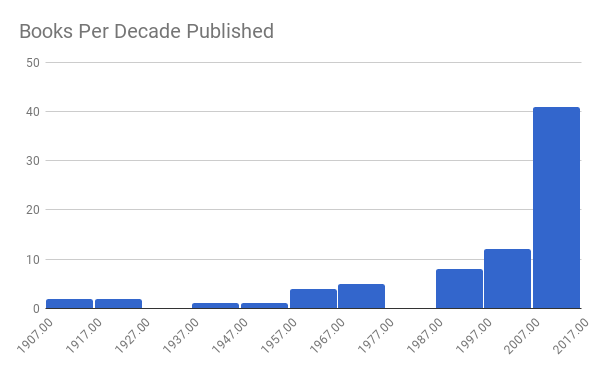
Not counting rereads, I completed 83 books in 2017. I was trying to read books from different genres, time periods, and authors, but there were some definite slants. First, in genres, I read non-fiction, sci-fi/fantasy, historical fiction, and general fiction books somewhat evenly (more fantasy than the others by a bit) – but I read no mysteries or romances, and only one thriller and one book of poetry. For next year, I’d like to read more non-fiction and more poetry! I don’t really mind missing out on the other genres and I don’t have to make sci-fi/fantasy a goal for it to be read…

For time periods, I read exclusively modern books this year and almost half of them were written in just the last decade:chart

This is definitely something I want to change, even if it means I’ll be reading fewer books overall. There is a lot of wisdom to be gained from the experience of past generations, and a lot of classic books I haven’t yet read!

The oldest book I read this year was almost going to be Wind in the Willows by Kenneth Grahame (a book alternately beautiful, silly, and innocent, by the way), but at the tail end of the year I discovered The Lord of the World by Robert Hugh Benson, which happened to be published just a year earlier in 1907. It couldn’t be more different, as a sort of Catholic version of the end-times novel popularized in the Protestant world by the Left Behind series. I did find it thought-provoking and even inspiring, as the story of a church disintegrating yet not destroyed in the face of the great tribulation (the nature of that tribulation itself is probably the most brilliant aspect of the book, as evil truly comes wearing the guise of an angel of light and seems to fulfill all the hopes and promises that humanity longs for). Next year, though, I hope to have both of these books beat by at least a few centuries!

As far as trying to read diverse authors went, about two-thirds of the books I read were written by women, and one-third by men. Again, about two-thirds were written by White American authors, while the other one-third were written by people of various ethnicities from various countries, including France, Italy, the UK, Nigeria, Ghana, Pakistan, China, and Japan. So a lot of the authors reflected me, demographically, as white women from the US, but I did branch out at least a little bit, and I hope to continue doing so next year.

While obviously not all 83 of these books were exceptional, there was only one that I truly disliked: Don’t Breathe a Word by Jennifer McMahon. The premise was intriguing, but the ending (in addition to being horribly depressing) wasn’t what I felt the whole book was leading towards, and the characters and writing weren’t in themselves compelling enough to make up for that.

On the other hand, there were many that I deeply loved! Ten of them I actually read more than once (typically just by starting again at the beginning as soon as I finished it for the first time), and from those I would most highly recommend The Bean Trees by Barbara Kingsolver, Watership Down by Richard Adams, and My Antonia by Willa Cather. I feel that these books have in them the seeds of enduring literature as well as just being books I enjoyed reading. But it is always hard to narrow things down! And one of my favorites of the year – A Canticle for Leibowitz by Walter M Miller Jr. – wasn’t reread because I could only find the audiobook. So, for the full list of what I read, you can click this link – the books in bold are ones that I believe are or will be classics, and the books in italics are the ones I read multiple times. If there are any that pique your interest, let me know and I’d be more than happy to share my thoughts about it with you!

Happy reading in the new year!

Posted in family life

2017

2017 is coming to a close.

We started out with postpartum depression and RSV; we’re ending with all three kids sick with the flu! (Well, to be more accurate, they were sick over Christmas and are mostly better now.) In between we fit more into one year than I would have thought possible, with therapies, medications, travel, moving into a new home, dipping our toes into the world of special needs education, and beginning a new round of transitions with my husband graduating and finding a job (which will start shortly after the New Year).

And I have learned so much this year, including about things that I thought I already understood but was able to look at from personal experience or through the new and edifying perspective of someone else’s experience or research. I acknowledged my anxiety as an obstacle in my path rather than a personal failing, thereby removing the associated guilt and shame and allowing myself to move forward; I began to make space for myself and the people I love to be different, express their differences, and be loved for who they are with those differences; I learned when to stand up for myself and when to disengage, and that both are ok given the circumstances as well as my own mental state; and I found the courage to make uncommon decisions for uncommon reasons without becoming defensive or belittling the choices I turned down. At least, those are the seeds of change that are beginning to germinate within me as a result of this year – I think I could spend a lifetime watching them grow!

This was also a year of good reading. What began as a way to cope with my depression when almost nothing else could distract my mind from the darkness turned into a re-ignition of my lifelong compulsive love of books and a chance to discover new characters, adventures, worlds, and authors. For the first time since childhood I kept a book log for myself, which was a massively encouraging endeavor in and of itself, and managed to read and record 84 previously-unread-by-me books since I started tracking mid-January! I think the books deserve their own post so I will say no more here – but it was a major part of my year and a consistent source of pleasure and refreshment as well as an escape from my own head.

And of course this was the year of Aubade, since she just barely made an appearance in 2016 but has by now infiltrated herself into every thread of the warp and weave of our lives. Through her, the boys have gained independence and learned compassion and gentleness. She has stolen our sleep but given us laughter. She is a confident baby princess, secure in her belief that whatever she wants, she should have, and she will get it for herself if no one will get it for her! She is a fearless baby explorer, certain that she can do whatever she sets her mind to do, and that around every corner (or behind every door, or on top of every high place) there is something new and exciting to discover. She is a bestower of hugs and a jealous claimant to her mommy’s lap. She is a passionate lover of showers (or pools, or baths, or splash pads), peek-a-boo, mud on her fingers, the thrill of the climb, the loudness of blenders and vacuums, snuggles with the people she loves, and singing or playing music. I can hardly believe she has only been in our lives for a year, because life without her would seem so empty.

Overall, it was a year of crashing lows, dark valleys to endure, and steep mountains to climb (my saint for the year was St. Jude, patron of hopeless causes, and it certainly seemed fitting when I was in the depths of the depression) – but it was also a year of soaring highs, transcendent mountain views, and glorious sunrises. A more stable and mundane year would certainly have been easier, but I am thankful for the things that happened and the way they shaped the person I am now. And now, let the adventures of 2018 begin!


Posted in musings

this day

some day, I won’t need to calm myself down with deep, measured breaths before making a routine phone call.

some day, I won’t feel insecure about my son’s differences and be afraid to take him places where he might stand out in a negative way

some day, I won’t build walls every time I get the chance to make a friend

some day, I will knock on a neighbor’s door even though it isn’t Halloween

I believe that I can change, and I believe that I will change, in the same way that a tree changes as it mature from a sapling to a giant – shaped by the primal clashing of the environmental forces around it with its own fierce urge to live and grow. I believe this because I have changed before…

this day, I no longer believe that a mistake makes me a failure as a person

this day, I no longer feel that I am personally to blame for every heartache or frustration in the people I love

this day, I advocate for my son the way he is and seek accommodations that will help him learn and grow

this day, I choose to swallow my fears and lean into community despite the challenges and inconveniences and anxieties that come with it

this day, I am stronger and braver and wiser than I was before, and some day I will be stronger and braver and wiser than I am now

what matters is not the speed at which I travel, but the direction of the path I take.

Posted in musings

thoughts and worries of a distracted mind

I’ve been thinking a lot about a few topics lately, none of which have made for suitable blog posts.

First, I’ve been very actively consumed by an off-the-record project I’m attempting for my job (basically, I’m trying to develop a database and website for our team, for essentially no cost, using only my own skills and whatever products are accessible for free or close to it. It’s difficult, time-consuming, and addictively enjoyable).

Second, I’ve been noticing how my hormonal cycle still affects my depression even with the Zoloft. And when I’m exhausted and down for a week or so out of every month, I feel like I spend the rest of the month digging myself back out of a hole. Still, it’s much better than being continually tired and depressed!

Finally, I’ve been concerned – or maybe nervous is a better word – about Rondel. His quality of speech hasn’t improved over the past year or so (although his language development has, which would be a greater problem), and may have even declined over the past six months. For people who don’t know him, he is a challenge to understand at all, and even I have to ask him to repeat himself if I can’t see his face or the context of his speech. He’s also had some anxiety or behavioral issues – it’s difficult to tell which may be causing the other, or if they’re both just feeding each other – that have made it increasingly difficult to take the kids out. On a good day he’s sweet, loving, funny, imaginative, energetic, and helpful; on a bad day he’s impulsive, defiant, silly in a “let’s make breaking the rules into a game” sort of way, aggressive, and clingy. And the bad days seem to be getting more frequent, and I never know what sort of day it’s going to be. But in my mind I’m just endlessly walking the treadmill of worry, and that doesn’t make for great reading 🙂 So we’re waiting to have him evaluated, and hopefully that will be profitable. Actually, I wouldn’t mind prayers to that effect!

But it has been a while, and we’re finally starting to settle into the semester and the new house, so hopefully you will see a lot more posts on here soon! I keep reminding myself that I need to write things down or else I’m going to forget them all when the kids have their own families and are wondering how far the apple fell from the tree…

Posted in family life

working mom of three kids thinks maybe it might be a good time to start using a planner

I have decided that my busy life is not abnormally busy but that this is just the new normal with three kids! I have been working on a project/sample/task tracking app for our team at work (with no experience, no funds, and no oversight – it’s a personal project because we are outgrowing our current solution), and I’m starting to think that I should make one for my personal life as well…

I have tried, at several different points throughout my life, to maintain some type of schedule or planner, and I’ve honestly never been able to keep at it for more than a week. Currently, I don’t even put all of my doctor appointments on a calendar. I just remember the date and time – and if I forget the time, I rely on the reminder call from the doctor’s office the day before. Needless to say, with three doctors of my own and three kids needing regular well visits, this isn’t the best long-term solution. So a calendar app would be a good start, but because appointments only show up on rare occasions, my calendar is typically empty and I get out of the habit of using it! If a calendar were built in to another app, and stayed out of the way unless something was scheduled, that would be much more useful for me.

It would also be nice to have lists – like to-do lists and grocery lists and wish lists – accessible in my planner app. Then when I have spare moments of time I won’t be stuck trying to remember all the things I want to do, because they’ll all be there in a list to pick from! And when I’m at the grocery store, I won’t forget what I need because I’ll have it on a list (this is particularly nice for when we run out of pantry staples or random things like bubble bath and toothbrushes… I can usually remember things like produce and milk).

Maybe I could even automate the to-do list so that if I checked off “Cleaned the Bathroom” it could be added back on to the list with a due date a week later!

I know there are paper-based planners that people swear by. Some of them look incredibly well thought out, with beauty and inspiring quotes to round out the planner’s layout and function. I just don’t think I would use one. I am incredibly prone to misplacing things, and at least a phone can be located when lost using the cloud… and it is already part of my routine, so it wouldn’t require me to remember one more thing every time I went out.

So hey, maybe it’s worth a shot! Near-impossible projects well out of the realm of my knowledge and expertise are what make life exciting (and since the stakes are relatively low, the excitement is mostly stress-free!).

What do you all use for managing your life/family/home/etc.?

Posted in family life, musings

a tale of two mothers

She walks briskly down the path, then stops and waits, impatiently beckoning to her young son to hurry up. Her words are sharp and her tone irritated, as though his slowness is an almost unbearable weight for her. Oblivious to the beauties around them, the pair slowly make their way down the trail in fits and starts, both of them belligerent, frustrated, and stressed.


A boy and his mother walk down a trail through woods near a creek, the water making a background song to their hike. They walk slowly, noticing the diversity of plant life surrounding them, examining the different shapes and textures of the leaves. The mother isn’t trying to make her son walk faster, but to engage him more deeply in the moment and place.


What differentiates these two mothers? What leads one to put the immediate task (reaching a destination) at a higher priority, despite the frustration of trying to control another person and ending up at cross purposes? What makes the other choose connection and relationship over speed and accomplishment? Is it personality, or character, or circumstance?

It is purely and simply choice.

I was both of these mothers, in instances just five minutes (and a major apology to Rondel) distant from each other. All that changed was that I remembered who I want to be, and chose to change my course. I was still just as frustrated at his slowness, but realized that I didn’t have to let those things (his slowness, my irritation) hurt our relationship or prevent us from savoring the beauty around us. 

We will never be perfect parents, but we always have the option to choose a better way.

Posted in family life, musings, quotes

different (a full review)

Sally and Nathan Clarkson’s book Different didn’t exactly live up to my hopes and dreams for it – that is, I suppose, it didn’t give me a checklist to follow or an instruction manual to read or even a set of principles to live by which would ensure success in the endeavor of parenting a unique and uniquely challenged child.

But that really wasn’t the point of the book. As Sally writes, “…don’t try to use our family’s experience as an exact template for your family. Every child is unique and requires a unique approach.”

And the story they told together, of struggles, pain, faith, and triumphs, was just as beautiful as I thought it would be. While they shared specific aspects of their personal lives, they made those intimate and individual stories relevant to a whole range of readers, drawing out empathy for both the challenging child and the challenged parent (or in other words, for both the different child and the parent who longed for normalcy). As there are in my close family many people on both sides of this dynamic, it spoke to me on a number of layers, and both encouraged and convicted me about several of my relationships.

(For example, it is easiest for me to apply the need for patience, acceptance, and understanding to my children, while failing to give that same grace to my husband, parents, siblings, or in-laws. Different, while primarily about that parent-child relationship, continually challenged me to scrutinize my motivations and intentions in my other relationships as well, and to try to bring them also into a more open, gracious, and loving posture.)

My primary take-away from the book in this season of my life is the value of making a home in which everyone in the family can feel at ease and accepted for who they are: a place where each one of us can truly feel that we belong. When my children are losing their tempers over trivial affronts, or melting down for inexplicable reasons, or refusing to answer a simple question when everyone else is waiting for their response, or taking out their frustrations on each other; when my husband is tired, preoccupied, or worried and speaks more sharply than typical; when I am moody and irritable and impatient – in those times, it is very hard to accept each other, to love each other, to give grace to each other. It is tempting to construct a narrative of the people in our family using only those negative moments, to focus on their immaturity or sinfulness, to attempt to fix and correct them with annoyance and frustration for their present state. But Sally addresses that temptation directly (emphases mine):

“…creating a welcoming home also includes the choice to accept the unique design of our families and the limitations of each family member. We have to learn to lean into life as something beautiful even if it is not exactly what we expected. Trusting that God works all things together for the good despite the challenges we face is a gift of worship we give to God. Acceptance with humility must eventually come to each of us if we are to please God and not always fight against the limitations of our own family pattern.

If Nathan had grown up in a home where he was constantly put down and corrected, I think the oxygen of God’s love would have been strangled from his heart, which needed a wide berth of unconditional acceptance. Love is the food our hearts need to grow, and so I had to figure out a way to give it in a way he could feel.”

I can choose to be impatient, irritated, frustrated with the imperfections I see in myself and my husband and the immaturity inherent in my young children – or I can choose to see the beauty and value of who we are and what we are building as a family. Only one of those choices will fill our home with the love our hearts need to grow, and the welcome we need to feel that here, at last, is a place where we – no matter how different – can truly belong.

therapy

Post-therapy I feel as I imagine Harry felt after one of Snape’s occlumency lessons… I’m sure it’s helpful in the long but it’s not comfortable or easy on the mind in the moment! At least my therapist is friendlier than Snape 😛

Posted in family life

to my dad

A father is important, a critical player in the development of a child, a power that influences lives for better or for worse. A good father is a precious thing. The gift of a great father can hardly be expressed.

Mine was one of the good ones. I’ll go so far as to say he was one of the great ones.

From my earliest memories, he was always willing to enter the world of our interests and activities, crowning them with the gift of his presence, of a companion in play or a fellow researcher in pursuit of some deeper understanding. He was – and still is – one of the best sounding boards I know for any idea, because he can think seriously and engage intelligently about almost any topic. He was – and still is – one of the best people to share something beautiful, profound, or exciting with because he will instantly seek to be and feel with you in the power of that emotion. 

As an example of the small everyday things he does that mean the world, just this week I was listening to Holst’s Planets suite and on the second time through found myself so swept away by Jupiter that I couldn’t focus on my work. So I sent my dad a quick text about how awesome it was, remembering that we’d seen it once together in concert – and he wrote back right away saying he was listening to it now too, and spent a few minutes analyzing the moods of the different planets with me. It’s not objectively a huge thing, but his eagerness to share in my interests, just because I’m his child, is one of the things I am most grateful for in life.

So Dad, I hope you have a wonderful Father’s Day! You are the best dad ever, in my admittedly biased opinion, and I’m so thankful for your encouragement and support through all the years of my life.