“Bravery is a muscle, but instead of building it through exercise, we strengthen it with each brave act we do, big or small, parent related or not.

“Bravery isn’t a limited resource, and it’s also something we all have within us.”

Debbie Reber, Differently Wired, Tilt 6: Parent From a Place of Possibility Instead of Fear.


If you liked the quote from Differently Wired, read my brief review of the book here and check back in June for the giveaway!

bravery

Posted in family life

pea gravel!

When we moved into our new house last summer, the home had been mostly fixed up (aside from a few plumbing issues that surfaced in our first month living here… old pipes) but the yards were completely flat dirt. Horrible dusty barren dirt, too, filled with trash; even the Bermuda grass could only survive in a few patches.

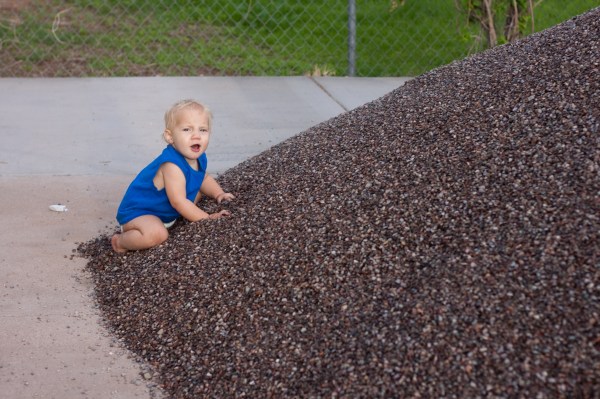
We’ve been slowly trying to make the space both aesthetically pleasing and functional, so towards that end we got twenty tons of pea gravel delivered one weekend, to fill in a play area in the back yard.

IMG_9028.jpg Continue reading “pea gravel!”

Posted in musings

pastor barbara and the out-of-sync girl

Once upon a time there was a church which had a female pastor. Now, this pastor wasn’t the lead pastor, or even the primary teaching pastor; she led the family and children’s ministries, actually, and spent most of her ministry time with women and youth. But she had the title of pastor – Pastor Barbara.

She was beautiful. She had long, curly brown hair and a nose with that perfect spark of defiance bringing its straight lines singing up from her face. She had a gentle way of moving – never too fast or too sudden – and a gentle way of speaking – never too loud or too harsh. And when she saw the children she loved and taught and prayed for, her whole body would glow with that love and light, like an emanation of the Holy Spirit through her presence.

There was a small girl at this church who adored Pastor Barbara wholeheartedly and unstintingly, although mostly from a distance as she was a quiet child. She enjoyed above all the new songs that Pastor Barbara would sing with them! For her, songs were a release from the uncertainty of social interactions, because the songs (at least the children’s songs that she knew) would specify how you were supposed to act. Take for example “Father Abraham:” no one would ever move that way in everyday life, but the song says to do it so everyone does it and no one has to worry about being out of sync.

Continue reading “pastor barbara and the out-of-sync girl”

Posted in musings

shelter from the shoulds

Sometimes it seems like there is a lot of pressure to do things for rather external and arbitrary reasons. Preparation for adulthood is a big one, for example – learn these math facts now so that you’ll be educated and prepared for your job as an adult; exercise and eat healthy now so that you’ll have better health when you’re older; practice a musical instrument as a child because you’ll regret not having done so when you’re older; and so on. Of course, if you attempted to prepare for adulthood in every possible way (even limiting yourself to a single culture), you would lose your childhood and probably wouldn’t be able to cover everything anyway…

Happiness is another oft-cited reason, and an even more arbitrary one, as the things which lead to a fulfilled and happy life for one individual can be radically different than the elements that are necessary for another. There might be pressure to get married and start a family when a person honestly does not want children or is not ready for the commitment of marriage. There might be a push to get off social media as a sort of “spiritual refreshment” when a person struggles to connect with their friends and communities through other means, so that the lack of social media pushes them into isolation.

And worst of all are the cultural “shoulds” – the things that people thing you ought to do, just because they are considered normal, or aspirational, or “good.” You “should” read these books, or listen to that music, or study American history in junior high, or clean your house with only vinegar and baking soda, or live in the city to fight suburban sprawl, or live in the country and try to be self-sustaining, or ride your bike as much as possible, or eat only these types of food, or dress in these types of clothes – just because that is what everyone else, in a large amorphous and vague blob, things you should do.

I’m trying to keep my kids sheltered from these “shoulds” for as long as I can.

IMG_8980

I want them to be free from that pressure long enough to gain confidence in who they are and in how they process the world.

IMG_8981

I want them to have the time and space to form their own goals, to explore their own interests, to decide what path makes the most sense for themselves, and to develop their own motivation.

IMG_8984

I don’t want them to be so exhausted from trying to live up to everyone else’s expectations that they have no margin left to imagine a future of their own choosing.

IMG_8985

I don’t want them to feel self-conscious about the judgment of others when they take a step backwards, or make a mistake, or pause to observe and analyze their course – the “shoulds” of perfection and speed are powerful and deadly.

IMG_8987

And whatever their goal might be – if it is finding a perch to sit on to study the world in its beauty and complexity, or taking a flying leap for the rush and satisfaction of a challenge overcome, or some path that never even occurred to me before they charted their course – I hope that they continue to live free and wild and bold and uniquely themselves, whether they accomplish that goal or not.

IMG_8989

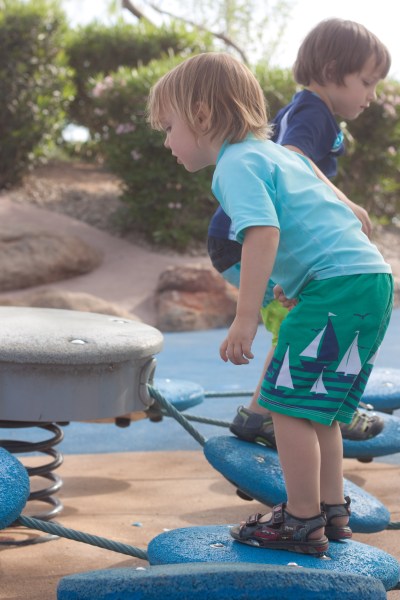
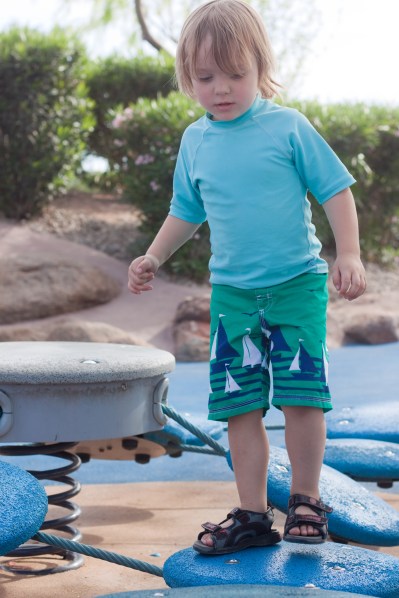
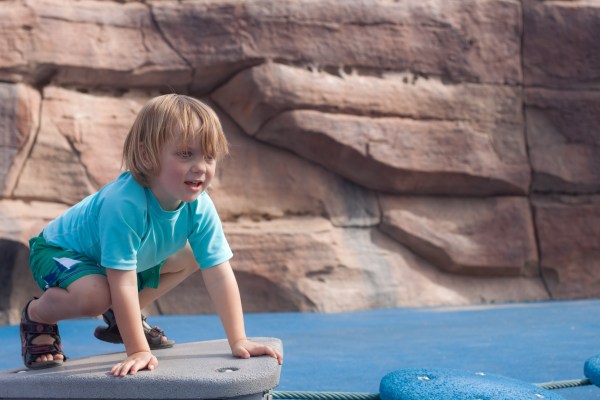
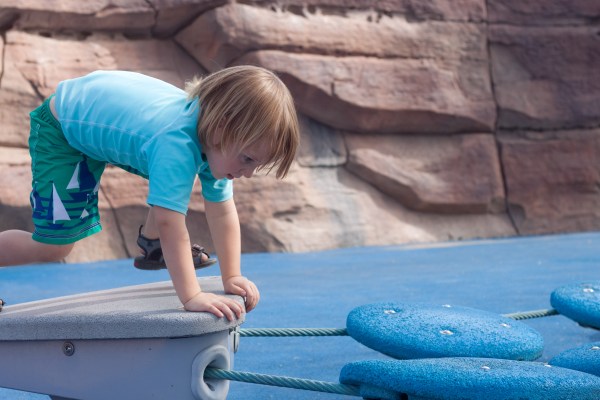
(Images are of Limerick playing on a spiderweb-type piece of playground equipment. In each image he is a bit more confident in his body language. In the second-to-last image he sits on the corner looking away from the camera, choosing his next step; in the last image he is leaping from one step to the next, completely airborne.)

Posted in family life, information, musings

acceptance vs. awareness

I’ve been spending a lot of time on Pinterest lately, in an effort to avoid Facebook (and while waiting for my books on hold to become available!), and I’ve found some really encouraging, helpful, and inspiring posts! I’ve also found quite a few off-the-wall recipes that I’ve made to varying familial approval… but let’s not dwell on that.

I think the following two images which I found there are amazing examples of the difference between awareness of autism and acceptance of autism (the first was uploaded directly to Pinterest by a user, and the second is from the Thirty Days of Autism blog):

Notice how in the first poster only the negative effects of autism are mentioned: meltdowns, avoidance, tears, frustration, worry, and stress. Autism is an evil, something that one needs to fight through with hope and prayer, like a sickness that needs to be overcome and that left unchecked would destroy one’s life. (And if it were a sickness, like cancer, that would be more than fine! As it is actually a neurological and developmental difference that is always going to be part of who a person is, however, this attitude can feel like a personal attack on an autistic individual’s identity.)

In contrast, the second poster focuses on the unique behaviors caused by autism – things that are different from normal, but neutral rather than negative: parallel play, a need for space, deep focus and passion, love of technology, and stimming. Autism is portrayed as a part of who that family is – something for which they love each other, not something despite which they love each other. Acceptance gives them the freedom to be themselves, however autistic that self might be, while still receiving unconditional love and support in the midst of their individual needs and struggles.

Let’s just say I know which lens I’d rather be seen through – and therefore, which perspective I want to take when raising my differently wired child.

Posted in family life, musings

fear of change

After eight years of working in a genomics research center, I’ll be transitioning to being a stay-at-home parent a week from now. Technically I’ll be working eight hours a week, in a sort of consultant role, which will keep me connected to the science – but it will still be a big change. It’s what I’ve been wanting ever since Rondel was born almost four years ago – but as it approaches, I find myself becoming more and more anxious.

I like my job, and I am good at my job. My supervisor respects me and my opinions; the researchers who rely on the services our facility provides respect me and my scientific knowledge and experience. I know what types of problems are most likely to arise, and I have tools and strategies for troubleshooting them. And I know that if I put in time, effort, and energy, I will have a successful outcome.

To be totally honest, I really like having the respect of other professionals whose opinion I value and who do innovative and important research. It gives me self-confidence: I may be a complete wreck if I have to call my doctor to schedule an appointment, but when I sit down with a researcher to discuss their experiment and figure out the best plan for them to take moving forward, I am completely at ease. It also gives me a sense of identity and self-definition: when acquaintances ask what I do, I can tell them about the science and feel that I’m doing something of worth, something that uses my talents and gifts, something beyond just staying at home and cleaning and cooking like any other person could do.

At the heart of my nervousness about the transition, then, I think, is a fear of losing that respect and identity – of becoming part of the crowd, no one in particular, no one with any valuable skills or gifts to offer my community. When I spend time with other moms, I feel so inadequate in the areas they are gifted in: my home is rarely clean, laundry and meals happen on an as-needed basis rather than with planning, small talk eludes me, playdates terrify me, schedules and extra activities overwhelm me, my children are dirty and wild. My mind is usually lost in a book, or an idea, or a project, instead of focusing on the people around me. I say nothing and feel isolated, or I say too much and still never manage to connect with anyone else. I simply don’t have the skills that these other women have, and without them, I’m not sure where I can fit in or belong in the mom world (especially the homeschool mom world… those women are so organized that I give up just at the thought of trying to be like them).

In the workforce, in academia, where everyone is a bit weird and everyone is valued simply for the expertise they offer, I knew where I fit in and I knew how I could flourish.

In this new world, I’m afraid I won’t ever be able to flourish – and that in my lack of flourishing, I will stunt my children’s future as well.

I’m not going to let my fears make a decision for me, when I believe on principle that a self-directed education is ideal for children, and when I observe pragmatically the stress that a classroom environment would add to our family life. I’m going to choose to let my love for my family be the motivating factor here instead!

But I’m still afraid.

Posted in musings

the unknowability of parenting outcomes

When I was very small (no more than six years old), my mom had a serious talk with me about my temper. Anger, she told me, was like a dark spot inside me, and if I held on to that anger I would be allowing that dark spot to grow and spread (at least, that is what I remember of the conversation now, over twenty years later…).

I didn’t bring this story up with my therapist when she was asking me why I thought anger was such a negative thing… I didn’t want to be a parent-blamer when I have such amazing parents! But it did make me wonder – how many of the well-intentioned discussions I have with my kids now, trying to help them understand the world and themselves and other people, will be internalized in an unhelpful way?

For example, tonight Rondel was being incredibly loud for no reason at all while I was lying down with the boys for bedtime – he was just trying to keep himself in a high-energy state by making random noises non-stop. I had asked him to be quiet multiple times, to no avail. Finally I turned to him and said that I couldn’t make him be quiet, that it was his choice – and that he could choose between being selfish and inconsiderate or kind and helpful. “And the choice you make,” I told him, “will affect the type of person you are becoming. So think about what type of person you want to be.”

“You want to be helpful” he replied. And he was silent after that (aside from asking for more water), snuggling up to me and letting his brother fall asleep in peace.

In the moment, my explanation worked and the boys fell asleep. I think the overall principle is a good one as well, and one I try to use for myself; it is paraphrased from C. S. Lewis. But I don’t know how that will settle down into the mind and heart of a four year old – if it will be a healthy motivator or a source of anxiety and shame in years to come.

Oh well.

I suppose all one can do as a parent is to try the best one can in the moment and pray that it will turn out alright!

Posted in family life

little problems, big feelings

We had some frustrations, today, as we went about our normal adventures.

Someone was upset to the point of tears because the cars in the lane next to us were moving and we weren’t and this child didn’t understand why (they had a left turn arrow…).

Someone broke down because their brother finished the bag of goldfish, even though they’d been able to eat an equal amount.

Someone sobbed and wailed in the grocery store because they were thirsty but didn’t want to drink from the water fountain.

Someone screamed and threatened because their brother put in the puzzle piece they wanted to do (make that two someones…)

Someone ran across the playground hiding their face in their hands because I wouldn’t let them push another kid off of the equipment they wanted to use.

Honestly, most of these moments involved fairly trivial triggers, at least from my perspective. It’s been a long time since forgetting a cup for my water and having to use a fountain instead brought me to tears… But for my children, these “little” things have a big impact. Something in their world isn’t functioning the way they expect or want it to, and it throws everything off kilter emotionally.

And when it does, I have the incredible privilege of being able to support and comfort them without being pulled underwater by my own equally strong emotions, since the things that bother them no longer affect me in that way. I can be the pillar of strength and the promise of unconditional love in those moments when they are falling apart, using those struggles as an opportunity to connect with them and deepen our relationship, instead of mocking or shaming them for “overreacting” to something so small. All I have to do is remember how vastly different their perspective is from mine, how much less experience they have to understand the world around them, and how little control and independence they have in their lives, and respond to them accordingly.

Posted in musings

thoughts on humanity

The single most important thing about any person is their humanity.

No matter what other characteristics define them – their race, gender, age, neurotype, health, sexual preference, career, level of education, immigration status, religion, whatever – every single person is human, and by virtue of being human they are entitled to respect and dignity.

Years ago, I stumbled across a few MRA and white supremacy outposts online; I remember reading through their blog archives in a kind of shocked daze, disbelieving that people could actually hold the opinions presented there. Authors attempted to use social and biological science to prove racist tenets, or to claim the superiority of the “alpha male” type over women and more “feminine” men (often just decent and courteous men). Careful rational examination of their source material could show where they were wrong, but the sheer volume of output would make that a full-time job – with little or no reward, given that they’ve already shown their disregard for real science or actual facts.

Since then, the hidden (and not-so-hidden) biases against the old and sick (e.g., assisted suicide), the LGBTQA community, the homeless (e.g., park bench design), illegal (and often legal) immigrants, and Muslims have risen and fallen through the headlines of the news cycle. Every time there is a group of people who try to make themselves appear and feel superior and, more malevolently, entitled by virtue of that superiority to demean, belittle, and discriminate against groups they deem inferior. We, the employed, do not wish to see or even think about the unemployed; we can provide for ourselves, they cannot so they must be lazy and shiftless, and thus do not even deserve to sleep on a bench where we might see them. We, the citizens, obviously deserved to be born in this nation with all the opportunities we have; those immigrants who were so stupid as to have been born elsewhere shouldn’t be allowed to come here and steal our opportunities. We, the heterosexual, are so uncomfortable with trans and homosexual individuals that we must clearly be the only natural and moral beings here – never mind our promiscuity and infidelity, we are the ones following God’s sexual plan for humanity, and those who disagree should be silenced and kept apart from each other.

And recently, as I’ve been reading through the online communities dedicated to respectful parenting and disability advocacy, I’ve begun to encounter childism and ableism in all their ugliness.

This week, when the horrible story of the Turpin family came to light, the comments I read on the New York Times were straightforward and predictable: this is why homeschooling should be prohibited, or, at least, more strictly regulated. My own coworkers have made the same comments in response to the simple fact that Arizona requires no academic testing of homeschooled students. Similarly, in the past, when horrible stories of bullying or sexual abuse perpetrated by teachers have surfaced, or when poor curriculum choices are exposed, the comments in the homeschooling community are equally predictable: this is why you should never send your children to public school! The issue at the heart of many of these comments is: who is entitled to control children. Does the state get to control children’s activities, in an attempt to create productive future citizens? Or does the family get to control their children, as the creators of and providers for those children during their development? In other words, both sides are coming from a position of childism, even as they claim to have children’s best interests at heart.

The whole philosophy of unschooling, in contrast, rests on the premise that children are not partial persons, or potential persons, but full persons deserving of the same respect and autonomy as adult persons (recognizing of course their individual needs and limitations). As fellow humans, they should have freedom to pursue their own interests and develop their own talents, instead of being forced into a one-size-fits-all standardized education or into the molds envisioned by their parents. They should have the liberty to use their time as they choose, to eat the foods they like when they are hungry, to sleep when they are tired, to play outside learning to control their own words and actions instead of sitting inside following adult directions all day.

(If you instantly picture children running wild, gorging on junk food, playing violent video games, watching stupid cartoons, and staying up all night, you may have some internalized childism or an incomplete understanding of unschooling. Children who are exposed to beauty and goodness, and given the opportunity to develop maturity and moral character, will resonate with those things just like adults will, since they are equally made in the image of the God of beauty, righteousness, and truth.)

But even in the unschooling community, there is uncertainty when it comes to children with special needs. Since my son most likely has autism or another developmental disorder, I noticed the number of parents commenting that they were unsure of how to maintain that level of freedom and respect while making sure that their children accessed all of the “services” and therapies needed to help them fit in and appear neurotypical. I noticed it even more in the public school setting, where an extremely strong emphasis was placed on accessing services now so that my son would be “caught up” to his peers in time for kindergarten. I picked up on it in the special needs ministry at my church, when the parents’ support group had a meeting about “grieving” over your child’s autism diagnosis as if there was some loss to you in not having a neurotypical child. And I discovered it for myself when I found a thousand support groups for parents of autistic children but hardly any communities for autistic adults. Their voices went unheard.

And in some dark corners of the Internet, some people made it even worse by painting adults with Asperger’s/autism as narcissists and psychopaths, incapable of parenting without emotionally neglecting or abusing their children, and inherently capable of committing the next mass shooting. Maybe they vented some frustration or boosted their own sense of self-worth by saying these horrible and untrue things about others, I don’t know. But I don’t really care. I think of Morenike, the autistic mother of autistic children who loves and advocates for them fearlessly and tirelessly, and who almost had her children removed several years ago, and I wonder what role this type of ableist stigma played in her situation.

And I am thankful beyond words for Ally Grace, another autistic mother of autistic children, who is an unschooler on top of that, and whose stories have helped give me the courage to let my children develop at their own pace and in their own way, with the pressure of needing to conform to some external, arbitrary, socially-defined metric – as well as the courage to be an unschooling parent despite my own social limitations.

I think as all the different “-isms” of discrimination come to light, society will slowly be forced into being more respectful and more accepting of those who are different, of those who may need more help or accommodation given the way the world is set up, but in the meantime there is a fairly vicious backlash of those who seem to think accepting the other somehow diminishes their own status or worth. They are the ones who create the websites in the dark underbelly of the Internet, and they are wrong. To receive another human being with dignity and respect, with courtesy and kindness, regardless of the differences between you and them, allows your own humanity – the image of God within you – to shine forth in beauty and power, even as it elevates their humanity. We can ascend together; we do not need to climb to the heavens on the downtrodden backs of the other.

Posted in family life

dance to the music no one else can hear

So now, having just explained in great detail why I think special ed preschool could be a great help for Rondel despite my misgivings about the public school system in general, I am going to argue the other side against myself. Hopefully writing this out will help me make a decision! And if not, hopefully it is helpful or interesting to someone else in a similar spot.

First, you should know this about Rondel.

When my son is in a highly stimulating, fun, chaotic environment, his energy ratchets up so high that he can’t always control it. Simultaneously, especially if he is hungry or tired (or if another kid is pushing his buttons), his anxiety often escalates as well. Either of these things could be a struggle independently, but when combined they can make situations very difficult for him. His body feels out of control, his emotions feel out of control, and his external environment feels out his control. In response to that, he will often take actions that on the surface appear irrational or bizarre: he may get overly aggressive in his play, wrestling after his friends have asked him to stop; he may try to run away to escape the chaos; or he may break down into incoherent tears.

Birthday parties, amusement parks, playgrounds, noisy restaurants, music class, movie theaters, and other noisy places can all cause sensory overload and meltdowns. Vigorous physical play may be avoided because of concerns about falling, sensory overload, and the potential for explosive outbursts and aggressive behaviors due to fight-or-flight reactions. Perhaps most unfortunately, the kinds of things done by the teachers who work hardest to make their classrooms fun for most kids – busy, colorful places with lots of “activity stations,” fun music, dancing, games – may be precisely the things that aggravate kids with SPD. As a result, these teachers may find that the harder they work to make class enjoyable and to involve these kids, the more they shut down or overload. It’s hard to imagine a more potent recipe for frustration and misunderstanding on both sides.

Brock Eide, The Mislabeled Child


Second, you should know this about me.

One of the greatest struggles in my life – a struggle that I have heard countless times in the lives of my friends and family as well – is feeling that I don’t belong: that there is no group of people among whom I can be completely myself and at the same time completely loved. It is out of this struggle that my parenting philosophy was born. My goal as a mother is to give my children a relationship (and ideally a whole family community) in which they will be listened to, understood, and unconditionally loved. Whatever societal forces are pressuring them to fit into a certain mold or to act a certain way, I want our home to be the safe place in which those forces have no power.

Now, I also have hopes and expectations for my children. I want them to be thinkers and readers; I want them to be wise and compassionate; I want them to love deeply and speak kindly. But even the wisest person has moments of foolishness; even the kindest person has words they regret. In those moments, I want my children to know that my love will not cease or waver, that I will always love them for who they are even as I help them grow and mature. And I want them to know that the rate of their growth is never a cause for shame, regardless of how slowly they may be progressing. The direction and the effort are the things that matter.


With both of those things in mind, putting Rondel in a special preschool designed solely to help him acquire certain skills by a certain deadline seems antithetical to my whole concept of parenthood. He is not a flowering bush that I can freely manipulate by well-timed applications of different fertilizers or hormones; he is his own person, uniquely designed and gifted, with his own path and timeline to follow. It is helpful for me to know the ways in which he is different than “normal,” so that I can anticipate his struggles instead of setting him up for failure, learn how to help him through difficult situations instead of flailing about in the dark, and access the accommodations he needs to thrive – but it isn’t helpful to focus on those differences as things that are “wrong” with him and try to fix them or train them out of him.

And my fear is that he will think just that: that we believe his way of being is inadequate or wrong, that we don’t accept him as who he is, and that we are willing to put him in an environment that stresses his sensory and emotional systems to the point of overload in an attempt to change him into someone else. It’s hard to think of a better way to demolish a child’s confidence in himself or to damage his trust in his parents’s love and understanding. When the music plays that only Rondel can hear, I want him to dance to that beat with freedom and fullness, holding nothing back in his pursuit of the calling for which God has designed him, no matter how strange or awkward that dance may appear to those who are deaf to the song. Speech therapy we can get at a private clinic, without needing to compromise our ideals in the process; the other skills he needs for life will grow in time, as he learns their value, in the context of love and peace and belonging.