Posted in family life

when a little boy turns three…

He knows birthdays involve cake, so he comes to you in tears with his sad tiny voice telling you he’s hungry, and when you ask him what he’s hungry for he answers, “cake!”

(You may have stayed up until 11:30 the night before baking said cake and want to cut into it just as much as he does! But these things must wait for the proper moment!)

IMG_2599-1
Six layer cakes require a ludicrous amount of buttercream frosting – as in, I used a whole pound of butter…

He may be so excited about being the center of the family circle, with everyone singing happy birthday to him, that he literally cannot contain his joy, and bounces up and down laughing the entire time.

IMG_7933

He may love rainbows so much that when the cake is cut and he sees for the first time the colorful layers within he may just squeal with delight!

IMG_7943
A rainbow cake is really the only appropriate choice for a child who has stayed up late with me pondering on the wavelength of different colors of light, how some colors can mix together to create others, and how white light can split apart into all the colors

He may be such a generous and inclusive little soul that he lets not only his beloved older brother but even the pushy and interfering (from his perspective) baby sister help unwrap his birthday presents.

And he may be so happy with his gifts that he spends the rest of the afternoon contentedly playing with them, with the family that he loves.

Happy birthday to a boy who is curious, intelligent, and observant like a scientist; who finds pleasure in order, symmetry, and patterns; who adapts his desires and whims to accommodate his siblings with a grace and maturity far beyond his years; who can be rough and wild with Rondel but gentle and protective with Aubade; who grows more independent every day and always loves to help and learn; and who still loves to snuggle with his mommy for any reason and no reason at all. It is such a joy to watch him grow – to see his understanding (emotional and intellectual) deepen and the lines of his personality and character emerge.

Posted in book lists, family life, musings

Charlotte’s Web

Fern loved Wilbur more than anything… Wilbur loved his milk, and he was never happier than when Fern was warming up a bottle for him. He would stand and gaze up at her with adoring eyes.

For the first few days of his life, Wilbur was allowed to live in a box near the stove in the pitch. Then, when Mrs. Arable complained, he was moved to a bigger box in the woodshed. At two weeks of age, he was moved outdoors. It was apple-blossom time, and the days were getting warmer. Mr. Arable fixed a small yard specially for Wilbur under an apple tree, and gave him a large wooden box full of straw, with a doorway cut in it so he could walk in and out as he pleased.

“Won’t he be cold at night?” asked Fern.

“No,” said her father. “You watch and see what he does.”

Carrying a bottle of milk, Fern sat down under the apple tree inside the yard. Wilbur ran to her and she held the bottle for him while he sucked. When he had finished the last drop, he grunted and walked sleepily into the box. Fern peered through the door. Wilbur was poking the straw with his snout. In a short time he had dug a tunnel in the straw. He crawled into the tunnel and disappeared from sight, completely covered with straw.

Rondel and I have begun reading Charlotte’s Web, by E.B. White, together, our first attempt at a legitimate chapter book. We’re proceeding slowly, at about one chapter a day, but already the story has captured his imagination.

He has commandeered Aubade’s pack and play to be his own little pig pen, where he can be alone and covered up with a blanket like Wilbur covers himself up with straw, but where his adoring and beloved friends (Fern in the book; Limerick and Aubade in reality; a mommy and baby bear in Limerick’s pretending) can sit and watch him through the mesh on the sides. Like Wilbur, he announces that he loves the bears “so much” because they love him and come visit him in his pig pen.

He was captivated by the tender and beautiful illustrations, courtesy of the one and only Garth Williams, of Fern holding Wilbur and feeding him from a bottle, and of Fern pushing Wilbur in a baby stroller with her doll. Wilbur’s special place in Fern’s heart, and the great love she gives to him and inspires from him in return, seem to make up his major impression of the book so far.

And for two consecutive nights now he has asked for me to move the pack and play into his bedroom so that he can sleep in there instead of in his bed, because, as he says “you are a little pig and this is your pig pen!” He can’t even stretch out all the way in there, which should serve as some indication of how absorbed he is by Wilbur’s world.

When a child’s imagination is so easily caught by a simple, gentle, well-told story, there is no need to be so anxious (as I often am, and as parents in general often are) about that child’s education and ability to learn. His mind is open and eager to learn, explore, create, and imagine – and new worlds, new information, and new friends to explain the world through their lives and adventures are only as far away as the pages of a good book.

Posted in family life, musings

holding Limerick through a meltdown

Tonight Limerick had a meltdown. He doesn’t have them as often as Rondel, but when he’s tired his big emotions can overwhelm him, and little things will push him over the edge. It’s par for the course when one is almost three years old!

When the meltdowns occur, there are two ways I can respond. First, I can try to reason with him in an attempt to make him feel better and stop crying. I have to admit that this is my default reaction, especially if other kids are awake, because I tend to be a logical problem-solver rather than a savvy emotional guru. However, it almost never accomplishes anything, especially with Limerick. He isn’t the most reasonable person at the best of times, and when he’s tired the sheer strength of his emotions renders his logical mind inaccessible.

The second response, which I’ve learned from parenting experts and cannot take credit for, but which I’ve found through experience to be far more effective, is to simply be present and available. With Rondel that typically looks like pulling him to me and hugging him until he calms down, because physical touch is one of his main ways of communicating love, but (as I’m discovering) with Limerick I usually need to sit a few feet away from him – say, on the floor beside his bed if he is in bed – and let him know that I’m there for him and that he can come sit with me if he wants. Slowly, as the emotional storm passes, he’ll scoot closer and closer until at last he is ensconced on my lap, rocking in my arms, restoring peace in his heart.

It’s becoming more instinctual to respond the second way, instead of remembering it only after I’ve reached the point of frustration and anger myself (I think the Zoloft helps me take that moment to stop and remember who I want to be as a parent, for which I am quite grateful!), and it is so rewarding.

Few things in parenting feel worse than going to bed having yelled at your exhausted and irrational toddler for acting out his exhaustion and developmental state, knowing that you’ve fallen so far short of your parenting ideals that it’s as if you ended up in a pigsty when you had intended to aim for the stars. But few things feel better than holding that toddler in your arms as he sniffles and hiccups away his final tears, gazing up at you as if you were their only solid ground in the middle of a buffeting ocean. No one enjoys a meltdown, but through it one can build deeper trust and connection than play and happy moments can provide on their own.

Posted in family life

Aubade at eight months

What do babies do at eight months?

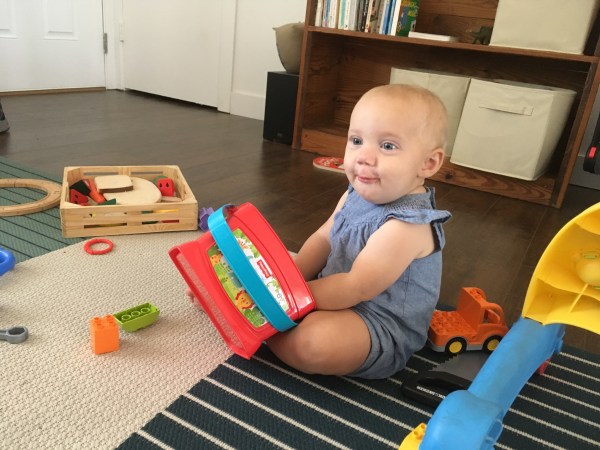
Well, this one is learning about “in” and “out” with her little red bucket and whatever miscellaneous toys she can find:

IMG_2237

She’s playing peek-a-boo on her own, taking the initiative to hide under a box or scarf then pop out eager to catch the smile or laugh on someone else’s face.

She’s noticing silly sounds that don’t match the normal cadence of speech (like the chug-chug of a train) and laughing at them:

IMG_2243

She’s eating every piece of food she can get her hands on and begging for more! We’re doing baby-led weaning so she’s had quite a large variety of foods already, ranging from the standard banana and Cheerios to pesto and spicy cilantro wheat berries.

She’s charging into every splash pad, hose spray, and puddle she can find, with no fear and pure delight!

IMG_2219

She’s solidly outgrown all her 9 month clothes and is starting to move from the 12 month to the 18 month selection (probably has something to do with all that eating!)

She understands and communicates so well; she is her own little person with an opinion about everything, an openness to exploration, and a great sense of humor – more quirky than Rondel’s pure goofiness, as if seeing something funny hiding just under the surface of everyday life:

IMG_2092

She’s bold, tough, independent, smart, joyful, curious, and persistent – I’m only eight months into knowing her and already I can’t imagine life without her!

Posted in family life

night time fears

Limerick has been having significant difficulties falling asleep, at nap time and at bed time, even when he is obviously exhausted (bags under his eyes, defiant and emotionally-driven behavior, constant yawns, lack of appetite and a desire for milk, etc.). I’ve been having trouble identifying exactly what is causing it; Limerick doesn’t seem able to express the problem when I ask him what’s wrong or what would help.

Tonight, knowing that a general source of fear among the under four set in the family has been monsters lurking in various places, I asked him if he was scared. Instantly his body got calm and he buried his face in his hands. (In the dialogue that follows, note that Limerick refers to himself as “you”).

“You’re afraid of a monster.”

“Monsters aren’t real, sweetie. They are just pretend, just part of a story, from someone’s imagination.”

“But you still think there’s a monster.”

“Well, can we pray and ask God to keep you safe from any monsters and help you not be scared?”

“That won’t help.”

“What if we ask God to send an angel to fight away any scary or bad things while you’re asleep?”

“That won’t help. You will still think there’s a monster.”

Oh baby. The power of our thoughts is so great. I’ve been in a similar place, where I had a belief that I cognitively knew was unfounded but couldn’t let go (mine was linked to my depression), and I know how hard it is to change one’s thoughts – especially when tired, and probably even more so when one is only two years old. Honestly, I’m impressed he was able to articulate his thoughts so clearly, and I’m not surprised he is struggling to overcome his fears with reason.

I asked him if he had ever seen a monster, and he said he had seen one in a movie. Now, he knows the Monsters Inc. monsters aren’t real, and he seemed to have overcome that fear, so I was a bit confused until he said, “You saw one in the snowman movie.” Ah! “Marshmallow isn’t real either, sweetheart. He is just a pretend story.” The relief in his body was palpable, and at last he was able to relax and fall asleep.

Sometimes it is so hard to get to the root of a behavior with a young child, because it can be difficult for them to understand it themselves, much less explain it to an adult. But it is so much better – for him and for our relationship – when I can take the time to discover the fears and thoughts that are going on underneath, instead of simply trying to address his refusal to lie down and go to sleep by controlling his actions.


Posted in family life, musings

parenting a preschooler

caterpillar_preschooler

When he is so upset about a broken cup that he can’t enjoy one of his favorite playgrounds…

When he asks “why?” in endless loops that don’t even make sense half the time and doesn’t even seem to listen to the answer…

When he wants to have long and challenging books read to him but gets distracted on every page by something different – and then cries if you stop reading…

When he wants help building his Duplos but gets frustrated if he isn’t doing it all by himself…

When he deliberately pushes the limits and disobeys in the “one finger across the line” sort of way…

When he is so big and sweetly thoughtful and fiercely independent…

When he is tired and whiny and just wants to snuggle…

When he is angry and unreasonable and tells me he’s going to break things and hit people…

When he laughs that crazy laugh that just about knocks him over…

When his mouth turns down in the frown that’s melted my heart since his infancy…

…then, it is up to me to remember that he is being three and a half years old, dealing with so much internal transition and growth, and adjusting to a new baby and my return to work, learning more about himself and the world every day. He is not an adult yet; he isn’t going to act like one, and it isn’t fair to expect it of him. What he needs is for me to love and accept him for who he is right now, and gently guide him as he grows into the fullness of who he will be.

Posted in family life

problem solving as a preschooler

Rondel’s always been a bit more of an abstract thinker than Limerick. You can explain something to him in terms of concepts and principles and he’ll get it, whereas Limerick will simply stare at you blankly until you end up just telling him what you do and do not want him to do in this situation right now. (This has been a huge help in dealing with his sensitivities, since he has the capacity to discuss them rationally and reason out ways to cope with them.) As he gets older, he’s been able to use this framework of concepts in his mind to network facts and ideas together and come up with some pretty creative solutions to problems.

Lately, one of the problems that’s been on his mind is Limerick’s chair. Limerick has a booster seat buckled to a kitchen chair, and has a tendency to push it away from the table with his feet while sitting in it, as well as to stand up in it if he’s not strapped in. Both of these things make me really nervous that he’s going to tip over, and so we’ve been talking about some different options for our kitchen dining area. Rondel’s been listening to these discussions and adding his own thoughts to the mix.

First, he noted that his own chair won’t tip over because there is a wall right behind it. So, he said, if Limerick sat in his chair and he sat in Limerick’s chair, Limerick wouldn’t be able to fall over and hit his head. But then he, Rondel, might fall over and hit his head! (Gesturing with his hands on his head and a sad face to accompany this statement). So that wouldn’t be a good solution.

A day or so later, he brought up the subject and suggested that we simply build a wall behind Limerick’s chair so that he would be protected from falling over in the same way that Rondel is. He showed me where the wall should be, and presented the idea as a fully logical solution to the problem – which I suppose it is, to someone who has no concept of the time or expense that goes into building a wall, not to mention the spatial ridiculousness of a wall in that location! But I was impressed that he had made the connection and come up with an idea.

I was even more impressed a few days later, when, I suppose unable to understand why his parents hadn’t yet build said wall, he told me that he was going to build a wall, using blocks, because “Blocks are especially good for building!” And a few minutes later, there behind Limerick’s chair was a little wall, and a very proud big brother wanting to show me what he had made:

img_5557

I asked him if I could take a picture of it and he got so excited! I love his initiative in doing something to solve this problem instead of waiting for the grown-ups to fix it, as well as his ingenuity in coming up with a solution and figuring out how he could implement it with the resources he had on hand.

Posted in family life

Being three

Three is such an interesting age.

The three-year-old is developing his sense of self, expressing his own opinions, exercising his will, and pushing for the things he wants. The easy compliance of the 1.5-2.5 year-old child, who occasionally tests boundaries but in general finds happiness in doing the will of the parents with whom he’s deeply attached, fades away. And the (sometimes difficult) thing to remember is that this separation of the child’s self from the parent’s self, as expressed by defiance, disobedience, or a different of opinion, is a good and healthy thing: a necessary part of growing up and becoming an individual. It is good for a child to begin to ask why a certain behavior is prohibited while another is encouraged, so they can develop a conceptual of morality and ethics instead of thinking of right and wrong as no more than a list of arbitrary rules. It is good for a preschooler to begin to process and understand his own emotions and desires, as distinct from his parents’ emotions and desires, as a first step for perceiving and responding to the emotions and desires of other people.

(As a note on that last point, the 3-4 year old child does not yet have a true sense of empathy; they just haven’t learned to observe other people’s feelings and mirror those feelings back in a compassionate way. Neither the brain development nor the social maturity is there yet! This is the time to begin overtly teaching the principles of empathy, however, building on the foundation of emotional connection and unconditional love that we have hopefully laid during the first few years of life. Learning this information consoled me greatly after I observed Rondel and another little boy at church engaged in an angry shoving and spitting match…)

But while all this development is going on under the surface, it tends to manifest itself in a huge variety of behaviors. Pretend/imaginative play soars to a new dimension: Rondel, always a storyteller, has now taken to creating whole worlds in his play, with characters who persist from day to day and whose relationships and interactions mirror what he himself is learning about friendship and kindness (as well as whatever frustrations he may be feeling…). On the flip side, controlling behaviors can also escalate, as the child finally has definite opinions of his own about what is the correct way to play with a certain toy, for example, and lacks the empathy to understand that different people may enjoy different ways of playing with the toy in question. As their emotional perception grows, they see and understand when others are upset but usually can’t guess why, and aren’t sure how to respond to the emotions that may scare or confuse them. Rondel tends to lose his cool completely when Limerick starts crying about something, screaming at his brother to stop crying and please be happy again! The intensity of the emotion, coupled with his own inability to understand it or do anything about it, overwhelms him. But when he’s simply presented with sadness, minus the raw intensity, he genuinely wants to help and will come over to give hugs and kisses to the person identified as sad.

It’s difficult to deal with at times, because the three-year-old is changing so fast in so many ways, and acting out in response to those changes, but at the same time fascinating and exciting to watch that development take place! I also like to think it is giving me some practice for adolescence 😉