Posted in book lists

my year in books, 2017

There isn’t much better than sitting down, uninterrupted, with a good book and a cup of hot tea 🙂

While most of the books I read this year were read on my phone while nursing Aubade, pumping at work, or staying up way too late at night (not counting pages snatched while cooking, eating, or using the bathroom), just the fact that I was reading was good enough for me, even with the interruptions and without the hot tea!

Not counting rereads, I completed 83 books in 2017. I was trying to read books from different genres, time periods, and authors, but there were some definite slants. First, in genres, I read non-fiction, sci-fi/fantasy, historical fiction, and general fiction books somewhat evenly (more fantasy than the others by a bit) – but I read no mysteries or romances, and only one thriller and one book of poetry. For next year, I’d like to read more non-fiction and more poetry! I don’t really mind missing out on the other genres and I don’t have to make sci-fi/fantasy a goal for it to be read…

For time periods, I read exclusively modern books this year and almost half of them were written in just the last decade:chart
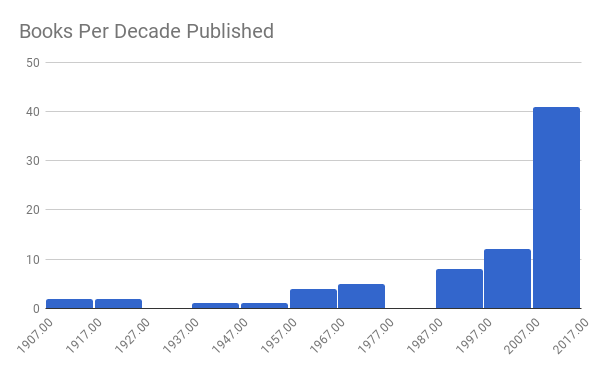
This is definitely something I want to change, even if it means I’ll be reading fewer books overall. There is a lot of wisdom to be gained from the experience of past generations, and a lot of classic books I haven’t yet read!

The oldest book I read this year was almost going to be Wind in the Willows by Kenneth Grahame (a book alternately beautiful, silly, and innocent, by the way), but at the tail end of the year I discovered The Lord of the World by Robert Hugh Benson, which happened to be published just a year earlier in 1907. It couldn’t be more different, as a sort of Catholic version of the end-times novel popularized in the Protestant world by the Left Behind series. I did find it thought-provoking and even inspiring, as the story of a church disintegrating yet not destroyed in the face of the great tribulation (the nature of that tribulation itself is probably the most brilliant aspect of the book, as evil truly comes wearing the guise of an angel of light and seems to fulfill all the hopes and promises that humanity longs for). Next year, though, I hope to have both of these books beat by at least a few centuries!

As far as trying to read diverse authors went, about two-thirds of the books I read were written by women, and one-third by men. Again, about two-thirds were written by White American authors, while the other one-third were written by people of various ethnicities from various countries, including France, Italy, the UK, Nigeria, Ghana, Pakistan, China, and Japan. So a lot of the authors reflected me, demographically, as white women from the US, but I did branch out at least a little bit, and I hope to continue doing so next year.

While obviously not all 83 of these books were exceptional, there was only one that I truly disliked: Don’t Breathe a Word by Jennifer McMahon. The premise was intriguing, but the ending (in addition to being horribly depressing) wasn’t what I felt the whole book was leading towards, and the characters and writing weren’t in themselves compelling enough to make up for that.

On the other hand, there were many that I deeply loved! Ten of them I actually read more than once (typically just by starting again at the beginning as soon as I finished it for the first time), and from those I would most highly recommend The Bean Trees by Barbara Kingsolver, Watership Down by Richard Adams, and My Antonia by Willa Cather. I feel that these books have in them the seeds of enduring literature as well as just being books I enjoyed reading. But it is always hard to narrow things down! And one of my favorites of the year – A Canticle for Leibowitz by Walter M Miller Jr. – wasn’t reread because I could only find the audiobook. So, for the full list of what I read, you can click this link – the books in bold are ones that I believe are or will be classics, and the books in italics are the ones I read multiple times. If there are any that pique your interest, let me know and I’d be more than happy to share my thoughts about it with you!

Happy reading in the new year!
Posted in book lists, family life, musings

Charlotte’s Web

Fern loved Wilbur more than anything… Wilbur loved his milk, and he was never happier than when Fern was warming up a bottle for him. He would stand and gaze up at her with adoring eyes.

For the first few days of his life, Wilbur was allowed to live in a box near the stove in the pitch. Then, when Mrs. Arable complained, he was moved to a bigger box in the woodshed. At two weeks of age, he was moved outdoors. It was apple-blossom time, and the days were getting warmer. Mr. Arable fixed a small yard specially for Wilbur under an apple tree, and gave him a large wooden box full of straw, with a doorway cut in it so he could walk in and out as he pleased.

“Won’t he be cold at night?” asked Fern.

“No,” said her father. “You watch and see what he does.”

Carrying a bottle of milk, Fern sat down under the apple tree inside the yard. Wilbur ran to her and she held the bottle for him while he sucked. When he had finished the last drop, he grunted and walked sleepily into the box. Fern peered through the door. Wilbur was poking the straw with his snout. In a short time he had dug a tunnel in the straw. He crawled into the tunnel and disappeared from sight, completely covered with straw.

Rondel and I have begun reading Charlotte’s Web, by E.B. White, together, our first attempt at a legitimate chapter book. We’re proceeding slowly, at about one chapter a day, but already the story has captured his imagination.

He has commandeered Aubade’s pack and play to be his own little pig pen, where he can be alone and covered up with a blanket like Wilbur covers himself up with straw, but where his adoring and beloved friends (Fern in the book; Limerick and Aubade in reality; a mommy and baby bear in Limerick’s pretending) can sit and watch him through the mesh on the sides. Like Wilbur, he announces that he loves the bears “so much” because they love him and come visit him in his pig pen.

He was captivated by the tender and beautiful illustrations, courtesy of the one and only Garth Williams, of Fern holding Wilbur and feeding him from a bottle, and of Fern pushing Wilbur in a baby stroller with her doll. Wilbur’s special place in Fern’s heart, and the great love she gives to him and inspires from him in return, seem to make up his major impression of the book so far.

And for two consecutive nights now he has asked for me to move the pack and play into his bedroom so that he can sleep in there instead of in his bed, because, as he says “you are a little pig and this is your pig pen!” He can’t even stretch out all the way in there, which should serve as some indication of how absorbed he is by Wilbur’s world.

When a child’s imagination is so easily caught by a simple, gentle, well-told story, there is no need to be so anxious (as I often am, and as parents in general often are) about that child’s education and ability to learn. His mind is open and eager to learn, explore, create, and imagine – and new worlds, new information, and new friends to explain the world through their lives and adventures are only as far away as the pages of a good book.

Posted in book lists, family life, musings, Uncategorized

celebrating St. Francis

I feel like the holidays come fast and furious once fall arrives! They are such a fun way to introduce or remind myself and my kids of the great men and women of God, and to help direct our own hearts back to Him as well.

St. Francis of Assisi’s feast day falls on October 4, less than a week after Michaelmas, providing a beautiful foil to the Michaelmas stories and themes of dragons, knights, and (spiritual or otherwise) battle. For of course, St. Francis is one of the gentlest saints in the liturgy: a man who gave up wealth and power; who befriended the outcast, the poor, and the sick; who rejoiced in the beauty of nature and loved animals as well as people with tenderness and understanding. While Michael illustrates the bravery and glory of fighting against evil, Francis illustrates the courage and beauty of seeking redemption and reconciliation.

(Of course, due to sickness and poor planning on my part, we didn’t actually celebrate until the 11th… better late than never I suppose!)

To introduce the boys to St. Francis, I checked out two books that seemed to have good reviews and were actually available at our local library. First:

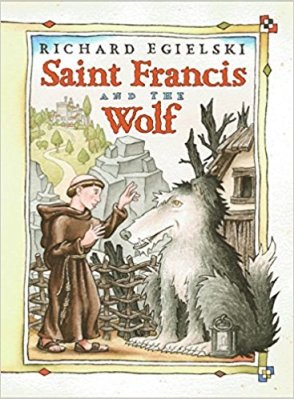
St. Francis and the Wolfby Richard Egielski

francisandwolf

This is a legend, retold in a way that is satisfyingly scary for a younger audience, without being over the top, and while retaining an emphasis on Francis’s message of peace and love. It shows how the obvious solution to something scary, dangerous, or disliked – trying to get rid of it or destroy it – isn’t always as effective as trying to communicate and make peace. And really it is just a well-told, fun story. Rondel has asked for this book many times since we borrowed it, and enjoys acting out the various characters as well!

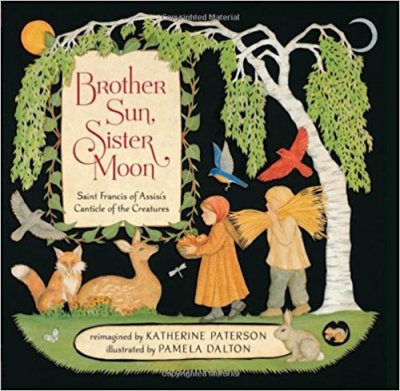
Brother Sun, Sister Moon, by Katherine Patterson

brothersunsistermoon

This book is an illustrated retelling of St. Francis’s canticle of the creatures in words that are accessible for small children, yet still retain the beauty and majesty of the original. The illustrations are exquisite as well, with every page showing how the aspect of creation in question (sun, moon, fire, wind, and so on) touches and blesses our world, as the words describe how those things reflect and honor their Creator. I was concerned that this book would be too advanced for the boys, but they have asked for it several times and are always held captivated by the beauty of its poetry and art. It makes a good counterpart to the more “fun” story above, also!

In addition to the books, we tried to make a sun-and-moon window hanger, but ran out of steam partway through due to the aforementioned illnesses; if we had more energy, I would have also had us make a bird feeder so that we could practice kindness to the animals around us as well (there aren’t many other animals besides birds in the middle of a city, since we don’t have pets…). While we don’t have the cold weather that makes feeders a perfect gift for the birds in October in other parts of the world, there are many native birds that benefit from feeders targeted at their unique needs and adaptations. Ah well, maybe next year 🙂

In the meantime, my goal is to emulate St. Francis’s compassion and gentleness, beginning in my home with my family but hopefully spreading outward to the other people with whom my life intersects! I also hope that, like him, I would have the courage to do what is right regardless of how strange it looks to the people around me. He somehow managed to care deeply for people without being a people-pleaser – a combination which strikes me as both a worthy and a difficult goal.

Posted in family life

silly kisses

We moved about two weeks ago (hence the silence on the blog – packing, unpacking, and dealing with leaks at the new house has kept me pretty busy!), and while the kids have settled in fairly well, bedtime is – as always – the time of day when their feelings of anxiety and discomfort seem to rise to the surface.

So we have the music and night light just like we did at the old house, but I’ve started lying in the room with the boys until they fall asleep, either with Aubade on the floor or with Limerick in his bed, which he much prefers. Limerick saw part of Monsters, Inc and, while he plays silly games about monsters with Rondel all day long and has a great time doing so, is now concerned that monsters will come out of his closet in the night. I’ve been shutting his closet doors and stacking toy boxes in front of them and that seems to help.

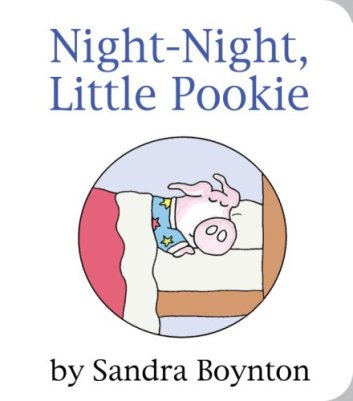
Another thing I added to the bedtime routine, to try to lighten everyone’s mood and end the day with laughter and snuggles, was “silly kisses” – essentially, the goodnight routine from Sandra Boynton’s book Night-Night, Little Pookie.

nightnightpookie

I use her words almost verbatim, but I replace the little pig’s name, Pookie, with whichever child’s name I’m tucking in at the moment.

“Good night, Rondel ears,” I say, for instance, as I kiss his ears.

“Good night, Rondel nose,” I say, as I kiss his nose.

“Good night, Rondel eyes that are ready to close,” I say, as I (attempt to) kiss his eyes. At this point there is inevitably much giggling.

“There are gentle winds blowing, and stars all above you. Night-night, little Rondel, I love you and love you, and love you and love you, and love you and love you,” I say, as I give him final hugs and snuggles.

Tonight, after I tucked them both in, Rondel said he wanted to give me silly kisses good night also, so I stood up and leaned in next to his bunk bed as he went through the whole ritual:

“Good night, Mommy ears. Good night, Mommy eyes that are ready to close. Good night, Mommy nose.” He kissed my glasses instead of my eyes since they were in the way, but made sure that he got both ears.

“There’s a gentle wind blowing and stars all above you – night-night, little Mommy, I love you and love you.”

I tucked him back in under his blankets and whispered in his ear how much I loved him, and as he snuggled down in his pillows he murmured, “I love you, Mommy.” And he was asleep in fifteen minutes, tired, cozy, and secure in his mommy’s presence and love.

The house may be different, but the family that surrounds him is the same, and that constancy gives him peace in the midst of transition. What a privilege it is to be able to provide that foundation and assurance to people who are still so small and vulnerable! I really don’t mind sleeping on the floor at all, if it is a tangible gift of my love to my children that meets them where they need me to be.

Posted in family life, musings, quotes

different (a full review)

Sally and Nathan Clarkson’s book Different didn’t exactly live up to my hopes and dreams for it – that is, I suppose, it didn’t give me a checklist to follow or an instruction manual to read or even a set of principles to live by which would ensure success in the endeavor of parenting a unique and uniquely challenged child.

But that really wasn’t the point of the book. As Sally writes, “…don’t try to use our family’s experience as an exact template for your family. Every child is unique and requires a unique approach.”

And the story they told together, of struggles, pain, faith, and triumphs, was just as beautiful as I thought it would be. While they shared specific aspects of their personal lives, they made those intimate and individual stories relevant to a whole range of readers, drawing out empathy for both the challenging child and the challenged parent (or in other words, for both the different child and the parent who longed for normalcy). As there are in my close family many people on both sides of this dynamic, it spoke to me on a number of layers, and both encouraged and convicted me about several of my relationships.

(For example, it is easiest for me to apply the need for patience, acceptance, and understanding to my children, while failing to give that same grace to my husband, parents, siblings, or in-laws. Different, while primarily about that parent-child relationship, continually challenged me to scrutinize my motivations and intentions in my other relationships as well, and to try to bring them also into a more open, gracious, and loving posture.)

My primary take-away from the book in this season of my life is the value of making a home in which everyone in the family can feel at ease and accepted for who they are: a place where each one of us can truly feel that we belong. When my children are losing their tempers over trivial affronts, or melting down for inexplicable reasons, or refusing to answer a simple question when everyone else is waiting for their response, or taking out their frustrations on each other; when my husband is tired, preoccupied, or worried and speaks more sharply than typical; when I am moody and irritable and impatient – in those times, it is very hard to accept each other, to love each other, to give grace to each other. It is tempting to construct a narrative of the people in our family using only those negative moments, to focus on their immaturity or sinfulness, to attempt to fix and correct them with annoyance and frustration for their present state. But Sally addresses that temptation directly (emphases mine):

“…creating a welcoming home also includes the choice to accept the unique design of our families and the limitations of each family member. We have to learn to lean into life as something beautiful even if it is not exactly what we expected. Trusting that God works all things together for the good despite the challenges we face is a gift of worship we give to God. Acceptance with humility must eventually come to each of us if we are to please God and not always fight against the limitations of our own family pattern.

If Nathan had grown up in a home where he was constantly put down and corrected, I think the oxygen of God’s love would have been strangled from his heart, which needed a wide berth of unconditional acceptance. Love is the food our hearts need to grow, and so I had to figure out a way to give it in a way he could feel.”

I can choose to be impatient, irritated, frustrated with the imperfections I see in myself and my husband and the immaturity inherent in my young children – or I can choose to see the beauty and value of who we are and what we are building as a family. Only one of those choices will fill our home with the love our hearts need to grow, and the welcome we need to feel that here, at last, is a place where we – no matter how different – can truly belong.

Posted in family life

how babies are made

“It was Spring.
The leaves burst out.
The flowers burst out.
And robins burst out of their eggs.”

“How are the baby robins made?”

“The mommy robin makes the baby in the egg inside herself and then keeps the eggs warm and safe while the babies grow big enough.”

That answer would have been enough a few months ago. Now there’s a pause – this clearly didn’t answer his real question.

“But how does the mommy robin make the baby?”

Oh shoot. I guess there’s a reason they call it “the birds and the bees”…

“Well, a special cell from the mommy robin – called an egg cell – meets up with a special cell from the daddy robin – called a sperm cell – and they combine to make a brand new cell that grows and grows into a baby robin. Baby birds grow inside eggs just like baby Aubade grew inside Mommy.”

Pause. He looks like it makes sense to him but he’s still thinking it over… I’m hoping this is all the information he needs and I open my mouth to start reading the book again.

“How did Mommy make baby Aubade?”

“The same way a mommy robin makes her babies! An egg cell from Mommy and a sperm cell from Daddy got together to make a new cell that grew and grew, forming Aubade’s shape and organs until she was big enough to be born.”

Then I quickly kept reading before he could ask how the sperm and egg cells found each other!

Posted in family life

blossoming creativity: Rondel at almost-four

I have decided that Rondel’s current age (almost four) must be one of my favorites.

His energy levels are becoming more consistent even if he doesn’t nap; his clingy, angry, defiant moods are decreasing; his silliness is developing some sophistication; his conversation and presence are more often than not interesting and enjoyable; and, most of all, his imagination has exploded like a firework. This, I keep thinking, is how I imagined parenting a young child to be.

Pretty much anything can be a source of inspiration to him, but the books he reads have a large influence on his play. After reading The Magic School Bus In the Time of The Dinosaurs, he built a mother and baby Maiasaura (and deviated from the biological reality by having the baby nurse… what can I say, he’s used to mammalian norms 🙂 ). After reading The Magic School Bus Inside the Human Body, he invented a game (the Body Game) where we move through the house between spaces that represent different parts of the human body – a blood vessel underneath a red blanket on the bunk bed, for instance, or the stomach under another blanket on the floor so we can have it mush us up like food. Then, of course, because he’s a three-year-old, we always have to end up getting pooped out into a potty with all the pillows and stuffies that are the “actual” poop.

Play that began as constructing a slide down the stairs with all the pillows from the beds turns into slides that bury people and then become mountains to climb back up. What started as the realization that Aubade’s crocheted blanket could be hooked onto the handle of the armoire door becomes a blanket bridge stretching from the armoire door (behind which is Grandma’s house) to the bedroom door, across which a monster truck carries our family from our house to Grandma’s house and back again, and into which is randomly stuck a bright orange toothbrush. Cups stacked up in the sink are rearranged to spray the water out in jets at various angles and the whole thing is proclaimed a volcano. Rondel bursting forth from beneath a blanket (after much preliminary rolling around) is also deemed the eruption of a volcano.

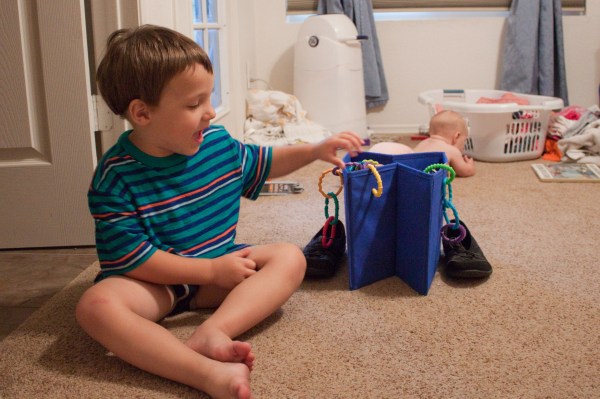
And every time we read Where the Wild Things Are, he has to have a monster at hand ready to read the story with us. Not wanting to shut down his imagination despite the onset of bedtime a few nights ago, I allowed him to build his monster to his complete satisfaction, helping him scour the house for the parts he needed.

IMG_7126

The folded front of the box is its mouth, and the links are legs connecting the feet (my shoes) to the head (the box). You can’t see, but inside the box more links are holding up a Slinky which is the digestive system of said monster 🙂 He was so proud of himself for designing and building it all by himself!

I absolutely love this creativity.

“It’s not that easy.” Grumwald felt his lungs scratching to become one in his chest. “I can’t just share my secret. It’s hard to explain. It’s hard to understand. It’s complicated.”

“Of course it is. It’s life.”

“So how do I do it then? How do I share my secret? What do I tell?”

“Your story.” The witch didn’t even hesitate. “You tell your story. That is what we all must do.”

“That’s not magic,” said Grumwald.

“Of course it is,” said the witch. “Story is the best magic there is.”

– Laurie Frankel, This Is How It Always Is

the best magic

Posted in family life, musings, quotes

parenting perspective

There were two things about Mama. One is she always expected the best out of me. And the other is that then no matter what I did, whatever I came home with, she acted like it was the moon I had just hung up in the sky and plugged in all the stars. Like I was that good.

– The Bean Trees, Barbara Kingsolver

This is the kind of parent I want to be.

It is so easy to fixate on the difficulties, the flaws, and the immaturity of one’s children – to be constantly thinking of how they need to grow and improve, or to be irritated by their boundary-testing, neediness, or even their boundless energy and silliness. At least, it is easy for me, sometimes, when I’m in my grumpy grownup or anxious mom modes! But there is so much more joy in parenting (and probably much more joy in my kids’ childhood) when I can see them in this way: as if they had hung up the moon and plugged in the stars.

There is so much good, so much beauty, in each of them, if only I choose to see it.

Posted in book lists

Kristin and Antonia: learning from my literary sisters

Over the past month I read both Kristin Lavransdatter, by Sigrid Undset, and My Antonia, by Willa Cather, for the first time. I couldn’t help but mentally compare the two eponymous protagonists as I was reading, as both are Catholic women written by female authors, but are in temperament and circumstance very different.

91Hp6MKOiRL.jpg

Kristin Lavransdatter, despite being raised in a noble and loving family, enters adult life unprepared and unwilling to battle her passions and bosom sins, pursuing her own whims regardless of the shame and inconvenience it causes the people who love her and sacrifice for her. It is not until near the end of her life that she is sufficiently humbled and matured to look back with repentance rather than mere regret, and to make the hard changes in her own life that following God and living rightly demand of her. I often found it difficult to read Kristin’s story compassionately or even patiently, because her struggles and misfortunes were so frequently caused by her own headstrong will and lack of self-control, when she should have known better than to act that way! But in that judgmental stance I was often rebuked by the gentleness and guiding love of her old village priest and a monk from a neighboring city, who lamented her sin, prayed for her peace, and offered their comfort and wisdom (and sometimes their correction) in her doubt. Love her, they seemed to say to me, protect and pray for her, do not judge her. Judgment will not help to restore her soul and heal her brokenness. And they were right; the scorn and shame of her neighbors stung, but she could ignore it, and it wasn’t that weight that in the end brought her back to God and taught her how to truly love another person selflessly and without resentment.

The book is written with a tempestuousness that matches that of the protagonist’s character – in the medieval Norway of the book (accurately depicted from what I can tell – the author did a lot of research), successions are contested, old folk beliefs fight with Christianity, famines strike, arranged marriages are disputed, childbirth is incredibly dangerous, miscarriages and depression and poverty hover beneath the surface, and epidemics sweep through society. Kristin is most definitely not the only fierce and passionate individual here! Her story and its setting draw the reader in from the beginning, and hold one’s interest captive through towering heights and plummeting lows.

51KeFj9GIyL.jpg

My Antonia, on the other hand, is one of the gentlest and most peaceful books I’ve ever read. Antonia’s character and life are sketched out through the eyes of a man who met her when they were both children in Nebraska (she from Bohemia, he from Virginia) and watched her grow up to full beauty and maturity with the affectionate eyes of an old friend. Where Kristin is blessed with beauty, love, and wisdom in the parents who raised her but squandered it in her own impulsive and passionate way, Antonia is struck with the incredible tragedy of her father’s suicide coupled with the small-mindedness and paranoia of her mother, and yet still manages to blossom.

And yet, Antonia is a passionate woman just as Kristin is, full of strong and rich emotions that carry her with them. She is by no means a weak or mild individual; she is strong enough to work the fields with the men, beautiful enough (in action as well as appearance) to turn every head, fun-loving and spirited, brave and opinionated. What makes her different is the direction in which her passions led her. Kristin’s passions were bent, misguided, uncontrolled, turned away from the good and praiseworthy; Antonia’s were, while not perfect, aimed in general towards truth and beauty. As Jim, Cather’s narrator, puts it near the end of the book:

She lent herself to immemorial human attitudes which we recognize by instinct as universal and true […] she still had that something which fires the imagination, could still stop one’s breath for a moment by a look or gesture that somehow revealed the meaning in common things. She had only to stand in the orchard, to put her hand on a little crab tree and look up at the apples, to make you feel the goodness of planting and tending and harvesting at last. All the strong things of her heart came out in her body, that had been so tireless in serving generous emotions.

Reading both books in close succession made me realize how the choices we make and the emotions we obey shape our lives and even our children’s lives, by painting two very different possible paths down which a woman of passion, beauty, intelligence, and potential could walk. Goodness does not remove all difficulties, as Antonia found through her suffering, but neither does repentance restore what all that is lost or heal all that is wounded, as Kristin found through her suffering. And the suffering endured with passionate love for the good, for truth, and for beauty will leave a much different mark on the people around us than suffering we bring down upon our own heads through our sin and poor choices.