Posted in family life

little autistic moments

Sitting together at the library, in two separate armchairs, Rondel and I examine the book in my hands. It is hardcover, with no plastic library jacket – smooth and pleasing to touch. The colors are soft and cool. It is thick; Rondel is full of anticipation and I am a bit apprehensive about how long it might be. When I open it, he looks up at me excitedly and says, “I can smell the pages!” More and more often he is noticing the smells of his environment, drawing out for himself an extra level of enjoyment (or disgust, sometimes, unfortunately) by way of his extra-sensitive senses.


Making toast for my three kids and a visiting friend, I fill up our small toaster oven with four slices. Rondel has asked for two pieces of toast at once, since he is hungry and we normally make two at once for him. I explain that the toaster is full so he will have to start with one and have a second piece later, and he seems unable to accept the change: wailing, threatening, screaming, sobbing. He even says that he wishes our friend (a toddler Aubade’s age who I occasionally babysit, and who Rondel loves) were not present if it means that he cannot have two pieces of toast at once. Limerick, 16 months younger, turns to him and says, “Dude, Rondel, the toaster is full! You can have another one later!” But it is always two pieces, and it is not alright that now this time it is only one.


After swimming at my parents’ house, I tell the kids that we will need to go home soon because Grandma isn’t feeling great and we don’t want to wear her out by staying too long. Rondel instantly begins telling me how he doesn’t want to leave, how he wants to stay at Grandma’s house forever, and so on. But when I ask him what he wants to do at Grandma’s house, he doesn’t know. He ends up suggesting, halfheartedly, that he could watch a movie, his go-to answer when faced with a transition he isn’t sure how to handle (it comes up in angry meltdown-inducing transitions as well as the more frequent “stuck” moments in between activities).


Getting up in the morning, sleepy-eyed and hungry, trying to figure out the day’s schedule, I am immediately bombarded with requests from Rondel to play board games. They continue for the whole day: after Aubade nurses, while she naps, as soon as one board game is finished, as a response when I ask if he is hungry for breakfast or lunch, and so on. If I say no, he keeps asking; he doesn’t usually get angry or demand that I play, but he tries to persuade me by making it more convenient and breaking the process down into smaller steps, persistently wearing me down. For example, he’ll bring the board into the kitchen if I’m making dinner, or he’ll offer to roll the die for me if my hands are occupied. It is his passion, his obsession right now, and he cannot let it go.


It is easy to see the ways that being autistic affects how he perceives and behaves in the world, in all these little moments. Some ways are positive; some are neutral; some are challenging for him and potentially also for the people around him. But they are undeniably there, pervasively present in his being in the world, making him distinctly different from most of his peers. And so we work together to make the world he lives in more supportive, so he can develop and mature and learn without the pressure of trying to continually mask. We establish routines and give him advance notice of upcoming changes; we give him extra space to process the unexpected; we coach him through transitions by helping him visualize what is coming next; we help him find creative ways to pursue his current passion when other people aren’t available to engage in it with him at the moment. With each day, he learns and grows and finds ways to be himself and cope with the expectations and realities of the world around him; with each day, we learn and grow and find ways to love, accept, and encourage him in his journey. The larger world adheres to a neurotypical standard, and we’re not going to be able to change that – but in our home we can give him a haven to be himself, to recharge and calm down, to be unconditionally loved.
Posted in musings

accepting autism when I want to be normal

I remember the first time I revealed my depression to another person, and the first time I admitted that I had wanted to commit suicide. It’s not an easy thing to be open about; it’s shameful, and dark, and has the potential to hurt the person you’re talking to quite a bit (especially if they knew you when you were going through it and didn’t open up to them until years later). I’ve found a way to accept it as a part of my story and talk about it now, though, and I hope when I talk about it that I can encourage others who experience it. I have a mental illness, I can say, without being ashamed or guilty. I have been in these dark valleys, and heard these poisoned voices, and felt the dank stagnant breath of despair on my face. If you are there, I can say, where hope seems entirely absent and all light is lost, where you are lost in a pathless wilderness and the very thought of finding a way out seems pointless, I have been there too, and I am a witness that it is possible to return to the land of the living.

Autism has been a more difficult name to claim for myself. While I don’t have a medical diagnosis, it’s not doubt about the validity of the label that stops me; I can see every symptom in my autistic son mirrored in myself, I score well above the cutoff for every ASD questionnaire I’ve ever taken, and it’s evident to others to the point that my husband laughed at me when I told him I wasn’t sure if I could be autistic myself.

Instead, I think what makes it difficult for me is the admission, in accepting this diagnosis, that I may struggle with certain things for the rest of my life without a “fix.” That some of the aspects of myself I’ve always hated, some of the traits I’ve never accepted, are part of my neurology that will never go away. I can take a pill to shut out the blackness of my depression; there is no pill that will help me fit in with a group, or know how to move my face the right way when I listening to someone talk, or recognize when a friend is being sarcastic and when they’re being serious. I can go to a therapist to talk through unhelpful thought patterns and try to replace them with healthy and positive ones so that a depressive trigger won’t need to set off a ruminative episode of self-hatred; I can’t go to a therapist to talk away the irritability caused by spending all day with three kids whose normal play and conversation feels like an assault of noise, or the emotional breakdown induced by a last-minute schedule change, or the heights of anxiety scaled every time a new event or social appointment is upcoming. I mean, a therapist could potentially help me find ways to cope with those physical and emotional reactions – but they are still always going to be there.

As we’ve gone through the process of Rondel’s diagnosis and my accompanying self-discovery, I’ve read and read blogs and articles from the #actuallyautistic community – I’ve sought to have my understanding shaped by the words of autistic adults and self-advocates. So I know that autism is just a different wiring, a different way of perceiving the world and being in the world. I know that very often it is social norms and expectations that make autism difficult, not autism itself – that is, the difficulties do not exist because autism is bad, but because it is different in a world not designed to accommodate differences. I love that autism has given me a mind like a database and an unfailing eye for patterns. I think I can give autism some credit for saving me from the girl drama of middle school and high school, for giving me dedicated and focused attention on things of interest and importance to me, for helping me to be an honest and trustworthy person, for developing my (often repetitive) love of books and reading.

But sometimes it is just hard. I don’t want to be a different person, but sometimes I’d love to be part of a conversation without constantly having to evaluate and compare my responses with the responses of the other people involved, without having to laugh at a joke even if I don’t get it at all, without having to guess whether a statement was meant to be funny or sarcastic or not. Sometimes I’d like to be invited when church friends or coworkers have a BBQ or a game night – and sometimes I’d like to receive an invitation with casual nonchalance instead of panicked uncertainty. Sometimes? – I wish I could actually be normal instead of just pretending to try to fit in.

violet_incredibles
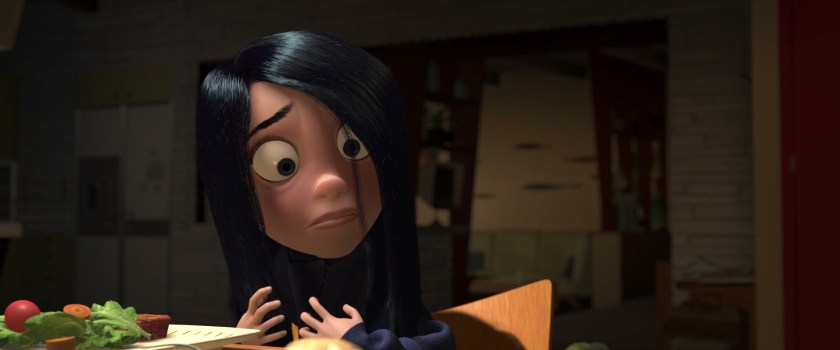
“Normal? What does anyone in this family know about normal? […] We act normal, Mom, I want to be normal!” – Violet Parr, Incredibles
But maybe it is harder to try to be someone I’m not, and waste my life wishing I were that other, neurotypical, person, than learning to accept and embrace who I am, struggles and all. Maybe it is harder, in the long run, to wear a disguise every day of my life and pretend that I never need help or support. I just know that right now I’m still too scared to take off that mask.

Posted in giveaway, sqt

{sqt} – differently wired

As we’ve navigated Rondel’s diagnostic process, one of the most helpful resources has been Deborah Reber’s podcast Tilt Parenting – and as a dedicated bibliophile, I have found her book Differently Wired to be equally if not more encouraging and challenging. It is currently the bestselling book in Amazon’s Disability Parenting category, and #18 in their overall Parenting list, and in my opinion (having read an early release copy) it deserves that top spot.

In fact, I think this book is important enough that I purchased an extra copy to giveaway, and that giveaway is live now! Head over to the official post to comment for an entry… I think my publicizing of it hasn’t been very effective so you have a good chance of winning 😛

Continue reading “{sqt} – differently wired”

Posted in family life, information, musings

responding to an autism diagnosis

We received Rondel’s clinical report today, with his official diagnosis of autism spectrum disorder. It was definitely not unexpected, and in many ways it is a huge relief to finally have it on paper with a physician’s signature and notes.

But it is also very hard to read through the report and take in the medical assessment of my child, who I see in all his brilliance and originality and intelligence, and who is being evaluated in light of his struggles and deficits. It is the very embodiment of the pathology paradigm, particularly given the list of recommendations at the end of the report that includes ABA, a therapy that is consistently attacked by autistic adults who experienced it as children. It reminded me of why we used the NODA app for diagnosis in the first place: so that Rondel wouldn’t need to be exposed to the pathology mindset, but would still be able to obtain a diagnosis for support, self-advocacy, and understanding. I just forgot that I as the parent would still have to deal with all of that negativity on his behalf, and buffer him against it.

In an ideal world, doctors could still assign the autism label without calling it a disorder. There are definite differences between the way the autistic mind functions – in the way it perceives the world, in the way it processes information, and in the way it prefers to interact with other people and objects – and the way the majority of minds (neurotypical minds) function. What people often miss, including doctors and therapists, is that the autistic wiring comes with its own unique strengths as well as its own unique weaknesses. A diagnostic process that sought to exist within the neurodiversity paradigm rather than the pathology paradigm could look for examples of both these strengths and these weaknesses, to generate a complete picture of the individual, and to help develop specific plans of support for the individual. In other words, for example: you have autism, and so you struggle with sarcasm and implied humor, you have difficulty reading facial expressions, social interactions and small talk take a lot of energy because of how hard you have to work to keep up and fit in, and certain noises and smells make you want to curl up into a ball or run away – but you also have a mind like a steel trap, the ability to make connections between information and ideas, unique ways of solving problems, and intense loyalty towards the people you are attached to. How can we craft your daily routine to take advantage of your strengths without putting too much pressure on you in your areas of weakness? That would be useful and practical support, without pathologizing the condition.

The pathology paradigm shows up in other places than the medical profession, though. Even a shift in the diagnostic process would take a while to seep through the culture – and until the culture changes, a diagnosis of autism is still going to be met by attempts to sympathize over the tragedy of it, doubt (because your child doesn’t look like he has autism), pseudoscientific “cures”, and even blatant disbelief.

What I wish I could tell everyone I know is that I am not sad or upset at all by Rondel’s diagnosis. His mind is different, and it is different in a beautiful and wonderful way. Will he struggle in a neurotypical society because of those differences? Probably so. But with love and practical support, he can also flourish and give to the world using his unique gifts and talents. He has the focus and the interest to immerse himself deeply in a topic and absorb everything there is to know about it. He has the imagination to see past the status quo and envision new ways of being and doing. And he has support around him to help develop his emotional awareness and executive functioning (two things that were a struggle for me well into adulthood).

What I wish everyone knew is that autism doesn’t just look like one thing. It might look like a mostly non-verbal ten year old communicating in one or two word phrases, dumping out every toy box and taking apart every Duplo tower, standing with the outdoor curtains blowing against his cheek to calm his body down, dancing to his favorite music videos, wanting to be part of the social action around him even as it overwhelms him. It might look like a very verbal twelve year old swinging endlessly because the sensation is so enjoyable, singing the same made-up song over and over again because the repetitive loop is comfortable and fun and transitioning to something else is hard, identifying what day of the week any date falls on, and communicating the love of God in profound and beautiful words. It might look like a four year old melting down because the color he used on his picture doesn’t look the way he expected, talking nonstop to manage auditory input, mimicking the meter and pattern of books and songs in his own games with new characters and situations, wanting a parent to snuggle with him every night at bedtime, or demanding animal documentaries at every possible moment. It might look like an adult struggling to focus on assigned tasks at work because their mind is stuck on other less-prioritized projects, getting into arguments with their spouse because of missed non-verbal cues, falling apart at movies because the emotions and sensations are just too strong and overwhelming, crying because they are running fifteen minutes later than they wanted, or developing a new system of project tracking for their lab from scratch and becoming a source of expertise without formal training because of their analytical skills and desire to learn.

Labeling all of those individuals as autistic helps them to obtain the support they need for the shared weaknesses that accompany the condition (weaknesses partially but not entirely due to living in a neurotypical society), but it doesn’t predict what they will do with their strengths and how their lives will play out. We are just as unique as neurotypical individuals in that regard! I believe – and this is why I think the neurodiversity paradigm is so critical – that if we can stop thinking of neurodivergence as disordered we can create better conditions for autistic and other neurodivergent individuals, a culture where all people can receive support in their areas of weakness and be given the opportunity to explore, develop, and contribute in their areas of strength.

What I wish everyone could see is that the autistic way of seeing and perceiving the world is also beautiful. That a person’s thoughts and feelings are equally valid whether they prefer to speak them, write them down, sign them, or use an assisted communication device. That the same processing circuits that cause us to flap our hands or scratch our arms or chew on our clothes to stay regulated are the same ones that allow us to retain incredibly detailed information and connect seemingly unrelated data in relevant and insightful ways. That the honesty and authenticity that keeps us from betraying or lying to the people we love makes up for our tendency to laugh at the wrong moments in a conversation or our inability to pick up on all your sarcasm or implied humor. That while we may experience and exist in a different way than you do, our differences do not make us less than you.

As an autistic adult (without an official diagnosis yet) raising an autistic child (now with an official diagnosis, hooray!), my plan for “treatment” consists mostly of helping Rondel to understand himself and to understand the world around him, cope with the things that are difficult and embrace the things that give him passion and fulfillment; and of prizing the wonderful individual that he is, and giving him the support he needs (right now, practically, speech therapy and mindfulness practice) to keep his areas of weakness from overshadowing and hindering his talents and strengths. It does not and will never include considering him to be disordered because his mind doesn’t function within that narrow range deemed “normal” or “typical” by the DSM.

Posted in musings

parenting towards inclusion

Inclusion begins with honesty.

If I gloss over the differences between people, my child will be confused by the discrepancy between what he sees and what he hears from me, and will intuit that difference is something shameful, something not to be spoken of.

Inclusion begins with knowledge.

Last week we watched a friend’s three children for a few hours at our home, one of whom is severely autistic. One of his favorite things to do is to take things apart (things like Duplo creations)… which was understandably frustrating for Rondel, who is very particular about his creations and gets worked up if anyone even gets too close to them. They were building together when the inevitable happened, and when I separated them Rondel told me that he didn’t like his friend “at all.”

But when I explained to him why his friend was behaving that way – that his brain was developing differently and he was in a lot of ways similar to Aubade as far as impulse control and the kinds of activities he enjoyed – it made sense to him, and he was able to adjust the way he played to accommodate those differences. Having that knowledge helped him to more fully include his friend.

Inclusion begins with presence.

One of the reasons I offered to watch my friend’s children (besides the fact that she needed someone urgently at the last minute) was that I want my children to spend time with people who aren’t like them: people of different ethnicities, people with physical disabilities, people with neurodivergences, people of different ages. It isn’t actually inclusive to sit around and talk about equality and opportunity and diversity if you aren’t living it out by filling your community with all types of people. I want my children to know from lived experience that even people who face incredible physical and mental challenges are just people, with their own needs and preferences and personalities, with their own unique strengths and weaknesses and quirks.

Inclusion begins with me.

Because my attitude and my choices determine the environment in which my children grow up, I have to shape it into one of acceptance and love. This is not necessarily easy for my introverted self, but I believe it is critically important for the future of our society and communities for inclusion to become part of the fabric of our everyday life and personal relationships. It begins here, in my home and in your home.

Posted in family life, information, musings

acceptance vs. awareness

I’ve been spending a lot of time on Pinterest lately, in an effort to avoid Facebook (and while waiting for my books on hold to become available!), and I’ve found some really encouraging, helpful, and inspiring posts! I’ve also found quite a few off-the-wall recipes that I’ve made to varying familial approval… but let’s not dwell on that.

I think the following two images which I found there are amazing examples of the difference between awareness of autism and acceptance of autism (the first was uploaded directly to Pinterest by a user, and the second is from the Thirty Days of Autism blog):

Notice how in the first poster only the negative effects of autism are mentioned: meltdowns, avoidance, tears, frustration, worry, and stress. Autism is an evil, something that one needs to fight through with hope and prayer, like a sickness that needs to be overcome and that left unchecked would destroy one’s life. (And if it were a sickness, like cancer, that would be more than fine! As it is actually a neurological and developmental difference that is always going to be part of who a person is, however, this attitude can feel like a personal attack on an autistic individual’s identity.)

In contrast, the second poster focuses on the unique behaviors caused by autism – things that are different from normal, but neutral rather than negative: parallel play, a need for space, deep focus and passion, love of technology, and stimming. Autism is portrayed as a part of who that family is – something for which they love each other, not something despite which they love each other. Acceptance gives them the freedom to be themselves, however autistic that self might be, while still receiving unconditional love and support in the midst of their individual needs and struggles.

Let’s just say I know which lens I’d rather be seen through – and therefore, which perspective I want to take when raising my differently wired child.

Posted in information, musings

Autism Acceptance Month

Did you know? April is officially Autism Acceptance Month!

(It’s ok, I didn’t know either until this year. Really the only month I ever remember is Black History Month in February.)

But this year I plan to do something about it! (Not sure exactly what yet, in the offline world, although Chris Bonello of Autistic Not Weird has some good ideas here.)

You may have heard some of the larger autism groups promoting April as Autism Awareness Month, and as a result wonder why I am using the word “Acceptance” instead.

Well…

It is because when I search for “vocal stimming” to find out what forms it takes and how it feels to those who do it (since I do not share this aspect of Rondel’s behavior), the entire first page of search results is geared towards how to make the stimming behavior stop.

It is because the majority of websites that refer to stimming, outside of autism advocacy pages, do so in an incredibly depersonalizing way, discounting the significance of the behavior to the autistic individual and seeing only the oddity of the action in a neurotypical world.

It is because most people have already heard the word autism and know that rates of diagnosis are increasing. The “Awareness” part of the job has already been done!

It is because no amount of “services”, supports, or therapies for autistic children will be sufficient in the long run if society isn’t able to reshape itself to accommodate the autistic way of being – those children all grow up to be adults, after all.

It is because the neurotypical world will lose out on all the beauty, humor, and insight that can come from a different way of looking at things if it keeps trying to fit everyone into a single narrow acceptable mold.

It is because, one day, I hope that every child and every adult will have the freedom to be different – to be openly and proudly autistic, ADD, introverted, extroverted, etc. – without inviting bias or feeling shame.

And after all, autism does not involve a breach of the moral code. There are no objections I can think of to the existence and self-expression of autistic people besides the differences that may make neurotypicals uncomfortable or inconvenienced. Maybe if the neurotypical world could meet the autistic world with genuine acceptance and unconditional love (autists already bend their whole lives around neurotypical systems, after all), the two could create a greater whole.