Posted in autism acceptance month

seven awesome things about being autistic

This post is part of my april autism series for autism acceptance month. Visit the first post here for links to the rest of the series!

Because autism is still seen in a largely negative light, I thought I’d cover some of the positive aspects of being autistic before addressing the challenges associated with it (you can come back tomorrow for that side of the coin). And since today is also the {sqt} linkup with Kelly, I have seven positive autistic traits listed here!

  1. Systems-oriented thinking and pattern recognition
    • “Autistic systems-oriented thinking, developed to its fullest potentials, means insight into the rich depths of underlying patterns and structures, the beauty of the deeper levels of natural order beneath surface realities, the beauty of the Tao.” – Nick Walker, “Autism, Aikido, and Systems-Oriented Thinking”
    • This is probably the defining characteristic of my method of approaching the world. I strive to organize the data I observe into systems and structures and patterns, always editing them to encompass more complete datasets, always delighting in each new connection and relationship I can find. As a kid, it meant I was quite good at games like Set (which is all about patterns), and loved exploring the grammatical structures of language and the mathematical patterns of numbers. In school, it meant I was able to assimilate information from different classes into a cohesive whole, giving myself a strong network of data to pull from for tests and projects. At work, it means I’ve spent a lot of my time learning database science on the side to help my team process and record information more efficiently, to pull out the patterns and connections between the datapoints we need to store. And personally, it means I never settle into one philosophy of life – new information can always shift my internal understanding of the structures of reality, hopefully into a more accurate conformation πŸ™‚
  2. Sensitivity to beauty
    • Increased sensory sensitivities, while definitely a challenge at times, can be accompanied by increased awareness of and sensitivity to beauty in the world. This could be natural beauty: the still blue of a cloudless sky, or the undulating mist off a waterfall; it could be artistic beauty: the throbbing pulse or soaring heights of instruments that express emotion we could never put into words; it could be the small and unnoticed details of life: the scent of rising bread or the sweep of curtains blowing in the wind. Just as we can be inordinately bothered by sensory inputs most people don’t notice, so too we can see and be awed by the beauty of things most people don’t notice – like the texture of a piece of fabric, or the feathers on the back of a moth.
  3. Powers of observation
    • This is connected to the first two traits, obviously: good observational skills are needed to create useful systems for understanding the patterns of reality, or to find beauty in the details that often escape attention. It makes a lot of sense in light of the definition of autism I shared here earlier also – if the autistic mind is taking in more information more intensely than the neurotypical mind, it’s going to be able to observe more details. Rondel notices all the bugs around him wherever he goes, and pays attention to the shape of their bodies and the patterns of their color; when he wasn’t even two, he was able to figure out the make (and often model) of a car by paying attention to the details of its shape and design. A friend at church notices the relationships between the people around him, putting together the connections of family and friendship in his mind even though he struggles to articulate them verbally. I was apparently able to see instantly if something had been changed in a room when I was a very young child. The details we observe may not always be particularly useful, but our minds are thirsty for them, hungrily seeking out the information around us to store away inside.
  4. Honesty and Loyalty
    • Many autistic people are highly uncomfortable with untruths. As the author of the blogΒ An Intense World says, “It’s not that someone with autism cannot lie. I can lie… [but] when I lie, it really, really, really, really, really bothers me. It’s like a deep brain itch I can’t scratch. So I don’t lie. It just bothers me too deeply, and I’d rather not be that uncomfortable all the time.” I’ve found that I can tell incomplete truths if absolutely necessary, but even that is difficult to do – part of me wants to provide all the information involved so the communicated picture is accurate.
    • Many autistic people are also highly loyal. While autistic individuals may not form many attachments, the ones we do form are deep and lasting. I can see this already in my son: while he has normal conflicts with his siblings, he has equally as many conflicts with me because he identifies himself so strongly with his siblings that he is ready to fight for them if I reprimand or correct them. As Cynthia Kim writes on her blogΒ Musings of an Aspie, “My attachments to people are few, but when I do form a bond with someone it’s a strong one. I will stand up for the people I care about in the face of a great deal of opposition.”
  5. Creativity and Unique Problem-Solving Skills
    • Autistic people see the world differently – so the things they create and the solutions they envision are also often a bit different! In my personal life, I see the unique style and form of my sister’s poetry and other creative writing; the way a child with severe speech delays at my church is able to communicate his thoughts through actions and echoed scripts; and the endless repertoire of “games” my son designs to explore his interest in the animal world and include his siblings at the same time (not to mention his eye for three-dimensional representation of said animals). When I was in high school volunteering in the children’s ministry at my church, a young boy who was later diagnosed with Asperger’s (part of the autism spectrum) noticed the folding table wiggling one week, crawled under the table, and proceeded to analyze the joints until he’d discovered multiple potential causes and tried to fix them. And he was only five!
  6. Deep or abstract thinking
    • Rondel asked me the other day why Jesus needed the disciples if He is God and can do anything. He asks me if God can know what we are going to do before we do it, and how that works, and seems to understand the answers I give him. He wants to know how high you can go before the air ends, and why the earth holds the air to it, and what exactly gravity is. He asks me if I will always love him, and why, and how I know that I will, and the answers give him peace when he’s recovering from a struggle with his more negative impulses. Autistic people usually don’t have much “common sense”, but our minds like to explore the deeper questions of life, and we are often able to separate facts and ideas from their social context to examine and compare them on a level field or in a new context.
  7. Expertise (and special interests!)
    • When the autistic brain gets excited about something, that thing becomes rather all-encompassing. We can spend hours a day for months or even years absorbed in the thing that is so fascinating to us – and as a result, we can accumulate some serious expertise in those areas! Rondel is a good example of how this can look in young children. His first special interest was vehicles, and as I noted above he was a master of vehicle identification at a ridiculously young age (I once asked him if a particular car that he’d told me was a Mazda was a Mazda 5 or a Mazda 3 hatchback and he knew the right answer without hesitation…). Next came dinosaurs, when he learned so many different species of dinosaurs that his grandparents were amazed (and often emphatically corrected!). Now that animals are his primary focus, he can talk for hours about the characteristics of different animals, the interactions between them, the environments they live in, and so on. By the time an autistic person reaches adulthood, they’ve cycled through quite a few of these interests, providing themselves with a solid network of information to build upon for the next one (or for more mundane things like work). And even in areas that are not special interests, autistic skills in observation and pattern recognition can lead to the development of expertise, as I’ve found in my own work environment.
    • Beyond the usefulness of expertise, of course, special interests are a source of pure joy. Rondel isΒ so happy when his mind is full of animal facts and stories and experiences, and he’ll engage with anyone available about the topic. I am so happy when I’m reading Harry Potter fan fiction (my current most embarrassing interest) that I struggle to stop reading and do anything else, and if someone is willing to listen I can share all my favorite theories and plot lines and alternate universes until they manage to escape.Β It is satisfying in a profound way to plunge into the depths of something and discover the hidden treasure within, to block out the overload of information from everywhere else and really seek to know one specific category of things. And experiencing that joy is one of the most awesome things I can think of about being autistic.

If you are autistic, what is one of your favorite things about it? If you have a friend or family member who is autistic, what is one of your favorite things about them that stems from the fact that they are autistic?
Posted in autism acceptance month, information, quotes

the autistic operating system

This post is part of my april autism series for autism acceptance month. Visit the first post here for links to the rest of the series!

I still remember the first time I heard of autism, although I don’t remember exactly how old I was (I think I was younger than 10). My dad was talking about one of his coworkers who had twins, telling my mom that while one of the children was developing normally, the other didn’t speak and liked to watch objects spin instead of playing with them in a typical way. My major impression was that autism was a sad and life-ruining thing (probably because my dad said it was sad), but I didn’t really understand what was so wrong about this little boy’s way of being and developing. In hindsight, I think this was the first time I realized that there was a “normal” way to be and that there could be something wrong about being different.

In the years since then, I’ve learned a lot more about what autism actually is: not a spectre of damaged children unable to connect and interact as humans, but a different neurological operating system that manifests in a fairly consistent range of behavioral patterns. Interestingly, these behaviors do not include either intellectual or language impairments, although both of these can present along with autism in an individual. Instead, autistic differences center around areas of social communication, sensory processing, and cognitive focus (including executive functioning). Autistic development is not necessarily disordered – it just proceeds on a different timeline than normal. Autistic ways of thinking, of processing sensory information, of handling emotions in the self and others, are not broken – just different.

The medical definition of autism can of course be found in the DSM-V, and I believe it is good to read and understand that definition even if it does portray autism in a pathologized way, but my personal favorite description comes from Nick Walker at NeurocosmopolitanismΒ (go read the full article!):

The complex set of interrelated characteristics that distinguish autistic neurology from non-autistic neurology is not yet fully understood, but current evidence indicates that the central distinction is that autistic brains are characterized by particularly high levels of synaptic connectivity and responsiveness. This tends to make the autistic individual’s subjective experience more intense and chaotic than that of non-autistic individuals: on both the sensorimotor and cognitive levels, the autistic mind tends to register more information, and the impact of each bit of information tends to be both stronger and less predictable.Β (emphasis added)

Walker puts so much useful information into this paragraph. While lists of common autistic behaviors can be helpful, especially when deciding whether an ASD diagnosis might describe yourself or someone you know, they can often seem disjointed and random without an understanding of their underlying cause (and, I think, can contribute to the common uninformed statement that “everyone is a little bit autistic).

But knowing this central difference between the neurotypical and autistic brain can provide a clearer delineation between the two, regardless of potentially overlapping behaviors, and can also explain many of the strengths and challenges associated with autism. For example, autistic individuals can often have excellent long-term memory and fact recall, as well as higher innate abilities to analyze data and detect patterns – all of which makes sense if the autistic brain is picking up on more information (with more internal emphasis), on a cognitive level, than the neurotypical brain. On the other hand, picking up more information with a stronger impact on the sensory level can make coping with everyday life extremely difficult, when “normal” touch and sound and smell can be acutely uncomfortable or overwhelming.

I’ll be going through more of those differences, both positive and negative, later this week, but for now the important point is that all autistic traits and behaviors stem from a fundamental neurological difference, and that autism, this difference in a person’s innate operating system – in the way they perceive, process, and respond to the world around them – does not make an autistic individual anyΒ less in terms of personhood, human dignity, ethical consideration, or worth.

Posted in autism acceptance month, information, links

autism acceptance month

Each April is Autism Acceptance Month.

Not, as some groups would put it, Autism Awareness Month. It’s a different perspective, because it’s coming from a different place. The autism awareness campaigns – like the Light It Up Blue campaign from the notorious organization Autism Speaks – tend to originate from medical professionals and non-autistic parents, people who see autism primarily as a disorder that merits pity and needs to be cured. The autism acceptance campaign, on the other hand, originates with autistic self-advocates (specifically the Autistic Self-Advocacy Network): people who understand autism to be a difference rather than a disorder – a difference that gives to us even as it makes certain things more challenging, and a difference that shapes our identities. To those who advocate for acceptance, considering autism to be a disorder and trying to eliminate it feels like a personal offense.

We are here,Β say the autistic self-advocates, we are autistic, and we have the same rights and humanity as everyone else. Stop trying to make the way we think and feel and act mirror yours; our autistic personhood is just as valid as your neurotypical personhood.

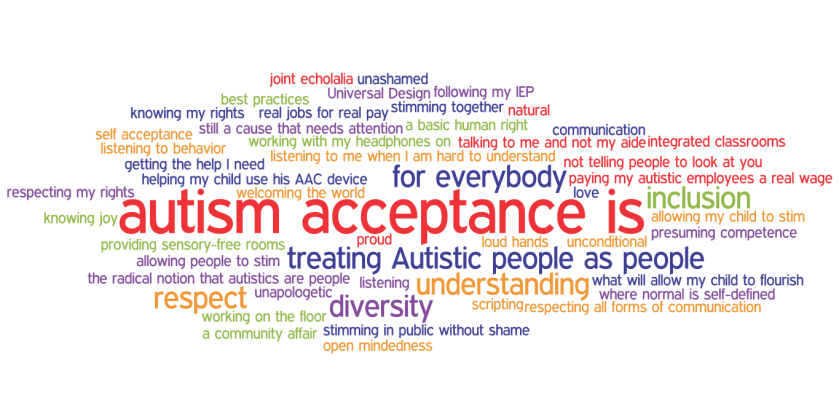
AAMwordcloud3
autism acceptance word cloud from the autism acceptance month website

This year, for the month of April, I have two major goals. First, I am going to spend the month writing about autism from the perspective of neurodiversity and acceptance, both as a (probable/self-diagnosed) autistic adult and as the parent of an autistic child. Second, I am going to pursue an official medical diagnosis for myself (although all the evaluations are in April, I won’t have the final word until May, unfortunately). I hope that you will join me on this journey – that together we can learn more about neurodivergence and how it affects individuals and society, and find ways to accept and love the differences in ourselves and those around us.

I highly, highly recommend that anyone wanting to learn more about autism focus on information from autistic people. Otherwise, it’s as if you’re trying to learn about the African-American cultural experience from a bunch of white authors, or trying to figure out what it feels like to be queer from the observations of the straight/cis community. Non-autistic professionals can give you an understanding of the history of the diagnosis, or the medical definition of the diagnosis, but they cannot tell you what it is like to live as an autistic person. They simply don’t have that inside understanding.

To get you started, here are some of my favorite #actuallyautistic internet presences (some of them are more than just blogs!), in no particular order:

  • Autistic Not Weird,Β by Chris Bonnello
    • I’ve been following ANW for a long time now, since back when it was simply a blog. Chris Bonnello has a great sense of humor, a lot of stories to share, and an accessible way of explaining technical information. This was one of the first blogs I read that was written by an autistic adult, and finding that I could identify with almost everything he wrote pushed me forward in my own path of self-discovery. The ANW community on Facebook is one of the most inclusive I’ve run across, with autistic individuals and their families asking and answering practical questions honestly and kindly.
  • Suburban Autistics, by Ally Grace
    • I found this blog by searching for gentle parenting tips, actually! Ally Grace and several of her children are autistic, and she writes about parenting in a gentle, accepting, positive way. I am always both inspired and challenged to be a kinder, more compassionate person and parent when I read her work – and to give myself a touch more grace in my own struggles as well. If you are on Facebook, I believe she is a bit more active there than on the blog.
  • Neurocosmopolitanism, by Nick Walker
    • I don’t think this blog is active anymore, but it is foundational in my understanding of neurodivergence. I would quote liberally from his articles except that once I start, it’s hard to stop! So just go and read them in full. Start withΒ Throw Away the Master’s ToolsΒ if you really want to understand the mindset behind acceptance as opposed to awareness.
  • The Girl with the Curly Hair, by Alis Rowe
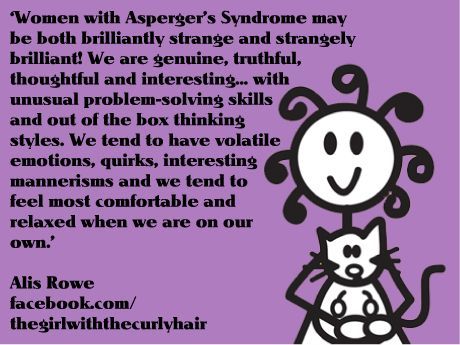
    • This is significantly more than a blog; it is a compendium of resources, especially for autistic women. Honestly, my main interaction with this site has been mediated through Pinterest, where I’ve found so many quotes – Β accompanied by the curly-haired girl illustration herself that – resonate with me on a deep level. (In the following quote, keep in mind that in the US the diagnosis of Asperger’s Syndrome has been deprecated and replaced by an autism diagnosis.)
alisrowequote
Quote: ‘Women with Asperger’s Syndrome may be both brilliantly strange and strangely brilliant! We are genuine, truthful, thoughtful and interesting… with unusual problem-solving skills and out of the box thinking styles. We tend to have volatile emotions, quirks, interesting mannerisms and we tend to feel most comfortable and relaxed when we are on our own.’

So for World Autism Awareness Day today, let’s start looking at autism from the perspective of difference rather than disorder, and seek to understand it from the inside out! My challenge for you is to pick one of the websites I shared above and read at least one article from it πŸ™‚ I’d love to hear what you read and anything from it that stood out to you!


all posts in the april autism series will link here after they’re published!

Posted in information, musings

quack quack: my autistic duck analogy

Whenever my husband and I talk with people about autism, or describe some of the behaviors and traits that are related to it, someone will inevitably identify with one or more of those behaviors and joke about how they must be on the spectrum too. As another logical conclusion would be that autism is an exaggerated or imagined condition, I am glad that no one I know has used their identification with an autistic trait as an opportunity to disbelieve the existence of autism! However, the situation is common enough that I’ve been searching for a good way to illustrate the difference between having one or more common autistic behaviors and actually being autistic.

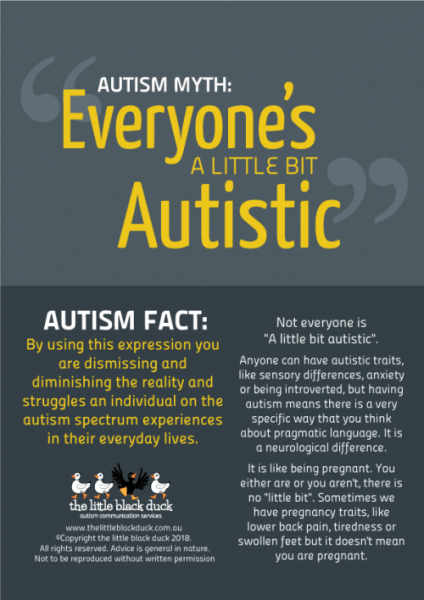
An infographic from Little Black Duck (an Australian company specializing in autism communication services) uses the analogy of pregnancy: someone might have some of the symptoms that are commonly associated with pregnancy, like sore feet or nausea or weight gain, without actually being pregnant – there is a different underlying cause behind the similar or even identical presentations.

everyonesautistic-500x708

I think this is a helpful analogy for the most part, except for the fact that autism as a condition is defined by the presence and degree of certain types of behaviors. Pregnancy is very clearly distinguished from non-pregnancy by the presence of a fetus; there is no such clear-cut biological test to distinguish the autistic mind from the allistic mind. Those very human behaviors that present in both autistic and allistic individuals are the only metric used in making the diagnosis, and the line is drawn at a somewhat subjective conjunction of multiple co-occuring traits and the severity thereof.

To me, the clinical struggle of defining the autism spectrum seems similar to the zoological struggle of defining a taxonomical species. Perhaps a duck could be defined as a warm-blooded, egg-laying animal with wings, feathers, webbed feet, and a broad bill. A seagull could relate to many of these duck traits, but not having all of them would fall short of the official criteria. A bat or a snake or a duck-billed platypus could relate on a more distant level, while a moose or bear would struggle to understand the duck at all save from an external perspective.

Likewise, some people will relate to the social anxiety many autistic people struggle with; some people will identify with sensory sensitivities; others will connect with the difficulties of small talk and nonverbal communication. People with other neurodifferences, like ADHD or FAS, will probably have more behaviors in common with autistic people than the general allistic population will, but like the seagull will fall short of the official criteria for the diagnosis. On the flip side, some people will lack almost all of the autistic traits and behaviors, and struggle more to bridge the differences between them and their autistic family and colleagues. But just like ducks are still animals, and all of their characteristic traits are shared (individually or in sets) by some species or another in the animal kingdom, so too autistic people are still human, and all of their characteristic traits can be found scattered throughout the general human population. It is only when all those traits converge that a duck is defined, or autism is diagnosed.

Now I just have to wait for a conversational opportunity to use my new analogy πŸ™‚ What do you all think? Does it make sense? How do you try to explain the difference between autism as a neurotype and commonly seen autistic behaviors?

Posted in musings

because it is good to belong somewhere

One of my favorite things about our church is the group of people I’ve gotten to know through the special needs branch of the kids ministry (called Equipped, for future more succinct reference). I’m not one who ever really feels that I belong in any particular group, but it comes close here – at the least, I feel like here are people who desire to understand and support our whole family, and who have a solid foundation and similar experiences on which to build that understanding and support.

To provide a concrete example of what I mean, I skipped our small group’s Christmas get-together (familiar people, familiar place, convenient time of day) because I was worried about the social expectations involved; but I jumped at the chance to go to the Equipped Christmas party (only some familiar people, unfamiliar place, inconvenient time of day) because I knew that whatever behavioral issues came up we would be unconditionally loved and accepted, and because I knew there would be other people there like us potentially dealing with the exact same behaviors and struggles. To be not alone, and for one’s difficulties to be understood and normalized, is an incredible gift.

I think it is for this reason that minorities and people with other differences often find themselves isolated from what could be called the mainstream culture (it may only be mainstream relative to a certain location or culture subset, of course). It is just so much more comfortable for any human being to be around people who are similar to them, with whom they can connect across some significant differentiating and identifying characteristic – and for people who are typically outnumbered or alone in those key characteristics in everyday life, a chance to not be the odd one out is like a breath of fresh air.

It is of course good and important to know how to live in mainstream culture, and it is at least as good and important to understand minority cultures of which one is not a part (I am always thankful for every person who tries to understand autism instead of judging or ignoring it, who isn’t offended by my refusal to participate in Sunday morning “greet your neighbor” moments for instance!), but it is also good to find a place where you can be yourself – and as a parent, to connect with a community where your child can be themselves around other children like them, so they too can have a place and time to no longer feel different and alone. And that is the gift that my church is striving to give to her children with differences and disabilities, all these neurotypical parents seeking to understand and support their children instead of forcing them to hide their true selves and appear “normal”, and it is (even incomplete and imperfect) a beautiful thing.

Posted in musings

stimming for joy

I stimmed today, for the pure joy of it.

I shook my hands back and forth like there was a vibrato in my wrists; I made waves through the air like the swirling lines of a dancing ribbon; I watched my fingers sparkle against the sky.

We were at the park; a storm was rolling in and the air was cool and crisp, with a bite to the wind. I was pushing Aubade and Limerick on the swings, feeling like I could fly with them, happy in the weather and the hours we’d been at the park already and the laughter bubbling from them as they swung. I would run towards them as they flew backwards, then dart backwards out of the way just before they could swing forwards and crash into me, and they would laugh so hard they could hardly catch a breath. Aubade would crow, “Three!” and I would push her three times, each one bigger than the last, so the third push would make her erupt with glee. And as the happiness ran through me it ran to my hands, and I chose to let it be instead of shutting it down, and I found as my hands danced in response to my happiness they also made it grow, until I was as completely blissful as I have ever been as far back as I can remember.

Normally, IΒ have my body on some sort of lockdown – I can feel an impulse to move and then before I even have time to process it there is a counter signal to hold still. Normally, the only things that get through this lockdown are the stims that I need to cope with my anxiety or the stims that occur when I’m thinking hard enough about something else that I don’t notice what my body is doing. In other words, I let my body process and express my negative or neutral emotional states (at least to some extent, because I have learned that it is important for my mental health), but I prevent it from feeling my joy.

I’m starting to think, now, that the stimming of my happiness may also be important for my mental health. I have walked the thought paths of depression for so many years, always feeling inadequate, always feeling like I was carrying a nameless secret that would make people reject me if they found out, always shutting down my happiness from reaching my body so that even the moments of the most joy and beauty were tinged with sorrow. But here my body is ready and waiting to give to me the gift of happiness – of taking my happiness and escalating it, elevating it, prolonging it – able to protect me from the darkness of those roads, if only I am willing to let it do so.

I stimmed today, for the pure joy of it. I hope I can feel free and confident enough to do it again.

Posted in family life, musings

parental ableism

It is hard to be a child. It is hard to be a parent.

It is harder still to be a child with a disability – to be noticeably different from the world while still having to find a way to live in it, to be growing and developing on a different timeline and watching younger friends and siblings attaining higher skills, to be unable to participate in “normal” activities and events. And it can be harder to be the parent of a different child as well: there is the pain of seeing your child left behind, isolated, excluded; there is the sorrow of knowing certain paths are closed for them; there is the hurt of watching them hurt, physically or mentally, because of their condition.

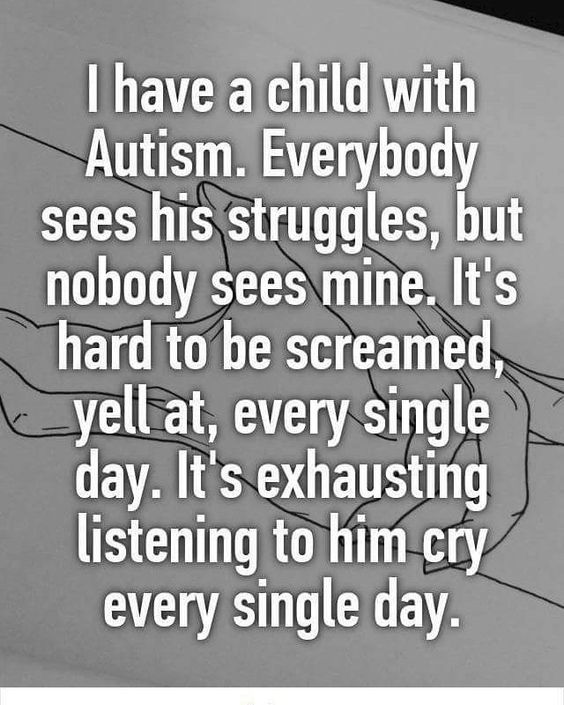
Anyone who denies that parenthood can be difficult is delusional, but in the autism world there is a subset of parents who twist their children’s difference into a curse, who portray themselves as martyrs and who thus by implication make themselves out to be the victims of their children’s autism (and, since autism is an integral part of a person, victims of their children). I haven’t had much contact with these parents, and I am not sure how large of a group they are though I have read about them often on neurodiversity advocacy websites, so I didn’t have the inoculation of experience to protect me when I opened up Pinterest and saw this image at the top of my home page:

badparent
White words on a gray background: “I have a child with Autism. Everybody sees his struggles, but nobody sees mine. It’s hard to be screamed, yell at, every single day. It’s exhausting listening to him cry every single day.”

This parent is clearly feeling resentful of their child. They see their son struggling, and instead of responding with compassion they just resent the burden that those struggles impose upon them as the parent. (So while they “see” their son’s struggles it doesn’t seem like they are knowing and understanding their son in his struggles.)

Well guess what?

Your son didn’t ask to have a parent who doesn’t want to hear his tears with love, or to help make his environment safer and more accepting so that he’s not continually triggered to tears and screams, or to view him with compassion and understanding.

Your son didn’t ask to be born autistic in a world that values normalcy and conformity, especially in children, who are expected to walk in obedient lockstep through the typical developmental stages and the standard grades of school.

And I can guarantee you that your son doesn’t want to scream and yell at you all day long. Every child – yes, even autistic children – want to have a relationship of peace and love with the people that they are most closely tied to. His behavior is how he is communicating to you that something in his life is horribly, terribly, wrong. He could be non-verbal and in physical pain he doesn’t know how to communicate or address (like my friend’s son often is). He could be overwhelmed by an uncomfortable sound or smell or feeling, and be unable to handle that sensory input on its own or in conjunction with some other social trigger (like my son often is). He could be in ABA training for hours each day and have no other way to tell you that it is sucking the life out of him to be forced into a neurotypical box where he knows he will always fail and always be judged.

Maybe you, as the adult in this relationship, need to address the anger issues you have with your son’s autism before blaming him for the way you are reacting to his attempts to communicate with you. I understand that things can be hard, but it is never appropriate to shame your child for his struggles on the most public forum possible (the Internet), and it is incredibly immature to add to that by insinuating that your struggles are all due to his inability to be a normal child, that you are some sort of martyr for putting up with him. Get the support you need, and check your attitude, in a private community where your child’s dignity can be protected and respected.

goodparent
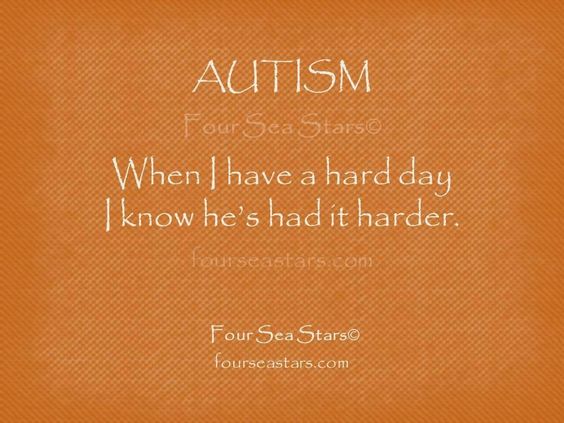
White words on an orange background: “AUTISM. When I have a hard day I know he’s had it harder.”

I love this second image so much because it acknowledges that both parents and children will struggle without victimizing either of them, without an attitude of resentment towards either of them, and with respect and tenderness towards both of them. (And it puts it so gently too!)

Like I said above, the hard and difficult behavior of a child, especially a child on the spectrum, and even more especially a non-verbal child, is a method of communication. Their needs and wants and struggles will show up in the way they act, and while their behaviors may be particularly challenging for a parent to deal with, they are a symptom of something deeper that is wrong.

And if you are that parent, faced with those challenging behaviors, feeling at the end of your rope, unsupported in your own struggles, please find help, and please do not blame your child or their autism for your struggles. Honestly, blaming anything only leads to more resentment. Try to see those behaviors as a clue to finding the best way to support and help your child. Try to see your child as fully human and fully deserving of respect and dignity despite their struggles and the struggles you have as their parent. And try to remember that no matter how hard your day is – as a neurotypical adult in a world set up for the way you operate – that your child’s day – as a neurodivergent child in a world foreign and alien to the way they operate – was almost certainly harder.

Posted in sqt

{sqt} – why I write about neurodivergence

For this week’s quick takes linkup Kelly wrote about why she and a few other bloggers write about their families and how disability affects them, with some solid insight about the good to be gained from writing and the pitfalls to avoid. I do recommend reading it, especially if you write or are considering writing about your own family! (Key takeaways? Show how the happiness of everyday life is not less because of disability, and don’t overshare about your children’s private issues.) From my perspective, here are several of the reasons that I write as much as I do about my own neurodivergence and Rondel’s autism on this blog (in no particular order).

  1. Writing helps me process life. Since I learned how to write I have consistently found it far easier to coherently express my thoughts in a written format than vocally. My mom and I actually had a journal for writing back and forth to each other when I was around 10 or 11 that we used and that I appreciated a lot! Similarly, my husband and I used Facebook Messenger for most of our serious pre-marital conversations, because the anxiety involved was so much less and the processing time could be longer. Now, I use the blog to help me focus on things I want to remember, organize events as they happen (since I can never remember anything chronological reliably), and fully formulate my thoughts on issues that are important to me.
  2. My son is a human person of innate worth due all the respect that any other person should receive. (Well of course, you should say). But from a lot of the autism rhetoric on the internet, a person could easily come to the conclusion that this is a radical or even untrue statement – and for that reason alone I believe it is essential to write about him and our family in a way that demonstrates his humanity. Some of his actions may not look like what society expects; his developmental timeline may be different than “normal”; and he may struggle with things that most people consider to be trivial inconveniences or perhaps don’t even notice. But those developmental differences do not make him less worthy or less human.
  3. Autistic children grow up to be autistic adults, and they still struggle with things that most people don’t struggle with. So that’s why I write about myself: first so that people can understand why I or other neurodivergent adults may act in certain ways, second so that neurotypical adults don’t trivialize our struggles because they only perceive the slight quirks and oddities that show through our masking, and finally so that younger neurodivergent individuals can see adults like them living and struggling and coping and thriving in the world. We might not be the best at forming in-person communities (and it would be hard anywhere except in a large city anyways), but even just knowing other people like me through the Internet has been hugely encouraging and enlightening; I’d love to be able to extend that gift to someone else.
  4. As a corollary to this, it has been especially difficult for me to find a community of Christian autistic/neurodivergent adults, particularly women. There is one in my small group which is amazing – I don’t recall having had that kind of connection in an adult friendship before – but other than that there are just a couple blogs that’s I’ve found. I would love to both share how I live my faith as a neurodivergent individual and help the church deepen its understanding of neurodivergent individuals, and maybe I can start small here.
  5. Sometimes I find things that I want to share, and the blog is an easier way for me to share them than on Facebook, where it is so easy to hurt feelings. See this link for an example:Β Ink and Daggers: Small TalkΒ (trigger warnings for ableism, child abuse, and language).
  6. I can’t think fast enough in conversation to discuss things that are close to my heart. I struggle to read my companion’s reactions, to gauge where next to move the discussion, to know how to change the subject without giving them my agreement, to be passionate without getting emotional and losing the words I need most. I wish I could tell everyone about neurodivergence, to promote acceptance instead of toxic awareness, to advocate for myself and Rondel and other people who are hurt daily by the ableist assumption that they are less because they are not normal, to help people to understand instead of pathologize autistic behavior. But I just cannot manage all the little things required by conversation while a high-stakes, emotionally-charged issue is the topic; it never ends well. Instead I write, and maybe my words will reach eyes that need to read them instead of ears that need to hear them.
  7. Finally, this story is all-too-common among people whose differences were seen purely as deficits, whose superficial abnormalities were trained out of them but who were never given coping skills for their deeper struggles, who were only ever valued for appearing normal and never praised for their unique abilities. This is not my story, because I was blessed with parents who always sought to understand and support, but it is a story I have read time and time again in the online adult autistic community. I write to try to create, with my words, a world in which this is not the norm for autistic children. (Is it the norm, you ask? Surely it can’t be that bad? Well, it is the result of therapeutic practices condoned by major groups such as Autism Speaks and the Judge Rotenberg Center, so it is definitely mainstream. I am hoping it is becoming less common, of course.) I write also to share those more painful and disturbing stories – and the principles gleaned from them – so that fewer people can say, “oh, I didn’t know!” as an excuse for their inaction and indifference.
Posted in musings

making accommodations for myself

Every fall and spring the women’s ministry at our church creates a Bible study and hosts a few events for all the women at the church (in addition to the regularly-meeting discipleship small groups). I’ve never attended any of the events before, or been part of the study groups, just because life has been busy, but I have been feeling the need for more structure in my spiritual life to give me direction and motivation, so I went to the first meeting of the year a few weeks ago (leaving Paul to do bedtime with all three kids πŸ˜‰ )

Large group events like this can be challenging for me for a number of reasons. The first is simply the uncertainty: I had no way of knowing the schedule or plan for the event, nor did I know if anyone I knew well would be attending. The second is the number of people and the accompanying audio and visual (and potentially olfactory) stimulation. I often have significant anxiety or discomfort in church every Sunday because of this factor, and there was no reason to expect it to be different at this event. A third reason is my desire to appear normal and fit in; I really don’t like attention and so I somehow needed to find a way to handle any stress without looking like I was stressed (this is called masking).

Fortunately, as a 29 year-old, I’ve developed a few strategies for coping with these challenges.

To deal with my uncertainty, I thought back to other group events I’ve been to in the past and created a potential outline for the night: mingling, some talking from the front, maybe some music, probably some discussion questions. Other than knowing that mingling always comes first, I figured the schedule would be some modular arrangement of those four activity types, and I would just need to be prepared for all of them. I put my smile on, focused on looking at least near people’s faces when conversing, and thought of some basic questions to bring up that no one would be offended by (like asking about their previous experiences with the women’s ministry at our church – a particularly good icebreaker for the kickoff event for a new semester).

For coping with sensory overload (during both mingling and music) and for staying focused during the presentations from the front, I brought my fidget cube and a pen and paper. I am not really a note-taker, but writing is a fairly effective stim when listening to a speaker; the fidget cube is perfect during discussion and small talk as it is small and discreet, and can even be used during music. My goal for the night was not to pick my skin at all, and thanks to near-constant use of my alternate stims I mostly succeeded! I definitely flapped a lot in the car on my way home to shake off the tense/overloaded feeling though πŸ™‚

[Flapping connects back to the masking issue: hand-flapping has never been a major stim for me because it is just such a big obvious motion and I feel extremely anxious and self-conscious if I do it anywhere anyone can see me. Skin-picking is more typically more subtle (unless I start bleeding…), as is rubbing my fingers together back and forth, and the fidget cube and writing are almost normal. But as I’ve been learning more about the purpose of stimming, which is to help the body cope with sensory processing difficulties, I’ve been trying to give my body opportunities to stim naturally without instantly shutting it down because of my social anxiety. Right now that looks like stepping out of an overwhelming environment and letting my body work through the overload before going back or moving on to something else, and finding a more private space where I can relax in the way that works most efficiently for me. Bluntly, I’ll leave church a few minutes early (like I always have, to pick up the kids), and instead of just walking to their classrooms I’ll let myself flap on the way; it only takes a minute or so and it decreases my inner tension so much.

Also I dislike the word “flap” but that’s what the action is usually called so it’s not really up to me to rename it…]

Anyway, the event was overall a success! Was it exhausting? Yes, of course – but it was also spiritually encouraging. I got to be with other women who love God, talking about Him, reading His word, singing songs of praise and worship to Him, and I even got to have a long-ish chat (far away from the realm of small talk) at the end of the night with an incredible woman who I deeply respect for a number of reasons, leaving me better equipped to pray for her and for family.

While my definition of a challenge may be very different than yours, I think it is true for everyone that it is sometimes very worthwhile to attempt challenging things – and that it is always worthwhile to give yourself the compassion, understanding, and acceptance needed to adequately prepare for and evaluate yourself during those challenging things. These were some of the ways I accepted and made accommodations for my own struggles (instead of telling myself I should just fight through them and be normal) – what are some of your strategies for doing so?

Posted in family life, sqt

{sqt} – solo parenting, friends, and broken AC in the summer

It’s been a different sort of week over here! For the Seven Quick Takes link-up with Kelly, here are some of the highlights:

  1. Limerick has beenΒ so tired, every day. We went to the zoo on Monday at his request, and he was so tired that he asked to go home every 30 minutes. He napped on Sunday and Monday (which he never does), and has been so tired in the evenings that he struggles to get through swim lessons despite loving and enjoying them. I don’t know if he just isn’t sleeping well at night, or if he has some sort of vitamin/mineral deficiency (thinking about iron specifically). He also hasn’t been eating much, but that isn’t a new thing; compared to the other two he has never been a big eater. His four-year well check is in just two months so for now my plan is to try to get him in bed earlier and facilitate naps when possible.
  2. Paul went up to Prescott for his first business-related trip this week! He even got to deliver a short presentation at the conference! Aubade is definitely missing him though, and while it sometimes seems like the boys don’t care whether he is here or not, Rondel has told me several times that he wishes Daddy were back. There’s something special about getting to share everything with him at the end of the day when he comes from work.
  3. Corollary to take 3, I’ve been doing bedtime for all three kids instead of splitting the responsibility with Paul; the first night Aubade got to fall asleep on her own while I put the boys down, and the second night the boys got to fall asleep on their own while I put Aubade down. I can’t recall any previous night where I have left their bedroom and they have fallen asleep without tears or trying to follow me out, but this time they were out in less than fifteen minutes without any complaints. It was amazing (and so needed, as Aubade was having a really hard time).
  4. We had a playdate with a new family I met online through an unschooling group! It was really neat to watch Rondel running around with a kid around his same age, both of them being monsters and hand-flapping and trying to climb crazy rope ladders and getting scared and not really talking to each other but definitely playing together. A couple weeks ago a younger girl we know from church made a comment about Rondel chewing on his shirt (it’s one of his stims, and a pretty innocuous one honestly) and that being kind of weird or gross; this new friend didn’t see a problem with it at all (and in fact I noticed her experiment with chewing on the collar of her shirt as well). So that was also really encouraging to me, as I’m trying to find friends among whom Rondel can fit in while being himself.
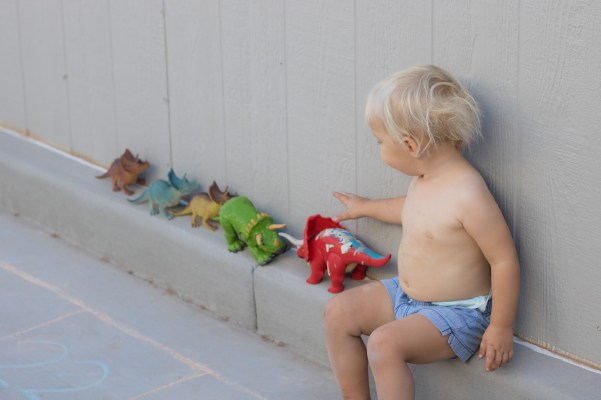
  5. Random thought of the week – why do so many people make such a big deal out of autistic kids lining up their toys? I mean, is it really so strange? I think some behaviorists see it as “abnormal” play, or play reflecting a lack of imagination, but I don’t know how accurate that is. I know when Rondel lines up his toys, it is usually because they are on some sort of migration. I also know that my mom used to line up toy cars and drive them on parade as a child, and that my daughter likes to line her toys to display them – and they are both neurotypical. There is just something so nice about a line, especially as opposed to a pile…
    IMG_0624
    image is of a blond toddler sitting on a curb against a wall, head turned towards a line of toy Triceratops also on the curb. She was very particular about only selecting the Triceratops from the dinosaur box…


  6. Both boys mastered the “l” sound and the “tw” sound this week! When they are counting, eleven and twelve come out far clearer than before. I am so proud of the effort they’ve put into it, and they are so pleased with their newfound ability πŸ™‚ Rondel still has moments where he doesn’t want to try to say sounds the correct way, because it’s hard and he thinks he can’t do it, but he tries often enough that he’s improving. Limerick tries no matter what, and he’s improving in leaps and bounds. Hopefully soon they’ll have their pronouns completely straightened out as well – it really confuses strangers and other children when they use “you” to refer to themselves.
  7. We had one random day of rainy cool weather this week – the high was in the mid-80s instead of around 100 where it has been hovering – and very conveniently our AC decided to break that evening after everything was cooled down already. It was rather dramatic: I was out back playing with the boys after sunset, when we heard a loud pop and saw sparks on the roof. I tried to turn on the AC to test it (and to bring the temperature down from 83 to 80 for bed), and nothing happened. It turns out a poor-quality wire had been rubbing on a piece of metal long enough that the insulation wore away and the humidity in the air enabled an arc to form between the two, shorting the wire and blowing a fuse. Fortunately, since the highs are going back up to 100, it was a quick and easy fix and we had AC by the time the external temperatures reached 90. But, as the AC repairman warned us, it is an old unit that has had some shoddy repair work done in the past, so we’ll most likely need to replace it in the next 2-3 years. Ah home ownership πŸ™‚

I hope you all had a great week, whether it fell into the swing of your normal routines or stretched them a bit out of shape! And I hope that you are finding friends – or keeping friends – who love you and accept you just the way you are. Those types of friends can be hard to find, and they really are as precious as silver and gold.