Change is hard. Routines give life structure and reduce anxiety. This is probably especially true in a partially autistic household…
But sometimes, you have to swallow your fears and set out into the great wide somewhere, without knowing what might happen, even expecting that something may happen for which you are utterly unprepared.
And then, sometimes – more often than your fears would lead you to believe – there is freedom, and there is joy.
There are places and times when the beauty and the wonder overcomes the discomfort of uncertainty or freezing water, and happiness can reign uncontested.
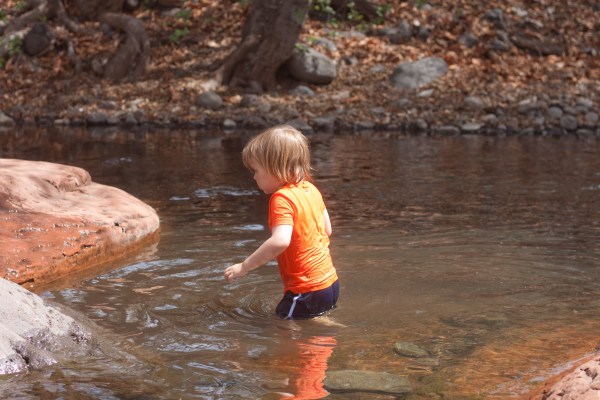
There are moments when the lure of the next rock over proves greater than your apprehension about the deep pool that lies between you and it, and moments when crossing over through your fears ends up being one of the best parts of your day because that thing you were so worried about is actually something you love, that brings out the adventurer in your soul.
It takes a lot of energy to step outside the normal and comfortable patterns of everyday life; I’ve discovered that I need to plan for a day of rest and recovery afterwards. But the thrill of living more fully, more expansively, less bound by our anxieties and routines, is very often worth it.
And for me, the scent of the clean air, the caress of the warm sun, the rhythm of the flowing water, the strength and grace in every line of plant and rock – those things are always worth the effort it takes to find them.
(Many thanks to the friends who made this possible by inviting us along and giving me a safety net to quiet my anxieties! I wouldn’t have gone without the assurance of helping adult hands, since my husband wasn’t able to come along, and now I know that I am capable of handling this kind of adventure on my own in the future. Your support was invaluable for the moment as well as for the moments that are still to come.)
As we proceed with Rondel’s diagnosis (since the school district is unable to provide an actual medical diagnosis in their evaluations), we’re using an innovative diagnostic app developed by a local children’s hospital, which involves capturing multiple videos of Rondel’s actions and interactions in specific situations. I like the concept a lot, as it lets the doctors see into Rondel’s everyday life and observe him unnoticed for far longer than would be possible in an office setting! However, as I’m going through the videos to trim and upload them, I keep wondering if the specialists will see the differences that we believe are present – or if they will tell us that his struggles are due to something like poor parenting. Maybe if I were stricter, or reinforced acceptable behaviors more consistently, or provided him with a more stable routine, or cleaned up our diet, or or or or…
…then maybe he would be fine, maybe he would be normal, maybe he would fit in with all the other kids instead of sticking out uncomfortably.
He just isn’t so significantly different that it’s obviously a medical problem to a layperson. His differences are hidden, partially masked, behind his gregariousness and intelligence and creativity, until he’s used up all his energy on coping and he falls apart. So when people see him melting down or acting out, it’s easy for them to assume he is doing so willfully, or to think that he is simply being “spoiled” and “self-centered.” Even I, who see him every day, wonder sometimes if the difference is truly there, all the way down, no matter what, or if I could find some parenting technique that would work better for him and “catch him up” to his peers.
But I wonder that about myself also. Do I fail to maintain relationships or engage in neighborhood community-building because I am selfish, lazy, and don’t care about other people? If I were a better Christian, could I overcome my introversion? Many people do, after all, and are able to make time to recharge themselves. So am I guilty of using my social anxiety as an excuse to cover up for my vices or inadequacies?
Similarly, before I was diagnosed with depression (and honestly sometimes still), I would tell myself that if I just tried harder – if I prayed more, exercised more, ate better, spent more time in self-care, spent more time with close friends, practiced the right mental exercises, etc – I could get through the negative feelings and be fine. Getting the diagnosis was one of the best days of my life, because of what it meant to me: that I wasn’t an awful person taking advantage of the people around me, just a sick person who was trying as hard as possible to find joy and light but needed some extra help.
And my hope is that a diagnosis will be a similar gift to Rondel: a confirmation that his differences are real, and valid, and significant; a reminder that some things will be harder and it will be ok to seek and use help and support; and a shield against the barbs of guilt and shame that always accompany deviations from social and cultural norms. The alternative – refusing to acknowledge and name the neurological differences that give rise to his behavioral differences – is only a recipe for disaster as he grows older and begins to notice his differences without a framework for comprehending and addressing them. How much better to provide him with a framework of informed understanding, acceptance, support, and unconditional love!
We started out with postpartum depression and RSV; we’re ending with all three kids sick with the flu! (Well, to be more accurate, they were sick over Christmas and are mostly better now.) In between we fit more into one year than I would have thought possible, with therapies, medications, travel, moving into a new home, dipping our toes into the world of special needs education, and beginning a new round of transitions with my husband graduating and finding a job (which will start shortly after the New Year).
And I have learned so much this year, including about things that I thought I already understood but was able to look at from personal experience or through the new and edifying perspective of someone else’s experience or research. I acknowledged my anxiety as an obstacle in my path rather than a personal failing, thereby removing the associated guilt and shame and allowing myself to move forward; I began to make space for myself and the people I love to be different, express their differences, and be loved for who they are with those differences; I learned when to stand up for myself and when to disengage, and that both are ok given the circumstances as well as my own mental state; and I found the courage to make uncommon decisions for uncommon reasons without becoming defensive or belittling the choices I turned down. At least, those are the seeds of change that are beginning to germinate within me as a result of this year – I think I could spend a lifetime watching them grow!
This was also a year of good reading. What began as a way to cope with my depression when almost nothing else could distract my mind from the darkness turned into a re-ignition of my lifelong compulsive love of books and a chance to discover new characters, adventures, worlds, and authors. For the first time since childhood I kept a book log for myself, which was a massively encouraging endeavor in and of itself, and managed to read and record 84 previously-unread-by-me books since I started tracking mid-January! I think the books deserve their own post so I will say no more here – but it was a major part of my year and a consistent source of pleasure and refreshment as well as an escape from my own head.
And of course this was the year of Aubade, since she just barely made an appearance in 2016 but has by now infiltrated herself into every thread of the warp and weave of our lives. Through her, the boys have gained independence and learned compassion and gentleness. She has stolen our sleep but given us laughter. She is a confident baby princess, secure in her belief that whatever she wants, she should have, and she will get it for herself if no one will get it for her! She is a fearless baby explorer, certain that she can do whatever she sets her mind to do, and that around every corner (or behind every door, or on top of every high place) there is something new and exciting to discover. She is a bestower of hugs and a jealous claimant to her mommy’s lap. She is a passionate lover of showers (or pools, or baths, or splash pads), peek-a-boo, mud on her fingers, the thrill of the climb, the loudness of blenders and vacuums, snuggles with the people she loves, and singing or playing music. I can hardly believe she has only been in our lives for a year, because life without her would seem so empty.
Overall, it was a year of crashing lows, dark valleys to endure, and steep mountains to climb (my saint for the year was St. Jude, patron of hopeless causes, and it certainly seemed fitting when I was in the depths of the depression) – but it was also a year of soaring highs, transcendent mountain views, and glorious sunrises. A more stable and mundane year would certainly have been easier, but I am thankful for the things that happened and the way they shaped the person I am now. And now, let the adventures of 2018 begin!
I’ve been thinking a lot about a few topics lately, none of which have made for suitable blog posts.
First, I’ve been very actively consumed by an off-the-record project I’m attempting for my job (basically, I’m trying to develop a database and website for our team, for essentially no cost, using only my own skills and whatever products are accessible for free or close to it. It’s difficult, time-consuming, and addictively enjoyable).
Second, I’ve been noticing how my hormonal cycle still affects my depression even with the Zoloft. And when I’m exhausted and down for a week or so out of every month, I feel like I spend the rest of the month digging myself back out of a hole. Still, it’s much better than being continually tired and depressed!
Finally, I’ve been concerned – or maybe nervous is a better word – about Rondel. His quality of speech hasn’t improved over the past year or so (although his language development has, which would be a greater problem), and may have even declined over the past six months. For people who don’t know him, he is a challenge to understand at all, and even I have to ask him to repeat himself if I can’t see his face or the context of his speech. He’s also had some anxiety or behavioral issues – it’s difficult to tell which may be causing the other, or if they’re both just feeding each other – that have made it increasingly difficult to take the kids out. On a good day he’s sweet, loving, funny, imaginative, energetic, and helpful; on a bad day he’s impulsive, defiant, silly in a “let’s make breaking the rules into a game” sort of way, aggressive, and clingy. And the bad days seem to be getting more frequent, and I never know what sort of day it’s going to be. But in my mind I’m just endlessly walking the treadmill of worry, and that doesn’t make for great reading 🙂 So we’re waiting to have him evaluated, and hopefully that will be profitable. Actually, I wouldn’t mind prayers to that effect!
But it has been a while, and we’re finally starting to settle into the semester and the new house, so hopefully you will see a lot more posts on here soon! I keep reminding myself that I need to write things down or else I’m going to forget them all when the kids have their own families and are wondering how far the apple fell from the tree…
Once upon a time there was a little girl who worried. She didn’t worry about practical things, like fires and robbers; she trusted her mom to handle things like that. But she worried about heaven, and how to know what happens when you die. She worried about wanting to be alone and making her friends feel hurt. She worried about being the littlest and the last and being left out because she was too late. She worried about losing her stuffed bunny that kept her company in the dark at night.
When she grew up, her worries didn’t really leave; they just changed to fit her new grown-up circumstances. She still worried about death, and wondered just what she would find after passing through that painful door. She worried that her introversion made her less of a good Christian by crippling her witness to Jesus’s love and grace. She worried about never measuring up to the people around her; she worried about missing out on something important by showing up late to anything. And she worried about losing the people closest to her, the relationships that mattered most, the love that kept her feeling safe in the dark at night.
This little girl didn’t realize, for years and years, that she worried about all these things. She thought that because she didn’t care about what other people thought of her, and wasn’t anxious about the future, and didn’t get nervous for doctor appointments or tests, and could handle large crowds and speaking in public (although it wasn’t enjoyable), that she wasn’t a worrier. She prided herself on her ability not to worry, to trust God with the outcome, to embrace new situations and attack new problems with confidence. But the worries were always there, in the dark corners, ignored but not silent.
They were there in the moments she wanted to speak but couldn’t open her mouth for fear of saying the wrong thing; they were there in the Psalms of trust and strength she memorized and would recite over and over again before getting out of the car and walking back into the relationships that mattered so much they hurt; they were there in the nights lying sleepless in bed aching over a careless word that might have damaged a friendship; they were there in the years and years of picking away all the bumps and scabs and scratches on her arms. But it wasn’t until they grew so strong that she couldn’t leave her house without physical panic that she admitted they were there, and that she wanted to let them go and help them rest in peace.
Worry grows like a climbing plant, wrapping its tendrils tightly around the support bars of your heart, cracking stone, weakening foundations, inserting itself into every nook and cranny and taking hold. Removing it is not the task of a day, nor an effort for the faint-hearted. Sometimes, this grown-up girl worried that it would be an futile effort, not worth the time and energy it demanded. But now that she knew how deeply it could incapacitate her if allowed to grow freely, she could see that even just keeping it fought back and somewhat maintained was a necessary (if unrewarding and unending) task. Left to itself, it would destroy everything else.
Worry builds unseen walls around the tended places of your heart, sealing them in, claiming to protect them from danger and harm. But all the time, as it builds, it pricks and pokes and pierces those vulnerable and intimate areas with images of all the possible scenarios that could bring about your devastation and despair. You may be safe from the actual event you fear, but you are locked in a dungeon with your worst tormentor of all. It took years of patient love, proving the worries false and unfounded, to open doors in those walls and coax the frightened areas of this girl’s heart out into the wild and beautiful free world again, and still she finds herself drawing back into those confines in moments of fear or anger. But now she knows the feeling of warm sun, fresh air, and flowing water in the deepest part of her being; now she knows the peace that comes from leaving behind worry’s dark and fearsome fortress.
Worry tried to convince this girl, through all these years, that she was unable to control the forces surrounding her life, and that events were sure to overwhelm her at some point or another. It tried to tell her that she could never hope to be enough, to break her spirit and close her in. But the deeper story, the more lasting truth, is that worry has trained her to be a warrior, fighting for her own joy and peace and love and beauty, and for all those things for the world she lives in: a warrior who will never give up, who knows her enemy is a liar and a coward – a warrior who fights with hope.
I’ve been listening to some podcast archives from the Royal College of Psychiatrists and in one heard a man tell the interviewing doctor, about depression, “I don’t think you’re ever cured – it’s like alcoholism, it will always be there.” (I paraphrased).
That’s a reality I’m coming to terms with, as I have a new and more normal mood thanks to the medicine and therapy, but still feel the old out-of-sync emotions and unhelpful habits of thought there in my mind, popping up at tiny triggers or for no apparent reason at all. When the Zoloft started working – when I felt that first incredible lightening of the burden of depression on my mind and body – I suddenly had these amazing hopes and even expectations for my continuing treatment: that I would be completely cured, completely rid of the shaming voices, the heavy dragging slowness of thought, the spirals into despair, the frantic panic of seeing and fearing the darkness and irrationality closing in. I knew I would be sad, frustrated, and angry, of course, but those are normal emotions, a healthy part of life; I felt sad a few weeks back when the bikes were stolen and was surprised that I was able to feel simply sad without all the depressive corollaries. It was a clean and cleansing feeling. So sadness is beautiful, and even frustration and anger can be helpful and are certainly normal! But I thought the depression would be completely, utterly, totally, eradicated.
But there I was at work, feeling down. There were some triggers (a failed experiment, though no one was at fault), but nothing major, and still I felt the old familiar emotions, the whispers that I wasn’t good enough, would never be good enough; still I was weighed down with the weariness of continuing on when everything is pointless; still the voices tempted me with suggestions of sleep or drink or death to blot out the world and the pain of inadequacy and shame, to finally find peace from the tormenting emotions. Depression and anxiety have this irritating tendency to build on themselves; one begins to feel down about feeling down, or anxious about feeling anxious; and that’s what happened here as well. And then on the podcast came the line from a fellow sufferer: “I don’t think you’re ever cured.”
Suddenly it all made sense. It wasn’t a happy revelation, but it was a fortifying one. Just as it might never be safe for a recovered alcoholic to have a drink, so it might never be safe for this recovered depressive to let down her mental guard, to relax her mental vigilance. Into the breach, when the sentry is sleeping, the depression can attack or silently infiltrate. Oddly enough the thought tasted hopeful on my tongue: if the unhelpful thoughts and destructive emotions return, it doesn’t mean I’ve relapsed and can never hope to be cured – it just means I need to repair the walls and increase the guard. But what is the most hopeful thought of all is that now I have experienced genuine happiness, abundance of joy, and everyday normal emotions. I know what they feel like, and I know I am capable of them: so when I do feel depressed, I can remind myself that the depression need not last forever. I have overcome before, and I can overcome again.
Well, it’s been a busy few weeks here. To be honest, it’s been harder since Aubade’s birth than I expected it would be, considering that this is our third baby (so we should have more confidence and experience by now) and that she is a significantly easier baby than the first two. It seems like life just keeps throwing curveballs at us…
To begin with, my physical and emotional recovery from the birth has been a bit more complicated this time around, what with the severe tear on the physical side and the postpartum depression and anxiety on the emotional side. Those baby blues I wrote about last month escalated into depression and anxiety so bad that they were making it hard for me to get out of bed and be present with the kids every day; I would get up and shower because I wanted to keep the tear clean, and force myself to get dressed in presentable clothes, because if I didn’t I would just curl up under the covers and feel horrible. My husband would get home from school and I would take Aubade up to bed with me and hide from the world, so overwhelmed from the few hours of parenting on my own. I wasn’t interested in anything at all, really, but I was devouring books just to keep my mind off of real life and to drown out the thoughts of fear and guilt that kept pouring in. And the anxiety – of being left alone with the kids, of driving, of leaving the house, of talking to people outside my family, of letting everyone down, of being “crazy”, and so on – was so strong (despite its obvious irrationality) that I would have waves of pain course through my chest.
My OB treated me with a series of progesterone shots, operating on the principle that the sudden decrease in progesterone at the end of pregnancy can throw the whole hormonal system out of sync and cause PPD/PPA. Fortunately my husband was able to take care of some of them at home so I didn’t have to set up an appointment every other day for the whole series! And they definitely took the edge off of the negative emotions. The first day it felt like I was on a high – much better than normal – and I thought maybe that’s how things would settle in… but no such luck. I’m still in a hole, but it’s not as deep as it was, and some days I feel like I might be climbing out of it.
In the middle of all of this, we started getting sick. Apparently it had been a mild winter here in the illness department, but February brought all the germs with it and everyone across the valley is catching and spreading disease. Naively I thought that Aubade would be safe from anything going around because her immune system would be bolstered by mine since she’s exclusively breastfeeding, but it didn’t work out that way. Last Thursday I took all three kids to their pediatrician and after prescribing albuterol, antibiotics, and steroids for the boys she told me to take Aubade straight to the ER at the children’s hospital by our house. I was in shock. The boys had never been sick as newborns, so I didn’t realize how differently a serious illness could present in a newborn as opposed to an older baby or toddler. But because they have fewer energy reserves to draw on, and because they don’t know how to breathe through their mouths, an upper respiratory infection that might just cause a cough and a runny nose in a toddler can accelerate a baby’s breathing rate to the point of exhaustion.
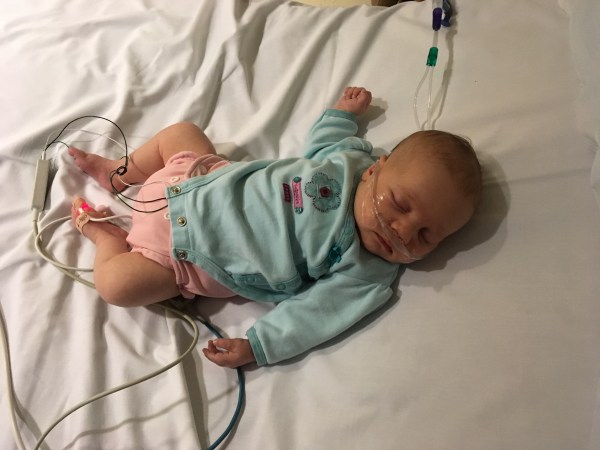
The ER took Aubade’s symptoms as seriously as our pediatrician had; we were in a room within 30 minutes, which is quite impressive for a busy urban emergency department, and within another 30 minutes a respiratory therapist had evaluated her and hooked her up to a high-flow oxygen machine. (The high-flow machine pushes air gently down the baby’s airways, so that they don’t have to work so hard to pull air in past all the congestion in their nose and lungs; the oxygen concentration was originally set twice as high as normal air but they told me it was really the pressure more than the oxygen that she needed.) May I note in passing how much I appreciated the ER nurses? Fast, competent, and caring without a hint of saccharine, they inspired confidence and relieved my anxieties without minimizing Aubade’s condition. Even before the respiratory therapist arrived, they had suctioned out her nose and lungs, and did so again a few hours later when her breathing began to worsen. The pediatric nurses we had after transferring out of the ER that evening were not so wonderful by comparison, though they weren’t bad by any means.
Aubade in the ER
So… she ended up being in the hospital for the next two nights. The boys slept over at my mom’s house for one of those nights and the first night we had her back home; my husband fought off a stomach bug and tried to keep up with school and job applications and laundry; I sat in the hospital with Aubade and held her and watched movies and tried to sleep. It was rough, even though I could tell she was slowly improving the whole time we were there. RSV (respiratory syncytial virus) usually peaks around the fifth or sixth day, which is when we were in the hospital, so we were able to adequately support her breathing through the worst of it.
Rondel and Limerick caught the same virus, and both presented with coughs and ear infections, but since they are older it wasn’t as dangerous. Rondel is now on a preventative steroid inhalant, though, as every cold he gets turns into a cough – he’s been on Albuterol at least four times just this winter. I’m hoping it will help, and I’m also hoping it isn’t a sign that he’ll be officially diagnosed with asthma at some point in the future. I suppose the silver lining of all this is that my prayer life and relationship with the saints are both growing… that daily shower is a good time to maintain spiritual health as well as physical and emotional health, with a morning prayer thrown in with the shampooing and all. Better that than nothing, anyway, and I know the kids won’t distract me then.
But hopefully the rest of my maternity leave goes a bit better! We’ve still got a spring break trip up north, summer internship applications, physical therapy, and maybe a visit to a psychiatrist to fit in to these next five weeks, on top of the regular demands of school, parenting, and running a home… so if we can stay healthy (physically and mentally) it would be great 🙂







 little thoughts