Posted in family life

doctors and medicines (in which everyone is sick in various ways)

Well, it’s been a busy few weeks here. To be honest, it’s been harder since Aubade’s birth than I expected it would be, considering that this is our third baby (so we should have more confidence and experience by now) and that she is a significantly easier baby than the first two. It seems like life just keeps throwing curveballs at us…

To begin with, my physical and emotional recovery from the birth has been a bit more complicated this time around, what with the severe tear on the physical side and the postpartum depression and anxiety on the emotional side. Those baby blues I wrote about last month escalated into depression and anxiety so bad that they were making it hard for me to get out of bed and be present with the kids every day; I would get up and shower because I wanted to keep the tear clean, and force myself to get dressed in presentable clothes, because if I didn’t I would just curl up under the covers and feel horrible. My husband would get home from school and I would take Aubade up to bed with me and hide from the world, so overwhelmed from the few hours of parenting on my own. I wasn’t interested in anything at all, really, but I was devouring books just to keep my mind off of real life and to drown out the thoughts of fear and guilt that kept pouring in. And the anxiety – of being left alone with the kids, of driving, of leaving the house, of talking to people outside my family, of letting everyone down, of being “crazy”, and so on – was so strong (despite its obvious irrationality) that I would have waves of pain course through my chest.

My OB treated me with a series of progesterone shots, operating on the principle that the sudden decrease in progesterone at the end of pregnancy can throw the whole hormonal system out of sync and cause PPD/PPA. Fortunately my husband was able to take care of some of them at home so I didn’t have to set up an appointment every other day for the whole series! And they definitely took the edge off of the negative emotions. The first day it felt like I was on a high – much better than normal – and I thought maybe that’s how things would settle in… but no such luck. I’m still in a hole, but it’s not as deep as it was, and some days I feel like I might be climbing out of it.

In the middle of all of this, we started getting sick. Apparently it had been a mild winter here in the illness department, but February brought all the germs with it and everyone across the valley is catching and spreading disease. Naively I thought that Aubade would be safe from anything going around because her immune system would be bolstered by mine since she’s exclusively breastfeeding, but it didn’t work out that way. Last Thursday I took all three kids to their pediatrician and after prescribing albuterol, antibiotics, and steroids for the boys she told me to take Aubade straight to the ER at the children’s hospital by our house. I was in shock. The boys had never been sick as newborns, so I didn’t realize how differently a serious illness could present in a newborn as opposed to an older baby or toddler. But because they have fewer energy reserves to draw on, and because they don’t know how to breathe through their mouths, an upper respiratory infection that might just cause a cough and a runny nose in a toddler can accelerate a baby’s breathing rate to the point of exhaustion.

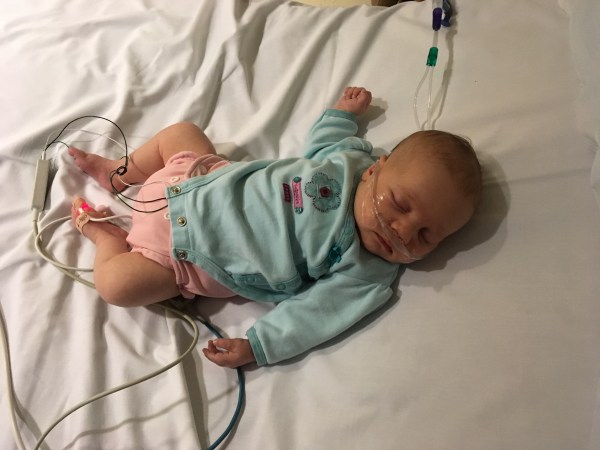
The ER took Aubade’s symptoms as seriously as our pediatrician had; we were in a room within 30 minutes, which is quite impressive for a busy urban emergency department, and within another 30 minutes a respiratory therapist had evaluated her and hooked her up to a high-flow oxygen machine. (The high-flow machine pushes air gently down the baby’s airways, so that they don’t have to work so hard to pull air in past all the congestion in their nose and lungs; the oxygen concentration was originally set twice as high as normal air but they told me it was really the pressure more than the oxygen that she needed.) May I note in passing how much I appreciated the ER nurses? Fast, competent, and caring without a hint of saccharine, they inspired confidence and relieved my anxieties without minimizing Aubade’s condition. Even before the respiratory therapist arrived, they had suctioned out her nose and lungs, and did so again a few hours later when her breathing began to worsen. The pediatric nurses we had after transferring out of the ER that evening were not so wonderful by comparison, though they weren’t bad by any means.
img_1544
Aubade in the ER

So… she ended up being in the hospital for the next two nights. The boys slept over at my mom’s house for one of those nights and the first night we had her back home; my husband fought off a stomach bug and tried to keep up with school and job applications and laundry; I sat in the hospital with Aubade and held her and watched movies and tried to sleep. It was rough, even though I could tell she was slowly improving the whole time we were there. RSV (respiratory syncytial virus) usually peaks around the fifth or sixth day, which is when we were in the hospital, so we were able to adequately support her breathing through the worst of it.

Rondel and Limerick caught the same virus, and both presented with coughs and ear infections, but since they are older it wasn’t as dangerous. Rondel is now on a preventative steroid inhalant, though, as every cold he gets turns into a cough – he’s been on Albuterol at least four times just this winter. I’m hoping it will help, and I’m also hoping it isn’t a sign that he’ll be officially diagnosed with asthma at some point in the future. I suppose the silver lining of all this is that my prayer life and relationship with the saints are both growing… that daily shower is a good time to maintain spiritual health as well as physical and emotional health, with a morning prayer thrown in with the shampooing and all. Better that than nothing, anyway, and I know the kids won’t distract me then.

But hopefully the rest of my maternity leave goes a bit better! We’ve still got a spring break trip up north, summer internship applications, physical therapy, and maybe a visit to a psychiatrist to fit in to these next five weeks, on top of the regular demands of school, parenting, and running a home… so if we can stay healthy (physically and mentally) it would be great 🙂

Posted in musings

growing beets

Our garden is starting to look lush and green again, now that harvest is at hand for the winter vegetables.

img_6471

It’s mostly beets… the cilantro didn’t grow this year, the carrots only made half-hearted attempts at it, and the one stand of dill that made it is off in the other corner of the raised bed. I do miss the cilantro, but beets are better than nothing I suppose! The effusion of green helps lift my spirits, though, even if half of what I planted never grew, and beets are lovely plants.

These particular beets ought to be ready to pull and eat by now, but the few that we’ve tried have been all leaves and no beets. It’s rather disappointing, even though beet greens are also good to eat, to find no dark red bulb waiting beneath the soil like hidden treasure. The soil was finally loose and rich (and not clay!) this year, which was our problem in past years; I think perhaps it was too rich as I recall reading somewhere that excess nitrogen can cause root vegetables to overproduce leaves instead. But who knows.

It makes me wonder if my life has (or can have) the same sort of imbalance – an overproduction of the things that look good from a distance, or in a casual acquaintance, and an absence of the things that are hidden and deep. Do I put all my energy and resources into looking like a good mom when I’m out in public, or do I give significantly of myself in loving and guiding my children at home when no one is watching? Is my goal to be known by my church community as someone who knows the Bible and has all the answers ready, or is my goal to know and love God and His words and His people? Do I work hard at home and at my job for the praise and appreciation of my family and coworkers, or for the inner satisfaction of excellence? To be honest with you, it’s often a struggle. I want both things, of course – both the leafy greens and the red beets are good! But when I have finite time and limited resources, I’m tempted to devote myself to the cultivation of greens at the expense of the beets: to make sure everything looks okay instead of making sure everything is good and right under the surface and behind the scenes. And in so doing, I end up with the same unfortunate imbalance from which my garden suffers, as beautiful as it is above ground.

Posted in musings

learning to know the saints (slowly and rather awkwardly)

Just a month or so ago I noticed that while I believe in the community of saints (that is, I believe that the church is the body of Christ, so the part of the body here on earth – us – is still one with the part of the body in heaven – the saints – and we are thus able to have some type of connection or relationship with them), I didn’t really know much about the any of the saints, and I didn’t have a particular relationship with or devotion to any of them except the Virgin Mary. It felt too contrived to try to pick a saint on my own, so I just registered my thought and moved on. I figured it would be best to let such relationships develop naturally, as my relationship with Mary has.

Well, earlier this year, as you know, kind of for the fun of it and to satisfy my curiosity, I used the random saint generator to find a saint of the year for myself, and was given St. Jude, the patron of hopeless and desperate causes. Interesting, I thought. I didn’t feel a connection, so I again registered it and moved on. I read the book of Jude but that was it.

Then I was hit by postpartum depression and anxiety at full force. It was obviously and drastically worse than the transitional sadness and fatigue I’d had the first couple weeks after Aubade was born; it was a massive effort just to get out of bed, and I felt like all my time and emotional energy was expended just in rolling away the negative thoughts that kept intruding into my mind. I would hear a sound (like a car in the bank parking lot behind our house, or a door opening downstairs) and feel stabbing anxiety pain course through my body in the half second before realizing what it was. And I was starting to build escapist fantasies in the back of my mind, because I just wanted to be at peace and peace felt so unattainable.

Hmm… a situation in which I was left feeling completely hopeless and desperate for help… and a patron saint whose speciality is in interceding for hopeless and desperate causes… maybe, I thought, that random saint generator wasn’t completely random. So, feeling very awkward and not really knowing what to say, I asked St. Jude if he would pray for me in this situation. After all, what is the worst that could happen? Nothing? And at best, he would hear my request and pray for my healing and peace; a saint living in eternity, championing the hopeless and lost, probably is better about consistently praying for his supplicants than the average busy and distracted friend (of course, I might just be extrapolating from my own inconsistent prayer life).

There is of course no way to verify that St. Jude did anything, but I know that I was able to fight my social anxiety enough to go to the new moms’ community after church two weeks ago, and that the only other woman there that week was an experienced mom who encouraged me spiritually and suggested I call my doctor; I know that instead of spinning into a hole of endless research and indecision I actually did call my doctor; I know that my husband and I started praying together every night, which we’ve never done before and which has really comforted and supported me; and I know that the progesterone shots my doctor prescribed, while not completely knocking out the PPD/PPA, have made me much more functional and given back a lot of the joy in my life. In other words, things don’t feel so hopeless anymore. If nothing else, I feel like someone outside of God and my family (namely, St. Jude) cares about me and how I’m doing emotionally and as a mother – that they are standing beside me before God, praying on my behalf.

I still think I’d like to let my relationships with the saints develop slowly and naturally, at their own pace, but I’m very glad that I’ve made the acquaintance of one of them this year so far, and I think I owe him some thanks.

Posted in musings

a repost on refugees

This post, originally published in November 2015, is relevant again this month as our new president does everything in his power to block both refugees and legal immigrants from targeted countries from entering the United States. A year ago, I thought it reasonable to hope that our country would respond with greatness and nobility to the refugee crisis; it seems far less likely now. To see the names and faces of some of the innocent people our country condemned to death in 1939, visit https://twitter.com/stl_manifest, a Twitter feed that went through the entire ship’s manifest and shared the people who were killed by the Nazis, in commemoration of Holocaust Remembrance Day on the 27th – it makes the whole tragedy feel more real and less distant. And then remember that the families, the children, fleeing from Syria and Somalia and Iraq are just as real, just as human, as these people from the past whose fate we so vocally lament.

I remember learning, as a child, about the ship St. Louis that sailed from Germany in 1939, carrying over 900 Jewish refugees to a Cuba that had just closed its doors. Turned away from her destination, the St. Louis asked President Roosevelt to give them safe harbor (a choice he could feasibly have made using the power of the executive order), but he never even replied. In the end, the passengers were scattered throughout Britain and Western Europe; half of those who returned to the continent were killed in the war. Hitler received the clear message that the rest of Western civilization was not particularly concerned about the fate of the Jewish people.

The "St. Louis," carrying more than 900 Jewish refugees, waits in the port of Havana. The Cuban government denied the passengers entry. Cuba, June 1 or 2, 1939.
The St. Louis at Havana. Courtesy of the United States Holocaust Museum.

Why was the United States so cavalier about the fate of these individuals, so cold to their plight? The USHMM has a good summary:

Despite the ongoing persecution of Jews in Germany, the State Department’s attitude was influenced by the economic hardships of the Depression, which intensified grassroots antisemitism, isolationism, and xenophobia. The number of entry visas was further limited by the Department’s inflexible application of a restrictive Immigration Law passed by the US Congress in 1924. Beginning in 1940, the United States further limited immigration by ordering American consuls abroad to delay visa approvals on national security grounds.

In short, substituting anti-Islamic sentiment for antisemitism, the United States was facing exactly the same attitudes in 1939 that she is today in 2015. Her citizens were afraid – afraid for their own economic security, afraid to be drawn into global problems, afraid of war, and afraid of people whose appearance, culture, and beliefs were different than their own. We have our own problems; let those people take care of themselves and leave us in peace.


In C.S. Lewis’s book That Hideous Strength, he allows the characters to muse for a while on the particular genius or defining characteristic of several different nations – in essence, the way in which those nations, despite the grime and decay of sin, most especially reflect some aspect of the coming kingdom of Christ.

He doesn’t make two blades of grass the same: how much less two saints, two nations, two angels. The whole work of healing Tellus [Earth] depends on nursing that little spark, on incarnating that ghost, which is still alive in every real people, and different in each. When Logres really dominates Britain, when the goddess Reason, the divine clearness, is really enthroned in France, when the order of Heaven is really followed in China – why, then it will be spring.

Since the first time I read that passage as a teenager I’ve wondered what could define the United States, my own country. It’s only now, as I consider the refugee crisis, that I think I see what is best, most characteristic, most beautiful about us – and what consequently is most violently attacked.

The United States, in theory, as a concept or an ideal, is a nation that welcomes the poor, the oppressed, the pioneer, the explorer, the entrepreneur, the “huddled masses yearning to be free,” and offers to each of them the opportunity to labor, live, learn, and love to the best of their ability. We’re not, historically, a country that supports and provides for each other well, but we are a country that provides opportunity well. In every age people have come here seeking that opportunity, and it has been here waiting for them. And as representatives from all nations and cultures have come here seeking that opportunity, we have taken them in and, though we have most definitely not always embraced the diversity they bring, we have given them the freedom to be and express who they are. With time, they become American, but they don’t need to lose their heritage to do so.

It is the same with God’s kingdom. All nations will come to it, seeking life, seeking love, seeking to learn and labor for a better future, and all those peoples will be assimilated into one people, His people, but they won’t have to lose their traditions and history to do so. We will be proudly and beautifully ourselves, carrying the full rich textured fabric of our past and our culture, as we walk into His kingdom, and all nations will be represented there in the fullness of their glory as well.


Is it any wonder, if this is the divine spark within our nation, that it should be so constantly besieged? It is always our fear that impedes us – our fear of the unknown future and our forgetfulness of the past.

Throughout our history there has been this countercurrent running, this voice that whispers fear in our ears. It tells us that letting in these new people will compromise our own position – steal our jobs, endanger our families, threaten our comfortable way of life. Having received opportunity for ourselves, our temptation is to withhold it from others. Having been born to privilege, safety, and relative wealth, we fear that offering the opportunity for others to work for those things will entail losing them ourselves. Having lived in freedom, we condemn others to oppression even as they beg at our feet for us to open our doors, or risk their lives to enter illegally.

I pray that this time, in this hour of need, our borders would open to those seeking shelter, desiring a new life, wanting simply the opportunity to pursue happiness and love that we have declared an inalienable human right; that we would overcome our fears of different cultures and religions and see the humanity behind them; that we would risk our comfort and security ever so slightly to save families and children from torture and death. I pray that we would not repeat our failure of the 1930s, ISIS terrorism standing in for Hitler’s Holocaust.

Is it too much to ask? I think not.

Posted in musings, quotes

the social underpinnings of racism: Trump and the 1950s

In the wake of Trump’s ascension to the presidency, a lot of people like me were left wondering how so many Americans could be so angry and feel so wronged that they were willing to tolerate blatant racism and misogyny in their leadership. There’s been a lot of confusion and a lot of anger, and not a lot of dialogue; each side tries to defend its beliefs by reciting wrongs against itself, or attempts to seize the moral high ground and demonize its opponents instead of listening to their grievances. It’s one of the reasons I’ve had to severely limit my social media time…

But as I was reading The Family Nobody Wanted, by Helen Doss, written before the height of the Civil Rights Movement, in the aftermath of the Japanese internment camps of WWII, I came across a passage that seemed quite relevant today:

First, prejudice is a contagious disease, as easily caught as measles, the babe from his parents, the school child from his playmates, the adult from his fellow workers and neighbors. To compound the social tragedy, prejudice once caught is hard to cure, since it unwittingly serves a number of morbid purposes. When a man is picked on by his boss, he can slam home and take it out on his family, and frequently does; however, a more socially approved outlet is to turn around and release the feelings of hate and anger on those of a minority racial group. If denied certain yearned-for opportunities and privileges, there is a devilish quirk within man which gives him perverse satisfaction in seeing that at least one segment of the population enjoys even less opportunities and privileges than he.

If a person feels socially or mentally inferior, has a persecuted feeling that society is crushing down on him, it is easy to bolster waning self-confidence by convincing himself, “At least there are whole groups of people socially, mentally, economically inferior to me.” Worse yet, he will try to keep minority groups in a deprived and subjugated position, to prove what his ego wants to believe.

Psychologists and psychiatrists have long told us that bottled-up feelings of aggression and anger can be dynamite to the happiness and well-being of the individual who refuses to recognize real causes behind his maladjustments. Multiply these fearful and emotionally tense individuals by thousands, by even millions, and you have social dynamite… Hostility will be exploded in any area where society permits it…

War has always been a socially glorified outlet for pent-up angers and frustrations of whole peoples. In America, our Negroes have provided another scapegoat, and so we have had race riots, Jim Crowism, and the Ku Klux Klan. On the West Coast first the Chinese, then the Japanese, provided another handy outlet for our inner tensions, and we have had discrimination in jobs and housing, an Orientals Exclusion Act, and the “relocation centers” of World War II.

The anger and other negative emotion of the dissatisfied people who voted for Trump is real. Many people felt disenfranchised, ignored, stuck in a world they didn’t ask for, unable to change their fate, feeling like their communities and families were broken. And Trump acknowledged those emotions when most other politicians were oblivious to them. Would these people on their own have decided to take out their anger on immigrants, women, and other minorities? I’m not sure; in many cases, I don’t think so. I know a lot of good people, who care deeply about human dignity and equality, who voted for Trump for one reason or another, trying to look past his faults. But Trump himself has most definitely established those groups as “acceptable” targets for the pent-up anger of anyone who feels ignored, overlooked, or under-appreciated; he has made them the scapegoat of the failures and frustrations of the majority.

Like it or not, whether you as an individual are racist or not, Trump has bolstered the cause of racism by making it more socially acceptable once again; he has directed the force of social anger towards some of the most vulnerable and unrepresented groups of all; he has given hostility a safe place to explode, and so set our country back in its fight against racism and for the equality of all. Racism is in so many ways a systemic issue, not an individual issue; that is why the attitude of the president is so powerful and influential. That is why it matters so much, especially now, to speak up against racism, to push social pressure against it as much as possible.

Posted in book lists

what I’ve been reading lately

After a rather long stretch of time in which I mostly reread my favorite fiction (Lord of the Rings and Harry Potter on repeat!) and kept up with the news and our church’s Bible-in-a-year plan, I have been diving back into the world of books. I realized that I have a lot of time in which I can read but not do much else (while Aubade is nursing, especially at night), but of course holding a book is complicated by said nursing… so I had been reading the news, surfing the web, and spending altogether too much time on Facebook, which was not helping my postpartum mood in the least. Then I remembered that all the libraries in my county have come together to create the Greater Phoenix Digital Library – meaning that more books than I have time to read are available on my phone, for free, with a simple app and the PIN from my library card. Honestly I’m not sure how I managed the boys’ newborn phases without this…

So, despite finding that a lot of the books on my wish list are checked out by other users of the library system, here are four books I’ve read this week that were completely new to me, in a variety of genres:

I Know Why the Caged Bird Sings, by Maya Angelou

cagedbirdangelou

This is of course a classic, and most people who haven’t read it are still familiar with some of Angelou’s poetry, at least (I knew of her mostly through her poetry, to be honest – Phenomenal Woman makes the social media rounds fairly frequently, and I love it every time I read it). But for me, who grew up in an educated, well-off, white family, it was eye-opening to see the deep personal and emotional impact of both intimate individual hurts (like parental divorce and sexual abuse) and systemic oppression (like the racism and poverty Angelou faced herself and saw affect her community). Someone’s story can be far more impactful than all the statistics and social study lessons in the world, especially when told with the simple power and unpretentious elegance of Angelou’s writing. It’s not an easy read, because of the painful topics it deals with, but it is definitely worth reading.

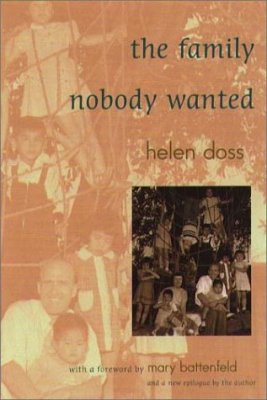
The Family Nobody Wanted, by Helen Doss

familynobodywanted

This is a memoir of quite a different type, although it touches on some of the same themes. Doss and her husband discovered as a young couple that they were infertile and that the demand for Caucasian infants to adopt was far greater than the number of babies available. So, in the 1940s and 50s, they built their family by adopting the unwanted children – children of mixed heritage who didn’t look “white” enough for mainstream American families to consider – and ended up with 12 children all together! The book is an honest look at their family life, addressing the racism directed at their children and family but mostly just full of hope and humor (I laughed out loud many times at the anecdotes Doss related – she is quite adept at capturing the funny side of disastrous moments as well as the dialogue of her young children).

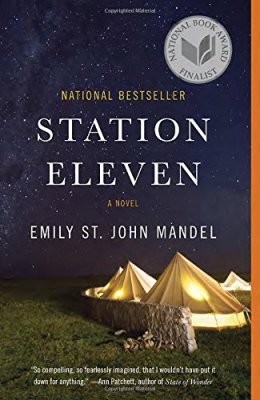
Station Eleven, by Emily St. John Mandel

stationeleven

After reading two memoirs, I decided to switch things up and chose this post-apocalyptic novel after seeing it on one of Modern Mrs. Darcy’s booklists (in general, that is a helpful site if you aren’t sure what book to read next!). I don’t normally read this type of fiction because it is dark and suspenseful and keeps me up all night, and this was no exception… The basic premise is that a strain of the flu wiped out the vast majority of the world’s population, disrupting civilization to the extent that people are living without electricity, without medicine, scavenging and hunting to survive, holding on to what scraps of art and culture they can salvage, and falling prey to cults and prophets who offer some explanation for why so few survived. Mandel’s characters are diverse in personality and background, and the different ways they experience the pandemic (as well as the years before and after it) feel very authentic. I particularly liked how the threads of theatre, music, and literature wound through the characters’ stories without devolving into preachy passages about the meaning and value of those things in a broken world; the novel is far more about what it means to be human, and how humanity survives and even perhaps recovers from an event so utterly devastating.

Half the Sky: Turning Oppression into Opportunity for Women Worldwide, by Nicholas Kristof and Sheryl WuDunn

halfthesky

Kristof and WuDunn examine the inequality of women in the developing world in a number of different arenas, including forced prostitution, rape (as a tool of shame or a weapon of war), maternal mortality and injury, and education. Each issue tackled is presented in light of the story of one or two individual women, spotlighting the problems involved as well as the complexities faced in addressing those problems; for instance, we see how difficult it is to truly free an underage girl from forced prostitution in the story of one young woman who returns multiple times to feed her drug addiction – which was in itself instigated by her captors and abusers. Some stories are inspiring; some are less so; and the statistics that they illustrate are often bleak. As a new mother myself, having experienced a labor (with my first) that would have resulted in death or serious injury without access to a surgeon, it is horrifying and saddening to read about women who have had similar experiences without the medical care available to me and others in the West. There is so much pain and death that could have been avoided. On the other hand, however, the book also shows us the stories of whole communities that have been improved by simple investments in education, or by deciding to take justice for women seriously. In addition to the stories and the statistics, a unique and valuable aspect of this book is the appendix listing specific organizations that are working in effective ways to address the issues faced by women in the developing world, to give the reader ideas of whom to support. I would encourage anyone – especially anyone who believes that things like rape and maternal care are only “women’s issues” – to read this book and see just how much communities can grow and heal when they come to realize that women, as in the eponymous proverb, “hold up half the sky.”

What have you all been reading lately? I’d love to hear your recommendations, since I have a short window of reading opportunity open right now!

Posted in musings

a prayer for hope

Our Father, who art in heaven
Hallowed be Thy name.

Father, your name goes unspoken, or mocked, or used for profit and manipulation. The names of all the people in the world – the movers, the powerful, the close at hand – constantly echo around us, while your name lies forgotten and unspoken on the side. And you feel so far away from us, enthroned in heaven in glory and peace while this world falls apart beneath you.

Thy kingdom come, Thy will be done,
On earth as it is in heaven.

It seems as though your kingdom is so far from coming, Father. This world seems more broken every day: my Facebook feed is filled with laments, with arrogance, with anger, with half-truths; the news constantly reminds me of pain and division, oppression and war, hatred and selfishness. What principles are right and good and worthy? What means of applying those principles are most effective? People who love you and long for your kingdom don’t even agree with each other on the answers. And I feel lost, and confused, and I wonder how your kingdom will ever come, how your will may ever be done, when even your people are divided among themselves. Our brokenness seems complete, our hope extinguished.

Give us this day our daily bread

And yet, each day comes, and we are still here, and even the food we eat is a gift from you, a gift of hope, a promise of life. Every day we need it. And some, because of war and poverty and famine and corruption, do not have it. Where is their hope? Are you present for them like you are for us who have never known hunger? Is your power too weak or your love too small to provide for them also, when they cry out for food and their children die around them? Why do you not intervene when people tear the world apart and condemn others to starvation for their own gain? And it goes beyond the physical bread we need to live: we need emotional bread – love, hope, friendship, purpose; we need spiritual bread – the body of your Son given for us. Why do you allow so many to be cut off from those things, bereft of those great blessings, caught in misery and despair, for whom each morning is not a cause for joy at your faithfulness but simply the start of another journey through darkness and fear?

And forgive us our trespasses as we forgive those who trespass against us.

Is that why you wait so long to intervene in the evils of this world, Father? Are you offering even the oppressor a chance at forgiveness, a chance to work for the redemption and setting right of the brokenness they have caused? It is a hard and painful wait for the oppressed. For us, a thousand years are not as a day, but as an eternity, and we fail, eventually, to extend again forgiveness when it has been met time and time again by continued oppression and trespass. We forget our own sin in the burning awareness of the sins committed against us; we seethe with anger, hold onto our hurt, and drive your kingdom still further away in a cry for justice that does not extend beyond ourselves.

And lead us not into temptation,
But deliver us from evil.

Everywhere I look, there temptation and evil lie in wait. The temptation to put myself first, to let anger take root in my heart, to attack and demonize the people who disagree with me or inconvenience me, to close my ears to the hurts and needs and stories of others. The evil of corrupt institutions, of dysfunctional families, of systemic poverty, of generational sin – broken homes, communities, and nations, catching people in nets of pain and pride and wickedness. Deliver us, Father; restore us to your righteousness. It is such a faint hope, sometimes, a light believed in though still unseen, but it is the only hope we have.

Amen.

Posted in family life

finding myself again

One of the less pleasant aspects of Aubade’s birth was that it resulted in a 4th degree tear (baby girl was coming fast and needed to come fast as each push caused her to have pretty significant decels, indicating potential hypoxia – they actually had me on oxygen and made sure we waited in between pushes to get Aubade fully oxygenated before each new push, and she was quite big!). While it’s been healing as well as can be expected, it’s put some limitations on what I can do, which is really frustrating for me.

But! Today I pushed the boys in the stroller, while wearing Aubade, all the way to the Museum of Natural History two blocks down from our house! I’d been building up to it: I’ve walked with them to the children’s museum one block from the house with no stroller, just carrying Aubade and the diaper bag, since the boys can walk that distance fairly easily; and I’d taken all three of them to the grocery store and pushed them in the shopping cart (which in retrospect was rather stupid because I lifted Rondel in and out of the cart and he’s quite a bit above my lifting weight limit right now). But this was my first solo outing with the stroller. And it went really well! With the weather so frigid, gloomy, and drizzly these days, it is especially nice to have broadened the scope of where I can take the boys when my husband is at school – and it makes me feel much more like my normal self: confident, independent, and quite capable of planning and executing fun outings with my children!

I guess my whole point is that even when you know rationally that recovery takes time but will eventually happen, it’s easy to get discouraged and feel like you’re never going to be yourself again, until you have those little moments of normalcy that help you see that you are coming back. It’s true physically with the recovery from a tear (or C-section, as I learned with Rondel), and it’s true emotionally with the hormonal transition from pregnancy to postpartum; in either case, you might need some extra help getting there, but recovery is totally possible, and you will find yourself again.

Posted in Uncategorized

{just enough info} – 2017

{JEI} is a link-up with a different topic, and a few different leading questions, every week; I haven’t participated before, but the questions for this week made me stop and think in a New Year’s-y sort of way that I’d been avoiding otherwise, so I thought I’d share with you all.

1. What is one small thing, if you accomplish it in 2017, that will make you feel successful?

Forming an exercise routine and continuing it long enough for it to become a habit or discipline would make me feel insanely successful! I’d be happy with 15 minutes of intentional activity every day, to be honest. My body is going to need some extended rest to recover from Aubade’s birth, but because of that, and because of the anemia I had during the pregnancy, it’s going to be fairly weak and need some attention. I’d like to build back the strength and stamina I had before the kids, ideally – but just starting out with some core rebuilding exercises would make me feel like a success.

2. Have you picked a “word of the year” or patron saint of the year?

No patron saint here (how would I narrow it down? and it feels somewhat audacious to think a saint would be interested in being my patron, like asking someone to be a mentor…), but I did settle on the word: presence. I want to be more present this year, less lost in my own head; I want to engage with the real family I have, in the reality we share, instead of forming an idea or abstraction of them and interacting with that; I want to actively listen instead of chasing daydreams while my husband or children try to talk to me; I want to turn my phone on less frequently and run and play and laugh more often. It is easy for me to live in a world of theories and ideals, to the exclusion and detriment of the actual – and I don’t want to squander the actual blessings I’ve been given by not being as fully present with them as I can be.

And ok, I did go to http://saintsnamegenerator.com and have it randomly select a saint just to see who it would be, and it was St. Jude (author of the book of Jude in the New Testament). Apparently he’s the patron saint of hopeless and desperate causes… Honestly, I don’t know much about him, nor am I even that familiar with the book of Jude. Maybe I should rectify that – I need a book of the Bible to dig into deeply right now anyway!

3. What are you looking forward to in 2017?

I’m looking forward to my husband graduating and (hopefully) finding a job! We’ve been waiting for this next chapter of our lives for a long time now and it’s exciting to see just how close it is! The specifics of it will also help us make other decisions like where we’ll want to live (we’re outgrowing our current house because it doesn’t have the best bedroom layout, mostly) and what schooling choices we’ll make for the kids (since Rondel will be turning 4 this summer! Where does the time go?), so I’m looking forward to hammering out the details.

Head on over to Sweeping Up Joy for the rest of the link-up!

Posted in family life

a boy and his sister

Rondel is head-over-heels in love with Aubade. She’s the first thing he talks about when he wakes up in the morning, and he comes looking for her all throughout the day to snuggle with her, hold her, or check on her – he’ll just sit next to her beaming.

Earlier today she was lying on the bed and he came up and was looking at her for a while, then asked me, “why is she so little and cute?” (He brings up her littleness all the time.)

“You really like how little she is, don’t you?” I asked him in return.

In response he ducked his head down, curled up for a second, then bounced on his bottom on the bed, all with the most adorable little shy smile on his face.

“Did you just bounce because you were so happy about how cute and little [Aubade] is?”

“I did!” – with the same sweet smile.

As he leaned over her again, she flashed a big smile in his general direction, and I pointed that out to him – and he got so excited that he bounced up and down again.

“Her smile made me bounce!” he exclaimed.

There’s not much sweeter than a baby’s smile, even in the eyes of a preschooler, apparently. And there’s not much sweeter to the eyes of this momma than a big brother who adores his baby sister so completely.