
Watching my children play, I am reminded of the wonder and beauty of small and simple things. There is enough joy in a glass of milk to send a three year old dancing around the kitchen; there is enough beauty in a well-done coloring page to keep a distractible, active four year old still and entranced watching it happen; there is enough passion in a stuffed animal to occupy the full attention and imagination of the one year old who walk around snuggling and protecting it. Continue reading “wonder”
“Bravery is a muscle, but instead of building it through exercise, we strengthen it with each brave act we do, big or small, parent related or not.
“Bravery isn’t a limited resource, and it’s also something we all have within us.”
Debbie Reber, Differently Wired, Tilt 6: Parent From a Place of Possibility Instead of Fear.
If you liked the quote from Differently Wired, read my brief review of the book here and check back in June for the giveaway!
bravery
seven thoughts on motherhood
Today I’m linking up with Kelly at This Ain’t the Lyceum for the weekly Seven Quick Takes – head over to read the rest of the posts! And if you have time, catch up on Kelly’s May blog series highlighting different titles of Mary from around the world; it is undeniably worthwhile, simultaneously fascinating, inspiring, and convicting.
- I first learned what it was to be a mother from watching my own mother. There’s a theological term kenosis which describes how Jesus emptied Himself out in accordance with His Father’s will out of love for us – and I think the commitment, self-giving, and love my mother shows for her children is a human reflection of that quality. If one of her children is sick, she will offer to help even if she hardly has five minutes available in the day. If one of her children suffers from physical illness or emotional pain, she suffers too, and wakes in the night to pray on their behalf. If one of her children makes a decision that confuses, hurts, or disappoints her, she responds with a genuine desire to understand, constant forgiveness and unconditional love.
- I also learned from my mother that mothering is not limited to one’s own children. The posture of provision, nurturance, patience, and love can be extended to almost anyone – and she lives and has lived it in so many ways: with her struggling students as a professor, with other homeschooling families as a mentor and veteran, with kids at church, with her brother and nephews, with anyone who has ever entered the doors of her home, and more.
- Motherhood is one of the hardest and best things in my life. Perhaps more than any other experience, it has given me a desire to truly strive for holiness and sainthood, while never failing to expose the weaknesses and sins that make me dependent on the grace of God for that holiness.
- In addition to my mother and my own experience of being a mother, the person who has taught me the most about motherhood is (unsurprisingly) Mary herself, Mother of God, Mother of the Church. Ever since Limerick was born I found myself being drawn to her – finding peace in prayers inspired by her, finding comfort in sharing my struggles with her, asking her to lead me closer to her Son. And in every situation where I have turned to her – in labor with Aubade, in the depths of my postpartum depression, in the daily turns of life with young children – she has responded by opening and softening my heart to God, and by increasing my desire for and faith in Him. For Mary, motherhood is about bringing her lost and hurting children to their Savior and Healer through a relationship of love, compassion, hope, and connection.
- A mother will never desert you, never give up on you, never stop loving you, and never stop praying for you. She will probably never stop teasing and/or embarrassing you either, of course! But this persistence and constancy is but an echo of God’s maternal love, according to Isaiah 49:15: “Can a mother forget the baby at her breast and have no compassion on the child she has borne? Though she may forget, yet I will not forget you!”
- If mothers are awesome, grandmothers may be even more so. I have to mention my own mother again here 🙂 because if it weren’t for her wisdom and support as the grandmother of my children, my journey through motherhood would be much more difficult. As it is, my children reap the full benefits of her experience and have a huge amount of extra love poured into them. We watched a documentary this week in which an elephant baby became stuck in deep mud, and her panicked first-time mom was just making things worse attempting to dig her out. Things were looking bad when the elephant grandma noticed the situation, pushed the mom out of the way, and helped the baby out. It just seemed so emblematic of every great grandmotherly relationship! Grandmothers are crucial to passing relational knowledge and experiential wisdom down through the generations.
- Here’s an amazing quote – succinct and powerful – from St. Edith Stein to wrap up. “To be a mother is to nourish and protect true humanity and bring it to development.” (The Significance of Women’s Value in National Life). There you go. That is what we do, fellow moms – that is why we pour ourselves out in all the little and big things of each day with these children we’ve been given, that we might nourish, protect, and bring to development the intrinsic humanity within each of them.
Don’t forget to head over to This Ain’t The Lyceum for the rest of the linkup!
letting go
My therapist used to tell me, “it isn’t your business what other people think of you.” I’m still not sure I completely agree with her, since what other people think can occasionally have fairly large consequences on a practical level (promotions at work, for example) – but in general it’s correct. I’m entitled to my beliefs and opinions, and other people are entitled to theirs. Someone else might think I’m antisocial or making poor parenting choices because I want to homeschool; I might think someone is arrogant and disconnected from local community because they are a snowbird. But if I choose to live my life based on the thoughts of others about me and my decisions, I’ll be miserable (just like all those snowbirds would be, sweltering here all summer without the communities they grew up in, or being shut in all winter there because they can’t shovel themselves out anymore).
I have to let it go. Continue reading “letting go”
pea gravel!
When we moved into our new house last summer, the home had been mostly fixed up (aside from a few plumbing issues that surfaced in our first month living here… old pipes) but the yards were completely flat dirt. Horrible dusty barren dirt, too, filled with trash; even the Bermuda grass could only survive in a few patches.
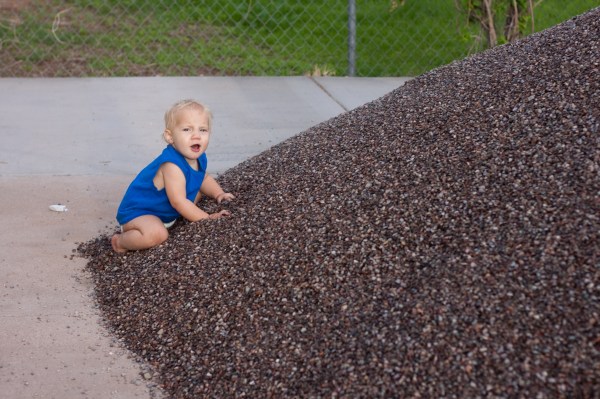
We’ve been slowly trying to make the space both aesthetically pleasing and functional, so towards that end we got twenty tons of pea gravel delivered one weekend, to fill in a play area in the back yard.
pastor barbara and the out-of-sync girl
Once upon a time there was a church which had a female pastor. Now, this pastor wasn’t the lead pastor, or even the primary teaching pastor; she led the family and children’s ministries, actually, and spent most of her ministry time with women and youth. But she had the title of pastor – Pastor Barbara.
She was beautiful. She had long, curly brown hair and a nose with that perfect spark of defiance bringing its straight lines singing up from her face. She had a gentle way of moving – never too fast or too sudden – and a gentle way of speaking – never too loud or too harsh. And when she saw the children she loved and taught and prayed for, her whole body would glow with that love and light, like an emanation of the Holy Spirit through her presence.
There was a small girl at this church who adored Pastor Barbara wholeheartedly and unstintingly, although mostly from a distance as she was a quiet child. She enjoyed above all the new songs that Pastor Barbara would sing with them! For her, songs were a release from the uncertainty of social interactions, because the songs (at least the children’s songs that she knew) would specify how you were supposed to act. Take for example “Father Abraham:” no one would ever move that way in everyday life, but the song says to do it so everyone does it and no one has to worry about being out of sync.
it seems that our school system is failing everyone these days…
As the teacher walkout continues here in Arizona I feel like I’m just beginning to process the events and come to an opinion about it all. It’s an interesting topic for me, since I’ve always been an outsider to the school system and maintain that self-directed learning is better ideologically than the authoritarian traditional educational model we have in the US – and yet, at the same time, I recognize that the majority of children are in public schools and as a Christian who desires the good of my neighbors and community I want those public schools to be the best that they can be for the sake of the children in them. In a perfect world the school system would be fundamentally different, and I believe it is important to work towards those deep system-level changes – but in the meantime, there are children in the schools now who deserve the best our society can give them instead of being neglected in the pursuit of future goals, and pragmatic changes for their short-term benefit are a good thing.
One of my friends shared the following image on Facebook: Continue reading “it seems that our school system is failing everyone these days…”
{SQT} – first week home
It’s been a long time since I remembered about the Seven Quick Takes link up far enough in advance to write a post for it! This is a good week for it, too, since it was my first week as a (mostly) SAHM…
Also, after writing these I realized that every point on the list can serve as an example of some autism characteristic. I suppose it supports the argument that autism is an integral part of who an autistic person is – informing their strengths, joys, temptations, and weaknesses. Bonus points if you can name the trait that is on display in each quick take 😛 Continue reading “{SQT} – first week home”
brokenness
“We are all broken by something. We have all hurt someone and have been hurt. We all share the condition of brokenness even if our brokenness is not equivalent. […] Being broken is what makes us human. We all have our reasons. Sometimes we’re fractured by the choices we make; sometimes we’re shattered by things we would never have chosen. But our brokenness is also the source of our common humanity, the basis for our shared search for comfort, meaning, and healing. Our shared vulnerability and imperfection nurtures and sustains our capacity for compassion.
“We have a choice. We can embrace our humanness, which means embracing our broken natures and the compassion that remains our best hope for healing. Or we can deny our brokenness, forswear compassion, and, as a result, deny our own humanity. […]
“So many of us have become afraid and angry. We’ve become so fearful and vengeful that we’ve thrown away children, discarded the disabled, and sanctioned the imprisonment of the sick and the weak – not because they are a threat to public safety or beyond rehabilitation, but because we think it makes us seem tough, less broken. […] But simply punishing the broken – walking away from them or hiding them from sight – only ensures that they remain broken and we do, too. There is no wholeness outside of our reciprocal humanity.”
– Bryan Stevenson, Just Mercy, emphasis added
The last line from the quote above lingers in my mind, settling down slowly through my thoughts like gentle rain seeping deeper into the clay soil of our desert yard (and my thoughts are holding onto it like that clay retains the water that falls upon it).
I am reminded of C. S. Lewis’s attempt (in Mere Christianity) at explaining how one man’s sin could affect the whole human race, and how one man’s righteousness could restore it, in which he compared humanity to a tree, each individual inextricably bound to the others through time and space, biologically and spiritually, so that sickness could spread from one to all the rest, and likewise healing.
I am reminded of the Apostle Paul’s letter to the Corinthians, where he writes that if he suffers, it is for the purpose of bringing them comfort and salvation, and that if he is comforted, that is also for their comfort and salvation. He was willing to be broken himself to help restore them to wholeness, and to share his healing with them. To be honest, I don’t think it would have been a satisfactory and complete healing for him if he knew that the church he loved was still broken and suffering, either through sin or persecution.
But I also know, from observation and experience, that vulnerability is hard, that grace is hard, that walking with another person on the path from brokenness to healing is incredibly hard. People don’t usually respond the way you might want or expect, and their journey toward wholeness tends to be circuitous and rocky. Rehabilitation isn’t a process of making over broken people into our image (or some ideal image), but rather a process of helping those people find freedom from the bonds of trauma, regret, addiction, illness, and so on. I don’t think it is possible without some amount of pain.
And as for how this might look, practically, in my life? I have no idea. There are many possibilities, obviously, since all of us are so broken, but I don’t know where to go after the basic beginnings of extending love and grace to my family and immediate community. I do know, at least, that I intend to keep my eyes and ears open to the stories and hurts of other people, so that when the opportunity to show love and mercy does arise I am prepared.
differently wired: an introduction
I don’t remember when I first discovered Debbie Reber’s podcast, TILT Parenting, but I do know that I immediately went back and binge-listened to the entire archive, and have assiduously awaited each new episode since. It is a mix of practical advice and principled encouragement, of understanding acceptance and useful support; it encourages parents through their struggles while maintaining the worth, dignity, and humanity of their neurodivergent children. Almost all of the episodes are interviews – some with experts in the field, like Steve Silberman (author of Neurotribes) and Dr. Ross Greene (author of The Explosive Child and found of the non-profit organization Lives in the Balance); others with life coaches and parents of neurodivergent children, sharing their stories and offering real-life suggestions; still others are with Reber’s son Asher, giving the perspective of a neurodivergent child a huge platform and helping parents understand where their children might be coming from.
So when she announced that she was writing a book, I was incredibly excited! When she asked listeners to consider joining her advance book team, I signed up as soon as possible – so I’ve gotten to answer polls about book publicity options, mostly, and should be helping publicize the book’s publication when it launches in mid-June. But unexpectedly, and wonderfully, Reber convinced her publisher to let all hundred-odd people on the team have access to an advance e-copy of the book. I was walking on clouds when I got that news…
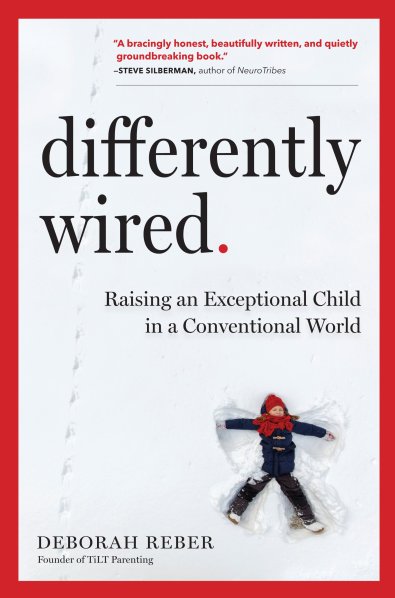
And now that I’ve read Differently Wired: Raising an Exceptional Child in a Conventional World, I want to share it with you, because it exceeded all my expectations.
Reber is a skilled author, adept at blending storytelling, science, principles, and pragmatics into a unified whole. In the first part of the book, she explains the problem: the failure of a system that is “good enough” for neurotypical individuals to accommodate the increase in neurodivergent individuals, trying to force them to change instead of offering supports that would allow them to flourish as they are. In the second part, she outlines eighteen “Tilts” – shifts in perspective that enable change – along with action items for putting each one into practice in some small way right away.
My plan is to share some of my favorite quotes and themes from the book with you over the next two months, and then, when the book launches, to give away one copy here on the blog! Maybe you are feeling frustrated and stuck, wanting to connect with your child more deeply but not sure how; maybe you are feeling hopeless about your child’s future and want to rekindle optimism and find a path forward; maybe you are worn out from fighting for your child’s needs and need encouragement on your journey. Reber’s book can help with all of that – and it is one of the only parenting resources I have come across that (as a neurodivergent individual myself) doesn’t leave me feeling “othered” and uncomfortable.
So keep checking back – I’ll be sharing content from the book, and will open the giveaway as soon as I receive the hard copy sometime in June. If you care for a child who processes, thinks and behaves outside of what people consider to be “normal,” this isn’t a book you’ll want to miss.
 little thoughts