Posted in musings, quotes

vocational marriage

I’ve been thinking about marriage for a few weeks now, in a conceptual sort of way, and I liked this quote I ran across:

Marriage is a vocation, inasmuch as it is a response to a specific call to experience conjugal love as an imperfect sign of the love between Christ and the Church. Consequently, the decision to marry and to have a family ought to be the fruit of a process of vocational discernment.

– Pope Francis, Amoris Laetitia

It’s easy to think of marriage in terms of romance and pleasure, or in terms of stability and security. Those, at least, are the common ways in which I see it presented. But both of those paradigms have a tendency to fall apart and betray us… the romance fades, we begin to seek (and find) pleasure in other people, emotional tensions escalate to the point where they’re not a fair trade even for financial security.

When marriage is viewed as a sign of the love between Christ and the Church, however, it doesn’t so easily crumble. After all, Christ never stops loving the Church no matter what crazy circumstances life throws at Him (or us)! There is a call to faithfulness, a commitment to sacrifice, that demands everything we have – so if we enter into marriage prepared with that mindset, our marriages are far more likely to endure. This mindset also suggests, however, that one should approach marriage with the same sort of serious deliberation with which one approaches faith or a call to religious life, understanding that this is a covenant and pledge which will change and shape the rest of one’s life: hence, of course, Francis’s encouragement to discern if it is truly one’s vocation before entering into it.

Do we do this? Or do we treat marriage as our automatic life plan, assuming we can find a partner? Do we say, well, I want the romance and the intimacy and the security and the friendship and the tax benefits and maybe a kid or two as well, so marriage sounds like the way to go – or do we say, am I ready, am I mature enough to sacrifice myself for another person, am I truly called to enter into this covenant, am I prepared to open myself up to new life?

Posted in musings

choice, identity, fatalism, and change

Sometimes the homosexual movement (and, I think, our culture as a whole) strikes me as a bit fatalistic – as if our identities were set in stone and nothing we do or choose can change them, only repress and mask them.

There is a sense in which this is true, of course; I doubt that I could change my sexual attractions, or my intellectual curiosity, or my Jekyll and Hyde combination of loyalty and jealousy. Those things form part of my personality and natural identity. Further, the core tendencies of our being seem to remain constant factors over the years. My primary identity no longer rests in my intelligence and academic prowess, but I still value my intelligence and operate out of confidence in it; on the negative side, I am no longer so frequently controlled by my anger, but it is still an ever-present struggle to be master over it. So both my strengths and my weaknesses remain with me, and although I try to favor the former over the latter in how I live and in what I express outwardly, they both form part of my essential personal identity.

On the other hand, there are deep things about myself that are chosen and could in theory change: namely, my religious and philosophical beliefs, my worldview. These beliefs are what informs my identity and causes certain aspects of it to develop and mature (or, on the contrary, atrophy and fade) over time. A belief that integrity and courage matter pits itself, in the core of my being, against my innate shyness, distaste of conflict, and anxiety. The belief of a Catholic nun that she has been called to celibacy for Christ sets itself against her natural sexual desires – for even the celibate have sexual identities, that they choose to set aside in the service of some belief. The belief that humility is valued by God over pride wars within me against my self-confidence, arrogance, and secret insecurities. The belief of an atheist in the value of independent free-thinking might war against his inner desire for an authority to trust or a guidebook to follow. So too, I would imagine, for the traditional Catholic or conservative Evangelical, the belief that homosexual actions are inherently disordered would set itself against some of the deepest desires and attractions within them.

These deeply held beliefs are not able to change our identities like a switch, or even, in many cases, like the gradual dawn of the sun. But they are able to guide and shape those identities – to prune and direct them as we grow. In my examples above, most of the traits and aspects of identity being fought against are not inherently bad and could be considered good given a different set of core beliefs (it is not hard to think of cultures and religions that place a much higher value on harmonious conduct than on the confrontation brought on by principled courage, or to call to mind worldviews that consider respect for authority far more important than critical thinking). So why choose to not embrace those aspects of our identity just as much as some other aspects? Again, it goes back to the framework of belief, the set of principles, that we have chosen to believe and to take as our truth. And that can change. It very often does change over the course of a person’s life!

So the language of identity need not be as fatalistic as it sometimes sounds. Perhaps we cannot ever truly change our identities without some great trauma or damage to ourselves, but we can shape their trajectory, giving more weight to some aspects and less to others. We can still choose the beliefs we hold, even if we cannot choose the components that make us up. For me, this is a great hope! I am not bound forever to the shyness, the anger, the jealousy, or the intellectual impatience that form a part of my identity, personality, and character – or, more accurately, I am not bound to be forever ruled by them. Their share of my life can decrease as the things I value more are increased.

What I have left out in this consideration is, of course, the reality of the changing power of the Holy Spirit, and the ability of Jesus to make us truly new creations in Him. I wanted to try to look at the questions of identity and choice from a less uniquely Christian viewpoint. But where I do find the most hope for personal change, as well as (rather surprisingly) the most grace for what I am right now, is in the transformative and redemptive plan of God. For that is what Christianity proclaims: that from the inside out, in the very center of our identity, we shall be changed, and everything that is wrong or disordered or confused or dead within us shall be removed, and what is good shall be made to flourish in ways we never dreamed.

Posted in musings

principles vs. rules: parenting checklists and the pursuit of holiness

There are a lot of practical things I can do to help my family and take care of our home. I can keep the house relatively decluttered, I can make sure the clothes and linens are clean, I can cook good healthy food for our meals, and so on. On the next level up, I can take my boys outside to run around and explore, I can read them good books to capture their imaginations, I can spend quality time with them just being silly and creative, and so on. On a still higher level, I can pray with them, share with them the stories of redemptive history, bring them with me to Jesus when life is hard, and so on.

The list of possible beneficial and important things to do on any one of those levels is so long as to be overwhelming.

Life is complex and multi-layered, because it is made up of (often messy) relationships between (hopefully growing) people – and when we take that complexity and try to reduce it to a list of “should’s” and “ought’s” and “do’s” and “do not’s”, we find that the list has grown enormously in an attempt to cover all the different facets and situations a person might face. It just isn’t possible!

Maybe that is why, in the sermon on the Mount, Jesus decided to give us a calling to godliness, a set of principles to aspire to, instead of a moral rulebook. God had given Moses the law, and although it was designed for the specific situations dealt with by a specific group of people at a specific time, it was still incredibly long and detailed. With the new covenant, then, it wouldn’t have been feasible to extend that law to fit all the changing situations of the future world – so instead God chose to call us into a holiness that transcends the righteousness of the law, not by disregarding it, but by writing those moral principles on our heart instead of writing a list of moral rules on stone for us to follow.

So the unwritten lists of what makes a good parent aren’t the standard that really ought to matter for me. If we don’t get outside one day because we’ve been resting, or working on conflict and attitude, or recuperating from being sick, or enjoying each other’s company baking and reading and building, it’s not the end of the world, no matter what all the natural parenting advocates say. If we have boxed macaroni and cheese and fish sticks for dinner instead of an organic from-scratch meal, I haven’t committed a sin.

But if I let my anger control me, so that my relationships with my children are marred by resentment, harsh words, and bitterness, I have sinned. If I am lax with my own tendencies toward sin, petting my propensity towards gluttony by giving myself the last cookie before bed, fanning my vainglory by checking my WordPress stats one last time before shutting down the computer, or stoking the fires of my envy by scrolling through the Facebook statuses of my friends, so that those sins gain a greater foothold in my heart, I have sinned, even if I have broken no written rule, because I have let something interfere with my pursuit of God and my desire for holiness. If I let laziness and self-centeredness dominate my spirit, and if those things are the reason for the convenience food and lack of outdoor play I give my boys, then I have sinned – even though those same actions might be a sacrificial labor of love from another mom in another situation.

The principles Christ gives us are at once simpler to enumerate and more difficult to obey, because they demand all of us, and apply to every aspect of every situation of our lives. It’s overwhelming in a different way than those crazy lists that grow longer in my head every time I read a new piece of parenting advice! The difference here, though, is that Jesus offers us grace to grow in holiness – we don’t have to accomplish it on our own, although we do have to keep getting back up and trying again each time we fail and repent and are forgiven. And He promises that one day, some day, we truly will be holy from the inside out, and be able to live out those principles from the sermon on the mount as though they were our nature. For they will be our nature, and we will be a new creation, and all the mundane details of our lives (even doing the laundry and cleaning the bathrooms!) will be suffused with the glow and beauty of holiness, a light that we can see dimly even now as we strive to walk with Him.

Posted in musings

marriage, celibacy, chastity, and grace

When it comes to sex, it seems that there are two very different basic mindsets: the Church’s ideal of chastity and the more pragmatic secular view of our culture. In the first, sex is part of the covenant of marriage, a way in which two people develop intimacy and practice mutual self-giving, and the means by which new human life is created. Sex isn’t about pleasure-seeking, or about fulfilling physical urges, but rather about offering one’s whole self to another, under God; the married individual has no more permission to lust after or use another person for personal pleasure than does the unmarried. And of course, considering all these boundaries around the understanding and act of sex within marriage, sex outside of marriage is not allowed at all, and celibacy, in which the individual dedicates his or her self-giving toward Christ and the Church rather than to a spouse and family, is honored and encouraged.

In contrast, our culture today tends to view sex as a means to enjoy ourselves – preferably with another person in a loving relationship, but not necessarily so. Sex is divorced from child-bearing as much as possible, so that physical pleasure can be had without the fear and burden of unwanted pregnancies. Masturbation is accepted (although never seen as the ideal) because how can making yourself feel good, without affecting anyone else, possibly be a bad thing? People have sexual needs, after all, and to deny them the chance to satisfy those needs is damaging and unrealistic, just as it would be damaging and unrealistic to expect people to go without eating or drinking. Even among Christians, this idea that people have physical sexual needs (as opposed to desires) is prevalent, with the result that marriage is turned into a vehicle to sexual fulfillment rather than a chance to give all of oneself, even one’s sexuality, to another person. While most Christians, looking at the example of Paul, admit that some few people are called to celibacy, the thought that large numbers of people might be called and equipped for it is simply bizarre.

There’s a third camp out there, probably the largest one to be honest, that ascribes to the ideals of the Church but denies (typically not in so many words) that those ideals can be lived out in a fallen world. Marriage provides the release for the sexual urges our sinful minds are unable to control, and thus the encouragement of celibacy opens the door for secret sexual sin as men (primarily) are left to burn with passion without an acceptable outlet.

What this third group omits from their understanding of sex and chastity is the efficacy of God’s grace for His children. I will grant that if we were simply left with a law to follow and no grace to help us follow it, and if that law specified heterosexual monogamy as the only acceptable setting for sex, than we would want as many people as possible to be happily married so that their physical drives wouldn’t lead them into sin. (Or, of course, we could seek to change the law so that those drives that aren’t satisfied in heterosexual monogamy could also be fulfilled… that is what our culture does, building off of the Christian misunderstanding of marriage as an outlet for sexual need to paint the whole concept of marriage itself as a constraining and damaging force on human sexuality.) But the whole beauty of the faith is that we are not left on our own with just a law to obey: we are given the ability to obey it, by grace, through the sacrifice of Jesus Christ for us. His righteousness is transmitted to us, not just as a legal covering, but as a reality that begins to transform us body and soul. Do we doubt the presence and power of His grace?

God has called all of His people to chastity, whether within marriage or out of it, and His grace will enable us to live chastely if we seek it. He doesn’t command and then leave us to obey on our own, but gives us His own life – Christ Himself living in us – that we might walk in righteousness. For some, that means the continual giving of oneself to God through giving oneself to another person in marriage, sexually as well as in all other areas of life, as marriage becomes the occasion for self-sacrifice, mutual submission, and radical service; for other, it will mean the continual giving of oneself to God through sacrifice and service to God’s people, giving up the pleasure of sex, the joy of biological children, the happiness of monogamous love, to be able to focus more completely on the work of God and to be free to serve God’s people wherever and whenever the need arises. Both paths are hard, and both are made possible by the free gift of the grace of God, who desires us to obey and gives us the ability to obey in Him.

(For a really good talk on this, in the context of celibate priests in the Catholic church, check out Father Eric Bergman’s talk at the Institute of Catholic Culture. He is a married priest, having originally been Anglican, so he has an interesting personal perspective on it!)

Posted in links, musings

fighting the fear of rejection

The deepest fear of the human mind is abandonment.

That statement was dropped ever-so-casually into a talk on Neuroscience and the Soul that I was listening to this week, and it stuck with me.

If our greatest fear is that the people we need won’t be there when we need them most, is it any wonder we try to keep our needs and burdens to ourselves, to avoid that letdown?

If we’re terrified that the people closest to us – the people we long to trust and by whom we need to be loved – will walk away if they knew our deepest selves, it is any wonder that we feel lonely and isolated, unable to truly share ourselves lest we suffer their rejection?

And I think about how our fear of abandonment, instead of being assuaged and lessened by deep trustworthy relationships over our lives, is actually strengthened and confirmed by our experiences.

The baby left to cry himself to sleep learns that he is just too much, too intense, too needy – that no one, not even the people he needs and loves the most, can handle his full range of emotion and personality.

The preschooler sent to her room to tantrum, isolated from her support system when she is most overwhelmed by her own emotions, learns that her anger and disappointment are going to cut her off from the feelings of love and security she craves.

The child bullied at school, dealing with intense rejection from his peer group and unsure of how to fit in and make friends, who then goes home and finds no sympathetic or listening ear, learns – writes deeply into his psyche – his own inadequacy and worthlessness.

We learn, as we grow, that the intensity and depth of our needs, the power of our emotions, and the uniqueness of our personalities contain things that no one else cares enough about to deal with – that the cry of our hearts for unconditional love will go unanswered. So teenagers hide their fears and questions and doubts and struggles from their parents because they’re afraid of being shot down and pushed away again. Spouses keep secrets and avoid topics of conversation because they’re afraid of conflict and disagreement leading to rejection and separation. We isolate ourselves so that we can avoid abandonment – we choose self-inflicted loneliness over the loneliness that whispers in our ears, “no one loves you; no one will ever love; you are not worthy of love.”

I remember in the early years of my marriage sitting in the car reciting psalms to myself before I could bring myself to go into our apartment, because I was so afraid that this beautiful relationship I had would suddenly and inexplicably fall apart – such is the depth and irrationality of this human fear of abandonment.

It takes incredible courage to open our soul to another, to risk this most fierce and desolate pain. We’re so often callous and insensitive to those are daring it, perhaps in ignorance, perhaps in self-protection – for to love another imperfect person unconditionally is also one of the most difficult things we can do. And yet this mutual dance of daring and difficulty, of risk and response, is where we can begin to redeem our broken covenants and communities.

Let us love each other with Christ’s love and allow ourselves to be loved in return; let us strive to know each other with grace and open our hearts to be known intimately in return. There is no great beauty without great labor and at least the risk of great pain.

Posted in musings, quotes

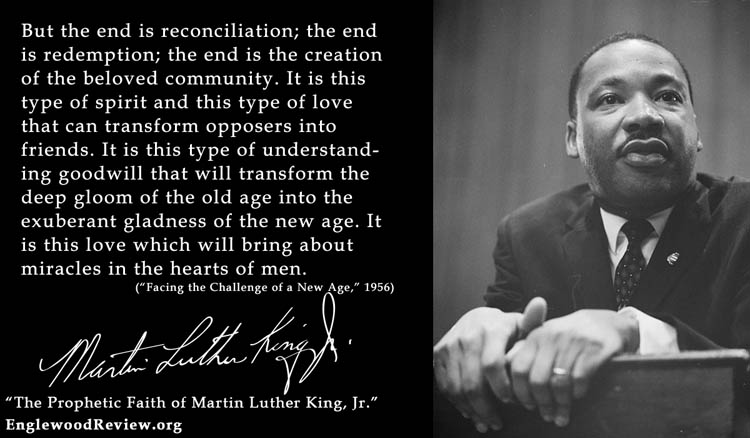
in memory of martin luther king jr

Today we remember the assassination of Martin Luther King Jr.

In the early church, people memorialized the martyrs by celebrating the day on which they died, because it was on that day that they were born into the fullness of new life in Christ and freed from the sinful tendencies of the flesh. In that spirit, then, today would be the appropriate feast day and memorial for Martin Luther King Jr., commemorating the death he died fighting for the freedom of his people, a fight that was both informed and characterized by his faith.

Of all the things that impress me about MLK, the ones that I think amazes me most are the tenacity with which he held to his faith in the face of the fear, antagonism, oppression, injustice, violence and hatred aimed at him by people who claimed to share that same faith, and his insistence at operating peacefully and striving for love when he was receiving all of that in return. How close he must have been to Christ, to keep living for Him in the midst of that storm of darkness! How strong his character must have been, forged in trials and infused by the Spirit Himself, to not waver on his principles or beliefs through all of his years in the civil rights movement!

I can tell you honestly that I don’t think my faith and character would hold up to the trials he faced. I can guarantee that I wouldn’t have faced those situations and people with the same combination of boldness and grace – I would have been running and hiding and hoping no one noticed me.

But his faith sustained him, his love directed him, and his courage kept his feet on the hard and beautiful path he had set out on. May we follow his example, and never by our silence, fear, or ignorance be complicit in the injustices he battled against.

MLK-Quote1

Posted in musings, quotes

stay with us, Lord – praying for faith

In a world that is culturally distant from God, in a society that tends toward individual isolation and values independence, self-sufficiency, skepticism, and cynicism, it can be hard to remember that God is always present with us, and even harder to feel that presence throughout the day. The urgencies and immediacies of each each moment cloud our awareness of Him, and focus our minds on the temporal and fleeting instead of the heavenly and eternal. The brokenness of our world makes it harder still to remember Him as a God both powerful and loving, because the pain of death, oppression, fear, war, terrorism, unemployment, sickness, and so on seem far more real and relevant than His high and unknown redemptive plan and purpose. Those things we see, are forced to see, time and time again; God, we have to take on a bit of faith.

And the Church, in her wisdom knowing how difficult it can be to rely on this invisible faith when the world we see is devolving into chaos and darkness, gives us these beautiful, simple prayers.

Christ rose from the dead and is always present in His Church.
Let us adore Him, and say:

Stay with us, Lord.

Lord Jesus, victor over sin and death, glorious and immortal,
Be always in our midst.

Stay with us, Lord.

Come to us in the power of Your victory,
And show our hearts the loving kindness of Your Father

Stay with us, Lord.

Come to heal a world wounded by division,
For You alone can transform our hearts and make them one.

Stay with us, Lord.

Strengthen our faith in final victory,
And renew our hope in Your second coming.

Stay with us, Lord.

(from Thursday’s Liturgy of the Hours)

That is what we pray for – His presence, His power, His love, His healing and transformation in our broken world – and it is what He has promised in His Word, so we know that one day, someday, our prayers will be fully answered and redemption fully brought forth. And in the meantime we pray for the faith to hold fast to Him when our sight and understanding fail.

Posted in family life, musings

grace in my inadequacies: striving for virtue as a mother of toddlers

Some days, as a parent, I just get so frustrated, so irritated, so impatient that it literally takes all I have not to yell at my kids. They usually aren’t doing anything wrong, either – just normal behavior that pushes my buttons.

Those are the days that remind me just how much I still need to grow in virtue and holiness.

Are my charity and compassion really so small that I can’t respond with a kind word and a helping hand when my toddler is whining for help wiping his nose because he’s sick and congested? It’s not loving, it’s not just, to snap at him every time just because I can’t handle the sound that he’s making because of how miserable he’s feeling – all it does is add to his sadness and upset by pushing him away from what should be his source of comfort and gentle love.

Are my temperance and self-control really so stunted that I can’t push back a meal or miss a little sleep because my boys need me for something that they can’t handle on their own? Can I not set aside my physical needs temporarily in order to take care of these little people who are depending on me for so much, and who in general have to bend to my schedule and my desires time and time again?

Is my joy so fleeting and shallow that the small irritants and storm clouds of everyday life are sufficient to wipe away my smile and bring a harsh edge to my voice? Am I really so far from the Root of happiness and peace that every small problem raises my temper or deadens my laughter?

Is my patience so short that I can’t deal with a toddler’s incessant questions or a baby’s irrational tears? How can I hope to teach them to love people well if I can’t love them well for who they are through their normal developmental needs?

And the hard answer to hear is yes, my virtues are that weak and undernourished, that immature and small. Sure, some days we have together are beautiful and by God’s grace I am living well in those moments, but in general – when I am tired, when someone is sick, when work is stressful, when Paul and I are having trouble communicating well, when I’m worried about someone I love – in general, in the normal stressors of life, my virtues aren’t strong enough to keep my feet in the path of holiness. At any rate, they still need the help of massive amounts of willpower and even more massive amounts of prayer!

My solace in those moments is knowing that the pain of striving towards virtue, the strain of denying my inclinations time and time again, the practice of coming back to God for mercy and grace hour after hour, will all result in an increase of virtue, in the same way that the aches and pains of exercise lead to greater strength. God wants us to grow in holiness, so His grace is extended for us for this purpose without stint or reservation – all we have to do is seek it and cooperate with it instead of pushing it away to pursue our own pleasures. It’s just a lot easier to say it that way than to actually live it out…

Posted in family life, links, musings

spending time outdoors, and trying to avoid the built environment in an urban setting

I read a rather depressing article in The Guardian this week about the amount of time kids spend outside – apparently, about 3/4 of kids in the UK spend less than an hour outside on an average day, which is less than the amount of outdoors time the UN recommends for prisoners. I don’t imagine it’s that much better in the US, particularly in urban environments.

There’s been a combination of factors leading up to this, I think. We have the increased attraction of indoor activities, to start – a proliferation of games, toys, and technologies that didn’t exist a few generations ago. We have an increased sense of parental fear and anxiety, which I think stems from the globalization of our news and the breakdown of neighborhood communities. And in general we have a cultural tendency toward comfort and convenience, and being outdoors in all weathers isn’t the most comfortable or convenient thing, especially when parental supervision is required!

But it is undeniable that outdoors, active play and exploration is one of the best possible things a young child can be doing.

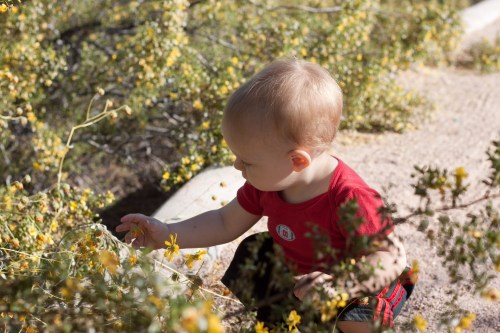
IMG_4291

So, in sort of the same spirit as my efforts to make sure my kids eat a variety of healthy foods, I’ve decided to be very intentional about getting them out of the house every day for an hour or two at a time (Limerick doesn’t usually last longer than that without needing some sort of rest or snack). I wish I had more wild and natural places for them to play easily, but at least I can get them outdoors with their hands in the dirt and rocks and grass!

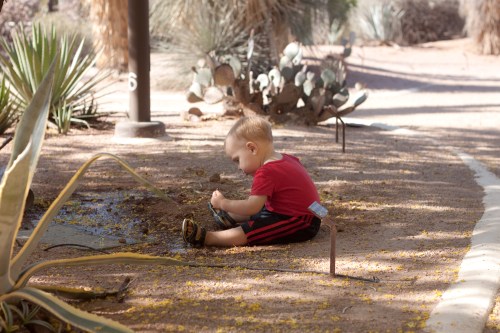
IMG_4338
And in the mud! Irrigation at the botanical garden makes for a great play place for a toddler.

Our city does offer a variety of parks, and we live in a walkable area, so that helps a lot. Just this weekend, actually, we discovered a new park that has a small desert botanical garden, some walking trails, and some Native American ruins in addition to the playground area! I’m anticipating a lot more exploration there…

Rondel and I stood under this palo verde, by the flower-crowned organ pipe cacti, and held very still so we could listen to the buzzing drone of all the bees over our heads. The branches were probably a good two feet above my head and we could still hear the hum loud and clear.

IMG_4340
Limerick learned the hard way that even the flower buds on cacti have prickles!

In a similar vein, I learned today about the concept of an urban farm preschool, where very young children who don’t live in a rural environment can still have daily exposure to the natural environment – to experience firsthand the ever-changing beauty and wildness of nature, to see how plants grow and bear fruit and die, to taste and touch and feel living things every day, to grow comfortable around dirt and animals and the unsanitized processes of the natural world. There’s another idea added to my catalog of small businesses I’d be interested in starting some day!

What are some of your favorite ways to encourage your children to play outdoors, especially those of you who live in more urban settings? How do you think our society as a whole might do a better job of enabling outdoor time for both children and adults?


Posted in musings

new life through a crown of thorns

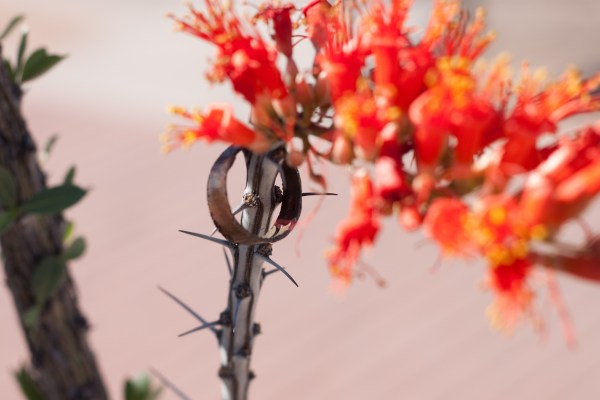
Through the crown of thorns comes beauty and new life.

IMG_4319
IMG_4320

(I found this at the park this morning – it was like a reminder from God, on this day of waiting and held breath between the crucifixion and resurrection, of both the pain and the beauty bound together in Christ’s sacrifice.)