My mom has pretty normal hands. They’re not too big and not too small, with fingernails that are neither short and stubby nor long and elegantly manicured. Her knuckles stand out, as do her veins, and in the winter her skin gets horribly dry.
But to me, they are hands of strength. I’ve seen those hands, chapped and cut and bleeding, folding laundry and doing dishes, serving with endurance. I’ve seen them cleaning and organizing messes they had no part in making, or trimming and weeding the garden.
To me, they are hands of love: hands that soothe a feverish child, that prepare meals, that zip up dresses or style hair, that type emails and pick up phones to advocate for her family and students.
To me, they are hands that create beauty and community, quilting and cross-stitching family treasures, decorating for each season, setting up events to bring people together and deepen friendships.
And when I rubbed my sick boy’s shoulder this morning, I looked down at my hand and saw my mom’s – and I thought, if my hands can bring half the service, love, and happiness to my family that hers have, they’ll be doing well.
Limerick turns restlessly on his crib, mutters into the darkness, settles himself back down with his bottle of water.
Rondel lies curled up against the back cushions of the couch, pillow beneath him, blanket kicked aside, breathing quiet and small in the darkness.
And I hope that as they sleep they are healing, so that when they wake the pain and fatigue will be gone, and their normal energetic exuberance can resurface.
When the normal pattern of our life involves hours spent running and climbing and laughing outside, days in a row snuggled up on couches, dozing on and off, quiet and slow, feel foreign and strange. When bright eyes are dull and weary, when little faces are pale, when active limbs are still and calm, nothing seems right.
And I think to myself, this is only a stomach bug, and they’re going to be better in a few days, and however do mothers cope when this becomes a new normal, and sickness buries its talons into a family? How do they not break with the pain of it, loving so deeply and being so horribly unable to stop the hurting and restore health and energy to their baby? It takes my breath away, how lucky I am, how many good cards I’ve drawn in this game of life; and if it were all to fall apart, would my faith hold firm? I hope that it would, but I pray that such a test will never come.
There are some things (both moral and doctrinal) about which the Church is incredibly clear and precise – things like the nature of the Trinity, or the objective sinfulness of abortion. She paints those pictures with clear lines and well-defined forms, even through the layers of human or divine complexity that color them.
There are other things about which she is largely silent, leaving the murky watercolors to be lived out in the conscience-informed prudence of her members. These things include education (where there are basic principles within which parents are left free to make decisions according to their wisdom and personality), housing choices (urban or rural? large home or small? bad neighborhood or good? – the choice may be a matter of obedience to God’s leading for an individual, but is never universally proscribed), career paths (let’s just say that some things are automatically excluded and that’s about it), and so on. These are things that touch a myriad of moral principles, but are not themselves defined or regulated in a binding way.
And while homosexual behavior falls solidly into the first camp, the Church having defined it as inherently disordered, transgenderism is just as definitely in the second camp. There is no official position, no magisterial teaching, no long history of tradition draw upon from the writings of the Fathers. We are left to figure it out on our own, to sort through the various principles that are at play, and to decide in the circumstances with which we are presented how best to behave as a follower of Christ in a shattered world. We cannot naively assume that everything is positive, nor should we cynically believe that everything is negative. We should not blow with the winds of extreme gender theory and deny that male and female have any real meaning, nor should we deny the reality of what most transgender and intersex individuals face by claiming that they are all perverts or performers. After all, if our reason and will can be weakened or damaged by sin, and if we respond to this brokenness not by throwing out our understanding of the importance of reason and will but by giving our support and love to those who are affected, why wouldn’t sexuality be the same? Can we give them the benefit of the doubt and believe what they say about their own experience? Can we acknowledge that maybe the general brokenness of creation has touched the link between their bodily and interior genders, and left them feeling incomplete or out of place?
I totally understand all the gut reactions most people have to transgenderism. It just feels strange. It feels especially strange when someone who has been living as one gender for years announces that they really identify with the other gender, because we don’t see the journey of growing self-awareness, suffering, and courage that have to build up in order for such an announcement to take place. You want to claim that their new identity must be a lie because otherwise your whole previous relationship with them feels false. You see their gender-typical body and wonder how in the world they can feel like the other gender. You feel like your own experience of your gender is being stereotyped and patronized by people who have no genuine understanding of it (especially when people like Jenner try to reduce femininity to fashion – I have serious trouble believing the authenticity of that transition, to be honest with you, because he/she doesn’t seem to understand or value womanhood as anything beyond physical appearance and sexual objectification). But those gut reactions, and the celebrities that fuel them, can’t address the moral and philosophical principles at play.
Can we find a way to embrace the “both-and” tension in this area, as Catholicism does in so many areas? Can we praise and value masculinity and femininity as the duality created in the image of God, without demonizing those who fall in between or are dealt aspects of both? Can we continue to see the beauty and mystery of the two sexes, both in marriage and society, but still make a space for those who, because of the fallenness of the world, don’t fit neatly into that dichotomy? The transgender individual is a human being just like us, called to holiness, called to Christ; he (in the universal sense) is our brother, for whom Christ died, for whom we are supposed to live, that he might know Christ and come to heaven in the end. How can we say we have truly loved him if our rejection pushes him away from the Church and away from Christ?
When my husband and I started our backyard garden a few years ago, we overestimated the quality of our soil (well, I overestimated it) and made our garden soil mix with 50% native soil, 30% compost, 10% peat moss, and 10% vermiculite. I had actually found this percent mix recommended for particularly poor native soil and so thought it would work for our adobe clay.
I wasn’t entirely wrong, but quite a few seasons of plants have now struggled to grow deep roots through the hard earth, and been small and stunted as a result. I have only to compare the growth of the plants in my garden to those in my mom’s garden to realize the significant impact made by the poor soil.
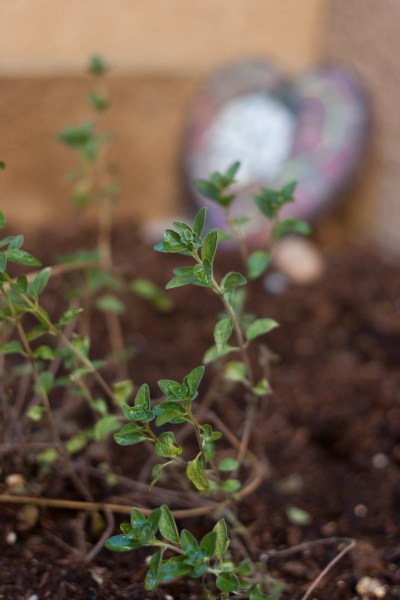
my oregano – a decent plant, but spindly compared to the massive bush in my mom’s garden, that has to be sheared back dramatically every few weeks to keep it from taking over
Each growing season, as we add more compost to the soil, it improves a little bit more, and eventually it may be as rich and soft and fertile as the soil in my mom’s garden was to begin with – but that process is going to take time, patience, and effort.
I think it is the same way with my heart – with all of our hearts, probably. We all start out in different places; some of us are more naturally inclined to virtue than others, some of us more easily bear the fruit of our beliefs, and some of us just need a lot more work before our actions take on the robust and fruitful nature of a plant in abundant health. We can all have the same seeds planted in us through books, experiences, relationships, and so on; we can all water those seeds in appropriate amounts through continued learning and the building of spiritual habits; but some of us will bear fruit in certain areas far more quickly and beautifully than others. It doesn’t necessarily mean we are trying harder – just that we had better starting material in that area.
For example, when it comes to sex, I started out with really good soil. I have no natural inclination toward sexual sins, and significant appreciation of the spiritual and physical mysteries of the marital act. It has always been an area that leads me to meditate on the incredible love of Christ for His Church, instead of an area of struggle and temptation. On the other hand, I have extremely poor soil when it comes to emotional regulation. My moods swing like a pendulum, and the negative emotions (anger, jealousy, suspicion, resentment, depression, and so on) linger and build up within me like a storm of darkness ready to break upon those closest to me. It damages my relationships, preventing me from becoming truly close to anyone, and wounds the people I love the most. So I can put in hours of prayer and concerted effort towards managing my emotional reactions and redirecting my thoughts and attitudes toward Christ, and still appear to have weak and scraggly plants in that part of my garden – but I can put almost no effort in to resisting sexual temptation and still enjoy healthy and thriving plants in that area. And these areas of strength and weakness are different for every person.
We can and ought to put in the time and effort to improve the soil in those struggling areas, and not just focus on improving the short-term health of the plants therein. How do we do this? By making everything we do be about Christ, centered on Christ, living in Christ, knowing Christ, loving Christ; by immersing ourselves in His word, by constantly coming to Him in prayer, by unifying ourselves to Him and to His people. If He is first, if He is all, everything else will find meaning and beauty in Him. If He is in us, He will be transforming us, mixing the rich compost of His life into the hard clay soil of our hearts, making us more like Him.
The suffering of the innocent is one of the most emotionally compelling arguments against the existence of a loving and powerful God. If He is able to intervene in our world, why doesn’t He stop more of the atrocities that poison it? Why do we seem to see Him act at some times and at others seem to be so conspicuously, unavoidably, alone? Why do some people receive supernatural visions or material comfort, while others suffer abuse and feel that heaven itself is blind and deaf to their prayers?
I will never be able to answer those questions. When my atheist friends bring up the dilemma, I have no short answer to satisfy them, no list of possible divine plans or actions that could make those evils ok.
But what I can tell them, what I do try to tell them, is that Christianity solidly agrees with them that the suffering of the innocent, the oppression and abuse of the vulnerable, is most definitely evil and is never “ok.” I don’t worship a God who is on friendly terms with evil. He hears the cry of the oppressed and avenges the innocent. Why He doesn’t just prevent the evil from occurring in the first place I don’t know for sure, but I would argue that it is because He gave us free will, and for that free will to be meaningful it has to be able to actually affect reality. If love and creativity and courage and honesty are to be authentic, then there must also be the possibility for hatred, destruction, cowardice, and deceit. And the greater the potential good, the greater the corresponding potential evil. It is the beauty and the horror of humanity.
And what does God do, faced with humanity’s evil choices? He gives us a moral standard to understand the difference between good and evil, justice and injustice. He calls us out of darkness into His light, offering us the chance to be forgiven and changed. He promises to punish those who commit evil, either in this life or the next, establishing His justice as a judge in court. And He enters into our suffering alongside of us, offering us the comfort and strength of His presence, giving us the opportunity to use our suffering with Him for the redemption and re-creation of the world.
This article on the national suicide rate, and its steep increase over the past 15 years, was quite interesting, if perhaps a bit morbid and depressing…
I strongly agree with one of the sources quoted in the article that this increase in the suicide rate is at least partially due to the social isolation caused by the breakdown of the family. Our culture is undermining the most intimate and permanent connections we have as people, and we are naturally suffering the side effects of loneliness and discouragement. We have chosen short-term self-fulfillment over mutual commitment and sacrifice, and while the victims of another person’s selfishness obviously pay the highest price, even those who appear successful in their quest for personal happiness may be eaten away inside by insecurity and pain if they have spent their life burning bridges and breaking connections.
And it is not surprising to me at all that the age group that has seen the highest rate of increase is middle-aged men and women, from 45-64 years old. These are the members of my parents’ generation, one of the first to grow up with rampant acceptable divorce, now reaching what should be some of the fullest and richest years of life, with children and grandchildren adding to their joy, and finding that the choices that seemed so independent, romantic, modern, and free have left them empty, alone, and unvalued as the final years of life approach. Having chosen pleasure or esteem or career success over family and unconditional love, they are discovering an ache in their hearts for the sustained and quiet love they have so long neglected. I expect that as each new cohort enters this age group, the suicide rate for it will continue to increase, at least for the next two or three, as the bitterness and dysfunction we have bred in our society bears the fruit of isolation and hopelessness; I hope that as my generation and my children’s generation witnesses the destruction of these social choices, we will be given the strength, courage, and grace to overcome them, and reduce this cultural burden of despair and death.
If you’re immersed in the Christian subculture, the emphasis is such that it can seem like pornography use or other sexual sin is the worst thing that can happen to a marriage. But really, you know, a marriage can weather that kind of storm, if both partners are willing to come together in humility and forgiveness and rebuild the trust that was broken. I’ve actually been privileged enough to witness this a couple times, not in people I’m particularly close to, but in friends of friends, and it is a truly powerful image of grace.
What I think is more damaging to a relationship, in the long run, though it doesn’t have the shock and awe moments of an affair or betrayal, is smoldering, simmering resentment, bitterness and contempt in one spouse towards the other (or even worse, in both partners toward each other). When there is this kind of baseline negativity towards one’s partner, they can do nothing right, there are no kind words, forgiveness is grudging, casual misunderstandings turn into fights, and the duties of sharing a home are carried out passive-aggressively. This marriage may look fine on the outside, but the inside is being eaten away by a cancer of unrighteous anger.
As the apostle Peter wrote, “love covers over a multitude of sin” (1 Peter 4:8) – and so, if a marriage is grounded in and sustained by love, the failings and imperfections of each spouse can be overcome in forgiveness and grace. But if a marriage lacks this deep and unconditional love, a love that bears all things, hopes all things, believes all things, endures all things, then it will be shaken to its core and in danger of destruction. It is hard, but essential, for us as married people to reset our baseline emotions toward our spouses, from a default of bitterness and resentment to the commanded love and mercy that analogizes Christ and the Church. Only by so doing can we hope to maintain the joy and beauty of our marriage, make our homes a holy and happy place for our children to grow, and reach out to our communities with genuine hospitality. Our attitudes toward our spouses ripple outward in their effects to touch everyone we know. May it be a ripple of love and abundance and joy rather than one of loneliness, hurt, and anger.
I wonder if everyone has a specific vice (as in, a tendency towards a general category of sins, vs. a specific sin itself) that proves most challenging for them, most difficult to remove, most damaging to their relationships and their own souls.
Mine would have to be wrath.
Misplaced, disproportionate, uncontrolled anger, strengthened by self-righteousness, latching onto my soul with bitterness and smoldering resentment.
The kind of flaring, volcanic passion that makes me, with all my gentle parenting ideals, wanting to slap my kid as hard as I can because he keeps laughing in my face and climbing out of bed when everyone is exhausted and needs to go to sleep.
The kind of all-consuming, fiery emotion that leaves me unable to focus, unable to work, unable to pray, unable to give back and build into the lives of others around me until I can manage to fight it off or sleep it off.
The kind of suspicious bitterness that remembers a past grievance and holds onto it forever, always expecting a repeat of the offense, never trusting completely again once the other person has made a mistake or sinned against me, withholding true forgiveness.
The kind of irrational reaction to events that responds as if every inconvenience or misunderstanding were a personal attack or insult or rejection, that makes me want to burn bridges between friends simply because of a chance word or my perception of the expression on someone’s face.
When I imagine being free of the presence and power of sin in my life, when I imagine what it would be like to be holy, the biggest change I envision is the disappearance of this dark and ugly anger, the liberation of my soul from its clutching tentacles. It was this vice that led me to pray the sinner’s prayer at 7 years old, that impelled me to more deeply fall in love with God at age 12, that continues to both be the bane of my existence and the thing that pushes me back to God asking for His mercy and forgiveness. Is there some way that these passions, in me and in others, can be redeemed and used for good? I don’t know. That kind of transformative power isn’t something I can picture right now, but maybe it is one of the incredible gifts God has in store for us. All I know is this: that my wrath is set to destroy me and everything I hold most dear, and that I need to pray, as so many have prayed before me:
Lord Jesus Christ, Son of God, have mercy on me, a sinner.
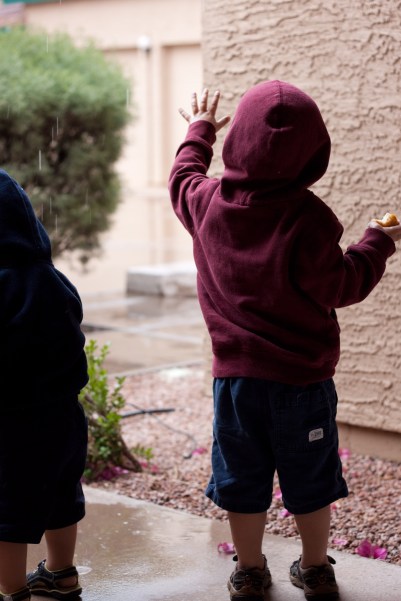
Sometimes, when everything is dry and parched and hot, rain comes bringing renewal and new life.
Maybe if I’d grown up somewhere wetter, rain wouldn’t always feel like a gift from heaven or an answered prayer – but to this desert girl, where water is always needed, rain is analogous to grace. It comes from God, not by any effort of our own, and we delight in it.
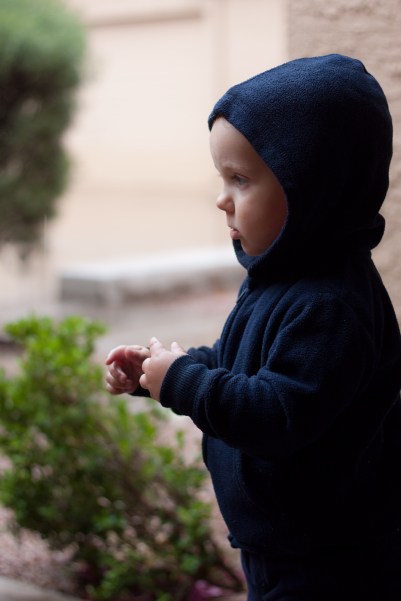
It got a bit cold for us out in the rain, because it was also fairly windy, but the boys were entranced by the water anyways.
I just hope that they will be just as entranced by grace itself as God pours it into their lives.
In gardening news, Rondel and I planted most of the purple sweet potato slips this weekend! Some were a lot bigger than others, so we’ll see if they all make it or not… the orange ones will need to grow a bit more in their jars first, but we left some space for them.
In other news, I was thinking this week about how joy can’t be taken for granted but must be fought for, sometimes by tooth and nail. I can’t just assume that relationships and circumstances will happily accommodate me, nor can I assume that my response to adverse situations will be one of cheerfulness and contentment. If I want to have joy, I have to do the hard work of maintaining it in my heart.
Practically, I know that there are a few specific things that consistently impair my ability to be joyful: issues with my husband, a lack of prayer, and sleep deprivation. (Hormones also play a role but there’s less I can actively do about that!) So when the morning starts off with a misunderstanding or argument with my husband, it tends to color my whole day in blacks and grays; by default, I either become sad and depressed or bitter and resentful. If joy really matters to me, I have to be willing to swallow my pride, bury my anger, and actively seek reconciliation and understanding again. Sometimes it’s as simple as a “sorry for what happened – I love you” sort of text – and yet, while it may be simple, it sometimes seems like an impossible task.
But it all comes down to whether or not I really want to live with joy. I don’t believe that I will always be able to have joy, no matter how hard I strive for it, but I do believe that it is a very different thing to be overwhelmed by my emotions and sinful tendencies but to still be fighting with all my strength for hope and peace and joy, than to raise the white flag to the general progression of discontent and stress and insecurity without a second thought. And after all, our joy is directly commanded by God. It is not a trivial or selfish thing to fight for it, but something that pleases Him and blesses everyone around us – so it is very much worth the effort that it takes.
In the emptiness of bleak despair, He is my fullness and hope.
In the piercing pain of loneliness, He is my comforter and my companion.
In the gnawing fear of inadequacy and rejection, He is my helper and the lover of my soul.
In the storm of brokenness and sin (my own and others’) that threatens to capsize me, He is the source and sustainer of my joy, and it is under His flag that I fight when I fight for joy.


 little thoughts