Posted in family life, information, sqt

{sqt} – here comes the monsoon!

People who don’t know Arizona well speak of our weather dismissively (particularly the summer weather). It’s hot enough that significant numbers of people head north for the summer, while compensating for their insecurities by arguing that their northern humid summers are actually worse. Even people who live here but have never had a chance to really get to know the seasons tend to treat the summer as a penance to be endured, a payment for the gorgeous winters, spent holed up inside thankful for air conditioning and swimming pools.

I will not debate the wonders of air conditioning and swimming pools 🙂

But I do think that Arizona summers are inherently beautiful and wonderful – they are just a lot more difficult to understand and fall in love with than most seasons in most other places. Maybe I identify with them a bit…

And now, we are fully entered into the most glorious part of summer: the monsoon season, the summer rains, the desert’s wet season. So to celebrate, here are seven quick takes about this season that I feel is so sadly neglected, forgotten, and dismissed.

  1. April, May, and June are without a doubt the official “dry season” here. The average monthly rainfall drops to 0.25 inches for April and plummets to 0.04 inches for June (which is another way of saying that every few years there will be rain in June, but don’t count on it). While daytime temperatures steadily climb throughout these three months, reaching 110 easily by mid-June, the lows stay in the 60s and 70s so mornings and evenings are still cool and comfortable. And as long as you stay hydrated, the highs are tolerable also. I have commuted by bike through the summer (coming home around 3-4 in the afternoon) and never felt more alive.
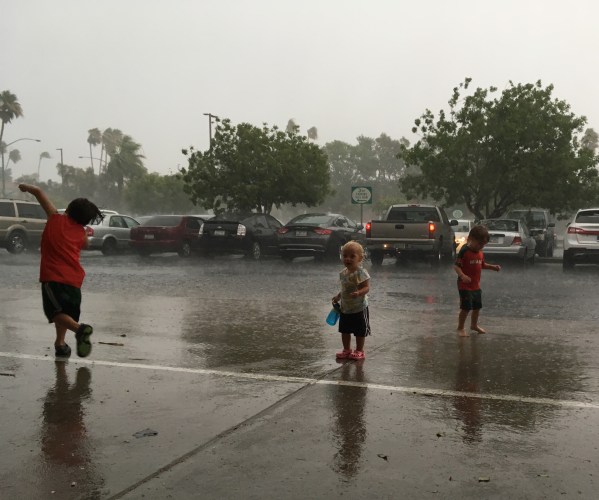
  2. Right when you start to feel that the heat has been going for too long – when the ground is cracking and the plants look thirsty even with irrigation – clouds start to blow in over the horizon. The dates are variable, but it is typically in early July. You step outside one morning and your glasses fog up like you’ve somehow teleported to Miami in your sleep. That afternoon you get an emergency alert on your phone for dust and poor visibility, and 30 minutes later when you look out the window all the trees are bowing low, the sky is slate gray, and the air is slanted lines of water. There may even be hail. This is when every child who isn’t chained down dashes outside to run and dance until they are soaked to the skin and shivering with the unexpected cold.
    FullSizeRender
    This was Monday, at the library. I glanced up and saw the rain and threw all the books in a bag and told the kids to run outside because IT’S RAINING GUYS IT’S RAINING! Don’t judge – we hadn’t seen rain since February!
  3. Remember the dust alert I mentioned above? They are triggered by impending dust storms (also called haboobs), and here’s what they look like from an aerial perspective:

    Massive Haboob hits Arizona
    This was the storm that hit us Monday. Photo credit Mike Olbinski, from this article.

    When I was a kid I used to go out in every dust storm I could just to feel the thrill of the wind and dust flying into me. Granted, it’s not the best if you’re asthmatic, and it spreads Valley Fever, but it can make you feel the power of wild nature even in a suburban backyard so it’s pretty awesome. There are also some funny side effects of having so much dust in the air – this week my coworkers all had to leave the lab in the middle of the storm because a fire alarm thought the dust from the haboob was smoke from a fire and went off!

  4. The ground, not having been rained on for five months, is understandably unprepared for such a torrential downpour. Roads flood (although they drain quickly once the rain stops), and any narrow places in the desert will also flood. Canyons or washes (essentially the drainage channels of the desert) are the worst places to be when it rains, and people have been killed in the sudden flooding. So if it starts to get cloudy and a cool wind blows, climb to high ground as fast as possible. In more developed places, you end up with lakes instead of yards 🙂
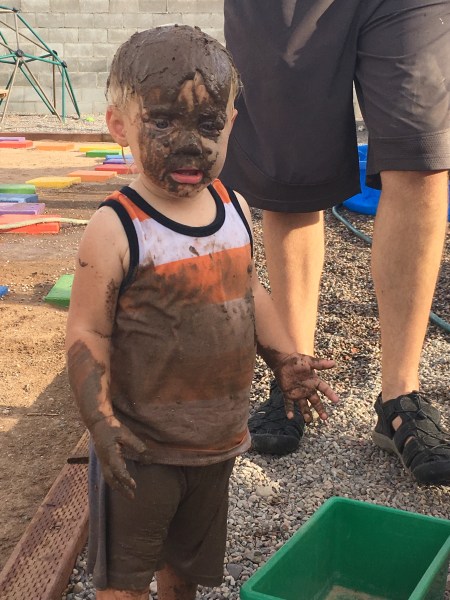
  5. Monsoons come in systems, so you’ll be hit with a huge storm like the one above from Monday and then have smaller rainstorms for the next few afternoons. It’s sort of like earthquakes and aftershocks. This week, we had the major storm on Monday and we’ve had at least a small shower every day since. Four consecutive rainy days after five months of nothing! It’s a change in pace, to say the least. It’s also necessitated a lot more cleaning up as mud gets everywhere. If I lived somewhere with wetter weather, I think I would need a mudroom!
    IMG_3601
    Considering she voluntarily became this muddy with only splash-over from the kiddie pool to help her, you can imagine what happens every time it rains…
  6. The wet monsoon season typically lasts through early September, although the actual storms only come every couple weeks. In between, it is just hot and humid. The humidity right now is 44% and even though it is 9:30pm and the sun has been down for over an hour it is still 91 degrees. So while June fits the Arizona stereotype of “dry heat”, we definitely see more of a humid heat in July – slightly lower highs because of the clouds, but significantly higher humidity.
  7. I have discovered that while there are many, many good picture books about the changing seasons in other parts of the world – books about leaves changing and falling off, books about animals preparing for hibernation, books about the first snowfall of winter, books about flowers blooming in the spring, etc. – there are very few picture books of any sort about the desert seasons or even the desert animals inhabiting those seasons. It is to the point that I am seriously contemplating writing my own to try to fill the gap! It’s like me as a woman reading a book with a strong female lead, or an African American child reading a book where the people in the pictures look like her. This is the place, the environment, the habitat that my children know, where their roots run deep, and while all the other places are fascinating and the books about them are wonderful, a book that resonates with their lived experience – with their home – would be special in a different and treasured way.

I’m joining the SQT link-up at This Ain’t The Lyceum today so head over and read the other blogs! Also, if you live in a place with under-appreciated or non-standard seasons, please share! I’d love to hear other people’s experiences 🙂

Posted in family life, musings

overcoming the fear of differences

Difference doesn’t need to be a reason for separation, distrust, or conflict.

This morning I watched as kids from 18 months to 10 years old played together. Everyone waited patiently without pushing or complaining when one of the toddlers wanted to climb up the ladder to the water slide, and the big girls helped her slide down when she was scared at the top. Four year olds and 8 year olds batted balloons across the house together; 3 year olds and 9 year olds danced to music videos together. The difference in their ages – a very significant difference, honestly, in both physical and mental development – was not an impediment to enjoying their time together.

This morning I watched as children with multiple developmental disorders and disabilities played together. A girl with Down syndrome held hands with two “normal” girls as they careened down the water slide together laughing. Four boys with varying levels of autism and speech and language delays and two neurotypical boys took turns on the slide, crashing into each other, trying new ways of going down, splashing themselves and each other, without any comments on the different abilities or behaviors represented. The point was to enjoy the water, and they all enjoyed it in each other’s presence without being held back by the very noticeable differences between them.

This morning I watched as people gathered together to celebrate the life of a boy who is different in multiple ways, who faces unique challenges, and who is very much loved. I am sure that it was this love, spilling over from everyone present, that smoothed out all the potential conflict that could have been caused by the myriad of differences there this morning. By learning to love at least one other person unconditionally, with complete acceptance, with eyes to see them for who they are, with ears ready to hear them however they are able to communicate, we begin to learn how to extend that love to others as well. We look for the bright shining highlights in each other, instead of the behavioral challenges or the confusing differences. We strive for connection and communication even in the most difficult moments, instead of letting those difficulties drive us away. We begin to learn to say, and think, and live, with this perspective: that I am made in the image and likeness of God, and so are you, no matter how different we are from one another; let us meet in the heart and center of that image; let it bind us together in love.

This morning I watched a small microcosm of the kingdom of God play out before me, and my heart was filled to see it.

Differences are so often a cause of fear and suspicion. This person acts and looks and speaks differently than me, so I don’t know how to predict their actions, so I am afraid and want to stay away from them, or I speak more harshly to them because of my unease and discomfort. These people are not like me, so maybe they don’t deserve the same freedoms that I have. An older couple may ask their neighbors why they don’t just keep their children inside, as if because of their age the children have less of a right to access public outdoor space. A concerned citizen may call the police if they see a developmentally delayed adult acting strangely and defend their actions by protesting that the individual should just stay inside their group home if they can’t behave “normally” in public. A group of fairly enlightened founding fathers may preserve slavery and oppress native people because they see them as less capable or even less human. White southerners may institute separate facilities for themselves and legislate others out because they are afraid of being “contaminated” by people of other races. And normally compassionate Americans may applaud strict and trauma-inducing policies of family separation because they are afraid that these immigrants may be lawless criminals and traffickers.

But it doesn’t have to be that way. And we who are parents have the chance to shape the future world into a more understanding and loving place by giving our children the chance, here and now, to experience difference and to see how little it really matter when it comes to living and enjoying life together.

Posted in family life

an oasis in the desert

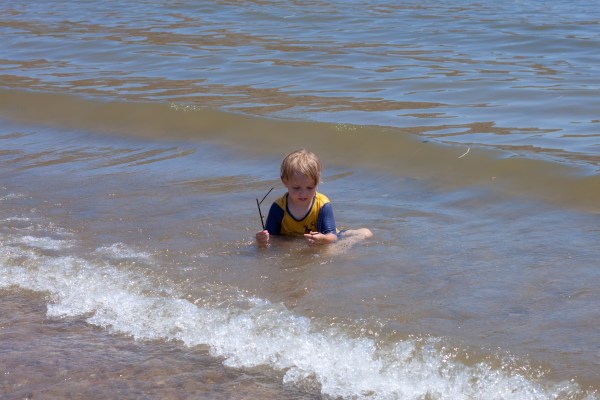
I took my children to the lake last Thursday.

Yes, even here in the desert we have lakes! They are mostly manmade and act as water reservoirs… but they also serve as beautiful oases, especially when temperatures start rising.

IMG_9519

My sister-in-law joined us for a couple hours with her four kids, which was especially good when Limerick got in too deep and started panicking and needed me – that extra pair of adult eyes and hands makes a big difference sometimes. It was also fun for us just to spend time with them! But we stayed after they needed to leave and it was equally wonderful in different ways.

IMG_9554

I mentioned our day trip to someone and they instantly reacted with the words, “what a chore!”

I still haven’t been able to figure it out.

It isn’t a chore to spend time outside, in the natural unbuilt environment, enjoying the beauty of creation. In fact, it’s something I’m constantly striving to do more often! I want my children to love and respect the natural world, to feel connected to it and desire to protect and preserve it; they won’t if they are never exposed to it. And we were so lucky on this particular day to be visited by a herd of wild horses. I mean, how often do you get to see large wild animals like that? We were all in awe – even Aubade kept pointing and exclaiming in wonder as they moved through the water.

It isn’t a chore to take my children out on an excursion – at least not this type of outing. Rondel and I both struggle in crowded indoor environments, or in highly structured populated activities, because of the constant sensory bombardment and social expectations. Limerick and Aubade are both still noisy constantly-moving little people (as they should be!). So when we’re outside, away from the artificial stimuli and the obscure social norms of the city, free to make the sounds we want to make and move our bodies in comfortable ways without bothering anyone, it is incredibly relaxing and refreshing.

It isn’t a chore to be with my children, to let go of my own pursuits and just focus on them for an afternoon, enjoying the small details of life with them. They remind me how exciting a lake bed scattered with shells can be; they delight my heart with their surprised laughter at things that are now old and familiar to me. After you’ve been to the beach a few times, you anticipate the way the waves knock into you; when you’re only 1 or 3 or 4, each new wave comes as a surprise and a gift.

IMG_9614

And it certainly wasn’t a chore to watch Rondel and Limerick playing together for hours, intent on their exploration of this new world, sharing it with each other as best friends do. On the contrary, it was a gift for me as a parent to see my children growing and deepening in their relationship with each other in such a natural and unforced way.

I know these days are fleeting. For only these few years will I have such a strong influence on their lives, and such a deep connection; I don’t want them to stay little forever, but I do want to live these years with intentionality. Of course it takes a bit of planning and organization to take three small children to the lake for the afternoon. But the riches all of us reap as a result far more than outweigh that work of preparation. For us, places like this are more than just real and physical oases in the desert: they are also oases of renewal for our souls.

Posted in book lists, family life

literary explorations – traveling the world with picture books!

Inspired by the great resource Give Your Child The World, a globally-inspired picture book anthology by Jamie C. Martin, as well as by Rondel’s fascination with animals from around the world, we had a sort of Africa focus in our home a couple weeks ago. Martin is actually hosting a virtual book club spending one week on each world region over the summer, which I’m attempting to keep up with, but I’m woefully unprepared for Asia this week…

Anyway, Africa was a great place to start since most of Rondel’s favorite animals live there, and it was a natural connection to then begin reading stories involving those animals and the people who live near them. We also experimented with some African recipes (there is a huge variety of cuisines across the continent, so we were barely able to explore any of it and it still felt like a lot!) and crafts (but my kids don’t do so well with directed crafts). Of the books we could find from Martin’s recommendations at our library, two really stood out as our favorites: Bringing the Rain to Kapiti Plain, a Nandi folktale retold by Verna Aardema; and Wangari’s Trees of Peace, a brief pictorial biography of Wangari Maathai, a Kenyan Nobel Peace Prize laureate who helped restore land degraded by irresponsible logging (and in the process helped maintain peace and prevent poverty in her home country), by Jeanette Winter.

The biography of Wangari is written at a level that even Limerick, at 3.5, can understand and follow along with, so many of the details of her life have obviously been omitted – this is just the general arc of her story. But those spare elements have been woven together, with the help of beautiful images, to create a compelling narrative. Every time we read it (which was often, since Limerick kept requesting it), Rondel would be devastated when Wangari returns to Kenya after studying abroad to find the forests cut down, the village women walking miles for firewood and food, and desert encroaching upon the arable land. The boys’ eyes would widen, riveted on the book, when Wangari stands “tall as an oak” to protect the remaining forests, when the government officials beat her and jail her for protesting their course of action. And at the end, when millions of trees spread across Kenya again, the boys would be all smiles and laughter, imagining the birdsong in the forest. So I would highly recommend it as a brief introduction to Wangari and modern Africa for young children.

In addition, it has given me a point of comparison when talking with the boys about current events in our own country. When Wangari is jailed, the book tells us that “Right is right, even if you’re alone,” and the whole story demonstrates how the right thing to do can sometimes be the opposite of what the government or people in authority want to do. So when the boys heard our president talking for a few minutes before I changed the radio station (I usually only listen to talk radio when I’m alone in the car), and asked questions about what he was saying, I could explain his position and then also explain how I thought it was wrong, morally wrong if not legally wrong, and how his power and authority didn’t make all of his beliefs or actions morally right and good. And I was able to tell them that unlike Wangari, people like us would be able to peacefully protest those wrong things without fear of imprisonment, because our nation makes space for differing opinions and protests (ideally, of course, but since they’re 3 and 4 they get the idealized version on some things still).

Wangari cared deeply about her country – she loved it – and that’s why she was able to work for its improvement with such persistence, devotion, and passion. She started with small things she knew she could do (like physically planting new trees to replace the harvested ones), and let her love guide her into bigger and bigger forms of activism. And when I look around me and see people cynically apathetic about this country, it makes me want to instill in my children a love for their country and a passion to make it better, in small personal ways and perhaps even in big political ways. It is only with the love and dedication of people like Wangari that we can heal our culture, our environment, and our world; I’d much rather my children be like her than like the enforcers of government authority who beat and imprisoned her.

At this point I’m doubtful that any other picture book we find for this book club will influence our family quite as much as this one has! But every one we’ve managed to find so far from Martin’s anthology has been worth a second read at least; we’ve learned a lot, and we’ve laughed a lot, and we’ve filled our home with beautiful pictures and stories, and there isn’t much more to ask for from a picture book 🙂

At the time of posting, Amazon has Give Your Child the World available on Kindle for only $0.99! It is a resource worth far more than that.

Posted in family life, sqt

starting our summer strong

Because Rondel was in zoo camp every morning this week (which, by the way, was a major success – he absolutely loved it), I got to spend some more focused time with Limerick and Aubade, and they got to spend more time playing together. Normally, Rondel does most of the talking and directing when the kids are playing, so I was curious what would happen in his absence; what happened was that Limerick filled in the gaps quite easily and just about talked non-stop, especially towards the beginning of the week. And it was nice to have the chance to listen to him without having to simultaneously try to listen to Rondel… it can be a bit much when they are both talking to me (and demanding a response!) at the same time.

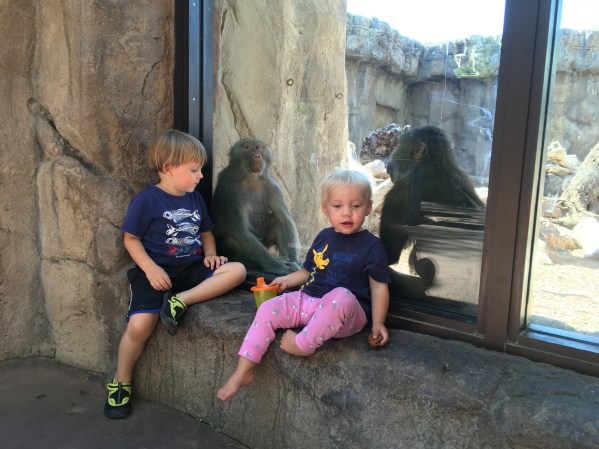
  1. On the first day, we stayed at the zoo and watched the Andean bears for a long time. Limerick decided he would be an imaginary creature called a buck bear, and spent at least thirty minutes describing this animal and its habitat to me while Aubade slept. (It is very much an atypical bear, as it has sticky feet like geckos and gills like a fish! Rondel never lets him get away with such aberrations from reality 😛 ). He also was brave enough to sit right against the glass next to the baboon! He’d been watching Aubade interact with her for a while, and had clearly wanted to see the baboon up close himself, but had been too scared to do so. I was proud of him for getting closer even though he was nervous.IMG_3386
  2. On the second day, we came home and just hung out together. We cleaned, we read books, we played with stuffed animals – it was relaxed and fun. (Also, that night we received Rondel’s official diagnosis of autism, after several weeks of waiting.)
  3. On the third day we did more of the same, but stopped in Downtown Mesa on the way home to explore the musical instruments in front of the IDEA Museum. We used to visit there all the time when we lived within walking distance, when Rondel and Limerick were Aubade’s age, but she hasn’t gotten to experience it very much, and judging from her reactions she was very glad we went!

    Yes, I let her choose her own clothes and accessories… apparently oversized T-shirts pilfered from her brothers and metal chain VeggieTales necklaces are in fashion in the 18 month old set these day 🙂 She is so opinionated about what she wears – and always ridiculously cute in it, no matter how off-the-wall it may seem at first.

  4. On the fourth day of camp we rested in the morning but took Rondel with us down to IKEA in the afternoon! IKEA may be a store, but my children seem to think it is a giant playground. Every couch needs to be sat upon, every pillow smushed, every stuffed animal hugged, and every bed snuggled in. We were just there for some curtains, but we lingered everywhere (and let Aubade take a nice long nap in her carseat in the shopping cart en route!). Then I kept my momentum going long enough to hang and hem the curtains, and make a curtain and valance for the kitchen sink window with some fabric I found in my stash.IMG_3475Here they are all pulled back! Those are south-facing windows… and it’s summer in Arizona… so the curtains haven’t been spending too much time open like this. Even just the white fabric over the sink made a noticeable difference when I first hung it up. And I impressed myself (and probably my husband too) by managing to actually complete a project!
  5. The last day of zoo camp I missed out on drop off, pick up, and sweet time with the littles because it was my husband’s day off and my day to go in and work. Not quite as fun, or not fun in the same way, but I did get to consult with a colleague from a different core facility and develop a project and sample tracker for their instruments and workflows, which was both interesting and satisfying. Since I’ve started working such limited hours, and partly from home, my position has shifted a bit away from the biology lab work to the information systems behind the lab work, and I’m finding it really engaging.
  6. It feels like we began the summer at a sprint, and I think it is just going to keep on this way as we have swim lessons and a visit from my sister in June, and my parents are funding a second session of zoo camp for Rondel as a birthday present in July. But honestly the heat is so intense that having planned activities helps prevent me from doing nothing but lounging around the house eating ice cream! Not that ice cream is a bad thing, necessarily… I finally jumped on the nice cream train this summer, one night when Rondel was emotionally collapsing over the absence of ice cream in our house and I knew there were tons of frozen bananas just calling to me. The plain vanilla flavor isn’t my favorite, but the chocolate peanut butter version tastes like decadent chocolate ice cream, with the added bonus of being healthy enough that I can serve it to the kids for lunch and become the coolest mom ever. I don’t really have a recipe, but in essence I just blend up frozen banana chunks in the food processor, with a bit of milk if necessary, and then add in a huge scoop of peanut butter and a couple tablespoons of cocoa powder. We’ve made at least three batches in the past two weeks, and would have made more if we hadn’t run out of bananas and had to buy more, wait for them to get nice and overripe, and then wait for them to freeze! My skepticism regarding this whole concept has been removed by the goodness of nice cream.
  7. And zoo camp itself? Well, every morning Rondel cooperated with me to get dressed and eat his food, he ran ahead into the group to participate, and he greeted me back at the end with endless excitement, ready to tell me about everything he did. He got to pet, hold, and feed a huge variety of animals (from bunnies and boa constrictors to sting rays and giraffes); he drew pictures; he played games with other kids; he got to bring home a sting ray tooth that he sifted out of the sand in a pool; and he got to see so many animals that he loves. In short, he got to practice social skills and adaptability while also being in one of his favorite places in the world, getting to spend time focused on animals without any distractions. I just wish I had pictures!

What are your favorite ways to deal with the heat, especially with little kids? They don’t approve of me just lying in the sun soaking it up, but running around when it’s 100 degrees outside gets tiring fast! And do you have any awesome plans for the summer?

Linking up with Kelly at This Ain’t The Lyceum today!

Posted in family life, information, musings

responding to an autism diagnosis

We received Rondel’s clinical report today, with his official diagnosis of autism spectrum disorder. It was definitely not unexpected, and in many ways it is a huge relief to finally have it on paper with a physician’s signature and notes.

But it is also very hard to read through the report and take in the medical assessment of my child, who I see in all his brilliance and originality and intelligence, and who is being evaluated in light of his struggles and deficits. It is the very embodiment of the pathology paradigm, particularly given the list of recommendations at the end of the report that includes ABA, a therapy that is consistently attacked by autistic adults who experienced it as children. It reminded me of why we used the NODA app for diagnosis in the first place: so that Rondel wouldn’t need to be exposed to the pathology mindset, but would still be able to obtain a diagnosis for support, self-advocacy, and understanding. I just forgot that I as the parent would still have to deal with all of that negativity on his behalf, and buffer him against it.

In an ideal world, doctors could still assign the autism label without calling it a disorder. There are definite differences between the way the autistic mind functions – in the way it perceives the world, in the way it processes information, and in the way it prefers to interact with other people and objects – and the way the majority of minds (neurotypical minds) function. What people often miss, including doctors and therapists, is that the autistic wiring comes with its own unique strengths as well as its own unique weaknesses. A diagnostic process that sought to exist within the neurodiversity paradigm rather than the pathology paradigm could look for examples of both these strengths and these weaknesses, to generate a complete picture of the individual, and to help develop specific plans of support for the individual. In other words, for example: you have autism, and so you struggle with sarcasm and implied humor, you have difficulty reading facial expressions, social interactions and small talk take a lot of energy because of how hard you have to work to keep up and fit in, and certain noises and smells make you want to curl up into a ball or run away – but you also have a mind like a steel trap, the ability to make connections between information and ideas, unique ways of solving problems, and intense loyalty towards the people you are attached to. How can we craft your daily routine to take advantage of your strengths without putting too much pressure on you in your areas of weakness? That would be useful and practical support, without pathologizing the condition.

The pathology paradigm shows up in other places than the medical profession, though. Even a shift in the diagnostic process would take a while to seep through the culture – and until the culture changes, a diagnosis of autism is still going to be met by attempts to sympathize over the tragedy of it, doubt (because your child doesn’t look like he has autism), pseudoscientific “cures”, and even blatant disbelief.

What I wish I could tell everyone I know is that I am not sad or upset at all by Rondel’s diagnosis. His mind is different, and it is different in a beautiful and wonderful way. Will he struggle in a neurotypical society because of those differences? Probably so. But with love and practical support, he can also flourish and give to the world using his unique gifts and talents. He has the focus and the interest to immerse himself deeply in a topic and absorb everything there is to know about it. He has the imagination to see past the status quo and envision new ways of being and doing. And he has support around him to help develop his emotional awareness and executive functioning (two things that were a struggle for me well into adulthood).

What I wish everyone knew is that autism doesn’t just look like one thing. It might look like a mostly non-verbal ten year old communicating in one or two word phrases, dumping out every toy box and taking apart every Duplo tower, standing with the outdoor curtains blowing against his cheek to calm his body down, dancing to his favorite music videos, wanting to be part of the social action around him even as it overwhelms him. It might look like a very verbal twelve year old swinging endlessly because the sensation is so enjoyable, singing the same made-up song over and over again because the repetitive loop is comfortable and fun and transitioning to something else is hard, identifying what day of the week any date falls on, and communicating the love of God in profound and beautiful words. It might look like a four year old melting down because the color he used on his picture doesn’t look the way he expected, talking nonstop to manage auditory input, mimicking the meter and pattern of books and songs in his own games with new characters and situations, wanting a parent to snuggle with him every night at bedtime, or demanding animal documentaries at every possible moment. It might look like an adult struggling to focus on assigned tasks at work because their mind is stuck on other less-prioritized projects, getting into arguments with their spouse because of missed non-verbal cues, falling apart at movies because the emotions and sensations are just too strong and overwhelming, crying because they are running fifteen minutes later than they wanted, or developing a new system of project tracking for their lab from scratch and becoming a source of expertise without formal training because of their analytical skills and desire to learn.

Labeling all of those individuals as autistic helps them to obtain the support they need for the shared weaknesses that accompany the condition (weaknesses partially but not entirely due to living in a neurotypical society), but it doesn’t predict what they will do with their strengths and how their lives will play out. We are just as unique as neurotypical individuals in that regard! I believe – and this is why I think the neurodiversity paradigm is so critical – that if we can stop thinking of neurodivergence as disordered we can create better conditions for autistic and other neurodivergent individuals, a culture where all people can receive support in their areas of weakness and be given the opportunity to explore, develop, and contribute in their areas of strength.

What I wish everyone could see is that the autistic way of seeing and perceiving the world is also beautiful. That a person’s thoughts and feelings are equally valid whether they prefer to speak them, write them down, sign them, or use an assisted communication device. That the same processing circuits that cause us to flap our hands or scratch our arms or chew on our clothes to stay regulated are the same ones that allow us to retain incredibly detailed information and connect seemingly unrelated data in relevant and insightful ways. That the honesty and authenticity that keeps us from betraying or lying to the people we love makes up for our tendency to laugh at the wrong moments in a conversation or our inability to pick up on all your sarcasm or implied humor. That while we may experience and exist in a different way than you do, our differences do not make us less than you.

As an autistic adult (without an official diagnosis yet) raising an autistic child (now with an official diagnosis, hooray!), my plan for “treatment” consists mostly of helping Rondel to understand himself and to understand the world around him, cope with the things that are difficult and embrace the things that give him passion and fulfillment; and of prizing the wonderful individual that he is, and giving him the support he needs (right now, practically, speech therapy and mindfulness practice) to keep his areas of weakness from overshadowing and hindering his talents and strengths. It does not and will never include considering him to be disordered because his mind doesn’t function within that narrow range deemed “normal” or “typical” by the DSM.

Posted in family life, musings, quotes

presence

“Asher picked out a rocket Popsicle while I parked the bike and looked for a spot in the sun, eventually setting on a rainbow-colored, oversized hammock. We climbed in and lay next to each other, his head cradled in the nook of my arm, and we swung slowly, gazing up at the giant sycamore trees, new green leaves silhouetted against the blue sky. It was the first time in recent memory that I’d stopped moving, thinking, planning, working, or teaching and done nothing but be in that moment. A moment, I might add, in which Asher stopped talking about Minecraft and Plants Versus Zombies. Instead, as we lay there gently swaying, we talked about spring. And homeschooling. And beauty. And peace and contentedness. And how nature can be a kind of religion. And how important it is to notice and appreciate. And about how sticky hands get when Popsicle juice drips on them.

“[…] When we’re not living in presence, we miss the little things – the bright spots that are there, even when we have to search hard to find them. The tiny growth spurts. The moments of brilliance. The sparks of joy. To experience these things we have to fully be here, open and present.” – Debbie Reber, Differently Wired

It’s tempting for me to be always immersed in my phone, or a book, or a coloring sheet, or even just my to-do list for the day. But I’ve noticed that when I actively engage with my children, when I am present in their games and conversation (even if I am just observing while making dinner or cleaning), their imagination is sparked, their reactions are more positive, their responses are more mature, and their smiles are brighter.

IMG_9404

(Also, they tend to be much more accepting of time apart if our time together is truly a time of connection and presence, which allows me to have more space for deeper renewal and refreshment when I need it.)

It isn’t just me, the parent, who benefits when I choose to be present – my children benefit as well. My presence assures them of my love. It demonstrates that they are worthy of authentic attention and connection. It gives them confidence in the value of their ideas. It gives them the opportunity to learn from any experience and wisdom I may have.

And it is in all the moments, silly and stressful, happy and hard, that a deep and lasting relationship can grow between us. If I choose to be mentally elsewhere for those moments, I choose to stunt rather than nurture that relationship. But if I choose to be present, I am choosing to water and fertilize that relationship, and to weed out all the other trivial things that compete with my children for my attention, emotional energy, and time.

IMG_9450

Being present means playing peek-a-boo with Aubade when she hides her face in her hands.

Being present means talking in a baby voice for hours because the mommy animals in the house want me to be their baby elephant.

IMG_9447

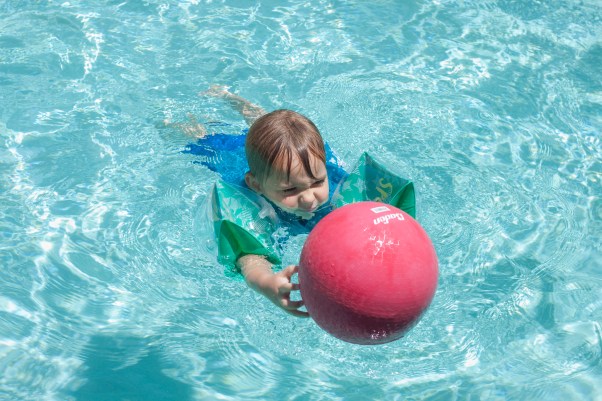
Being present means getting to cheer Limerick on when he chases a ball around the pool and finally manages to grab it, instead of staying oblivious to his persistence and success.

Being present means laughing when Rondel jumps into the pool and totally soaks me with the splash, instead of perceiving it as an interruption of my more important business.

IMG_9429

Being present means noticing how Limerick observes and investigates the world around him, constantly soaking up knowledge with his thirsty pattern-loving mind.

And most of all, being present means mutual openness, a sharing of happiness, and a fostering of love. Yes, I need space and time alone – but when I am with my kids, I am going to try to be fully present as much as possible.


If you liked the quote from Differently Wired, read my brief review of the book here and check back in June for the giveaway!

Also, check here for a list of some awesome pre-order bonuses you can receive for no additional cost if you order the book before June 12th!

Posted in family life, sqt

{sqt} – our random happenings

For the quick takes link up this week, some moments and thoughts that were really too small to make up a whole post on their own 🙂

  1. As Aubade grows older, her relationship with Limerick is really beginning to flourish and deepen. He took a while to adjust to having a younger sibling around, but recently he has taken on the older brother role more consciously. If he sees her lying down he will lie down next to her and snuggle; if she is playing with something he will join her; if she is struggling with something he will try to teach her or help her. He will also tell me how cute she is and how much he loves her, and will describe to me all the things she does that make him laugh. She in turn follows him around, wrestles and dances with him, randomly comes up and hugs him, and wants to play with everything he is playing with.

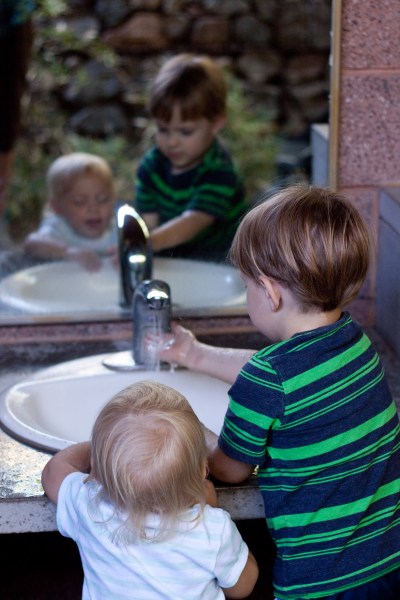
    IMG_9361
    Aubade and Limerick using an automatic sink, backs to the camera, faces reflected out-of-focus in a mirror behind the sink
  2. Non-toy items are apparently the best things to play with these days. Currently, all the forks are spread out on the kitchen table as a herd of fork monsters. They use their long sharp teeth to fight each other to establish dominance, I’ve heard.
  3. Limerick has a significant dislike for shoes, which is somewhat inconvenient now that the pavement is too hot to touch every afternoon. He has one pair he will tolerate when necessary but he takes them off every chance he can find (such as at the zoo, until a zoo volunteer told us it was against zoo rules).
    IMG_9388
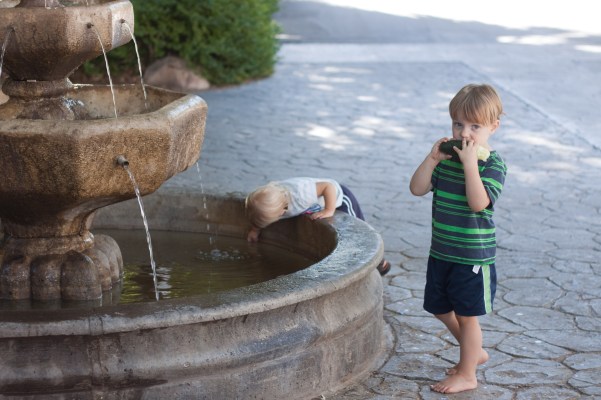
    Aubade is leaning into a large stone water fountain; Limerick, next to her, is looking at the camera while taking a bite out of a cucumber.

    Also, he likes to eat cucumbers like most people eat apples. I’m not going to try to persuade him otherwise!

  4. Rondel’s hair is so long. As in, almost shoulder length! I’m going to be sad when he finally asks to have it cut, I think.
  5. Our anniversary was this weekend! Seven years so far, with four homes, three kids, two jobs, and one degree along the way. We celebrated by having dinner as a family and spending most of it apart with one of us handling a meltdown and the other feeding the two remaining kids. How is that for real life? We are planning on doing something together when my parents are available to babysit, however 🙂
  6. I should not be allowed to go shopping on my own with the kids: I can’t resist when they ask for certain things. In other news, we now have a child-sized floating stuffed turtle that can double as a pool raft that will be living (and swimming) at Grandma’s house…
  7. A couple nights ago I was putting the boys to bed and they both plastered themselves up next to me, to the point where I started to feel panicky. Little kids have high physical touch requirements, and that can definitely be hard for me sometimes. But at other times I think to myself, when will I ever again have the opportunity to give and receive so many hugs and kisses and snuggles every day? And the spontaneous exuberant hug of a toddler is hard to match.

Head on over to This Ain’t The Lyceum for the rest of the {sqt} link-up today!

Posted in family life, musings

love

Love is such a difficult thing to describe; it is impossible to quantify. Rondel and Limerick have been attempting to articulate how much they appreciate or enjoy something by telling me they love it “even more” than they love something very special to them, including people (so one would say he loved Grandma more than Mommy, and the other one would state the opposite, or they would say they loved a new type of popsicle even more than swimming). They have also asked me a few times who I loved the most – talk about a question with no right answer!

What I’ve been explaining to them, and how I answered their question, was that I love all of them in different ways, because they are different people and our relationships are likewise different. I love them all just the same amount, but it looks different; in a sense, my love for each of them is a different color, but each color blazes with the same intensity, beauty, and brightness.

If they asked me which color represented my love for each of them, this is how I would respond…

Continue reading “love”

Posted in family life

holding open doors of possibility

Rondel loves the zoo. I think he would want to go there almost every day (some days have to be for Grandma’s house) if possible, and he never wants to leave no matter how long we’ve been there. There are always more animals to see, more wonders to explore, more facts to learn. As much as he enjoys the splash pad, he always asks to see another exhibit instead, despite the heat, until I mandate a water break on behalf of his siblings.

So I thought to myself, I wonder if the zoo is doing any summer camps? Rondel will probably still be too young, but I can still see what’s available. Blithely thinking these things, I went onto their website and discovered that Rondel is not too young by any means, and would be eligible to attend a half-day camp focusing either on animal stories or animal art.

Part of me leaped up in excitement! He loves the zoo! What a great opportunity! How awesome would it be to get to spend that much time at the zoo, talking about animals, looking at animals, surrounded by people who also love animals! What a chance to try to integrate with a group of peers, in an environment without a parent, to stretch his comfort zone and expand his social skills! And oh… what about dealing with loud groups, bright sunlight, the challenges of speech articulation delays, and the anxiety of the unknown? This is, after all, the boy who struggles in a typical Sunday school classroom even with a personal aide, and the boy who cries at the park if he turns around and can’t see me – even if I haven’t moved from where he left me. Would a summer camp be an adventure or a nightmare?

My husband had the wisest words about this dilemma, about the dichotomy between excitement and fear: that if we, as Rondel’s parents, make a decision for him based on our fears of what might happen, based on what we think his limitations and struggles might be, than we are placing that limitation on him instead of giving him a chance to grow and soar and potentially surprise us all with his abilities. We would need to plan well for it, obviously, to give him the best possible chance to succeed and to give him a way out if it proved to be too much, but it would be foolish – especially in the long-term – to simply close this door because we fear he will fail.

It reminded me of a passage from (you guessed it!) Differently Wired. (Reber really seems to have covered everything. I promise I didn’t begin writing this post trying to sneak a quote in!)

“Choosing fear equates our child with their diagnosis, rather than seeing them as creative beings who are here to shake up the world in their own magnificent way. Choosing fear is the very thing that keeps us stuck. Choosing fear creates a culture of apprehension and anxiety in our families, and affects the way our children, many of whom are already highly sensitive and anxious, feel about themselves. Operating from fear leads to more limited thinking and fearful energy, which both we and our child will feel, and less chance of our child’s uncovering and experiencing their extraordinary possibilities. It’s the epitome of a self-fulfilling prophecy.”

Instead of choosing to direct my child away from opportunities and experiences because I’m afraid they’ll be too hard for him, I am choosing to present him with the options and let him come to his own informed decision – and then, I am choosing to support him through the results of that decision, even if they prove to be difficult or unpleasant. That is the process that will help him grow in self-awareness and confidence, that will help him develop autonomy and independence, and that will therefore help him grow into greater possibilities instead of holding him back in a box created by my own anxious and limited imagination.


If you liked the quote from Differently Wired, read my brief review of the book here and check back in June for the giveaway!