Posted in information, musings

quack quack: my autistic duck analogy

Whenever my husband and I talk with people about autism, or describe some of the behaviors and traits that are related to it, someone will inevitably identify with one or more of those behaviors and joke about how they must be on the spectrum too. As another logical conclusion would be that autism is an exaggerated or imagined condition, I am glad that no one I know has used their identification with an autistic trait as an opportunity to disbelieve the existence of autism! However, the situation is common enough that I’ve been searching for a good way to illustrate the difference between having one or more common autistic behaviors and actually being autistic.

An infographic from Little Black Duck (an Australian company specializing in autism communication services) uses the analogy of pregnancy: someone might have some of the symptoms that are commonly associated with pregnancy, like sore feet or nausea or weight gain, without actually being pregnant – there is a different underlying cause behind the similar or even identical presentations.
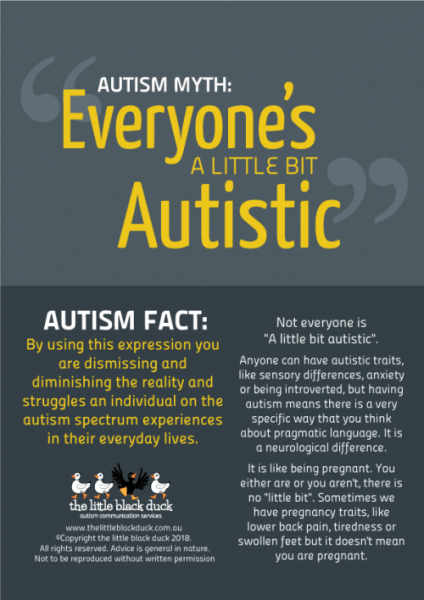
everyonesautistic-500x708

I think this is a helpful analogy for the most part, except for the fact that autism as a condition is defined by the presence and degree of certain types of behaviors. Pregnancy is very clearly distinguished from non-pregnancy by the presence of a fetus; there is no such clear-cut biological test to distinguish the autistic mind from the allistic mind. Those very human behaviors that present in both autistic and allistic individuals are the only metric used in making the diagnosis, and the line is drawn at a somewhat subjective conjunction of multiple co-occuring traits and the severity thereof.

To me, the clinical struggle of defining the autism spectrum seems similar to the zoological struggle of defining a taxonomical species. Perhaps a duck could be defined as a warm-blooded, egg-laying animal with wings, feathers, webbed feet, and a broad bill. A seagull could relate to many of these duck traits, but not having all of them would fall short of the official criteria. A bat or a snake or a duck-billed platypus could relate on a more distant level, while a moose or bear would struggle to understand the duck at all save from an external perspective.

Likewise, some people will relate to the social anxiety many autistic people struggle with; some people will identify with sensory sensitivities; others will connect with the difficulties of small talk and nonverbal communication. People with other neurodifferences, like ADHD or FAS, will probably have more behaviors in common with autistic people than the general allistic population will, but like the seagull will fall short of the official criteria for the diagnosis. On the flip side, some people will lack almost all of the autistic traits and behaviors, and struggle more to bridge the differences between them and their autistic family and colleagues. But just like ducks are still animals, and all of their characteristic traits are shared (individually or in sets) by some species or another in the animal kingdom, so too autistic people are still human, and all of their characteristic traits can be found scattered throughout the general human population. It is only when all those traits converge that a duck is defined, or autism is diagnosed.

Now I just have to wait for a conversational opportunity to use my new analogy 🙂 What do you all think? Does it make sense? How do you try to explain the difference between autism as a neurotype and commonly seen autistic behaviors?

Posted in family life

lizard love!

We are now officially pet owners!

Rondel had been asking us for months when we would get an animal of our own (seemingly taking it for granted that someday we would), and slowly things fell into place for us to be able to buy a pair of green anole lizards. Rondel and I talked about different types of animals and researched how to take care of them; Paul took him to pet stores to see the animals in person; and so we settled on lizards as an acceptable option. Paul found a tank and lamp at Savers; Rondel made a hide from a wooden puzzle box; I watched YouTube videos with Rondel about setting up the tank so the lizards could be comfortable and safe.

And finally, after days of Rondel asking us when, when, when? – we finally brought them home.

Aubade and Rondel were immediately entranced with them, pulling up chairs by the bookshelf and watching them explore their new home (it looks a bit bare in these first few pictures, but we’ve since added more vines and climbing sticks).

After a few days of helping them to adjust, and the addition of twenty little crickets to the tank (buying those at the pet store was definitely a new experience for me… the employee just reached into this big bin of crickets and started shaking them into a bag and they were hopping everywhere!), Rondel was able to hold them, one at a time, to his great delight. While the lizards were not sure about being handled at first, they seem to have become a lot more comfortable with Rondel, and he is definitely comfortable with them. He asks if he can take them out at least 3-4 times every day, and plays with them longer and longer each time. At this point he is able to gently lift one from the tank (I remove and replace the cover), remain calm and gentle while letting it climb all over him (he’s getting good at directing where they climb, also, though they both still try to get to the center of his upper back when they can), retrieve it if it hops off of him onto the floor, and gently return it to the tank when he is done.

I am greatly impressed.

He also keeps an eye on the temperature and humidity gauges, and knows how to mist the tank through the cover if the humidity is below the recommended range.

In short, especially for a five year old, he is showing himself to be quite responsible and very natural with the lizards… and he has already started asking when we will get more animals! If things go his way we will end up living in a zoo – and he would be such a happy little person, so I suppose more animals will be inevitable at some point. But for now we will just enjoy these two green additions to our home.

Posted in family life

picky eating, oral stims, and anxiety

Rondel is not exactly a stereotypical picky eater, but he is quite particular when it comes to food, for clear sensory-related reasons. Texture and temperature are probably the most important aspect of a food for him – his favorite foods tend to be either frozen or in the dry-to-crunchy range. So he can be quite happy eating some tortilla chips (sometimes he’ll tolerate them with melted cheese) alongside a bowl of frozen mixed veggies, he loves toast and frozen blueberries for breakfast, he prefers crackers to fig bars, he only enjoys chicken nuggets if the outer coating isn’t at all “mushy”, and he won’t eat any fresh fruit at all (except perhaps melon in the summer or pear in the fall) after having decided his primary previously acceptable fruit (apple) made his mouth feel funny. He will eat noodles and potatoes in moderation, but not consistently. Mexican refried beans and rice are acceptable, but runnier beans and rice dishes (I have a few really good ones) are not. I don’t think he has ever consented to eat soup or oatmeal, and the thought of sweet potato or avocado is enough to make him emotionally upset. Also, having a favorite food to accompany a merely tolerable one seems to help by resetting or calming the tactile receptors in his mouth.

I had never really given much thought to picky eating prior to having kids, because I tend to be a more adventurous eater, but I am realizing now that I have my own sensory quirks. I heavily prefer foods where each bite will have a variety of textures, or where the level of spiciness is enough to leave a burn, or where dedicated chewing may be required – so in a peanut butter sandwich I will use crunchy peanut butter and orange marmalade and toast the bread if at all possible; I attempt to make even normal bland foods more bold by adding extra seasonings (cayenne in the mac and cheese, double the recipe’s amount of every single spice for spice cookies); and I enjoy fairly tough meat but can only rarely handle creamy soup.

The appearance or smell of a food can also cause an overwhelming or challenging sensory reaction. Rondel reacts quite strongly to anything that looks mushy or gooey (like yogurt or banana); I recoil from unevenly bumpy foods (I avoided looking at peeled bananas for at least a year as a child). Rondel can be bothered by the smell of the food other people are eating or even by food that he enjoys eating (which I have only observed in myself during pregnancy – I notice smells quite well but am not usually bothered by them), but we’ve found that lighting a candle on the table makes things significantly better for him.

Interestingly enough, I have also recently noticed that eating painfully spicy food actually helps lower my anxiety levels, and temporarily decreases my reliance on other stims. I’m guessing it is similar for Rondel, and may be part of why he’s been a bit pickier and more wild lately as we are out of both tortilla chips and frozen blueberries. It makes me wish some of his earlier oral stims were still helpful for him – he had been able to translate overt licking of his hands and arms into chewing a wooden necklace, and it made a big difference for him in more stimulating environments especially – but he hasn’t shown much interest in them since this summer. I was beginning to think he would take after my grandmother, who still surreptitiously chews on her hands to stim! And who knows, maybe he will 🙂 in my experience, stims can ebb and flow over time, even if some are more enduring or central.

In the meantime, we’ll keep on freezing our yogurt into creamy cold dots, stocking our house with plenty of whole-grain bread for toast, lighting our candle at dinner, and continuing to try new foods in hope that some of them will cooperate with his unique blend of sensory cravings and aversions!

Posted in family life

aubade’s second birthday

It’s hard to lose the habit of calling one’s youngest child “baby”, I think. The older siblings protest as they grow, and the name passes on to the younger ones – but it holds on more tightly when there is no one to take up the mantle.

Still, now that Aubade is two, we don’t really have any babies in the family anymore, no matter how much we still call her our baby.

img_4303

At two, Aubade is hitting a verbal growth spurt, leaping from the occasional echoed two-word phrase to consistent spontaneous three and four word phrases – linking words are still a challenge, but her vocabulary is expanding exponentially. She has always been adept at communicating her thoughts, and it is so fun (and often amusing) to watch her incorporate language into that communication more and more.

Far more than either of the boys, Aubade has developed an attachment to certain toys (a few stuffed animals and a few hard rubber animals, alternating depending on her mood and the demands of the situation) and an affinity for choosing her own clothes. To be honest, she’s enjoyed selecting her own outfits for at least a year now – but at this point she likes clothes enough that she considers them birthday presents worth getting excited about. She even has a hierarchy of favorite pajamas… as she was telling me when I asked her what she wanted to wear, “bear jammies dirty… food on it. puppy jammies dirty… food on it. firetruck jammies!” (She did not have food on her dirty pajamas, but that is her current understanding of why clothes need to be washed. Wearing something for two consecutive days and nights apparently doesn’t count if you haven’t covered it in food…)

She loves to be held but she also loves to climb on your head and flip upside down in your arms; she pulls her brothers all around the house but also loves to find herself snuggled up with them, and never goes to bed without making sure to give them both a goodnight hug.

img_4280

She wants to do everything her brothers can do, and do it all by herself, and she has perfected the sideways glare, the downwards pout, and the backwards flop to use when she isn’t allowed to do something she wants. Also the persistent requesting of the thing desired, with perfect confidence, until you start to wonder why you aren’t just doing what she wants after all 🙂

She loves fiercely and plays fiercely and fights fiercely, all over tooth and claw and growls and pouncing possession of all things good and desirable as hers.

img_3754

She gets very enthusiastic about something for a short time, then moves on to the next thing – she doesn’t have the deep and lasting interests that the boys had even at this age, but rather roams widely over a variety of objects and activities. Limerick, for example, was happy to sit still on a three hour airplane flight with a magnet board drawing letters before he was even two years old; Rondel could spend hours talking about cars; but Aubade needs to be able to move, mostly, and to have a range of toys (or other medium-sized things) to move around with her. I think that means she is a typically developing two-year-old and that we have nothing to be concerned about!

img_4318

When she gets excited about something, she wiggles side to side in a manner slightly reminiscent of a satisfied feline. She will pretend to cough or laugh just to make other people laugh at her, and she has a smile that is almost a smirk that she flashes just for the answering attention of a smile in return. Far more so than the boys, she is tuned in to the people around her, seeking out eye contact and thriving on back-and-forth interactions, copying social behaviors and imitating types of play.

img_4308

But more than anything else? She is light and laughter, the flashing energy pulse of our family, the multiplier of our love – her very own self, just beginning to take on her own unique shape and form, unfolding in bright bold colors like a sudden grin or the brilliant burst of a firework.