Posted in autism acceptance month

stims!

This post is part of my april autism series for autism acceptance month. Visit the first post here for links to the rest of the series!

Before we began Rondel’s diagnostic process, I had never heard the words “stim” or “stimming” – so I’ll assume it’s new to a lot of you as well.

“When we feel an emotion or a collection of emotions very powerfully, stimming can help us manage these feelings without overloading. Often emotions like sadness, anger, or anxiety will prompt stimming as a way to both experience these less pleasant emotions while also keeping our cool.” – The Stimming Checklist

Essentially, a stim is a behavior that provides sensory, social, or emotional regulation to a person. Some of the most familiar (or stereotyped) stims among autistic people are hand flapping, rocking, and head banging – but to stop at those would be extremely limited and inaccurate. The Stimming Checklist has accumulated over 1400 different stims from user submissions (although some are essentially repeats as people submitted different wordings of the same behavior, there are still a lot), just to give you an idea of the diversity and range of stimming behavior! They also give a more detailed description of what stimming is and why people may stim, including the above quote about stimming for emotional regulation.

IMG_5281
From the Ausome Cork facebook page: 8 Functions of Stimming

My most reliable stim is skin picking. It can be embarrassing at times, since my upper arm is dotted with scars and scabs, but in the moment it is less noticeable than something like hand flapping (or running away screaming, lol), so I keep doing it. The sensation of it helps to alleviate almost any kind of tension, and also helps me stay focused on something if my thoughts are wandering (maybe by occupying the part of my brain that would otherwise be distracting me!). For example, if people around me (or even in a movie) are arguing and saying hurtful things, even if they are sarcastic or joking, I will start to pick to help calm down my physical reaction to the emotional turmoil I’m sensing around me. On the other hand, I’ll also pick if I’m bored and can’t do anything because I’m stuck waiting somewhere.

Hand flapping and deep breaths with loud exhales are stress-reducing in the way that pushing down the valve of a pressure cooker reduces the internal pressure – they cut out a lot of tension very rapidly but in a very dramatic manner – and I tend to only stim that way in the privacy of my own home. In class or other lecture-type environments, I write (notes, thoughts, or the alphabet), calculate irrational square roots by hand, draw geometric designs on grids, play games on my phone or laptop, or else generally become unable to sit still or pay attention due to my mind wandering off into some far off land and my physical tension steadily rising.

While stimming behaviors may appear strange or odd on the surface, therefore, it is important to understand that they can play a significant role in the life of an autistic person, as I am hardly a unique or extreme example. Trying to force someone to stop stimming altogether is going to be harmful in the long run: it will deny them access to some of their coping strategies for sensory overwhelm or emotional stress, and force them to spend significant amounts of energy and focus on holding in their stims at the expense of other things.

“If anything, stimming improves my concentration. It’s a release, like sneezing or scratching an itch. Have you ever tried to ignore an itch? What if someone told you it was wrong to scratch yourself to relieve an itch? What would that do for your concentration?” – Cynthia Kim, Musings of an Aspie

However, not all specific stims are healthy, no matter how helpful they may be in the moment. My skin picking certainly falls into this category, as does any other self-injurious stim. In these cases it is worth the effort to find a replacement stim, if at all possible (I haven’t found one for myself yet), and it is emphatically better to consciously redirect towards a positive replacement stim than to simply try to eliminate the damaging one. Without that deliberate replacement, it is likely that an equally unhealthy stim will take over instead (for example, I tried to stop picking my arm last year and ended up creating sores all over my legs. Not helpful at all, that.) So if I ever figure out a good strategy for finding a replacement and making it stick, I’ll be sure to update you…

Do you stim? What do you do and why? Does someone you know? What do you think about it? It’s ok if it seems weird 🙂 – I sometimes think my own stims are weird even though I know why I do them and how it helps me!
 

Posted in autism acceptance month

seven challenges of autism

This post is part of my april autism series for autism acceptance month. Visit the first post here for links to the rest of the series!

Yesterday I shared seven highlights of being autistic; today I’m sharing seven challenges. It would be dishonest to imply that autism is without struggle – that it is a purely neutral neurological difference – and it would make advocating for necessary supports far more difficult. We have to acknowledge what our problems and needs are before we can ask for help or expect others to recognize our challenges, after all.

  1. Social communication deficits
    • This is part of the diagnostic criteria for autism, actually. This is all the awkwardness and unusual behavior and missed cues – the differences in posture or gesture or volume that make a person stand out, or the more subtle tells of anxious fidgets and poorly timed laughter. This is being 13 and hurting a family member’s feelings because you didn’t appear grateful for their Christmas present, and being totally confused about it because you thought you had done everything right. This is being in high school and having a peer tell you that you really ought to look someone in the eye when having a conversation – and then learning to focus on people’s noses instead, so well that your psychologist doesn’t realize that’s what you’re doing (this may be part of why I like large and distinctive noses 😛 ). This is laughing with everyone else even though you didn’t understand the joke, or laughing at statements that no one else finds amusing. This is forgetting social scripts because you’re just so excited about something, and jumping right into the topic without the formalities of the greeting first. This is mistiming the breaks in the conversation and either cutting people off before they’ve finished or pausing too long and making them think you’re tuning out. It looks different for everyone, but it is always present and it takes a toll; even if you can play the part most of the time, it can be extremely draining, and when you can’t act that role you risk stares and stigma.
  2. Sensory sensitivities
    • This can also be a major struggle for many (most, probably) autistic people. Noises (even at normal volumes) can be physically painful or excruciatingly uncomfortable, as can certain smells. Textures – as relates to both touch and taste – can be incredibly important. Rondel cannot tolerate the texture of foods like banana, avocado, and sweet potato, for instance, and craves very cold or very dry foods instead. Touch can be very overstimulating; for example, we were releasing ladybugs and while the kids were letting them walk all over their hands, the feel of their feet on my hand made my whole body tense up and lingered for hours after the fact. While every autistic person is going to have different sensitivities, it is fair to assume that all of us will “overreact” to some sensory input in potentially unexpected ways – and it’s just the way our minds and bodies work together.
  3. Language development
    • Many autistic people struggle with some sort of language impairment; autistic speech ranges the full spectrum from non-verbal to completely fluent, but even the most verbal individuals tend to show certain idiosyncrasies. Some autistic individuals use assisted communication devices to help express their thoughts and feelings in words when they can’t do so verbally. My friend’s son can speak a limited number of words and phrases (always increasing!) that he uses to express a large range of questions and comments. Rondel began speaking rather earlier than normal, but his speech was very difficult to understand and his grasp of pronouns is still shaky (he refers to himself in second person, especially in emotionally charged environments). I used to have fairly significant echolalia, and would repeat whole sentences or the final few words of a sentence after speaking (I remember doing it quietly for a while, and then just in my head eventually. At one point my mom told me that she had considered taking me to a professional about it when I was little, but it tapered off on its own). Language abilities are not an accurate indication of an autistic individual’s intelligence or communicative desire, however. Amy Sequenzia is an excellent example of a person who, despite not being able to speak, has intelligent and powerful thoughts and ideas to share – she just uses the written word instead of the spoken word to do so.
  4. Rigidity (discomfort with uncertainty and change)
    • An autistic person doesn’t necessarily have a rigid schedule for each day which must be followed down to the time at which they use the bathroom – that’s a bit of a stereotype. But routines are most certainly a source of stability and thus of comfort, and it takes some time for the autistic mind to recalibrate when those routines are changed. Just today, for instance, I had to do bedtime with all three kids on my own, so I brought Aubade’s bed into the boys’ room and talked all afternoon about how we were going to have a sleepover and I would be snuggling with Aubade so I’d still be in the same room as the boys. When bedtime actually came, however, and the normal routine was altered by the fact that I was on Aubade’s bed rather than one of theirs, Rondel couldn’t handle it. He became angry, defiant, argumentative, and so keyed up that he couldn’t stay still or quiet, until he left the room for a bit to rage away his discomfort and adjust to the changed circumstances. I have found that for both myself and Rondel it is best to have a clear idea the night before (or at least first thing in the morning) what the general plan will be for the day, so that I’m not setting up expectations to be unmet, and to be honest and patient when plans do have to change.
  5. Anxiety
    • When I spoke with my psychologist on Thursday, she mentioned in passing that anxiety is such an assumed aspect of autism that not all clinicians even bother to mention it separately on a diagnosis. I always, always thought anxiety was normal. I didn’t realize until adulthood that most people don’t feel sharp pain in their chest after every significant social event (like an evening spent with a date), or have to do breathing exercises before making a phone call, or go through life with a generalized fear that they’re going to make a mistake and ruin everything, or scratch their skin until it bleeds to keep the nervous tension manageable. I didn’t even know that all of that was called anxiety until my youngest sister was diagnosed and I found myself trying to explain it to our middle sister… it was just how life was, for me. And apparently that’s how it is for most autistic people; according to Chris Bonnello’s 2018 autism survey (with over 11,000 responses), about 60% of autistic people struggle with anxiety disorders – it was at the top of the list of co-occuring mental health conditions.
  6. Intellectual impairment
    • This isn’t a side of autism I’ve personally experienced, except potentially secondhand though my friend’s son (although it is hard to tell because of his language delays). But according to the scientific literature at least half of all autistic individuals are also intellectually impaired, and in clinical terms this is the dividing line between “low-functioning” and “high-functioning” autism (I’m aware some people dislike these terms for their over-simplification and potentially demeaning tone, but as they’re used in the scientific literature it’s helpful to know the definition of the terms in that context). Autism advocacy that ignores this half of the autistic population is thus woefully incomplete! And this is definitely a challenge, given the unreliable quality of special education in the schools and residential support for adults. These people are at the highest risk of being abused, neglected, or taken advantage of, and it is important for society as a whole to realize that having less intelligence – just like having poorer social skills! – does not make a person less deserving of dignity and as much autonomy as is feasible.
  7. Emotional expression
    • Emotions can be terrifyingly treacherous for autistic people. They can be devilishly difficult to decipher, acutely uncomfortable to witness, and extremely explosive to experience. I find myself trying to share with Rondel the same lessons I had to learn about the anger that tries to take over, and empathizing with the overwhelming strength of those volatile emotions (I still have them after all – I’ve just learned more coping strategies by now). Some of the scenes in movies that are most moving to my husband are intensely horrible for me because of the raw and visible emotion involved; I can engage more fully with the character’s emotion if it is diluted or filtered somehow, like through the written words of a book or animation and scripting aimed at a younger audience. Otherwise it is too overwhelming. Similarly, I struggle to talk verbally about things that are important to me (or things that have a lot of anxiety wrapped around them). Both my mom and my husband have at different times in my life maintained a joint journal where I could write down things I needed to express and communicate and receive written responses without the anxiety-ridden emotional tension of a face-to-face conversation.

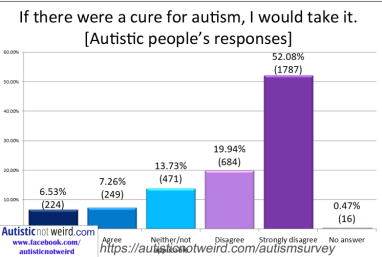
Every autistic individual struggles with different challenges, and these are just a few of many. I didn’t touch on the existential loneliness of feeling disconnected and different and left-out; the low employment rates of autistic adults; the common physical co-morbidities associated with autism; or the ever-present mask and concomitant imposter syndrome. But I think it is important to share another finding from Chris Bonnello’s survey: that of all his autistic respondents, less than 15% would take a cure for autism if it existed.

cureforautismsurveygraph

Challenges and all, autism is a part of our identity and to remove it would be to fundamentally change who we are. Instead of trying to do that, let’s acknowledge our differences and struggles and design (or improve, or strengthen) the societal supports that will allow autistic individuals to flourish and thrive in their own unique way.

Posted in autism acceptance month

seven awesome things about being autistic

This post is part of my april autism series for autism acceptance month. Visit the first post here for links to the rest of the series!

Because autism is still seen in a largely negative light, I thought I’d cover some of the positive aspects of being autistic before addressing the challenges associated with it (you can come back tomorrow for that side of the coin). And since today is also the {sqt} linkup with Kelly, I have seven positive autistic traits listed here!

  1. Systems-oriented thinking and pattern recognition
    • “Autistic systems-oriented thinking, developed to its fullest potentials, means insight into the rich depths of underlying patterns and structures, the beauty of the deeper levels of natural order beneath surface realities, the beauty of the Tao.” – Nick Walker, “Autism, Aikido, and Systems-Oriented Thinking”
    • This is probably the defining characteristic of my method of approaching the world. I strive to organize the data I observe into systems and structures and patterns, always editing them to encompass more complete datasets, always delighting in each new connection and relationship I can find. As a kid, it meant I was quite good at games like Set (which is all about patterns), and loved exploring the grammatical structures of language and the mathematical patterns of numbers. In school, it meant I was able to assimilate information from different classes into a cohesive whole, giving myself a strong network of data to pull from for tests and projects. At work, it means I’ve spent a lot of my time learning database science on the side to help my team process and record information more efficiently, to pull out the patterns and connections between the datapoints we need to store. And personally, it means I never settle into one philosophy of life – new information can always shift my internal understanding of the structures of reality, hopefully into a more accurate conformation 🙂
  2. Sensitivity to beauty
    • Increased sensory sensitivities, while definitely a challenge at times, can be accompanied by increased awareness of and sensitivity to beauty in the world. This could be natural beauty: the still blue of a cloudless sky, or the undulating mist off a waterfall; it could be artistic beauty: the throbbing pulse or soaring heights of instruments that express emotion we could never put into words; it could be the small and unnoticed details of life: the scent of rising bread or the sweep of curtains blowing in the wind. Just as we can be inordinately bothered by sensory inputs most people don’t notice, so too we can see and be awed by the beauty of things most people don’t notice – like the texture of a piece of fabric, or the feathers on the back of a moth.
  3. Powers of observation
    • This is connected to the first two traits, obviously: good observational skills are needed to create useful systems for understanding the patterns of reality, or to find beauty in the details that often escape attention. It makes a lot of sense in light of the definition of autism I shared here earlier also – if the autistic mind is taking in more information more intensely than the neurotypical mind, it’s going to be able to observe more details. Rondel notices all the bugs around him wherever he goes, and pays attention to the shape of their bodies and the patterns of their color; when he wasn’t even two, he was able to figure out the make (and often model) of a car by paying attention to the details of its shape and design. A friend at church notices the relationships between the people around him, putting together the connections of family and friendship in his mind even though he struggles to articulate them verbally. I was apparently able to see instantly if something had been changed in a room when I was a very young child. The details we observe may not always be particularly useful, but our minds are thirsty for them, hungrily seeking out the information around us to store away inside.
  4. Honesty and Loyalty
    • Many autistic people are highly uncomfortable with untruths. As the author of the blog An Intense World says, “It’s not that someone with autism cannot lie. I can lie… [but] when I lie, it really, really, really, really, really bothers me. It’s like a deep brain itch I can’t scratch. So I don’t lie. It just bothers me too deeply, and I’d rather not be that uncomfortable all the time.” I’ve found that I can tell incomplete truths if absolutely necessary, but even that is difficult to do – part of me wants to provide all the information involved so the communicated picture is accurate.
    • Many autistic people are also highly loyal. While autistic individuals may not form many attachments, the ones we do form are deep and lasting. I can see this already in my son: while he has normal conflicts with his siblings, he has equally as many conflicts with me because he identifies himself so strongly with his siblings that he is ready to fight for them if I reprimand or correct them. As Cynthia Kim writes on her blog Musings of an Aspie, “My attachments to people are few, but when I do form a bond with someone it’s a strong one. I will stand up for the people I care about in the face of a great deal of opposition.”
  5. Creativity and Unique Problem-Solving Skills
    • Autistic people see the world differently – so the things they create and the solutions they envision are also often a bit different! In my personal life, I see the unique style and form of my sister’s poetry and other creative writing; the way a child with severe speech delays at my church is able to communicate his thoughts through actions and echoed scripts; and the endless repertoire of “games” my son designs to explore his interest in the animal world and include his siblings at the same time (not to mention his eye for three-dimensional representation of said animals). When I was in high school volunteering in the children’s ministry at my church, a young boy who was later diagnosed with Asperger’s (part of the autism spectrum) noticed the folding table wiggling one week, crawled under the table, and proceeded to analyze the joints until he’d discovered multiple potential causes and tried to fix them. And he was only five!
  6. Deep or abstract thinking
    • Rondel asked me the other day why Jesus needed the disciples if He is God and can do anything. He asks me if God can know what we are going to do before we do it, and how that works, and seems to understand the answers I give him. He wants to know how high you can go before the air ends, and why the earth holds the air to it, and what exactly gravity is. He asks me if I will always love him, and why, and how I know that I will, and the answers give him peace when he’s recovering from a struggle with his more negative impulses. Autistic people usually don’t have much “common sense”, but our minds like to explore the deeper questions of life, and we are often able to separate facts and ideas from their social context to examine and compare them on a level field or in a new context.
  7. Expertise (and special interests!)
    • When the autistic brain gets excited about something, that thing becomes rather all-encompassing. We can spend hours a day for months or even years absorbed in the thing that is so fascinating to us – and as a result, we can accumulate some serious expertise in those areas! Rondel is a good example of how this can look in young children. His first special interest was vehicles, and as I noted above he was a master of vehicle identification at a ridiculously young age (I once asked him if a particular car that he’d told me was a Mazda was a Mazda 5 or a Mazda 3 hatchback and he knew the right answer without hesitation…). Next came dinosaurs, when he learned so many different species of dinosaurs that his grandparents were amazed (and often emphatically corrected!). Now that animals are his primary focus, he can talk for hours about the characteristics of different animals, the interactions between them, the environments they live in, and so on. By the time an autistic person reaches adulthood, they’ve cycled through quite a few of these interests, providing themselves with a solid network of information to build upon for the next one (or for more mundane things like work). And even in areas that are not special interests, autistic skills in observation and pattern recognition can lead to the development of expertise, as I’ve found in my own work environment.
    • Beyond the usefulness of expertise, of course, special interests are a source of pure joy. Rondel is so happy when his mind is full of animal facts and stories and experiences, and he’ll engage with anyone available about the topic. I am so happy when I’m reading Harry Potter fan fiction (my current most embarrassing interest) that I struggle to stop reading and do anything else, and if someone is willing to listen I can share all my favorite theories and plot lines and alternate universes until they manage to escape. It is satisfying in a profound way to plunge into the depths of something and discover the hidden treasure within, to block out the overload of information from everywhere else and really seek to know one specific category of things. And experiencing that joy is one of the most awesome things I can think of about being autistic.

If you are autistic, what is one of your favorite things about it? If you have a friend or family member who is autistic, what is one of your favorite things about them that stems from the fact that they are autistic?

Posted in autism acceptance month, information, quotes

the autistic operating system

This post is part of my april autism series for autism acceptance month. Visit the first post here for links to the rest of the series!

I still remember the first time I heard of autism, although I don’t remember exactly how old I was (I think I was younger than 10). My dad was talking about one of his coworkers who had twins, telling my mom that while one of the children was developing normally, the other didn’t speak and liked to watch objects spin instead of playing with them in a typical way. My major impression was that autism was a sad and life-ruining thing (probably because my dad said it was sad), but I didn’t really understand what was so wrong about this little boy’s way of being and developing. In hindsight, I think this was the first time I realized that there was a “normal” way to be and that there could be something wrong about being different.

In the years since then, I’ve learned a lot more about what autism actually is: not a spectre of damaged children unable to connect and interact as humans, but a different neurological operating system that manifests in a fairly consistent range of behavioral patterns. Interestingly, these behaviors do not include either intellectual or language impairments, although both of these can present along with autism in an individual. Instead, autistic differences center around areas of social communication, sensory processing, and cognitive focus (including executive functioning). Autistic development is not necessarily disordered – it just proceeds on a different timeline than normal. Autistic ways of thinking, of processing sensory information, of handling emotions in the self and others, are not broken – just different.

The medical definition of autism can of course be found in the DSM-V, and I believe it is good to read and understand that definition even if it does portray autism in a pathologized way, but my personal favorite description comes from Nick Walker at Neurocosmopolitanism (go read the full article!):

The complex set of interrelated characteristics that distinguish autistic neurology from non-autistic neurology is not yet fully understood, but current evidence indicates that the central distinction is that autistic brains are characterized by particularly high levels of synaptic connectivity and responsiveness. This tends to make the autistic individual’s subjective experience more intense and chaotic than that of non-autistic individuals: on both the sensorimotor and cognitive levels, the autistic mind tends to register more information, and the impact of each bit of information tends to be both stronger and less predictable. (emphasis added)

Walker puts so much useful information into this paragraph. While lists of common autistic behaviors can be helpful, especially when deciding whether an ASD diagnosis might describe yourself or someone you know, they can often seem disjointed and random without an understanding of their underlying cause (and, I think, can contribute to the common uninformed statement that “everyone is a little bit autistic).

But knowing this central difference between the neurotypical and autistic brain can provide a clearer delineation between the two, regardless of potentially overlapping behaviors, and can also explain many of the strengths and challenges associated with autism. For example, autistic individuals can often have excellent long-term memory and fact recall, as well as higher innate abilities to analyze data and detect patterns – all of which makes sense if the autistic brain is picking up on more information (with more internal emphasis), on a cognitive level, than the neurotypical brain. On the other hand, picking up more information with a stronger impact on the sensory level can make coping with everyday life extremely difficult, when “normal” touch and sound and smell can be acutely uncomfortable or overwhelming.

I’ll be going through more of those differences, both positive and negative, later this week, but for now the important point is that all autistic traits and behaviors stem from a fundamental neurological difference, and that autism, this difference in a person’s innate operating system – in the way they perceive, process, and respond to the world around them – does not make an autistic individual any less in terms of personhood, human dignity, ethical consideration, or worth.

Posted in autism acceptance month, information, links

autism acceptance month

Each April is Autism Acceptance Month.

Not, as some groups would put it, Autism Awareness Month. It’s a different perspective, because it’s coming from a different place. The autism awareness campaigns – like the Light It Up Blue campaign from the notorious organization Autism Speaks – tend to originate from medical professionals and non-autistic parents, people who see autism primarily as a disorder that merits pity and needs to be cured. The autism acceptance campaign, on the other hand, originates with autistic self-advocates (specifically the Autistic Self-Advocacy Network): people who understand autism to be a difference rather than a disorder – a difference that gives to us even as it makes certain things more challenging, and a difference that shapes our identities. To those who advocate for acceptance, considering autism to be a disorder and trying to eliminate it feels like a personal offense.

We are here, say the autistic self-advocates, we are autistic, and we have the same rights and humanity as everyone else. Stop trying to make the way we think and feel and act mirror yours; our autistic personhood is just as valid as your neurotypical personhood.

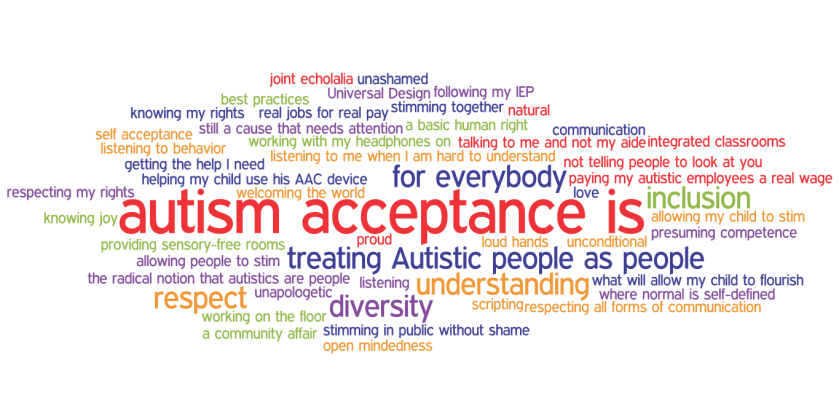
AAMwordcloud3
autism acceptance word cloud from the autism acceptance month website

This year, for the month of April, I have two major goals. First, I am going to spend the month writing about autism from the perspective of neurodiversity and acceptance, both as a (probable/self-diagnosed) autistic adult and as the parent of an autistic child. Second, I am going to pursue an official medical diagnosis for myself (although all the evaluations are in April, I won’t have the final word until May, unfortunately). I hope that you will join me on this journey – that together we can learn more about neurodivergence and how it affects individuals and society, and find ways to accept and love the differences in ourselves and those around us.

I highly, highly recommend that anyone wanting to learn more about autism focus on information from autistic people. Otherwise, it’s as if you’re trying to learn about the African-American cultural experience from a bunch of white authors, or trying to figure out what it feels like to be queer from the observations of the straight/cis community. Non-autistic professionals can give you an understanding of the history of the diagnosis, or the medical definition of the diagnosis, but they cannot tell you what it is like to live as an autistic person. They simply don’t have that inside understanding.

To get you started, here are some of my favorite #actuallyautistic internet presences (some of them are more than just blogs!), in no particular order:

  • Autistic Not Weird, by Chris Bonnello
    • I’ve been following ANW for a long time now, since back when it was simply a blog. Chris Bonnello has a great sense of humor, a lot of stories to share, and an accessible way of explaining technical information. This was one of the first blogs I read that was written by an autistic adult, and finding that I could identify with almost everything he wrote pushed me forward in my own path of self-discovery. The ANW community on Facebook is one of the most inclusive I’ve run across, with autistic individuals and their families asking and answering practical questions honestly and kindly.
  • Suburban Autistics, by Ally Grace
    • I found this blog by searching for gentle parenting tips, actually! Ally Grace and several of her children are autistic, and she writes about parenting in a gentle, accepting, positive way. I am always both inspired and challenged to be a kinder, more compassionate person and parent when I read her work – and to give myself a touch more grace in my own struggles as well. If you are on Facebook, I believe she is a bit more active there than on the blog.
  • Neurocosmopolitanism, by Nick Walker
    • I don’t think this blog is active anymore, but it is foundational in my understanding of neurodivergence. I would quote liberally from his articles except that once I start, it’s hard to stop! So just go and read them in full. Start with Throw Away the Master’s Tools if you really want to understand the mindset behind acceptance as opposed to awareness.
  • The Girl with the Curly Hair, by Alis Rowe
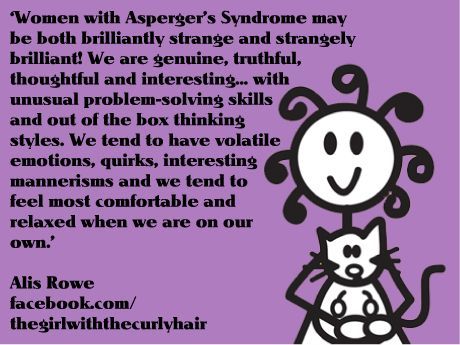
    • This is significantly more than a blog; it is a compendium of resources, especially for autistic women. Honestly, my main interaction with this site has been mediated through Pinterest, where I’ve found so many quotes –  accompanied by the curly-haired girl illustration herself that – resonate with me on a deep level. (In the following quote, keep in mind that in the US the diagnosis of Asperger’s Syndrome has been deprecated and replaced by an autism diagnosis.)
alisrowequote
Quote: ‘Women with Asperger’s Syndrome may be both brilliantly strange and strangely brilliant! We are genuine, truthful, thoughtful and interesting… with unusual problem-solving skills and out of the box thinking styles. We tend to have volatile emotions, quirks, interesting mannerisms and we tend to feel most comfortable and relaxed when we are on our own.’

So for World Autism Awareness Day today, let’s start looking at autism from the perspective of difference rather than disorder, and seek to understand it from the inside out! My challenge for you is to pick one of the websites I shared above and read at least one article from it 🙂 I’d love to hear what you read and anything from it that stood out to you!


all posts in the april autism series will link here after they’re published!

Posted in hikes

hiking with littles: picacho peak

Now, anyone who has made it to the top of Picacho Peak knows that it obviously isn’t a good hike for small children. The trail is steep and slippery, to the point that there are cables drilled into the rock as handholds to prevent hikers from falling – and it’s an amazing trail if you can do it, but there’s no way I’m going to recommend doing it with three kids five and under!

However, Picacho Peak is one of the most beautiful wildflower sites in the state, particularly during a magnificent spring bloom like the one we’re having this year, so we made the drive down to bask in the beauty along all the short interpretative trails around the base of the mountain.

There were so many poppies. The wild golden poppies that grow here are one of my favorite flowers – like a more glamorous version of the buttercups I loved as a child in the Northeast – and when they carpet the ground it seems to shimmer in the sunlight.

There were patches of lupine as well, their deep blues and purples providing the perfect foil to the golden poppies.

One of the shorter trails led up to a small cave overlooking the valley around the base of the peak, and the kids had a lot of fun clambering over the boulders above the cave, as well as stroking the velvet softness of the poppies and delighting in the presence of the wildflowers (as is only to be expected!).

I really couldn’t have asked for a better opportunity to bask in the desert spring. I would definitely and without hesitation recommend Picacho Peak to anyone who is in the state in the month of March, especially if the preceding winter has been on the rainier side, no matter their hiking abilities – there is something for every level here, and beauty to make it worthwhile even without reaching the summit.

There is a $7.00 entrance fee since the peak is a state park, but there are also covered picnic tables, clean bathrooms, a very nice little gift store/information center (with some fun Southwest themed souvenirs and books), and even a small playground, and the trails are well-maintained – so the fees are apparently being used to good effect here 🙂 My only regret is that I have waited so long to come back since the last time I hiked the peak (with my dad, as a teenager, to the top), and I won’t be making that mistake again.

How to get there from the East Valley: There are a few ways to get started, but whether you take the US-60 or the Loop 101 or the Loop 202, you’ll want to end up on the I-10 E headed toward Tuscon. From there it’s very straightforward – you just keep driving south until exit 219, and then follow the signs into the state park. I believe you can pay the entrance fee with a card if you go into the visitor’s center, but it is simplest to bring cash and pay as you drive by.

Posted in hikes

hiking with littles: superstition mountains – treasure loop trail

Now that our very wet winter has come to an end, the desert has burst into life with a wild spring bloom, and I’ve been trying to take the kids out to see the mountains turned green with wildflowers decorating the slopes. My mood always tends to improve as the colder and grayer season ends (can’t imagine what I’d be like if I lived elsewhere), so I’ve had the energy and motivation to hike again – and the prospect of flowers definitely adds to that motivation!

The day we chose to hike the Treasure Loop trail in the Superstition Mountains was unfortunately cloudy and rainy, so many of the flowers stayed hidden away, but it was still a beautiful hike.

Treasure Loop trail is almost 2.5 miles long and moderately difficult – the trail is broad and well-marked, but it can be steep and slippery in places. We took a few hours doing it… in out defense, we stopped to smell the flowers a time or two (and count their petals, in Limerick’s case):

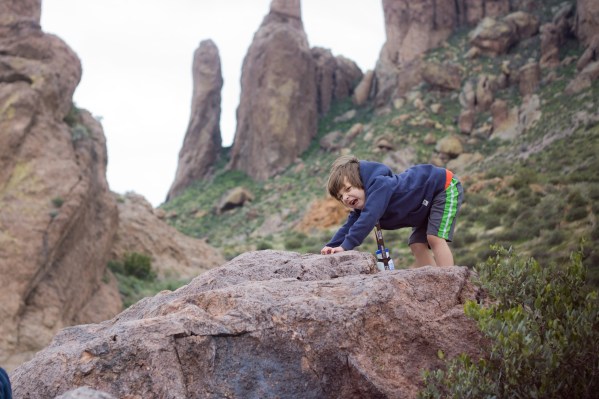
We also took time to climb up some boulders near the path and pretend to be mountain lions:

190730

And of course we took breaks for snuggles and snacks (the bench at the overlook was really timed perfectly for the kids’ hunger):

190780190784

The cold and wind did make the hike considerably more challenging, as Aubade really dislikes being cold and getting wind in her face (we’ve had this issue on other hikes). Because the trail ended up being a lot colder than our home just 30 minutes away, Aubade wore my jacket for most of the hike, which helped and was adorable but left me rather cold as a result 🙂 I guess it’s just a reminder to check the weather at the actual trailhead before deciding what to wear!

For others considering Treasure Loop, I’d say it would take much less time with just slightly older kids – we were mostly slowed down by Aubade (and our spirit of exploration!). Good footwear is important though as the trail can get quite slippery once you start coming back down the slope. This is a fairly popular trail from what I could tell, based on the number of other hikers we saw on a weekday, but it wasn’t overly crowded. It can be accessed from free parking spots by the First Water trailhead, or through the Lost Dutchman state park for a $7.00 entrance fee (as well as a shorter hike and good bathrooms, both of which were needed with my little hikers). We enjoyed it and I’m sure we’ll be back next spring 🙂

How to get there from the East Valley: take the 60 to Apache Junction and exit on Idaho Road; turn right onto Apache Trail and continue until you reach the entrance to the Lost Dutchman State Park. The entrance fee is $7.00 and the ranger will give you a map of the trails and state park roads/parking lots.

Posted in musings

internalized ableism

Sometimes the things we hate the most are things inside ourselves.

If you’ve read the Harry Potter series, you may remember the story of Dumbledore’s younger sister Ariana, who was unable to acknowledge or accept her own magical abilities after a traumatizing encounter at a young age. Because of her experience, she began to see her magic as something freaky, abnormal, disgusting, or fearsome – so she tried to conceal it, control it, eradicate it. But it was a part of who she was, and for all her attempts it would still come bursting out, wild and uncontrolled, in moments of high stress or emotion. And through trying to bury her magic, she was never able to reach the heights of power and beauty that she would otherwise have been capable of: her own self-hatred, shaped by the fear and disgust of others, held her back.

The movie Frozen tells a similar story. Elsa tries for years to lock in her power, controlling it only in the sense of never using it and never letting anyone know it exists – but she has to isolate herself to do so, locking herself away just as she tries to lock her power away, and when circumstances intensify, her power is revealed in erratic, wild, dangerous ways. And because of all those years of the people she loved and trusted most telling her not to use her power, to hide it, to control it, she is (at first, anyway) unable to see the beauty and potential of it. She is swamped by feelings of her own inadequacy and monstrosity, believing the lies of the disgusted and fearful crowds.

This is what internalized ableism looks like.

This is how it feels to believe that a part of you is broken or inadequate or shameful, that something about yourself should be hidden and controlled and never talked about, that something central to the core of your being is something normal people are right to be afraid of or disgusted by. This is what it looks like to shut down your abilities because they are different than other people’s abilities and they make you stand out in an uncomfortable way – to deny the fullness of who you are in a futile attempt to just blend in and meet the expectations of normalcy. It can lead to anxiety or depression: to a fear of rejection, perhaps, a fear of being revealed as some sort of unlovable freak or incompetent imposter. It can lead to resentment of or contempt for those who are open about their differences – maybe there is a bit of jealousy there: that someone else is able to live without shame into the fullness of the abilities God gave them, without the constant self-hatred and fear; or that someone else gets to inconvenience everyone with their needs while you have to suck it up and pretend your needs don’t exist because you don’t want to be the abnormal monstrous burden that your ableism tells you that you are.

It gets a bit emotionally convoluted, in case you couldn’t tell 🙂

And the worst part is that it is so hard to see it in yourself, and so hard to change it once you do. Shifting your paradigm about the world and your place in it feels like repeating a lie, over and and over again, in an attempt to make it true. Different is not less, over and over again. My needs do not detract from the value of my personhood, over and over again. Having areas of weakness does not mean I am incompetent and lazy, over and over again. Asking for help does not mean I am a failure, over and over again. My success, and my path to it, might not look normal, and that is ok – over and over again. Maybe if the new thoughts get repeated enough they can beat down the ascendancy of the old negative ones.

Ariana never had the chance; she died before she was able to heal, if she ever would have been able to anyway. But Elsa – by the end of her story she is beginning to learn, beginning to accept herself with her differences, not despite them. She is beginning to see the extra beauty the world can hold because of the differences of the people in it, no matter how abnormal or debilitating their abilities may seem at first. She is beginning to focus on what she can do instead of trying – and failing – to act just like everyone else, and in so doing is able to fill a unique place in her community instead of staying isolated and hurting.

We all have something to give, and we all have strengths and abilities we can develop, and we hurt ourselves most of all when we believe the lies that say our differences make us less or that we should be ashamed of our weaknesses and needs. Society has enough contempt for the disabled and the neurodivergent; why should we add to it with our own self-hatred?


Posted in family life, sqt, wwlw

{sqt} – because limerick loves numbers

If you ask him, Limerick will tell you that his favorite thing in the whole world is numbers. More than milk, more than cookies, more than hugs – numbers are the best. So I thought I would capture seven ways he shows that love for this week’s {SQT}! Join Kelly for the rest of the linkup 🙂

  1. Limerick’s favorite numbers of all are 1, 11, 111, and so on – anything that is all 1’s. So the other day as we were skip-counting back and forth together the way we do, he decided we should count by 11. When he got to 1111 (and he was the one who got to say it!), he was so happy that he stood up on his chair and clapped his hands together while laughing for joy.
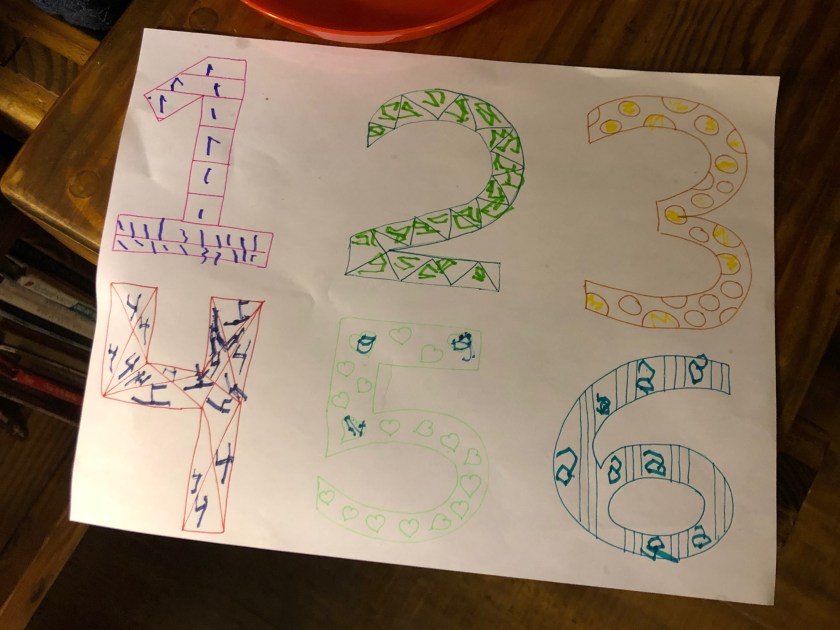
  2. This past week he’s been asking me to make number coloring pages for him, where I’ll draw the outlines of numbers on a page and he’ll color them in. Well, for one of those pages, he decided the best way to color them in would be to fill all the little spaces with smaller versions of the number he was coloring – very meta 🙂
    IMG_5113
    Limerick’s coloring page – don’t be too critical of his handwriting! He is only 4 after all 🙂
  3. In addition to coloring numbers, Limerick likes me to make skip-counting number boards for him – this week alone we’ve made one that counted by 499, one that counted by 999, one that counted by 4, and one that counted by 1 but had all the multiples of 3 drawn in a different color. After a board is made we’ll play a game with it once or twice but then it is on to the next one! I sometimes think he just likes watching the numbers appear on the paper as I write them…
  4. Speaking of watching numbers, Limerick’s favorite book, You Can Count On Monsters by Richard Schwartz, gives him plenty of chances to do just that. He will sit for hours poring over every page of the book, noticing how the focal number of each page breaks down into its factors and figuring out how the accompanying monster illustration incorporates those factors (or the number itself, if it is prime). He’s been through it at least three times this week, taking 2-3 hours each time, and it doesn’t seem to be growing old yet.countonmonsters
  5. I pulled out a math workbook for Limerick this week also, thinking he might be interested, and so far he has just been turning the pages looking at all the numbers and math problems and shapes. He isn’t interested in writing anything down, but when I ask him about any of the problems he knows the answer instantly, or knows how to figure it out. There are some fractions later in the book that would be more of a challenge for him, though, so maybe that will catch his attention eventually. It’s a bit of a tightrope balancing between guiding him towards new information and allowing him the joy of freely exploring numbers without pushing or interfering.
  6. I did, however, get to explain different base systems to him this week! I just sat down at the table and started counting in hexadecimal on a piece of paper, and he glanced over and was immediately intrigued. We discussed what place value means in the context of the various base systems, and ended up writing out 1-32 in decimal, hexadecimal, binary, and base 6. I think binary was his favorite because there were so many 1’s and the numbers got long so quickly!
  7. One other fun book we’ve read through a few times (though not as recently) is Bedtime Math by Laura Overdeck. It’s been a great introduction to the application of numbers, and a challenge for Limerick to translate the words into the more familiar arithmetic. He’s actually quite good at tracking along with the question as I read it, deciphering the logical connections, and doing the math in his head – he can for most of the stories do even the most difficult problem on the page already!

All in all, I just have to echo Limerick and say that he really does love numbers the best 🙂 And he has, honestly, since he was 18 months old and would sit on the driveway drawing them in wide circles around himself until he was familiar with each one, and since he was 2 years old and would count the bites remaining on his plate at dinner and practice subtracting them as he ate. I’m looking forward to watching this love continue to grow with him in the years to come!

Posted in musings

it is not surprising that those who neglect the Mother of God also demean and objectify womanhood

A toxic strain of misogyny dwells within Christianity, an infection that pretends to be part of its host. It makes women out to be spun glass or precious china – beautiful objects, of great value and worthy of being protected. Notice that this analogy, while purporting to elevate women, actually paints women as objects, not persons, and portrays them as being unable to protect themselves or others who they love or who are vulnerable and in need. It limits the acceptable competencies of womanhood (i.e., from fighting to nurturing) and removes agency and autonomy from women.

A particularly egregious article from the well-known ministry Desiring God has by virtue of its poor writing made this misogyny more blatant than is typical (or, likely, than was intended). First, the author writes that “our God, our nature, our love must firmly say, You are too precious, my mother, my daughter, my beloved. It is my glory to die that you may live.” Here part of the true reasoning behind the overprotective platitudes is revealed: the pride of men is at stake, and it is a fragile thing! Far be it from these men to endure the long years of loneliness and deprivation following the death of a loved one; no, for them it is the single shining moment of a glorious death that they crave, that though the women they leave behind might suffer and be forgotten, they at least might be remembered and praised for their valiant bravery. No matter that if they had fought together, this man and his mother (or daughter, or beloved) may have both escaped unscathed, or more effectively protected their children or neighbors. The heroics of the man would be diminished, his glory tarnished! May it never be!

I (and I believe I speak for most women here) have no desire to be the token object by which a man’s glory is elevated, a precious thing but a thing all the same. Womanhood complements manhood that the two might fight the battles of life hand in hand, and they are not so dichotomously opposed that is must always be the men who die in glory and the women who remain at home in silence and tedium. The strength of manhood grows more patient and steadfast when tempered by the daily tasks of nurturing and maintaining a family and home; the strength of womanhood gains sharpness and fire when allowed to whet itself on the battlefield (whether philosophical, political, or physical). Though cultural traditions have often mandated otherwise, God has given to some women – like Deborah and Joan of Arc – a vocation of war and public ferocity; and He has similarly given to some men, though their names may be lost to a history that treasures only moments of flashy glory, a vocation of tenderness and private service.

The unfortunate article in question, however, does not content itself with this first statement of objectification. In the concluding paragraph, the author states that “God’s story for all eternity consists of a Son who slew a Dragon to save a Bride.” Conveniently, it seems, he forgets or ignores the great foremother of that Son, of whose seed – not of Adam’s seed, note – the Lord promised that the Savior would one day come. Conveniently again he forgets or ignores the Mother of that Son, who suffered the ignominy and shame of an unwed pregnancy to bear Him for the world, who raised Him in poverty and exile to know and love the Scriptures, who protected with her own body the Savior who that Dragon was waiting to devour. In His person, Jesus united deity with humanity, and though He took the form of a man, He ensured in the person of His Mother that womanhood was not omitted from the salvific narrative, a mere passive item to be protected and preserved. In her, womanhood also fought against the temptations and forces of Satan, and by her obedience and faith – by her willingness to be thrown into the center of the battle for the souls of all humanity – the Son of God was able to be the Son of Man as well, and so die and rise again to bring life to us all.

Of course, it is so much easier to forget about Mary. She comes with theological baggage enough to make any Protestant uncomfortable, especially the Reformed persuasion at Desiring God. But when we write her out of the story, we run the risk of writing out womanhood in general, from social and cultural mores as well as from the life of faith. You can keep your precious china, locked away in your home, safe from the dangers of life until it fades and grows brittle with the years of disuse. Let me instead be a woman like Mary, if I can dare to even dream so high – a woman like Deborah, like Joan of Arc, like Catherine of Siena and Teresa of Avila, like the saints who fought for the faith and the martyrs who died for it; I am like them a woman, a child of God, and I refuse to be objectified.